A black hole is one of the most unsettling ideas ever discovered by science. It is not simply a “hole” in space, nor is it a cosmic vacuum cleaner endlessly sucking in everything around it. A black hole is something far stranger and far more elegant: a region of space where gravity becomes so intense that nothing—not even light—can escape once it crosses a certain boundary.
That last part is what makes black holes feel almost mythical. Light is the fastest thing in the universe. It moves at about 300,000 kilometers per second, fast enough to circle Earth more than seven times in a single second. Light escapes stars, it escapes exploding galaxies, it escapes everything we have ever seen.
So why can’t it escape a black hole?
The simplest answer is that a black hole bends space and time so extremely that the path leading outward disappears. But that statement, while accurate, can sound mysterious unless we unpack what it really means. The deeper truth is not just about light being “too weak” to fight gravity. It is about how gravity changes the geometry of reality itself.
To understand why light cannot escape, we need to understand what gravity truly is, what “escape” means in physics, and what happens at the invisible border of a black hole called the event horizon.
What Is Light, Really?
Before we can explain why light cannot escape, we should clarify what light is.
Light is electromagnetic radiation. It can behave like a wave and also like a particle. Its particle form is called a photon. Photons have no rest mass, meaning they cannot sit still. They are always moving at the speed of light in a vacuum.
This is not just a fast speed. It is the ultimate speed limit of the universe. According to Einstein’s theory of relativity, nothing carrying information or energy can travel faster than light.
This is crucial. Light cannot go faster. It cannot “push harder.” It cannot accelerate like a rocket. A photon is already traveling at the maximum speed nature allows.
So when we say light cannot escape a black hole, we are not saying gravity slows it down until it stops. Light does not behave like a thrown ball that gradually loses speed.
Instead, gravity changes the rules of space and time around the black hole so radically that even moving at the maximum speed is not enough to find a path out.
What Does “Escape” Mean in Physics?
To escape something in physics means to move away from it forever, never falling back. If you throw a rock upward, it rises, slows down, and falls back. That rock didn’t escape Earth.
If you launch a rocket fast enough, it can overcome Earth’s gravity and travel into space permanently. That rocket has reached escape velocity.
Escape velocity is not a special kind of engine power. It is a speed threshold. For any gravitational object, there is a minimum speed needed to break free.
For Earth, escape velocity is about 11.2 kilometers per second. For the Sun, it is about 617 kilometers per second. These are huge speeds, but they are still far below the speed of light.
The key point is this: the stronger the gravity, the higher the escape velocity.
Now imagine an object so dense and massive that the escape velocity becomes equal to the speed of light.
At that point, even light cannot escape.
This is the simplest and most intuitive explanation of why black holes trap light. A black hole is an object whose gravity is so strong that the escape velocity at a certain distance from it exceeds the speed of light.
Since nothing can move faster than light, nothing can escape.
That is the basic idea. But black holes are even stranger than that.
How Can Escape Velocity Become the Speed of Light?
The concept of escape velocity comes from Newtonian gravity, and while it gives the right intuition, black holes are ultimately explained by Einstein’s general relativity.
Still, the escape velocity concept is a good stepping stone.
Escape velocity depends on mass and radius. The smaller the radius for the same mass, the stronger the gravitational pull at the surface. Compressing mass into a smaller space increases gravity dramatically.
If you could compress the Earth into a sphere about the size of a marble, its surface gravity would become so strong that even light might not escape. Earth would become a black hole.
The same is true for the Sun. If the Sun were compressed down to a radius of about three kilometers, it would become a black hole.
These examples show something profound: black holes are not made of “special matter.” They are made by concentrating mass into an extremely small volume.
A black hole is not defined by what it is made of, but by how dense it is.
And when density becomes extreme, gravity becomes extreme.
Gravity Is Not Just a Force: It Is Warped Spacetime
Most people grow up imagining gravity as an invisible pulling force. You drop an object, and gravity pulls it down. That picture works well for everyday life, but it is not the deepest truth.
Einstein showed that gravity is not really a force in the usual sense. Instead, gravity is the bending of spacetime.
Spacetime is the combined fabric of space and time. In Einstein’s universe, mass and energy distort this fabric, creating curvature. Objects move along the curves, following the straightest possible paths through warped geometry.
This is why planets orbit stars. They are not being “pulled” in the way a magnet pulls iron. They are moving along curved paths in spacetime shaped by the star’s mass.
A helpful analogy is a stretched rubber sheet. If you place a heavy ball in the center, the sheet curves downward. If you roll a smaller ball nearby, it will spiral inward. The heavy ball has changed the shape of the surface.
That analogy is imperfect because real spacetime is four-dimensional and the curvature involves time as well as space. But the idea is correct: mass changes geometry, and geometry determines motion.
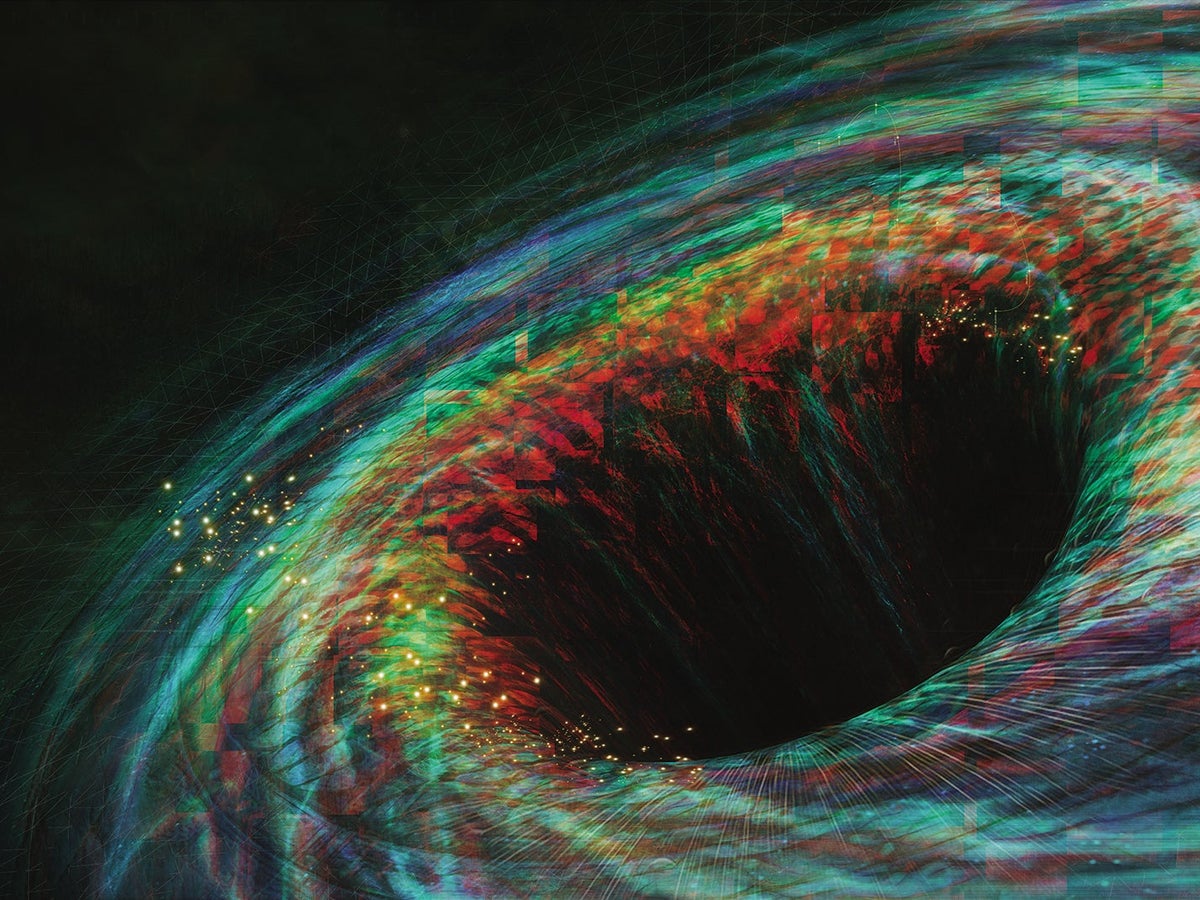
Now imagine a mass so concentrated that it warps spacetime into an extreme funnel. Near the center, the curvature becomes so steep that every path points inward.
That is the essence of a black hole.
The Event Horizon: The Point of No Return
A black hole has a boundary called the event horizon. This is not a physical surface like the crust of a planet. It is not made of solid matter. It is a mathematical boundary in spacetime.
The event horizon marks the point where escape becomes impossible.
Outside the event horizon, light can still travel outward. It might be bent, slowed in appearance, or redshifted, but it can still get away.
At the event horizon, the escape velocity equals the speed of light. Light emitted exactly at the horizon would hover there, trapped in a delicate balance.
Inside the event horizon, the escape velocity is greater than the speed of light. Since nothing can exceed light speed, there is no possible trajectory that leads outward.
This is why black holes are black. Not because they absorb light like a sponge, but because light that enters cannot return.
The event horizon is the line that divides the universe into two regions: the part where you still have a future that can lead outward, and the part where the future only leads deeper in.
And that brings us to the most mind-bending truth about black holes.
Inside a Black Hole, “Outward” Stops Being a Direction
Here is the simplest explanation that captures the deepest reality:
Inside a black hole, the direction outward no longer exists as a possible future.
This is not just a matter of being pulled too strongly. It is a matter of geometry and time.
In ordinary space, you can choose directions. You can go north, south, up, down, left, right. Even if gravity is strong, you can still point outward and try to climb away.
But inside a black hole, spacetime is warped so severely that moving toward the center is like moving forward in time.
That statement sounds absurd, but it is accurate according to general relativity.
Outside a black hole, you can avoid falling in by using enough speed. You can orbit, you can escape, you can resist. But once you cross the event horizon, every possible path through spacetime leads toward the singularity—the black hole’s central region of extreme density.
Even if you fire a rocket at full power outward, you will still move inward, because inward is not merely a direction in space anymore. It is the direction of your future.
This is why light cannot escape. Light always travels along the fastest possible paths in spacetime. But inside the horizon, those paths all lead inward.
Light is not being “stopped.” It is being forced to travel into the future, and the future points toward the center.
That is what makes a black hole so terrifying. It is not just a trap. It is a region where the universe’s geometry itself becomes a prison.
Why Light Can’t “Turn Around” and Leave
Imagine shining a flashlight outward while inside a black hole. Intuitively, you might think the beam should still move outward at light speed.
And it does—locally.
This is another strange point: from the perspective of someone falling into a black hole, light still moves at the speed of light nearby. The laws of physics still behave normally in small regions.
But the overall geometry of spacetime is so distorted that the beam’s path curves inward. The light travels forward, but the space it moves through is curved in such a way that it cannot reach the outside universe.
It is like trying to swim upstream in a river that is flowing faster than the maximum speed you can swim. You can paddle as hard as you want, but the current carries you downstream.
That river analogy is actually quite powerful. The “flow” is not water, but spacetime itself. Near the event horizon, spacetime is effectively flowing inward faster than light can travel outward.
Again, light is not slowing down. Spacetime is dragging everything inward.
Gravitational Time Dilation: Time Itself Breaks Into Strange Behavior
Another reason black holes confuse people is because time behaves differently near them.
According to general relativity, gravity affects time. The stronger the gravitational field, the slower time passes relative to a distant observer.
Near the event horizon, this effect becomes extreme. If you watched an astronaut falling toward a black hole from far away, you would see them slow down. Their movements would become sluggish. Their clock would tick more slowly. Their radio signals would stretch into lower frequencies.
To you, it would appear as though they never actually cross the event horizon. They would seem frozen at the edge, gradually fading as their light becomes redshifted into invisibility.
But for the astronaut, nothing unusual happens at the horizon (assuming the black hole is large enough that tidal forces are not deadly at that point). They cross it in finite time and continue falling inward.
This strange mismatch happens because time is not universal. Black holes expose the fact that time depends on gravity.
Light trying to escape from near the event horizon becomes increasingly redshifted. Its wavelength stretches, its energy drops, and it fades. Eventually, light leaving from extremely close to the horizon becomes so weak and stretched that it effectively disappears from the outside universe.
This is not the main reason light cannot escape, but it is part of why black holes appear black even before you consider the complete “no escape” condition.
The Photon Sphere: Light Can Orbit a Black Hole
One of the most fascinating regions around a black hole is called the photon sphere.
This is a region outside the event horizon where gravity is strong enough that light can actually orbit the black hole in circles. Photons can loop around the black hole, spiraling in complex paths.
For a non-rotating black hole, the photon sphere lies at about 1.5 times the radius of the event horizon.
This means that black holes do not simply swallow light instantly. Light can be bent into rings, warped into arcs, and trapped temporarily in orbit before either escaping or falling inward.
The famous image of the black hole in galaxy M87, captured by the Event Horizon Telescope, shows a glowing ring of light. That ring is not the event horizon itself, but light from superheated matter swirling around the black hole, bent by intense gravity into a bright circle.
Black holes do not only hide light. They also sculpt it.
They turn the universe into a gravitational lens so powerful it can distort reality into shapes that seem almost impossible.
The Singularity: The Point Where Physics Breaks
Deep inside the black hole lies what is called the singularity, a region where density becomes infinite and spacetime curvature becomes infinite—at least according to the equations of general relativity.
The singularity is not something we fully understand. It is likely a sign that our current physics is incomplete. General relativity works beautifully for stars and galaxies, but it does not include quantum mechanics, and quantum effects become important at extremely small scales.
Many physicists believe that the true interior of a black hole may not contain an “infinite point,” but rather some unknown quantum structure that prevents actual infinity. Some theories propose that singularities may be replaced by quantum foam, or that black holes connect to other regions of spacetime through wormholes, though these ideas remain speculative.
But even if the singularity is not literally infinite, the key idea remains: inside a black hole, the gravitational collapse becomes unstoppable. Matter and light are forced inward toward whatever the final state is.
Light cannot escape because the structure of spacetime leads it inevitably to the center.
What Happens to Light When It Falls In?
If light enters a black hole, it continues traveling at the speed of light, but its path is bent inward. It follows a geodesic, the straightest possible line in curved spacetime.
From the outside universe, that light is lost forever. It no longer carries information outward. It cannot return.
Does the light get destroyed?
In a sense, it becomes part of the black hole’s mass-energy. Black holes grow when they absorb matter and radiation. Energy is conserved, so the energy carried by photons contributes to the black hole’s gravitational mass.
This is why black holes can grow simply by absorbing light. Even a beam of sunlight adds mass, though the amount is extremely tiny.
In physics, energy and mass are linked by Einstein’s famous equation:
E = mc²
This means energy has gravitational effects. A black hole does not care whether you throw in a planet or a photon. If it carries energy, it contributes to the black hole.
Light becomes part of the black hole’s gravitational story.
But If Light Can’t Escape, How Do We Know Black Holes Exist?
This question reveals one of the greatest triumphs of modern astronomy.
We cannot see black holes directly because they emit no light from within the event horizon. But we can see their influence.
We detect black holes by watching how they affect nearby matter. Stars orbiting an invisible massive object can reveal its presence. Gas swirling around a black hole heats up, emitting X-rays and radio waves before crossing the horizon. The gravity of black holes bends background light, creating gravitational lensing effects.
We can also detect black holes through gravitational waves. When two black holes collide, they send ripples through spacetime. These ripples were detected directly for the first time in 2015 by the LIGO observatory.
So black holes are not guesses. They are confirmed cosmic objects.
We know they exist because the universe around them behaves exactly as Einstein’s equations predict.
The Simplest Explanation in One Sentence
If someone asked for the simplest explanation of why light can’t escape a black hole, the best answer is this:
A black hole bends spacetime so strongly that all possible paths forward lead inward, and since light cannot travel faster than itself, it cannot find a path back out.
That is the real essence. It is not that light “lacks power.” It is that the universe’s geometry has been warped into a trap with no exit.
Are Black Holes Truly Eternal Prisons?
For a long time, physicists believed black holes were permanent. If something fell in, it was gone forever.
But quantum physics introduced a surprising twist.
In the 1970s, Stephen Hawking showed that black holes are not perfectly black. Due to quantum effects near the event horizon, black holes can emit a faint radiation now called Hawking radiation.
This radiation causes black holes to lose mass over extremely long timescales. Eventually, if nothing else falls in, a black hole could evaporate completely.
Hawking radiation is incredibly weak for large black holes, far too weak to notice with current technology. A black hole the mass of the Sun would take an unimaginable amount of time—far longer than the current age of the universe—to evaporate.
But the existence of Hawking radiation changes the philosophical meaning of black holes. They are not necessarily eternal prisons. They may leak energy, slowly dissolving back into the universe.
However, Hawking radiation does not allow light to escape from inside the event horizon. It is generated by quantum processes near the horizon itself, not by photons climbing out from within.
So the fundamental rule remains: once light crosses the horizon, it cannot return.
Why the Event Horizon Is Not a Physical Wall
One of the strangest aspects of black holes is that the event horizon is not something you could feel. It is not a barrier you would crash into. In fact, if the black hole is large enough, you could cross the event horizon without even noticing at that moment.
The reason is that gravity at the horizon of a supermassive black hole can be relatively gentle. The black hole’s mass is spread over a larger radius, so the gravitational gradient is not extreme at the edge.
This is deeply counterintuitive. We imagine black holes as violent objects that tear everything apart instantly. In reality, the horizon is just a boundary where escape becomes impossible.
The real danger is tidal forces, the stretching effect of gravity, which become stronger closer to the center. In small black holes, tidal forces at the horizon could tear you apart instantly in a process sometimes called spaghettification. In supermassive black holes, you might survive crossing the horizon but would eventually be destroyed deeper inside.
But regardless of your survival, the outcome is the same: you cannot send a signal outward once you cross.
The event horizon is not a wall. It is a one-way door in spacetime.
Why Nothing Can Escape Once Inside
To truly grasp why escape is impossible, you must remember that nothing can move faster than light.
If you are inside the event horizon and you try to escape, you would need to travel outward faster than light because spacetime curvature has made the required escape velocity exceed c.
But faster-than-light travel is forbidden by relativity. It would break causality, allowing effects to happen before causes. It would unravel the logical structure of the universe.
So the universe enforces a hard limit: no matter what you do, you cannot outrun the curvature of spacetime inside the horizon.
This is why black holes are so absolute. They are not merely strong gravitational objects. They are regions where the structure of causality itself has been altered.
Inside the horizon, your future is sealed.
The Emotional Reality of a Black Hole
Black holes are more than scientific objects. They are symbols of the extreme.
They represent a place where the universe becomes so intense that familiar concepts fail. Space becomes distorted. Time becomes flexible. Light, the great messenger of reality, is silenced.
In everyday life, light means information. It means visibility. It means knowledge. We see the world because light escapes objects and reaches our eyes. Light is the reason the universe is not hidden from us.
A black hole is a place where information vanishes from view. It is a cosmic secret-keeper. It is the universe drawing a curtain over part of itself.
That is why black holes inspire such deep fascination. They are not just massive objects. They are boundaries of knowledge.
Even with all our technology, we cannot see beyond the event horizon. We can only infer, calculate, and imagine.
Black holes remind us that there are places in the universe where nature becomes too extreme for direct observation, and we must rely on mathematics as our telescope.
The Final Answer: Why Can’t Light Escape a Black Hole?
Light cannot escape a black hole because the black hole’s gravity warps spacetime so severely that beyond the event horizon, all possible paths forward lead inward. The escape velocity becomes greater than the speed of light, and since nothing can exceed that speed limit, light has no route back out.
This is not because light is weak, but because the universe itself is curved into a trap.
A black hole is not simply an object with strong gravity. It is a region where space and time have been bent into a shape that removes the concept of “escape.”
The universe has many wonders—nebulae, galaxies, exploding stars—but black holes stand apart. They are where physics reaches its most dramatic extreme, where the fabric of reality becomes a labyrinth with no exit.
And in that silent darkness, where light itself cannot return, we glimpse the most haunting truth of all: the universe is not obligated to be understandable everywhere.
Yet even then, through theory and observation, we continue to learn.
Because that is what science does.
It shines light into the darkness—until it reaches the edge of the black hole, where the darkness finally wins.