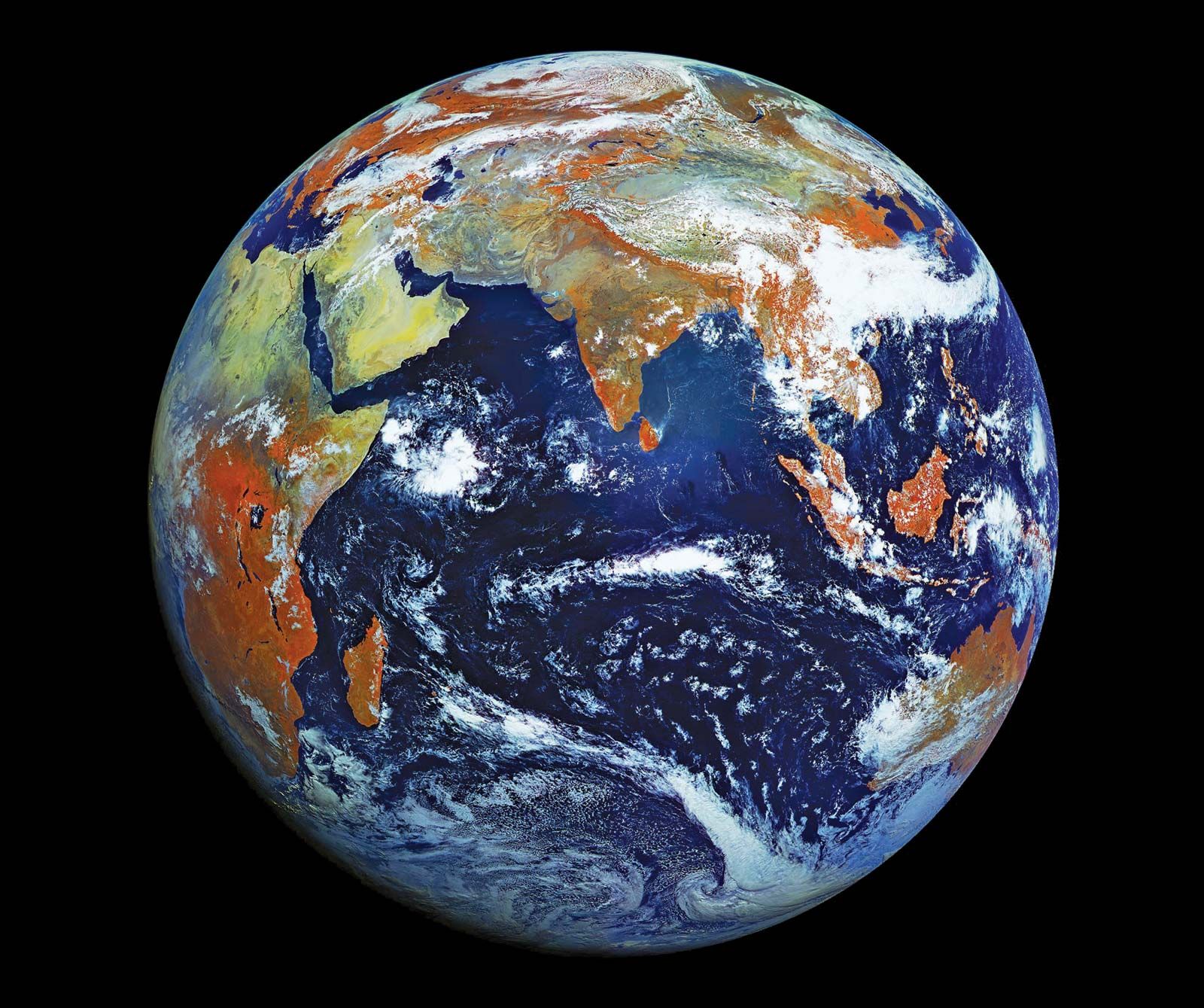
Every second of your life, whether you feel it or not, you are moving at extraordinary speed. If you are standing near the equator, you are being carried eastward at roughly 1,670 kilometers per hour by Earth’s rotation. Even at mid-latitudes, the speed is still well over 1,000 kilometers per hour. We do not sense this motion because everything around us—air, oceans, buildings, mountains—moves with the planet. It is a shared motion, a cosmic conveyor belt so steady that it fades into invisibility.
Earth’s rotation defines the rhythm of our days and nights. It shapes wind patterns, ocean currents, and the planet’s equatorial bulge. It subtly influences gravity and determines the way storms spin. It is so fundamental to life that we rarely think of it.
But imagine, just for a moment, that Earth stopped rotating.
Not gradually over millions of years. Not slowing gently. Imagine it stopped instantly—its solid body freezing in place—for just one second. After that second, it resumes rotating exactly as before.
One second sounds harmless. A blink. A heartbeat. A pause between words.
In reality, it would be catastrophic.
To understand why, we must first understand what rotation truly means for our planet.
The Physics of a Spinning World
Earth rotates once every 23 hours, 56 minutes, and 4 seconds relative to the distant stars. This rotation creates centrifugal effects that slightly counteract gravity, especially near the equator. Because of this, Earth is not a perfect sphere. It bulges outward at the equator by about 21 kilometers compared to the poles.
The rotational motion also gives rise to the Coriolis effect, which influences large-scale atmospheric and oceanic circulation. It is why hurricanes spin counterclockwise in the Northern Hemisphere and clockwise in the Southern Hemisphere. It helps organize trade winds, jet streams, and ocean gyres.
But the most immediate consequence of rotation is velocity. At the equator, Earth’s circumference is about 40,075 kilometers. Dividing that by one day gives a surface speed of approximately 465 meters per second.
That means every object not anchored to bedrock is already moving eastward at that speed.
If Earth’s solid body suddenly stopped, everything not rigidly attached to it would keep moving.
Inertia would take over.
Inertia: The Relentless Law
Newton’s first law of motion states that an object in motion remains in motion unless acted upon by an external force. This principle, formulated by Isaac Newton, governs the thought experiment we are exploring.
If Earth’s crust stopped instantly, the atmosphere would not. The oceans would not. Cars, planes, people, buildings—unless firmly embedded in bedrock—would not.
They would continue moving eastward at hundreds of meters per second.
Imagine standing on the ground when, without warning, the planet beneath you stops. You would not gently tip forward. You would be hurled eastward at the speed you were previously traveling with Earth’s rotation.
At the equator, that is roughly 1,670 kilometers per hour—faster than the speed of sound.
This is not a strong wind.
It is a supersonic impact with the landscape.
The First Milliseconds: Global Devastation
In the first fraction of a second after Earth stops, the atmosphere continues its eastward motion. The ground halts; the air does not. The result is a global shockwave of unimaginable power.
The entire atmosphere would become a planet-wide hurricane traveling eastward at supersonic speed. The friction between air and surface would generate intense heat. Structures would be torn apart almost instantly. Forests flattened. Skyscrapers shredded. Vehicles flung like toys.
The force exerted by wind increases with the square of velocity. Winds of even 300 kilometers per hour are enough to cause catastrophic damage. Here, we are discussing winds exceeding 1,000 kilometers per hour in many regions, and much higher near the equator.
The devastation would not be localized. It would be everywhere at once.
The oceans, too, would surge eastward. Water at the equator is moving with enormous kinetic energy. When the planet stops beneath it, that water does not politely settle. It continues forward, slamming into continents.
Mega-tsunamis thousands of meters high would crash into eastern coastlines. Entire coastal cities would vanish beneath walls of water.
The Atlantic Ocean would surge into Europe and Africa. The Pacific would slam into the Americas and Asia. Low-lying regions would be erased within moments.
All of this would unfold in less than a second.
The Fate of Continents and Mountains
Solid rock is not immune. Although mountains are anchored to Earth’s crust, the sudden stress would fracture them. The crust itself would experience extraordinary shear forces.
The equatorial bulge exists because of rotation. If rotation stopped instantly, the centrifugal force that helps maintain this bulge would vanish. Gravity would begin reshaping the planet toward a more perfect sphere.
This redistribution would not happen smoothly. It would trigger massive tectonic adjustments. Earthquakes far beyond any recorded in human history would ripple across the globe.
Fault lines would rupture. Volcanic systems could destabilize. Entire regions might sink or rise as the crust responded to new gravitational equilibrium.
For one second, the stopping is the primary disaster. But the consequences of that second would continue unfolding for years.
What Happens to Gravity?
Earth’s rotation slightly reduces effective gravity at the equator. When rotation stops, that reduction disappears. Gravity would become marginally stronger at equatorial regions.
The change is small—about 0.3 percent—but measurable. Objects would weigh slightly more at the equator than before.
However, this increase in gravity is trivial compared to the inertial catastrophe. It would not crush people. The true devastation lies in horizontal motion, not vertical force.
The Atmosphere in Chaos
When Earth resumes rotating after one second, another violent adjustment would occur.
During the stopped second, the atmosphere continues racing eastward relative to the ground. When the ground resumes motion, it suddenly accelerates beneath the still-moving air.
This creates another phase of violent turbulence.
The atmosphere would not instantly synchronize with Earth’s resumed rotation. Massive pressure differences would develop. Shockwaves would circle the planet. Jet streams would be shredded and reformed. Weather systems would collapse and reorganize chaotically.
The climate system would not simply “go back to normal.” It would require time—perhaps years—to stabilize.
Dust and debris thrown into the atmosphere from the initial destruction could block sunlight. Wildfires ignited by friction and lightning would add smoke and soot. Global temperatures might drop temporarily due to reduced solar radiation reaching the surface.
The Oceans Reshaped
The oceans would be permanently altered.
Without rotation, water naturally redistributes toward the poles, because the equatorial bulge partly results from centrifugal force. When that force disappears, water would begin migrating poleward.
Over time, this would create deeper polar oceans and expose equatorial regions.
But because the rotation resumes after one second in our scenario, the redistribution would begin but then be violently interrupted. The oceans would slosh with colossal momentum.
Coastal geography would change dramatically. Sediments would be relocated. Entire ecosystems would collapse.
Coral reefs, already sensitive to environmental changes, would be devastated by temperature shifts and mechanical destruction. Marine life would suffer from shock, turbulence, and chemical changes in water composition.
The Magnetic Field and the Core
Earth’s magnetic field is generated by the motion of molten iron in its outer core, a process known as the geodynamo. The core’s rotation is linked to, but not identical with, the rotation of the crust.
If only the crust stopped for one second, the core might continue rotating due to its immense inertia. The relative motion between core and mantle could induce additional stresses and possibly alter magnetic field behavior temporarily.
However, a single second is likely too short to collapse the magnetic field entirely. The geodynamo operates on timescales much longer than a heartbeat.
Still, transient disturbances in the magnetic field could occur, affecting satellites and communication systems—if any survived.
Survivability: Would Anyone Live?
In equatorial regions, survival would be nearly impossible. The horizontal velocity is simply too high.
At higher latitudes, the rotational speed is lower. Near the poles, the surface velocity approaches zero. In theory, people close to the poles might experience less extreme inertial effects.
But even there, the global atmospheric shockwaves and seismic upheaval would be devastating.
Underground bunkers deeply embedded in bedrock might offer limited protection. Submarines deep beneath the ocean surface could avoid some atmospheric destruction but would still face violent water movement.
The scale of devastation suggests that human civilization would not survive intact. Whether any individuals would endure is uncertain, but the probability is extremely low.
Energy on a Planetary Scale
The rotational kinetic energy of Earth is enormous—approximately 2.14 × 10²⁹ joules. To stop the planet instantly would require removing this energy in an instant.
Where would it go?
In our thought experiment, it effectively transfers into the kinetic energy of the atmosphere, oceans, and anything not rigidly bound to the crust. That energy manifests as motion, heat, and destruction.
The amount of energy involved dwarfs the energy released by the most powerful nuclear weapons. It exceeds by many orders of magnitude the total annual energy consumption of human civilization.
Stopping Earth’s rotation, even briefly, is not a gentle event. It is a planetary-scale release of stored motion.
The Sky Above a Frozen Earth
During the one second of halted rotation, something surreal would happen in the sky.
The Sun, Moon, and stars would appear to pause in their westward motion. The apparent motion of the sky is largely due to Earth’s rotation. If the planet stops, the sky’s drift stops too.
For that one second, the heavens would freeze.
But no one would likely notice. The violence on the ground would be overwhelming.
When rotation resumes, the sky would continue its familiar arc as if nothing happened.
Cosmically, one second is trivial.
Geologically and biologically, it would be apocalyptic.
Could This Ever Happen?
From a physical standpoint, an instantaneous stop is nearly impossible without an unimaginable external torque. No known natural process could halt Earth’s rotation in a single second.
Large asteroid impacts can slightly alter rotation rate. Tidal interactions with the Moon gradually slow Earth’s spin over millions of years. Even the massive earthquake in 2011 in Japan slightly changed Earth’s rotation by tiny fractions of a second.
But a complete stop in one second violates the limits of plausible astrophysical processes.
This scenario is a thought experiment—a way to explore the consequences of inertia and planetary motion.
The Deeper Lesson
So what if Earth stopped rotating for just one second?
The answer is stark: it would unleash catastrophic winds, mega-tsunamis, global earthquakes, atmospheric chaos, and likely the near-total destruction of life as we know it.
But beyond the drama lies a deeper insight.
We live on a dynamic planet, balanced in motion. Its spin shapes our days, our climate, our geography. We rarely think about the silent speed beneath our feet.
Physics teaches us that motion is not something that requires constant force. It persists naturally. The Earth spins not because something is pushing it every moment, but because nothing has stopped it.
And that steady spin, inherited from the formation of the solar system billions of years ago, continues to carry us through space at astonishing speed.
The thought of it stopping, even for a second, reminds us how delicately our world is tuned. Stability is not the absence of motion—it is the harmony of motion.
We are passengers on a spinning sphere, orbiting a star, moving through a galaxy, drifting in an expanding universe. The ground feels solid. The sky feels still. But beneath that illusion lies extraordinary movement.
Earth has been turning for over four billion years. Every sunrise is a testament to that spin. Every nightfall is a quiet affirmation that the motion continues.
And as long as it does, life goes on.
The day Earth stops—even for a second—would be the day that motion, so constant and unseen, reveals its true power.