Imagine a world where the sky is still blue, oceans still breathe with life, and forests still sway in the wind—but no cities rise from the ground. No airplanes cross the clouds. No music is recorded, no books are written, and no satellites circle the Earth. The planet continues its ancient rhythm, shaped by climate, geology, and evolution, but one species never appears: modern humans.
This is not just a science-fiction fantasy. It is a thought experiment that forces us to confront one of the most remarkable events in Earth’s history: the evolution of Homo sapiens. Humans did not simply “appear.” We emerged through a long chain of evolutionary changes that began millions of years ago, branching from a common ancestor shared with other apes. Our species became unusual not because we were destined to, but because a rare combination of environmental pressures, genetic mutations, and chance events shaped us into something unlike any other creature.
So what if that chain broke? What if humans never evolved from apes? What would Earth look like today? Would another intelligent species take our place? Would nature be healthier, wilder, and more balanced? Or would the planet remain trapped in a biological world where intelligence never becomes dominant?
The answers are complex, and they reveal something profound: humans are both an accident of evolution and a geological force that has reshaped the Earth.
Understanding the Evolutionary Truth: Humans Did Not Evolve from Modern Apes
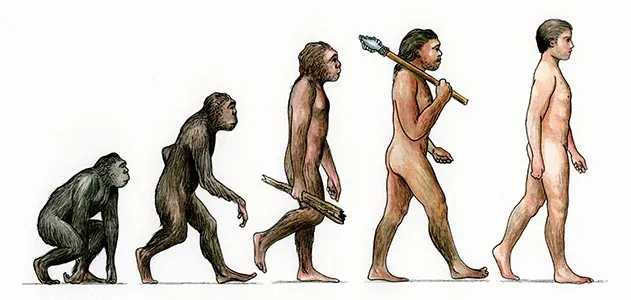
Before exploring the alternate history, one scientific clarification is essential. Humans did not evolve from the chimpanzees, gorillas, or orangutans alive today. Modern humans and modern apes share a common ancestor that lived roughly six to seven million years ago. From that ancestor, separate evolutionary branches emerged, leading to the African great apes on one side and the human lineage on the other.
That human lineage included multiple species, not just Homo sapiens. Australopithecus, Homo habilis, Homo erectus, Neanderthals, Denisovans, and other extinct relatives all played roles in the evolutionary drama that eventually produced us.
So the question “What if humans never evolved from apes?” is better framed as: what if the evolutionary branch leading to Homo sapiens never developed, or went extinct before becoming dominant?
This could happen in many plausible ways. Climate changes could have wiped out early hominins. Disease could have ended small populations. A catastrophic volcanic eruption could have erased crucial evolutionary steps. Competition from predators could have kept early hominins from expanding.
Evolution is not a ladder. It is a branching tree, and branches can die.
If our branch died, the world would not be “missing humans” in a simple sense. It would be missing a planetary revolution.
A World Without Humans: The Earth Would Still Be Alive and Ancient
The first thing to understand about a humanless Earth is that the planet would not feel empty. It would not feel unfinished. It would simply continue along its natural evolutionary course.
Forests would expand and contract depending on climate. Grasslands would shift with rainfall patterns. Ice ages would still come and go. Earth’s continents would still drift. Volcanoes would still erupt. Coral reefs would still rise and fall with sea level changes. Species would still evolve, adapt, and go extinct.
The planet lived for billions of years before humans existed. It does not require us.
But it would look dramatically different.
Without humans, Earth would almost certainly be far wilder, with ecosystems more intact and megafauna far more abundant. The absence of agriculture, industrial development, and mass hunting would mean that the planet’s landscapes would be shaped mostly by natural processes rather than human decisions.
In such a world, nature would not be “peaceful.” It would still be violent, full of predation, starvation, disease, and competition. But it would be balanced by ecological systems that evolved over millions of years.
The Fate of Other Great Apes Without Humans
One of the most striking changes would involve the survival of other great apes. Today, chimpanzees, gorillas, and orangutans are endangered largely because of habitat destruction, hunting, and human-driven climate change.
In a world without humans, these apes would likely thrive.
Chimpanzees might inhabit much larger regions of Africa. Gorilla populations might be far more widespread. Orangutans might dominate vast rainforests across Southeast Asia. These species would continue evolving, potentially branching into new forms over hundreds of thousands or millions of years.
Would they become more intelligent? Possibly, but not necessarily.
Evolution does not reward intelligence unless it improves survival and reproduction. The human brain is extremely energy-demanding. It only evolved because it provided advantages in tool use, social cooperation, communication, and adaptability. Without strong selection pressures pushing apes toward advanced cognition, they might remain similar to what they are today.
However, given enough time, it is possible that some ape lineages would evolve new traits, perhaps even leading to a new type of highly intelligent primate.
But intelligence like ours is not guaranteed. It is rare, costly, and dependent on environmental conditions.
Would Another Species Become “Human”?
This is one of the most haunting questions in evolutionary science. If humans never existed, would another species eventually develop civilization?
The honest answer is: maybe, but it would not be certain.
Several animals show high intelligence, including dolphins, whales, elephants, corvids, parrots, and octopuses. Some can solve puzzles, use tools, recognize themselves in mirrors, communicate socially, and demonstrate complex memory.
Yet intelligence alone is not enough to create civilization. Civilization requires a unique combination of traits.
A species must have the ability to manipulate objects with precision, like hands capable of fine motor control. It must live long enough to accumulate knowledge across generations. It must be social enough to cooperate in large groups. It must have a communication system capable of transmitting complex ideas. And it must have access to an environment where technology can be developed and preserved.
Dolphins may be intelligent, but they live underwater and lack hands for building tools. Octopuses are brilliant, but they have short lifespans and mostly solitary lifestyles. Elephants are social and intelligent, but their bodies are not well suited for fine toolmaking.
The most likely candidates to develop human-like intelligence would still be primates. Their grasping hands, forward-facing eyes, and flexible behavior make them well-suited for complex tool use. So if humans never evolved, another primate lineage might eventually fill the role.
But it could take millions of years. And it might never happen.
Earth could remain a planet full of animals with no technological civilization at all.
The Mammoths, Sabertooths, and Giants That Might Still Walk the Earth
One of the most immediate consequences of a world without humans would be the survival of many large animals that disappeared during the last 50,000 years.
Scientists widely agree that human hunting, combined with climate shifts, played a major role in the extinction of many megafauna species. Mammoths, mastodons, giant ground sloths, woolly rhinoceroses, cave bears, and sabertooth cats vanished in relatively recent geological time. In Australia, giant marsupials disappeared. In the Americas, entire ecosystems of large herbivores collapsed.
Without humans, many of these creatures might still exist today.
Imagine North America with herds of mammoths roaming grassy plains. Imagine Europe with woolly rhinoceroses and cave lions. Imagine Australia with giant wombat-like diprotodons. Imagine South America still home to enormous sloths the size of elephants.
These animals were not doomed by nature alone. They were pushed over the edge by an unusually effective predator: humans with weapons, cooperation, and strategy.
Without that predator, Earth might still be dominated by giants.
And ecosystems would be structured differently. Large herbivores shape landscapes by grazing, trampling, and spreading seeds. Their presence influences forest growth, grassland stability, and even fire patterns. A world with more megafauna would be a world with different vegetation, different climate feedback loops, and different biodiversity.
Forests Would Likely Cover More of the Planet
Today, much of Earth’s natural forest has been replaced by farmland, grazing land, and urban development. Massive regions of rainforest have been cut down for agriculture, logging, and mining. The Amazon, Congo Basin, and Southeast Asian rainforests are under constant pressure.
Without humans, forests would dominate far more territory.
Grasslands would still exist, shaped by climate and large herbivores, but human-driven deforestation would not occur. Rivers would flow through untouched landscapes. Wetlands would remain intact instead of being drained for cities and farms.
The planet’s land surface would likely hold more carbon in trees and soil, reducing atmospheric carbon dioxide levels compared to today.
This would likely mean a cooler planet overall, though natural climate cycles would still occur.
In many regions, the difference would be breathtaking. Where modern humans see roads, cities, and fields, there would be wild ecosystems—dense forests alive with predators, birds, insects, and mammals.
Earth would not be “better” in a moral sense, because nature has no morality. But it would be far less altered.
The Climate Would Be More Stable Without Industrial Civilization
Human activity has significantly changed Earth’s climate. The burning of fossil fuels has increased carbon dioxide and methane levels, trapping heat in the atmosphere and driving global warming. Industrial agriculture has added additional greenhouse gases. Deforestation reduces the planet’s ability to absorb carbon.
Without humans, none of this industrial activity would exist.
The climate would still change, but it would change according to natural forces such as volcanic eruptions, solar cycles, ocean currents, and long-term orbital variations known as Milankovitch cycles. These orbital cycles influence ice ages and warm periods over tens of thousands of years.
In fact, Earth might currently be on a slow path toward another glacial period if humans had not altered the atmosphere. Some climate scientists suggest that human greenhouse emissions may have delayed the next ice age.
In a world without humans, ice sheets might be slowly expanding again, depending on the timing of natural cycles. Northern landscapes might be colder, with more tundra and glaciers creeping downward.
Or Earth might remain in an interglacial period for thousands of years longer. Either way, the climate would likely be less extreme than what human-driven warming is now producing.
The atmosphere would be cleaner, and ocean acidification—a direct consequence of excess carbon dioxide—would not be rapidly damaging marine ecosystems.
Oceans Would Be Richer, Louder with Life, and Less Polluted
Modern oceans are under pressure from overfishing, plastic pollution, chemical runoff, and climate-driven warming. Coral reefs are dying due to heat stress and acidification. Many fish populations have collapsed.
Without humans, the oceans would be radically different.
Whales would likely be far more abundant. Large sharks would dominate many marine ecosystems. Fish populations would be balanced by natural predation rather than industrial harvesting. Coral reefs would thrive without human-driven warming and pollution.
Plastic would not exist. Oil spills would not occur. Chemical fertilizers would not wash into the sea, creating dead zones. Coastal ecosystems would remain healthier.
Ocean ecosystems would still face natural disasters—storms, volcanic activity, shifting currents—but they would not be overwhelmed by a species extracting life from the sea faster than it can recover.
The oceans might still be Earth’s greatest living wilderness, as they once were.
The Atmosphere Would Be Cleaner and the Night Sky Would Still Belong to the Stars
In the modern world, light pollution hides the stars for billions of people. Smog and industrial emissions cloud the air. Even in remote regions, microplastics and chemical pollutants have been detected in the atmosphere.
Without humans, the air would be clearer. Wildfires would still happen, and volcanic ash would still occasionally darken skies, but the constant haze of industrial civilization would not exist.
The night sky would be darker and more dramatic. The Milky Way would shine across the heavens like a river of light. Meteors would be visible without the glare of cities. Aurora borealis would dance above untouched polar regions.
The Earth would not go silent—storms would roar, animals would call, forests would creak—but the artificial noise of engines and machines would not exist.
The planet would feel older, more mysterious, and more alive.
Disease, Parasites, and Natural Selection Would Still Rule
A humanless Earth would not be a paradise. Nature is not gentle.
Animals would still suffer from disease, parasites, hunger, injury, and predation. Many young creatures would die before adulthood. Winters would kill the weak. Droughts would starve entire populations. Predator-prey cycles would rise and fall.
Evolution would continue shaping life with brutal efficiency. Natural selection would favor traits that help survival, even if they come at a cost.
In a sense, humans have partially escaped natural selection through medicine, technology, and social care. Without humans, the wild world would remain fully governed by evolutionary struggle.
Yet that struggle is not meaningless. It drives biodiversity. It creates adaptation. It produces new species and new forms of life.
The Earth would remain a living experiment, constantly rewriting itself.
Would Agriculture Ever Exist Without Humans?
Agriculture is not just a lifestyle choice. It is one of the greatest revolutions in Earth’s history. It allowed humans to produce food in large quantities, support massive populations, and build permanent settlements. Agriculture eventually led to cities, empires, science, and industry.
Without humans, agriculture as we know it would not exist.
No other species has ever developed true agriculture on the scale humans did. However, nature does contain examples of primitive farming behavior. Some ant species cultivate fungi. Certain insects herd aphids for their secretions. Termites build massive structures that regulate temperature and humidity.
These behaviors are impressive, but they do not lead to industrial civilization. They are evolutionary strategies embedded in instinct.
Without humans, there would be no wheat fields stretching across continents. No rice paddies feeding billions. No domesticated cattle, sheep, chickens, or horses. The entire concept of livestock would not exist.
Many animal species would remain wild rather than being shaped by selective breeding.
In fact, many domesticated animals would never have evolved into their modern forms at all. Dogs, for example, exist as they do today because of their long relationship with humans. Without humans, wolves would remain wolves, and no dog would ever bark in a home that never existed.
Would the Planet Have Fewer Extinctions?
One of the clearest consequences of humans is the acceleration of extinction. Scientists estimate that Earth is currently experiencing a mass extinction event driven largely by human activity, including habitat destruction, pollution, climate change, and overexploitation.
Without humans, extinction would still occur, but at a far slower natural rate.
Species would disappear due to competition, environmental changes, and random catastrophes. But the sudden global wave of extinction affecting amphibians, insects, mammals, and marine life would not be happening.
Biodiversity would likely be far higher.
This matters because biodiversity is not just beauty. It is stability. Ecosystems with more species tend to be more resilient to change. The web of life becomes stronger when it has more connections.
Without humans, Earth would likely be biologically richer and more balanced.
Would Fire Still Shape the Planet?
Humans have used fire as a tool for hundreds of thousands of years. Fire helped early humans survive cold climates, cook food, clear land, and protect against predators. Later, fire became central to agriculture and industry. Today, fossil fuel combustion is essentially a form of controlled burning that powers civilization.
Without humans, fire would still exist.
Lightning would ignite wildfires. Volcanic eruptions would spark flames. In many ecosystems, fire is natural and necessary. Some plants even depend on fire to release seeds.
However, the frequency and distribution of fire would likely be different. Humans have altered fire patterns dramatically. In some regions, humans suppress fires, allowing forests to grow unnaturally dense. In other regions, humans increase fires through land clearing and climate change.
Without humans, fires would follow more natural cycles. Landscapes would evolve accordingly.
Earth would still burn, but it would burn on nature’s schedule.
Would There Be Cities, Technology, or Industry?
The simplest answer is no. Without humans, there would be no civilization as we recognize it.
No skyscrapers. No roads. No factories. No cars. No computers. No medicine. No power grids. No global communication. No international travel. No music streaming through speakers. No telescopes pointed at distant galaxies.
But there is a deeper answer: technology might not exist at all.
Some animals use tools. Chimpanzees use sticks to fish termites. Crows use objects to extract food. Sea otters crack shells with rocks. But these behaviors are limited. They do not accumulate into complex technological systems. They do not produce metallurgy, writing, or electricity.
Human civilization is not just the result of intelligence. It is the result of cultural evolution. Humans can pass knowledge through language, teach skills across generations, and build on discoveries rather than starting over each time.
That cultural accumulation is what made technology explode.
Without humans, there would likely be no species capable of building a world-spanning civilization, at least not within the current time frame of a few million years.
Earth might remain a planet without machines.
And that would mean Earth would not enter the Anthropocene—the age in which one species becomes a planetary force.
Would Earth Be Healthier Without Humans?
In many ways, yes.
The climate would be more stable. The oceans would be cleaner. Forests would be larger. Many extinct species would still exist. Biodiversity would be richer. Rivers would run more naturally. The atmosphere would have fewer pollutants. Coral reefs would likely be thriving.
But “healthier” is a human word. Earth is not a patient in need of healing. Earth does not care if it is warm or cold, forested or barren. It has survived catastrophic asteroid impacts, massive volcanic eruptions, global glaciations, and periods when almost all life vanished.
Earth does not need humans, but humans need Earth.
From the perspective of life itself, however, the planet would likely support more stable ecosystems and a greater abundance of species. The natural world would not be dominated by one creature reshaping everything.
The world would be less controlled, less engineered, and far more wild.
Would Human Absence Prevent War, Suffering, and Cruelty?
It would prevent human war, genocide, and cruelty, because those are human behaviors. But suffering would not vanish.
Predators would still tear prey apart. Parasites would still consume hosts from within. Animals would still starve, freeze, and die from disease. Nature is filled with pain because life is fragile.
However, the specific kind of suffering humans cause—industrial slaughter, habitat destruction, environmental collapse, nuclear threats—would not exist.
The Earth would not carry the scars of trenches, land mines, chemical spills, or radioactive waste. It would not face the risk of nuclear war. It would not experience the psychological suffering that comes from human consciousness, anxiety, and existential fear.
Without humans, suffering would be simpler, more biological, and less deliberate.
The world would still be harsh, but it would be less complicated.
Would Intelligence Still Evolve Eventually?
This is where the thought experiment becomes truly cosmic.
Evolution does not aim for intelligence. Intelligence is not the final goal of life. Most successful organisms on Earth are not intelligent in the human sense. Bacteria, insects, and simple marine organisms dominate ecosystems because they reproduce efficiently and adapt rapidly.
Still, intelligence can be an advantage in certain environments, especially for social animals that need to solve problems, cooperate, and adapt.
If humans never evolved, intelligence would still exist in many forms. Dolphins would still be clever. Elephants would still grieve and remember. Birds would still solve puzzles. Apes would still form alliances and use tools.
But would intelligence ever reach the level of science, mathematics, and civilization?
It could, but it might take millions of years longer. Or it might never happen at all.
It is possible that Earth could remain a world of animals forever, without a species capable of leaving the planet or reshaping it through technology.
If intelligence did evolve again, it would not necessarily look like humans. It might be another primate species with different anatomy. It might be something stranger, perhaps an animal adapted to a different environment, evolving in ways we cannot easily predict.
But the existence of humans suggests that intelligence is at least possible, not impossible.
We are proof that nature can produce minds capable of understanding the universe.
Would Earth Ever Reach Space Without Humans?
Without humans, the answer is almost certainly no.
Space travel requires advanced technology, mathematics, metallurgy, and engineering. It requires long-term planning, cultural memory, and industrial production. It requires an entire civilization built around knowledge accumulation.
No other species has shown even the early signs of developing such a system.
Without humans, Earth would remain silent in the cosmic sense. No radio signals would leak into space. No spacecraft would leave the atmosphere. No footprints would ever press into the dust of the Moon. No rovers would crawl across Mars. No probes would drift beyond Pluto.
The universe would continue without ever knowing Earth had life—at least not in a way detectable across the stars.
Earth would remain a living world, but it would be hidden.
The Planet’s Geological Future Without Humans
Humans have become a geological force. We move more sediment than rivers in many parts of the world. We reshape coastlines, redirect waterways, and extract minerals from deep underground. We leave behind concrete, plastics, and radioactive materials that could remain for thousands or even millions of years.
Without humans, Earth’s geology would follow a more natural path.
Rivers would carve valleys without dams stopping them. Sediment would flow freely to deltas. Natural erosion would proceed without cities resisting it. The landscape would be shaped mostly by ice, water, wind, tectonics, and the movement of animals.
Even the atmosphere would be different. Carbon dioxide levels would likely be lower, meaning long-term climate patterns could shift.
Over millions of years, Earth would continue drifting toward new continents and new climates. Ice ages would return. Forests would expand and collapse. Species would adapt.
And eventually, life would face its ultimate challenge: the Sun itself.
In about a billion years, the Sun will grow brighter, making Earth’s climate hotter. Eventually, the oceans may evaporate. In the far future, Earth could become uninhabitable. Later still, the Sun will expand into a red giant.
Without humans, Earth would likely never escape this fate. No civilization would exist to move life elsewhere.
Life might flourish for hundreds of millions of years, but it would remain trapped on a planet with an expiration date.
The Deepest Irony: Without Humans, the Universe Would Remain Unobserved
Perhaps the strangest consequence of a world without humans is not ecological or geological. It is philosophical.
Without humans, the universe would still exist. Stars would burn. Galaxies would collide. Black holes would consume matter. Supernovae would explode. Planets would orbit in silence.
But there would be no one on Earth to understand any of it.
No mind would look at the stars and recognize them as suns. No one would calculate the age of the universe. No one would discover atoms, DNA, relativity, or quantum mechanics. No one would write poetry about the Moon or wonder what lies beyond the horizon.
Animals would still see the night sky, but they would not interpret it as a cosmic story. They would not build telescopes. They would not dream of traveling beyond their world.
In that sense, the universe would be darker—not physically, but intellectually. The cosmos would have no witness, at least on this planet.
Humans are not just a species. We are a way for the universe to become aware of itself, at least in a small corner of space and time.
That does not mean humans are “meant” to exist. But it does highlight how unusual our presence is.
What If Humans Never Evolved: The Most Likely Earth Today
If humans never evolved, Earth today would almost certainly be a planet dominated by wild ecosystems.
Africa would still be full of massive herds and predators, but with even greater abundance. Europe and Asia might still contain more large mammals than today. The Americas might still have mammoths and other megafauna. Australia might still host strange giant marsupials. Islands would have more unique species, unthreatened by invasive animals introduced by humans.
Forests would cover larger regions. Coral reefs would likely be healthier. The climate would be closer to its natural pre-industrial state. The oceans would be filled with more fish and whales.
There would be no cities, no roads, no artificial lights, no factories, no pollution, and no global extinction crisis driven by industry.
Earth would not be quiet, but it would be natural.
And it would be beautiful in a way that modern humans can only imagine.
The Final Truth: A Humanless Earth Would Not Be Empty, Just Different
The idea of a world without humans can feel unsettling because we are used to seeing ourselves as the center of Earth’s story. But in the grand timeline of life, humans are incredibly new. We have existed for only about 300,000 years, a blink compared to the age of dinosaurs or the age of the planet itself.
If humans never evolved, life would not stop. Earth would not mourn. Evolution would not pause.
But something extraordinary would be missing: the sudden rise of a species capable of reshaping the planet, exploring space, and asking questions about existence itself.
Without humans, Earth would likely be ecologically richer and less damaged. Yet it would also remain a world without science, without art, without technology, and without self-awareness at a planetary scale.
It would be a world where the forests still rule, the oceans still dominate, and the stars still shine above a planet that has never tried to understand them.
In the end, the question “What if humans never evolved from apes?” is not only about what the world would lose. It is also about what the world would gain: a wilder Earth, a more balanced biosphere, and a planet untouched by industrial ambition.
But it also reminds us of something sobering.
Humans were not inevitable.
We are the product of chance, time, and survival.
And because we exist, the Earth is no longer just a planet of life.
It is a planet of history.