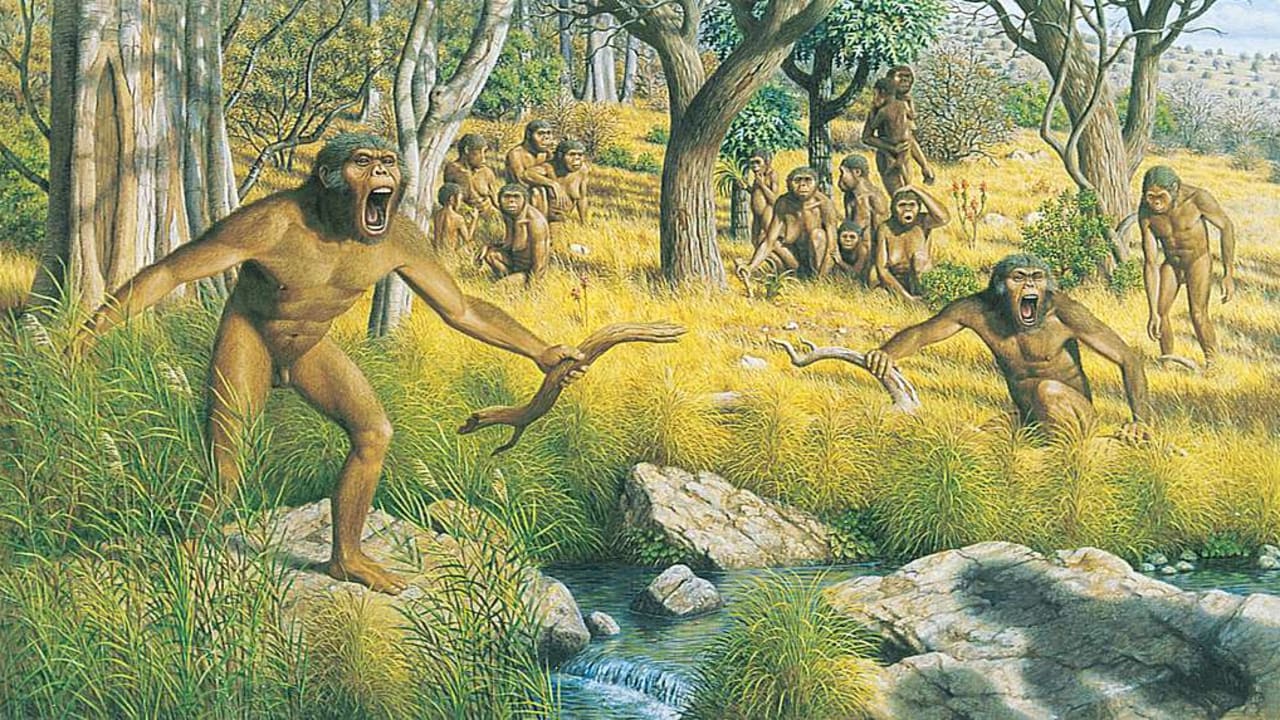
Few things separate humans from the rest of the animal kingdom as dramatically as the way we move. We walk upright, balanced on two legs, our heads held high, hands free to gesture, carry, build, and create. It feels natural now—so natural that most people never stop to consider how strange it really is. Among mammals, bipedal walking is rare. Among primates, it is almost unique.
Chimpanzees can stand. Gorillas can shuffle on two legs for short distances. Even monkeys can rise briefly when they want to reach for something. But none of them live their lives this way. Humans do. Our skeleton, our muscles, our spine, our hips, and even our feet are built for upright walking. It is one of the defining features of our species.
But why did it happen? What pushed our ancestors to abandon the stability of four-limbed movement for the risky experiment of walking on two legs?
The real answer is not a single dramatic moment or one simple advantage. It is a long evolutionary story, written over millions of years, shaped by shifting climates, changing landscapes, survival pressures, and the surprising benefits of standing tall. Yet at the heart of it all lies a powerful truth: upright walking was not merely a way of moving. It was a way of becoming human.
The Mystery of Bipedalism
Bipedalism—the ability to walk habitually on two legs—is one of the earliest and most important milestones in human evolution. In fact, it appears long before large brains, complex tools, language, or art. This is one of the most surprising facts in paleoanthropology: our ancestors began walking upright millions of years before they became recognizably “human” in any other sense.
The oldest evidence of bipedalism dates back at least six million years. Fossils of early hominins such as Sahelanthropus tchadensis and Orrorin tugenensis suggest upright posture, while Ardipithecus ramidus, living about 4.4 million years ago, shows a mix of tree-climbing anatomy and features consistent with bipedal walking. By the time of Australopithecus afarensis, the species of the famous fossil “Lucy” around 3.2 million years ago, bipedalism was clearly established.
So the question becomes unavoidable: why did upright walking appear so early? It must have offered a strong survival advantage. Evolution does not commit to a radical anatomical shift without a payoff. Standing upright changes everything: how you balance, how you run, how you climb, how you give birth, how you breathe. It reshapes the entire body.
To understand the “real reason,” we have to travel back to a world that no longer exists.
A Changing Africa: The World That Forced a New Way of Life
Human evolution took place primarily in Africa, and Africa’s environment has never been static. Over the last several million years, climate changes repeatedly transformed forests into woodlands and grasslands, then back again. Rainfall patterns shifted. Seasons became more pronounced. Dense tree canopies that once provided food and safety began to break apart.
For early primates, trees were life. The forest canopy offered fruit, leaves, insects, and protection from predators. Moving through trees was efficient and safe compared to walking on the ground. But as the environment became more open in some regions, our ancestors increasingly faced a difficult choice: adapt or disappear.
When forests shrink into patchy woodland, food becomes scattered. A group may need to travel farther between trees, crossing open ground. Predators become more dangerous in these exposed spaces. The ability to move efficiently across land becomes critical.
This is where bipedalism begins to make sense. Walking on two legs may have been a solution to a landscape that was no longer purely forest, but not yet fully savanna either. Our ancestors lived in a transitional environment, and their bodies began to reflect that transition.
But environment alone is not a full explanation. Many animals adapted to open landscapes without becoming bipedal. Early humans did something different, and that difference suggests a deeper evolutionary advantage.
The Energy Advantage: Walking Upright Is Surprisingly Efficient
One of the most convincing scientific explanations for bipedalism is energy efficiency. Human walking, compared to the knuckle-walking of chimpanzees, is remarkably economical over long distances.
Studies of biomechanics show that upright walking allows the body to use pendulum-like motion. Each step recycles energy as the body vaults over the supporting leg. Humans also have long legs relative to body size, which increases stride length and reduces the energy cost of travel. Over time, even small energy savings can mean the difference between survival and starvation.
In an environment where food sources were spread out, being able to walk farther while burning fewer calories would have been a major advantage. It could mean reaching fruit trees before competitors. It could mean surviving seasonal droughts when food was scarce. It could mean migrating to better habitats.
Evolution favors efficiency. A body that spends less energy to get the same reward is a body more likely to pass on its genes.
This is a powerful reason, but it still does not capture the full story. Walking upright is efficient, yes—but why did our ancestors evolve upright walking rather than simply becoming faster quadrupeds? Why not develop longer arms and legs for running on all fours, as many animals do?
The answer lies partly in what bipedalism makes possible.
Free Hands: The Beginning of a New Kind of Survival
Walking on two legs frees the hands, and this may be one of the most important evolutionary consequences in the history of life on Earth.
Hands are not just for movement. In primates, hands are already specialized for grasping, climbing, and manipulating objects. When our ancestors began to walk upright, their hands became available for carrying food, holding tools, transporting infants, and eventually shaping the environment itself.
Imagine a small group of early hominins moving between trees. A quadrupedal animal can only carry something small in its mouth while walking. But a biped can gather food and carry it back to a safe location. It can transport fruit, roots, or scavenged meat. It can bring resources to mates or offspring.
This ability could change social behavior. If individuals could carry food back to a group, sharing might become more important. Cooperative living would be encouraged. Family bonds could strengthen. Over long periods, such changes could influence the evolution of social intelligence and communication.
The freed hands also made tool use more practical. Tool use existed before humans—chimpanzees use sticks and stones—but the transition to habitual bipedalism may have allowed more frequent tool carrying and tool-making.
The hands became instruments of survival rather than simply limbs for locomotion. This shift cannot be overstated. A creature with free hands is a creature capable of altering its destiny.
But the free-hands explanation, while important, may not fully explain why bipedalism began in the first place. It explains why it was beneficial once it started, but evolution still needed a trigger.
That trigger may have been tied to danger.
Standing Tall: Seeing Over Grass and Spotting Predators
In an open environment, height matters. When forests thin and grasslands expand, visibility becomes a powerful advantage. Standing upright allows an animal to see farther. It can scan for predators. It can locate distant trees, water sources, or food patches.
A chimpanzee in tall grass is vulnerable. A bipedal hominin can rise above the vegetation, gaining information that could save its life. Even if upright posture was first used occasionally, those individuals who stood and walked upright more effectively may have had better survival rates.
Predation pressure is one of evolution’s most relentless forces. Early hominins were not top predators. They were small, relatively slow, and poorly armed. Their best defense was awareness and cooperation. If bipedalism improved the ability to detect danger early, it would have been strongly favored.
This explanation fits well with the idea that bipedalism emerged gradually. It may have begun as a behavior used when needed—standing to look around—then slowly became more frequent as anatomical changes made it easier and more efficient.
But bipedalism did more than improve vision. It changed how our ancestors interacted with heat.
The Heat Problem: Upright Walking as Climate Adaptation
Africa is hot. Even in woodland environments, the sun can be brutal, and heat stress is deadly. Humans are unusual among mammals because we are excellent at dissipating heat. We sweat heavily, and our mostly hairless bodies allow evaporation to cool us efficiently.
Bipedalism contributes to this heat management in subtle but important ways. Standing upright reduces the amount of body surface exposed directly to the overhead sun compared to a quadruped. A four-legged animal presents a broad back to the sun, absorbing heat. A biped presents a narrower profile.
At the same time, being upright raises the body higher into cooler, faster-moving air currents, increasing convective cooling. Walking upright can also reduce the total energy cost of movement, meaning less internal heat is produced for the same travel distance.
This thermoregulation advantage becomes especially important in open landscapes where shade is limited. If early hominins were increasingly active during hotter parts of the day—perhaps to avoid predators or compete for food—heat tolerance could become a decisive advantage.
Some scientists argue that bipedalism, combined with improved sweating and reduced body hair, allowed humans to become endurance specialists, capable of traveling long distances under the sun when other animals would overheat.
This idea connects bipedalism not just to walking, but to a larger evolutionary shift: humans becoming creatures of long-range movement.
The Carrying Hypothesis: Food, Babies, and Social Bonds
Another compelling explanation is the carrying hypothesis. Early hominins may have benefited from being able to carry food back to mates and offspring. In primates, raising young is demanding, and infants are dependent for long periods. Carrying a baby while moving on four limbs is difficult. Carrying with arms while walking upright is easier.
If bipedalism improved infant transport, it could have increased reproductive success. Individuals who could move with offspring safely might have had higher survival rates for their young. Over time, this would favor anatomical traits that supported upright posture.
Carrying food also influences mating strategies. Some evolutionary models propose that males who could bring food to females and offspring increased their chances of reproduction, encouraging more stable pair bonding. This is not a universally accepted theory, but it highlights an important point: bipedalism may have reshaped social structures, not just movement.
Evolution is rarely only about muscles and bones. It is about behavior, relationships, and survival strategies. Walking upright may have been woven into a larger transformation in how our ancestors lived together.
But there is still another possibility—one that suggests bipedalism began not on the ground, but in the trees.
The Tree-to-Ground Transition: Bipedalism May Have Started Above Earth
For a long time, the classic explanation was that humans became bipedal after leaving the trees and moving into open savannas. But newer fossil evidence complicates this story.
Ardipithecus ramidus, for example, appears to have lived in a woodland environment, not a wide-open savanna. Its anatomy suggests it could walk upright on the ground, but it also had features for climbing. This implies that bipedalism emerged while our ancestors were still spending significant time in trees.
Some scientists propose that bipedalism may have originated as a form of upright movement along branches. Moving on two legs on large tree limbs could have helped early hominins reach fruit, balance while feeding, or carry food while climbing.
This is sometimes called the arboreal bipedalism hypothesis. It suggests that upright posture was not invented on the ground, but refined there.
If true, this changes the emotional image of human evolution. Instead of imagining our ancestors suddenly stepping onto the savanna and standing up like a dramatic transformation, we might imagine something more gradual: upright movement practiced among branches, then carried down into the open world when the environment demanded it.
Evolution does not leap. It repurposes.
Bipedalism may have been an old trick that became the defining trait of a new species.
The Anatomy of Upright Walking: What Had to Change
Walking upright is not as simple as standing on two legs. It requires a complete re-engineering of the body. The fossil record reveals that this transformation happened step by step, not all at once.
The human spine is shaped like an S, allowing balance over the hips. The pelvis is shorter and wider than that of chimpanzees, creating a stable platform for upright posture. The femur angles inward from the hip to the knee, bringing the feet under the body’s center of gravity. Human feet have arches that act as shock absorbers and energy springs. The big toe aligns with the other toes rather than sticking out for gripping branches.
Even the skull had to change. The opening where the spinal cord connects to the skull, called the foramen magnum, is positioned more underneath the head in humans. This helps balance the head on the spine.
None of these changes are minor. Each one affects childbirth, speed, climbing ability, and vulnerability to injury. The shift to bipedalism was a major evolutionary gamble.
But it paid off.
The Cost of Walking Upright
If bipedalism was so beneficial, why did it not evolve in many other animals? The answer lies in the costs.
Walking upright makes the body less stable in some situations. It increases stress on the spine, hips, knees, and feet. It makes falling more dangerous. It contributes to back pain, hernias, joint problems, and difficult childbirth.
Human childbirth is famously painful and risky compared to many other mammals, partly because the pelvis must balance the demands of upright walking with the demands of delivering a large-brained infant. This evolutionary compromise is one of the most dramatic examples of trade-offs in biology.
Bipedalism also reduces climbing efficiency. Chimpanzees and other primates are far better climbers than humans because their bodies are optimized for life in trees.
So the fact that bipedalism evolved tells us something important: the benefits were enormous. They outweighed the costs so strongly that natural selection reshaped an entire lineage.
That means bipedalism was not a cosmetic change. It was a survival strategy.
Was Tool Use the Real Reason?
Many people assume humans began walking upright in order to use tools. It sounds logical: free hands allow tool-making, and tool-making is central to human success.
But the timeline suggests that bipedalism came first.
The earliest strong evidence for habitual bipedalism appears millions of years before the earliest known stone tools. While it is possible that early hominins used simple tools made of wood or bone that did not fossilize, the most convincing evidence suggests that upright walking was established before advanced tool culture.
This means tool use was likely an evolutionary consequence of bipedalism rather than its original cause.
Once hands were free, the door to tool use opened wider. But bipedalism probably did not begin as a “decision” to become tool users. Evolution does not plan ahead. It selects what works in the present moment.
The earliest hominins were not imagining spears, fire, or cities. They were trying to survive the next season.
Running, Hunting, and the Rise of Endurance Humans
One of the most fascinating consequences of bipedalism is what it later enabled: endurance running.
Humans are not the fastest animals. A cheetah can outrun us easily. Even a horse can leave us behind. But humans are exceptional at running long distances in hot conditions. Our upright posture, long legs, spring-like tendons, and sweating system allow us to pursue prey over hours until the animal overheats and collapses.
This hunting strategy, sometimes called persistence hunting, has been documented in some traditional human societies. It may have been an important part of early Homo species survival.
Bipedalism laid the groundwork for this. A quadrupedal primate is not built for endurance running. But an upright hominin could eventually become a long-distance traveler, capable of migrating, hunting, and exploring new territories.
This is one reason humans spread across the planet. Walking upright was not only about survival in Africa—it became the foundation of a species that would eventually cross deserts, mountains, and ice-age landscapes.
In this sense, bipedalism was the first step toward humanity becoming a global creature.
The Real Reason: No Single Answer, But One Central Theme
So what is the real reason humans started walking upright?
The honest scientific answer is that there is no single reason. Bipedalism likely evolved through a combination of pressures and advantages, each reinforcing the other over millions of years.
But there is a central theme that unites them: environmental change forced adaptation, and upright walking offered a versatile solution.
Walking upright allowed early hominins to travel efficiently across patchy landscapes. It freed the hands to carry food, infants, and tools. It improved visibility in open terrain. It reduced heat stress under the sun. It supported new social behaviors such as sharing and cooperation. It eventually enabled long-distance movement and hunting strategies that no other primate could match.
Bipedalism was not just a way to walk. It was a way to expand possibilities.
That is why it became permanent.
Evolution did not give humans upright walking because it looked impressive. It gave it because it worked, again and again, under harsh and changing conditions.
Fossil Footprints: The Evidence Written in Stone
One of the most iconic pieces of evidence for early bipedalism is the Laetoli footprints, discovered in Tanzania and dated to about 3.6 million years ago. These fossilized footprints were left by Australopithecus afarensis individuals walking across volcanic ash.
The footprints are haunting. They look unmistakably human. The stride is upright. The big toe is aligned. The gait is confident.
These footprints are more than scientific data. They are a frozen moment in time, a silent record of a creature that was not yet fully human, but already walking like one.
They remind us that bipedalism was not an abstract concept. It was lived. It was practiced step by step, across ancient landscapes, under skies filled with stars that looked much the same as ours.
The Laetoli footprints are evidence that upright walking was not experimental by that point. It was already a way of life.
How Bipedalism Shaped the Human Mind
Perhaps the most profound part of this story is not what bipedalism did to our bodies, but what it may have done to our minds.
Walking upright changed how our ancestors interacted with the world. It changed what they could see, what they could carry, how they could hunt, and how they could use their hands. Over time, these changes may have driven the evolution of intelligence.
Tool use became more common. Cooperation became more valuable. Communication became more important. Social learning became essential. A creature that could carry objects could also manipulate them, experiment with them, and improve them.
Bipedalism did not directly create the human brain, but it may have created the lifestyle pressures that favored brain expansion later.
It allowed our ancestors to become more than tree-dwellers. It turned them into explorers.
And exploration is one of the strongest forces behind intelligence.
The Emotional Truth of Upright Walking
There is something deeply symbolic about standing upright. Even today, we associate upright posture with confidence, alertness, and dignity. To stand is to be ready. To walk upright is to move forward with purpose.
But this symbolism is not just cultural. It reflects an ancient biological shift.
When our ancestors stood up, they entered a new relationship with the world. They left behind the constant shelter of branches and faced the open horizon. They became more exposed, but also more capable. They gained freedom at the cost of vulnerability.
That trade-off defines much of the human story.
Bipedalism is not simply an evolutionary feature. It is the first chapter of our transformation from ordinary primates into a species that reshaped the planet.
The moment our ancestors began to walk upright, they began to change the rules of survival.
The Long Road to Becoming Human
Bipedalism did not happen overnight. It was not a sudden leap from four legs to two. It was a gradual shift shaped by countless small anatomical adjustments and behavioral experiments.
Some individuals may have walked upright only occasionally at first. Over generations, those who did it more efficiently survived better. Their offspring inherited slightly different hips, spines, and leg structures. Over millions of years, these changes accumulated until upright walking became the default.
And once it became the default, everything else followed.
The hands became more skillful. Tools became more common. Hunting became more strategic. Social life became more complex. Brains grew larger. Language emerged. Culture exploded.
It is possible that without bipedalism, none of these later achievements would have happened in the same way. The upright body is the platform on which human civilization was built.
Our cities, art, technology, and science all trace back to a simple but radical change: the decision of evolution to lift our ancestors onto two legs.
Conclusion: Why Humans Walk Upright
Humans started walking upright because the world changed, and our ancestors needed a new way to survive.
As forests became patchy and landscapes opened, upright walking offered energy efficiency, improved visibility, and better heat management. It freed the hands for carrying food and offspring, encouraged new social strategies, and eventually opened the door to tool use and long-distance travel.
There was no single “real reason,” but rather a powerful combination of pressures that made bipedalism the winning strategy.
The real reason humans started walking upright is that it gave our ancestors freedom—freedom to move farther, to carry more, to see farther ahead, and to live in a world that was no longer confined to the trees.
Bipedalism was not just a physical change. It was the beginning of a new kind of life.
It was the first step toward becoming human.
And every time you take a step today—across a street, through a field, down a hallway—you are repeating a movement that began millions of years ago, when a small primate stood up under the African sky and walked into the future.