Look in a mirror. Tilt your head slightly. Run your fingers along the edge of your jaw until you reach the front of your face, where the lower jaw rises and forms a small, forward-pointing ridge. That subtle bump—sometimes sharp, sometimes rounded, sometimes barely noticeable—is your chin.
It is so familiar that most people never question it. It feels as natural as having a nose or eyebrows. Yet the chin is one of the strangest features of the human body, because it seems almost unnecessary. It does not help you chew. It does not help you breathe. It does not help you see or hear. And yet it is there, uniquely defining the human face.
In fact, if you compare humans with other animals, the chin becomes even more mysterious. Gorillas and chimpanzees, our closest living relatives, do not have chins. Neither do dogs, cats, horses, or elephants. Even our extinct cousins—Neanderthals and earlier hominins—did not have chins in the way modern humans do.
The chin appears to be an anatomical signature of Homo sapiens, one of the few skeletal traits that can instantly distinguish our species from other members of the human family tree.
But why did it evolve?
Despite decades of research, evolution still cannot provide a single, universally accepted explanation. The chin remains a puzzle: a bony protrusion that seems to serve no obvious survival purpose, yet became part of what it means to look human.
What Exactly Is a Human Chin?
To understand why chins are mysterious, we first have to define what a chin is in scientific terms. Anatomically, the human chin is called the mental eminence, a forward projection of the mandible, or lower jawbone. It is not simply the presence of a jaw. Many animals have strong jaws. It is not even the presence of a protruding jawline.
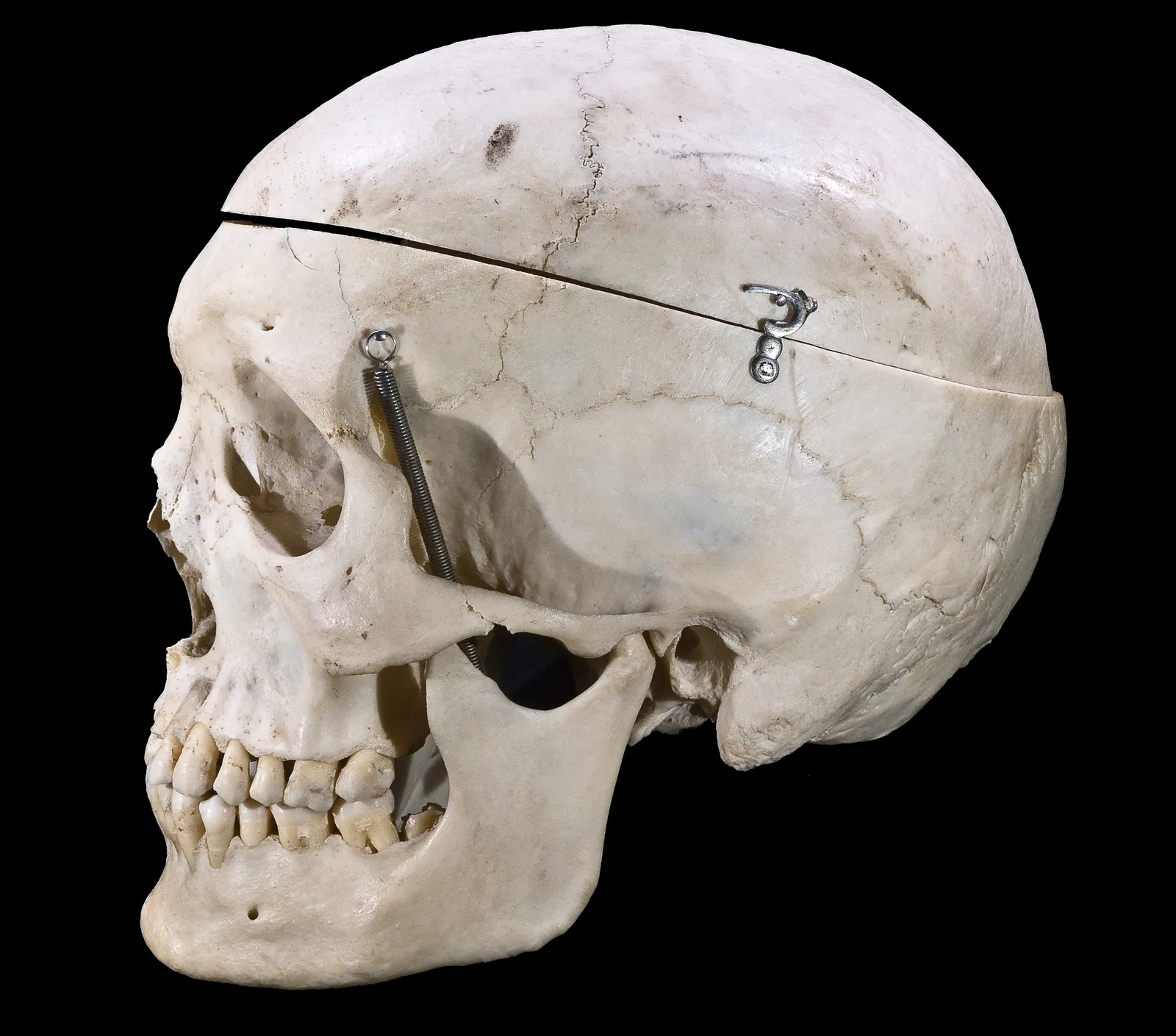
The chin is specifically the forward bulge at the front center of the mandible, often accompanied by two small lateral bumps called mental tubercles. Together, these form a distinctive shape that can be seen clearly in profile. It gives the lower face a kind of geometric structure, making it appear more angular and defined.
Importantly, the chin is not just soft tissue. It is bone. Even if you remove all flesh, a human skull still displays a chin-like projection.
This is what makes it such a fascinating evolutionary feature. Bones are expensive for the body to build and maintain. Natural selection usually does not waste energy on unnecessary structures. Yet the chin is there, persistent across human populations, varying in size but rarely absent.
It is not a random accident. It is part of our species design.
Why Other Primates Don’t Have Chins
If the chin were a simple consequence of having a jaw, we would expect other primates to have one. But they do not.
Chimpanzees and gorillas have jaws that slope backward from the teeth, often with strong protruding muzzles. Their faces are built differently because their teeth are larger relative to their skull size, and their chewing muscles are more powerful. Their mandibles are robust and thick, but the front of the jaw does not bulge outward into a chin.
Instead, the lower jaw in apes often looks like a continuous curve. The front is strong, but it is not projecting in the distinctive way that humans do.
This difference reflects deeper changes in the evolution of the human face. Humans have smaller teeth than apes. We have flatter faces, reduced snouts, and a more retracted jaw structure overall. These changes likely relate to diet, tool use, cooking, and speech-related anatomy.
But even with these differences, the chin remains unusual. A smaller jaw does not automatically produce a chin. It seems to require a specific pattern of bone growth that modern humans developed.
The Chin as a Signature of Homo sapiens
One of the most striking facts in paleoanthropology is that the true chin appears relatively late in human evolution.
Early hominins such as Australopithecus did not have chins. Homo erectus, a species that walked upright, used tools, and spread across continents, did not have a chin. Neanderthals, who had large brains and complex behavior, also lacked the distinct modern human chin.
Neanderthal jaws were strong and forward-projecting, but they lacked the mental eminence. Their mandibles were thick, and their facial structure was different, adapted to heavy chewing and possibly to cold climates. Their lower face tended to project forward, but not in the specific bulging way that forms a chin.
When anatomically modern humans appeared, the chin became one of their defining skeletal features. Fossils of early Homo sapiens from Africa show developing chin structures, though not always as pronounced as in later populations. Over time, the chin became more consistent.
This means the chin is not ancient. It is a relatively new evolutionary development. That fact alone raises an intriguing question: what changed in modern humans that caused this unique facial trait to emerge?
The Classic Question: Is the Chin an Adaptation?
Evolution is often described as a process that produces adaptations—traits shaped by natural selection because they improve survival or reproduction.
If the chin is an adaptation, it should have some functional benefit. Perhaps it strengthens the jaw. Perhaps it helps with speech. Perhaps it makes chewing more efficient. Perhaps it improves breathing or swallowing. Or perhaps it is sexually attractive and shaped by mate choice.
But when scientists examine the chin closely, the evidence for a clear functional advantage is surprisingly weak.
The chin does not provide obvious mechanical support. It does not seem essential for biting. Humans can chew perfectly well without prominent chins. Many people naturally have small or recessed chins and still function normally.
The chin also does not appear to play a major role in speech production. Speech depends on the tongue, vocal cords, airflow, and brain control. The chin might influence the shape of the lower face slightly, but it is not a key speech organ.
So if the chin is not clearly useful, it might not be an adaptation at all.
That possibility has led scientists into one of the most fascinating debates in evolutionary biology: could the chin be a byproduct rather than a purpose?
The Chin as an Evolutionary Byproduct
One of the most popular scientific explanations is that the chin is not something evolution specifically “wanted.” Instead, it may have emerged accidentally as a side effect of other changes in the human face.
This idea is known as a spandrel hypothesis, a concept borrowed from architecture. A spandrel is an architectural space that appears when you build arches, not because someone intended it, but because it is an inevitable result of the structure.
In evolution, a spandrel is a trait that arises because of the way other traits develop. It may not have been directly selected for, but it becomes part of the organism because it comes along with something else.
The chin might be such a feature.
As humans evolved smaller faces and smaller jaws, the lower jaw may have undergone structural changes that caused bone to accumulate at the front. Instead of sloping backward like an ape jaw, the human jaw may have retracted under the face, creating a need for reinforcement or producing a protrusion as a growth artifact.
In this view, the chin is not a purposeful adaptation. It is the fossil footprint of facial evolution.
This explanation is appealing because it fits the broader story of human evolution. Humans did not just evolve chins. We evolved flatter faces, smaller teeth, reduced chewing muscles, and lighter skulls. The chin could simply be one part of that transformation.
But if it is a byproduct, scientists still need to explain why the byproduct took this particular shape.
The Jaw Reduction Theory: Smaller Faces, Unexpected Geometry
One major evolutionary trend in Homo sapiens is facial reduction. Compared to earlier hominins and Neanderthals, modern humans have a smaller, more tucked-in face. Our jaws are less robust. Our teeth are smaller. Our skulls are more rounded.
This reduction likely happened because humans began cooking food, using tools to process meat and plants, and relying less on brute chewing strength. Cooking softens food dramatically. Stone tools and later technologies reduced the need for powerful jaws.
As chewing demands decreased, the human jaw could become smaller without threatening survival.
But bone growth is not always uniform. When a structure shrinks, it may not shrink evenly in every direction. The front of the mandible might have changed in a way that caused a protruding ridge.
Some researchers argue that as the jaw shortened, the dental arch moved backward relative to the lower edge of the jaw. This could create a bulge at the front, producing a chin-like shape.
This explanation does not require the chin to have a function. It is simply an outcome of the jaw’s rearrangement.
However, critics point out that jaw reduction alone does not always create a chin in other species. Many animals have small jaws without chins. Even some human populations have less prominent chins, but still show the basic structure.
So the jaw reduction theory is helpful, but incomplete.
The Mechanical Reinforcement Theory: A Structural Brace for the Jaw
Another hypothesis suggests the chin may serve as reinforcement, strengthening the mandible against stresses created by chewing.
The human jaw experiences significant forces during biting and chewing, especially when processing tough foods. A chin might act as a buttress, distributing stress and preventing the jaw from bending or fracturing.
In engineering, adding material in the right location can increase strength without requiring the entire structure to become thicker. Perhaps the chin is a clever evolutionary solution: a localized thickening at the front that strengthens the jaw while keeping it lightweight.
This theory has intuitive appeal. The chin is, after all, a thickened part of the jaw.
But biomechanical studies have produced mixed results. Some research suggests the chin does not significantly strengthen the mandible against typical chewing forces. Other studies propose that the chin may resist certain stress patterns, such as bending caused by forces at the teeth.
The problem is that chewing forces vary widely based on diet, behavior, and individual anatomy. Humans today eat relatively soft diets compared to ancient humans, yet chins remain. If the chin evolved purely as reinforcement, we might expect it to be more pronounced in populations with tougher diets, but the relationship is not consistent.
The reinforcement theory remains plausible, but it has not become definitive.
The Speech and Tongue Hypothesis: A Human Face Built for Language
Humans are the only animals that have developed complex spoken language. Our vocal anatomy is unique, and our brains are specialized for speech.
It is tempting to connect the chin to language. Some have suggested that the chin might have evolved to support the muscles of the tongue and lower lip, helping with articulation and fine motor control.
The chin region is where several important muscles attach, including those involved in moving the lower lip and shaping facial expressions. Speech depends heavily on lip movement, and human communication relies not only on sound but also on subtle facial cues.
But here, too, the evidence is limited.
The muscles that control speech and facial expression attach to the jaw and face in many mammals, not just humans. The chin itself is not necessary for muscle attachment. The lips can move perfectly well without a pronounced chin. Even individuals with less prominent chins have no speech impairment.
Most researchers today do not view speech as the primary reason the chin evolved, though it may have influenced facial evolution indirectly.
The chin may contribute slightly to the shape of the lower face, but it is unlikely to be the key anatomical breakthrough that allowed language.
Sexual Selection: Did Humans Evolve Chins Because They Look Attractive?
One of the most intriguing possibilities is that the chin evolved through sexual selection rather than survival selection.
Sexual selection occurs when traits evolve because they influence mate choice, not because they help an organism survive. Peacock feathers are the classic example. They are costly and even dangerous, but they persist because they attract mates.
Could the chin be a human version of that phenomenon?
In many cultures, a strong chin is associated with attractiveness, dominance, and masculinity. Some psychologists argue that chin shape may serve as a signal of hormonal development, health, or genetic quality. A prominent chin might indicate higher testosterone exposure during development, potentially acting as a cue in mate selection.
Women tend to have softer, less pronounced chins on average, while men tend to have more angular jawlines. This sexual dimorphism suggests that the chin could have been influenced by reproductive preferences.
However, the sexual selection theory has complications.
First, chins are present in both men and women. While men may have larger chins, women still have them. If chins were purely a sexually selected male trait, we might expect females to lack them entirely.
Second, attractiveness standards vary widely across cultures and historical periods. Some societies prefer strong chins, others do not emphasize them as much. If the chin were strongly driven by sexual selection, we might expect more variation or more extreme forms.
Still, sexual selection may have played a role, especially in shaping chin prominence and jawline structure after the chin already existed.
It is possible that the chin began as a developmental byproduct, and later became exaggerated or refined through mate choice.
The Social Signal Theory: Chins and the Evolution of the Human Face
Humans are intensely social animals. Our faces are not just biological structures; they are communication tools. Facial expressions are crucial for bonding, conflict resolution, trust-building, and emotional signaling.
Some anthropologists suggest that as humans evolved smaller, flatter faces, the chin may have helped create clearer facial contours. A chin can make expressions more readable. It adds structure to the lower face, making the mouth and lips visually distinct.
In social interaction, even subtle changes in facial shape can matter. Humans are unusually skilled at reading faces. We can detect mood, intent, and personality from tiny movements.
The chin might contribute to the overall architecture of the human face in a way that enhances communication. It may not be about chewing or survival, but about social life—about being seen and understood.
This theory is difficult to test, because it involves behavior, perception, and cultural evolution. But it aligns with the idea that Homo sapiens evolved not just as a physical species, but as a deeply social one.
Our faces may have been shaped by the demands of living in groups, forming alliances, raising children cooperatively, and communicating complex emotions.
The chin, in this sense, could be a small piece of a larger puzzle: the evolution of the human face as a social instrument.
Developmental Biology: The Chin May Be a Growth Accident
To truly understand the chin, scientists also examine embryology and developmental biology. Evolution works by altering development. Small changes in the timing and pattern of bone growth can create major differences in adult anatomy.
The human chin forms during development as the jawbone grows and remodels. Bone is not static. It is constantly reshaped by growth patterns, muscle forces, and genetic instructions.
Some researchers argue that the chin may arise because of the way human jaws develop differently from those of other primates. In apes, the lower jaw grows in a way that produces a sloping front. In humans, the growth pattern may involve a reduction of the upper face combined with forward thickening of the lower jaw.
The chin might be a consequence of developmental integration, meaning that changes in one part of the face automatically affect other parts. If the upper face becomes smaller and more vertical, the lower jaw may need to adjust for proper tooth alignment and structural balance.
The result could be the chin.
This explanation is attractive because it connects the chin to a known feature of human evolution: the reorganization of the skull. Humans have a different cranial base angle than apes. Our skull is more rounded. Our face sits differently beneath the braincase.
When you change the architecture of the skull, the jaw must adapt.
The chin could be one of those adaptations, not necessarily chosen directly by evolution, but emerging as the jaw reorganized itself under a changing skull.
The Neanderthal Comparison: Why They Had Big Faces but No Chins
Neanderthals are central to the chin mystery because they were so close to us in evolutionary terms. They lived across Europe and Asia for hundreds of thousands of years. They used tools, hunted, controlled fire, and likely had language or proto-language.
Their brains were as large as ours, sometimes even larger. Their culture was complex. Yet their skulls lacked a true chin.
Neanderthals had a projecting midface, large nasal cavities, and a robust jaw structure. Their lower jaw was thick and strong, but it sloped backward without forming the mental eminence typical of modern humans.
This difference suggests that the chin is not required for intelligence, tool use, or even advanced social behavior. It is not simply the result of being “more evolved.” It is a distinct evolutionary pathway that Homo sapiens took.
Some scientists think the chin may have emerged because modern humans evolved smaller faces faster than Neanderthals did. If the face retracts while the lower jaw maintains certain growth patterns, a chin might form.
In Neanderthals, the face remained forward-projecting, so the jaw never developed the same structural geometry.
This reinforces the idea that the chin might be tied to facial retraction and skull shape changes rather than a direct functional benefit.
Diet, Cooking, and the Changing Human Jaw
One of the most important shifts in human evolution was the increasing reliance on processed food. Early humans began using stone tools to cut meat and crush plants. Later, they controlled fire and cooked food.
Cooking is a biological revolution. Heat breaks down tough fibers, softens meat, gelatinizes starch, and makes nutrients easier to digest. A cooked diet requires less chewing force and less jaw strength.
As food became softer, the human jaw could shrink. Teeth became smaller. Chewing muscles reduced in size. This is reflected in the fossil record.
Modern humans have smaller jaws than many ancient humans. Even within recorded history, the shift toward agricultural and industrial diets has led to noticeable jaw changes. Orthodontic crowding and impacted wisdom teeth are far more common today, partly because our jaws are smaller than those of our ancestors.
This ongoing reduction suggests that human jaws are still evolving.
If jaw reduction is linked to the chin, then the chin might be an anatomical echo of dietary evolution. It may have emerged as the jaw reorganized itself in response to a softer diet and a changing skull.
But again, diet alone does not fully explain why the chin takes the specific form it does. Many animals eat soft diets without developing chins.
So diet is part of the story, but not the final answer.
Could the Chin Be a Random Trait That Drifted Into Existence?
Another possibility is that the chin evolved through genetic drift, rather than selection.
Genetic drift is the random change in gene frequencies over time, especially in small populations. If early Homo sapiens populations were relatively small and isolated, certain traits could have become common simply by chance.
If the genetic mutations that influenced chin development happened to spread in early human groups, the chin could become a fixed feature without providing a major advantage.
This is not as strange as it sounds. Not every trait in biology is adaptive. Some traits persist because they are neutral or because they are linked to other traits that are beneficial.
However, the chin is such a consistent feature of modern humans that many scientists hesitate to attribute it entirely to drift. Still, drift may have played a role in shaping variation in chin size and form across populations.
Evolution is not always a purposeful sculptor. Sometimes it is a gambler.
Why Scientists Still Debate the Chin
The reason the chin remains unsolved is that it sits at the intersection of many evolutionary forces. It involves biomechanics, skull development, diet, genetics, and social behavior. It may not have one single cause.
The chin may be the result of multiple overlapping influences.
Modern humans evolved smaller faces and jaws, which may have produced the chin as a developmental byproduct. Once it existed, it may have offered minor structural benefits. Over time, sexual selection and social signaling could have influenced its prominence.
This layered explanation is messy, but biology often is.
Evolution rarely works like a single clear engineering project. It works like a patchwork, building new forms out of old ones, modifying existing structures in unpredictable ways.
The chin may not be a feature with a single evolutionary purpose. It may be an evolutionary compromise, shaped by many pressures and accidents.
The Chin and Human Identity
Even though the chin’s origin remains uncertain, its impact is undeniable. The chin shapes human appearance. It affects how we perceive each other. It plays a role in attractiveness, identity, and expression.
Artists and sculptors have long understood this. The chin is central to portraiture. It defines the lower face and gives the human head a recognizable silhouette. It influences how age is perceived, how masculinity and femininity are interpreted, and how emotion is read.
A strong chin can make someone appear confident. A small chin can make someone appear gentle or youthful. These are cultural interpretations, but they are built on biological structure.
The chin is not just bone. It is part of the human story.
It is also a reminder that evolution is not always straightforward. Some of our most defining features may not have been “designed” for a clear purpose. They may have emerged from the complex history of our species.
What the Chin Tells Us About Evolution Itself
The chin is fascinating not because it is powerful, but because it is subtle. It is not a claw or a horn or a wing. It does not scream survival. Yet it became universal in our species.
That challenges the popular idea that evolution always produces traits with obvious functions.
Evolution often works indirectly. A structure can arise as a side effect of other changes. A trait can persist simply because it does not harm survival. Sometimes, a feature becomes important socially or culturally long after it first appears biologically.
The chin may be a perfect example of this complexity.
It may not have evolved because it helped humans survive. It may have evolved because the human face changed shape, and the jaw followed the rules of bone growth and geometry. Once the chin existed, it may have become part of what humans recognized as human, influencing attraction, identity, and social perception.
The chin reminds us that evolution does not always provide clean answers. Sometimes, the most human features are not those that made us stronger, but those that emerged as quiet consequences of becoming something new.
The Most Likely Explanation So Far
If we ask what explanation fits best with current scientific understanding, the strongest consensus leans toward the chin being primarily a developmental byproduct of facial reduction and skull reorganization in modern humans.
As Homo sapiens evolved flatter faces, smaller jaws, and a different cranial structure, the mandible likely remodeled itself in a way that produced a forward bulge at the front.
This does not mean the chin is useless. It may offer slight structural reinforcement. It may help with muscle attachment. It may influence facial shape in subtle social ways. But it probably did not evolve as a single-purpose adaptation.
Instead, it may be the outcome of a uniquely human reshaping of the skull—a consequence of becoming a species with a large brain, a flatter face, and a new way of living.
But even this is not fully proven.
The chin remains an evolutionary mystery because it sits in a gray zone where biology meets chance, where structure meets function, where survival meets identity.
Why the Mystery Still Matters
Some people might ask why it matters. Why obsess over a small bump of bone?
Because the chin represents something deeper than anatomy.
It represents the fact that even now, even after centuries of scientific progress, there are parts of the human story we still do not fully understand. We can map the human genome, reconstruct ancient migrations, and detect the chemical signatures of extinct species. Yet we still cannot completely explain why the human face looks the way it does.
That is humbling.
The chin is a reminder that the human body is not a finished design. It is a historical artifact. Every feature on your face is the result of millions of years of evolutionary changes—some purposeful, some accidental, some shaped by survival, some shaped by society.
The chin is part of that long journey.
And perhaps that is why it fascinates scientists so much. It is a question carved into our own bones. It is a mystery you carry every day, without realizing it.
Conclusion: The Chin as an Evolutionary Riddle Written on Every Face
Humans have chins because we are the only surviving species shaped by a particular evolutionary path. Somewhere in the transformation from earlier hominins to Homo sapiens, our faces flattened, our jaws shrank, and our skulls reorganized around a growing brain. Out of that complex remodeling, the chin emerged—subtle but unmistakable.
Evolution still cannot fully explain it because the chin does not fit neatly into the typical story of adaptation. It is not clearly a survival tool. It is not essential for chewing or speaking. It does not obviously protect us or make us stronger.
Instead, the chin seems to be a signature of our species, perhaps born from the unintended consequences of changing anatomy, perhaps shaped later by attraction and social meaning.
The truth may be that the chin is not one story but many stories layered together. It is a byproduct, a reinforcement, a signal, and a cultural symbol all at once.
And that is what makes it so deeply human.
Your chin is not just part of your face. It is a fossil of evolution’s creativity—an unresolved clue, an unanswered question, a quiet reminder that the journey of Homo sapiens is still being studied, still being interpreted, and still filled with mysteries hiding in plain sight.