On the windswept edges of Brazil’s shoreline, Joseph’s Coat grows quietly, its leaves catching sun and sea mist. For generations, people living along the coast have relied on this humble plant to ease inflammation, soothe pain, and fight infections. Yet despite its long history in folk medicine, the plant remained a mystery to modern science. Could its healing reputation be proven in the lab, or was it simply a story passed down through time?
Now, a team of Brazilian researchers has taken this question seriously. Their work, carried out at the Federal University of Grande Dourados, the State University of Campinas, and São Paulo State University, has resulted in one of the most detailed scientific investigations ever performed on the Joseph’s Coat plant. And the results reveal that the old stories may have been right all along.
The First Clues Hidden in Its Chemistry
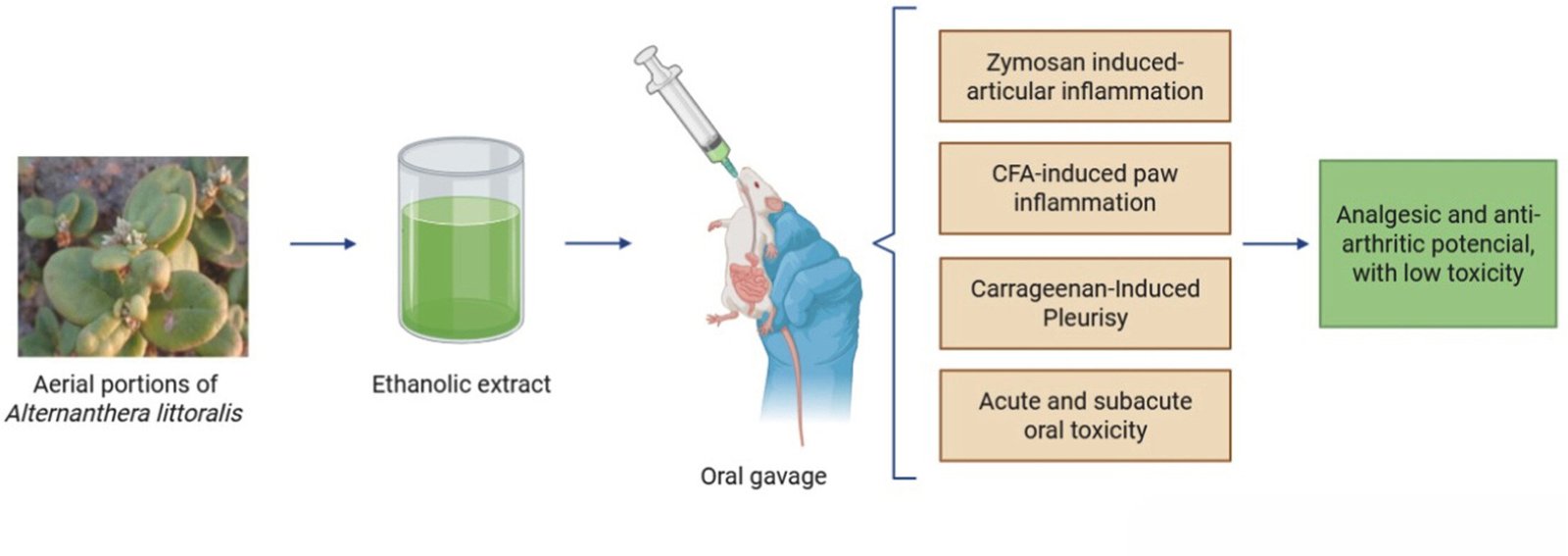
Before the researchers could test the plant’s effects on the body, they needed to understand what it was made of. Every medicinal plant holds a chemical fingerprint, and those compounds can reveal how it behaves inside living systems. The first phase of the investigation focused on identifying these compounds within the ethanolic extract taken from the aerial parts of the plant.
This initial work was led by Marcos Salvador, a pharmacist from the Institute of Biology at UNICAMP. His analysis served as the foundation for everything that followed. Without knowing what active molecules were present, the rest of the study would be like trying to open a locked door without knowing whether you even had a key.
Once the chemical profile was understood, the research journey could move into deeper, more demanding territory.
A Search for Relief in Inflamed Joints
With the plant’s molecular blueprint in hand, the team led by pharmacologist Cândida Kassuya at UFGD turned to the question at the heart of the study. Could this extract truly reduce inflammation? And more than that, could it ease the kinds of swelling and pain associated with arthritis?
To answer this, the researchers tested the extract in experimental models of the disease, observing how inflammation changed when the plant compounds entered the system. It was meticulous work, the type that demands patience and precision. But as the results accumulated, something remarkable became clear. The plant was performing exactly as folk healers had claimed for generations.
Unveiling the Plant’s Protective Power
The next step was crucial. A treatment can look promising, but unless scientists know it is safe, the journey toward real-world use cannot begin. That responsibility fell to the final phase of the project. “Finally, we performed the toxicological analyses under my coordination,” explains Arielle Cristina Arena, associate professor at UNESP’s Botucatu campus.
Her team’s analyses helped complete the puzzle, offering a clearer picture of how the extract interacts with the body and whether it poses risks at therapeutic doses.
What the researchers found was both scientifically compelling and culturally meaningful. The extract did not simply reduce inflammation; it did so in several measurable ways. “In the experimental models, we observed reduced edema, improved joint parameters, and modulation of inflammatory mediators, suggesting antioxidant and tissue-protective actions,” says Arena.
These findings echo what coastal communities have long believed, but now with data to support each step of the plant’s biological activity.
The Promise on the Horizon
The results paint a hopeful picture. According to Arena, the study not only reinforces the plant’s medicinal potential but also provides a strong scientific foundation for future research. The extract’s safety profile at therapeutic levels suggests that it could one day be developed into herbal medicines, possibly even treatments suited for human use.
Yet the team stresses that excitement must be balanced with caution. Even the most promising natural compounds must pass through rigorous testing before they can reach clinics or pharmacies. Additional toxicological work, controlled human trials, and extract standardization will all be necessary. Moreover, the regulatory pathway for turning a plant into a therapeutic product involves multiple steps, each designed to ensure safety and quality.
The researchers are committed to seeing this process through. “This research is part of an ongoing line of investigation developed by UFGD, UNESP, and UNICAMP, and our purpose is to value Brazilian biodiversity and traditional knowledge, but with a rigorous scientific basis, promoting the safe and rational use of natural products,” says Arena.
Why This Discovery Matters
The study of Joseph’s Coat is more than a scientific milestone. It is a bridge between traditional wisdom and modern research, showing how cultural knowledge can guide scientists toward meaningful discoveries. At the same time, it highlights the extraordinary medicinal potential hidden within Brazil’s rich biodiversity, much of which remains untapped.
Most importantly, the work provides new optimism for those searching for safer, more natural approaches to inflammation and arthritis. While the journey toward clinical application is far from over, this study represents a decisive step forward—a moment when a coastal plant, long valued by healers, finally receives the scientific attention it deserves.
If its promise holds, Joseph’s Coat could become not just a symbol of Brazil’s natural heritage, but a future ally in medicine’s ongoing battle against inflammation and chronic pain.
More information: Felipe Leoratto Parizoto et al, Ethanolic extract of Alternanthera littoralis P. Beauv. aerial parts: Safety assessment and efficacy in experimental models of articular, Journal of Ethnopharmacology (2026). DOI: 10.1016/j.jep.2025.120720