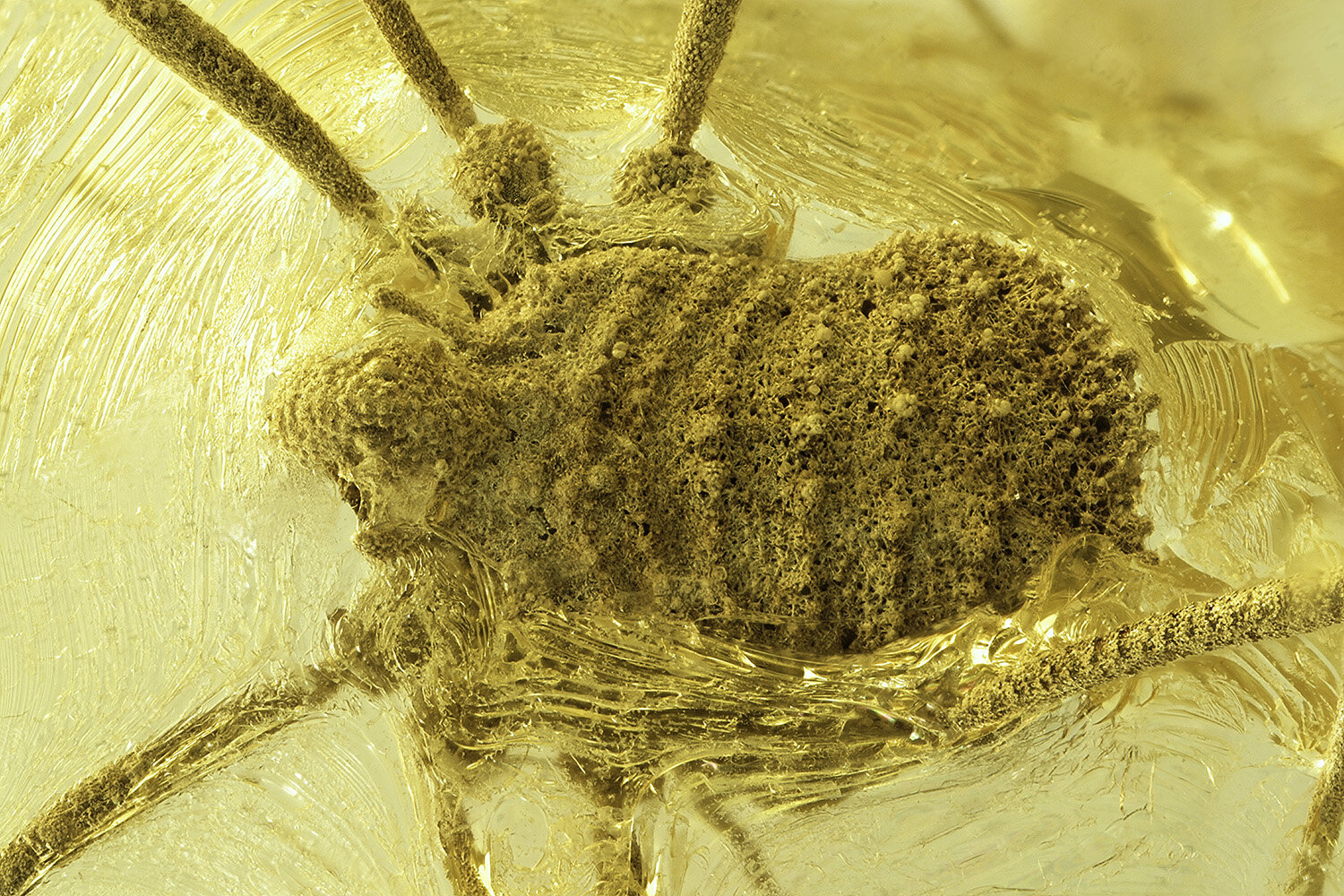
Imagine a world 35 million years ago, a time known as the Eocene epoch, where the forests of Europe were thick with resinous trees and teeming with strange, small lives. In this humid, ancient landscape, a tiny creature with a body like a piece of living lace picked its way through the undergrowth. It was a harvestman, a relative of the spider, but far more ornate than the spindly “daddy longlegs” we often see bobbing in our garden sheds today. As it moved, it stumbled into a sticky trap—a fresh, golden bead of tree resin. For tens of millions of years, that resin hardened into amber, acting as a prehistoric time capsule, until it was recently pulled from the earth in the Baltic and Ukraine regions by a team of German and Bulgarian researchers.
A Masterpiece Frozen in Golden Glass
This was no ordinary discovery. While many fossils are merely flattened impressions in stone, amber fossils represent a rare stroke of luck for science, preserving organisms in three-dimensional perfection. Led by paleontologist Christian Bartel from the Bavarian State Collections of Natural History (SNSB), the research team realized they were looking at a creature that had effectively vanished from the European continent. This tiny arachnid belonged to the Ortholasmatinae subfamily, a group famous for their bizarre and beautiful anatomy. These animals are often characterized by bodies that look less like skin and more like architecture, covered in lattice-like appendages and intricate structures.
Before this find, fossilized members of this specific subfamily were completely unknown to science. The researchers named the new species Balticolasma wunderlichi, a tribute to its origins and its unique physical form. When the scientists peered through the translucent orange of the amber, they saw a creature that looked remarkably like its modern-day relatives found in distant corners of the globe. It featured a highly structured body surface and a prominent eye mound, a raised platform on its head that held its visual organs. However, even with the clarity of the amber, the finest details of its ancient body remained hidden from the naked eye, requiring a more advanced way to look back through time.
Piercing the Veil with Atomic Light
To unlock the secrets of Balticolasma wunderlichi, the team traveled to the Deutsches-Elektronen Synchrotron (DESY) in Hamburg. Here, they used a specialized computed tomography (CT) station operated by the Helmholtz Center Hereon. These high-powered X-rays allowed the paleontologists to digitally peel away the layers of resin and stone, revealing the animal’s three-dimensional anatomy in breathtaking detail. The scans uncovered a net-like pattern of fine ridges that draped over the creature’s entire upper body, creating a biological mesh that served as a protective armor.
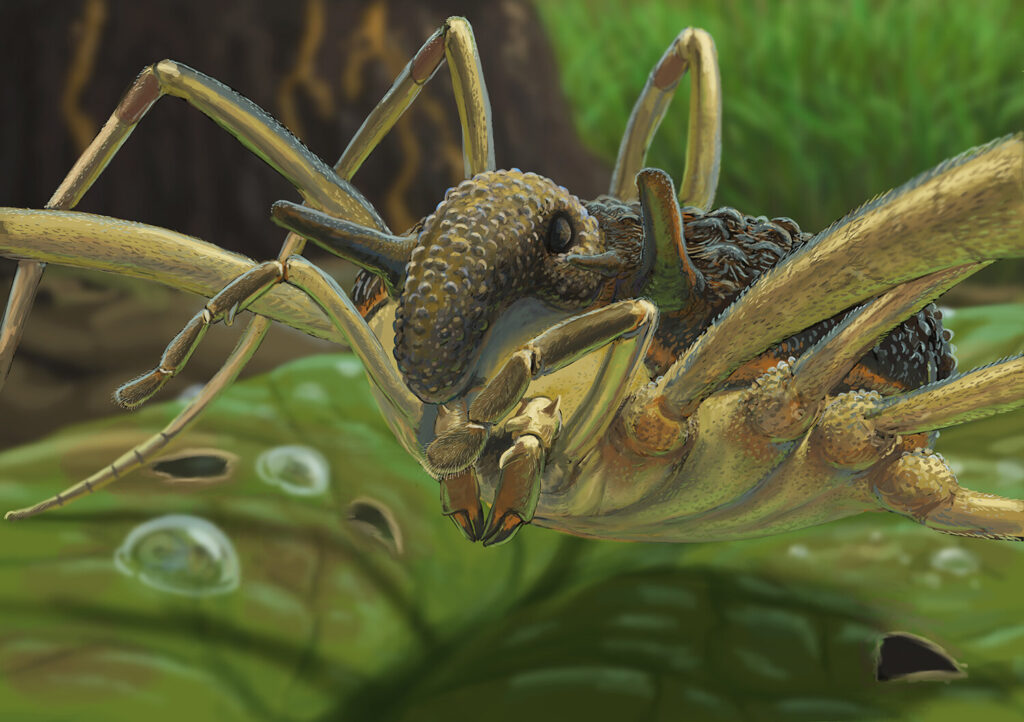
The digital reconstruction also highlighted the complexity of the animal’s face. The researchers found complex mouthparts bearing multiple appendages, tools perfectly adapted for its life in the Eocene leaf litter. These scans didn’t just show a fossil; they revealed a functional living machine, specialized for a world that ceased to exist millions of years before humans walked the Earth. By mapping every ridge and lattice, the team confirmed that this species was a true member of the Ortholasmatinae, making it the very first fossil representative of its kind ever described.
A Ghost from a Lost European Wilderness
The presence of this specific harvestman in Europe is what truly shook the scientific community. Today, if you want to find a living relative of Balticolasma wunderlichi, you would have to travel to East Asia or the forests of North and Central America. They are completely extinct in Europe. The discovery of this fossil in European amber deposits was a major surprise for Dr. Bartel and his colleagues, as it paints a new picture of how life was distributed across the globe in the deep past.
During the Eocene, the Northern Hemisphere was a much more connected place for these delicate arachnids. The evidence suggests that 35 million years ago, these “ornamented” harvestmen were far more widely distributed than they are today. They weren’t just isolated in the Americas or Asia; they were a standard part of the European fauna. This discovery helps scientists track the “ghosts” of biodiversity, showing how environmental shifts or geological changes eventually pushed these creatures out of Europe, leaving them only in the distant refuges where they survive today.
The Shared History of Amber Forests
The story of Balticolasma wunderlichi also helps solve a puzzle regarding the geography of the ancient world. The fossils were found in both Baltic amber and the ancient Ukrainian Rovno amber. This overlap is significant because it suggests that the ecosystems of these two regions—separated by great distances today—were once very similar. The research team, including co-author Dr. Jason Dunlop from the Museum für Naturkunde in Berlin, noted that this discovery brings the total number of known harvestman species in Baltic amber to 19, and seven in the Ukrainian deposits.
Crucially, six of these species, including the newly found Balticolasma wunderlichi, are found in both locations. This confirms that the “amber forests” were not isolated pockets of life but part of a vast, interconnected environment that stretched across the continent. These tiny creatures, stuck in resin, serve as the data points that allow researchers to map out the borders of ancient forests and the movement of species across a lost world.
Why This Ancient Arachnid Matters
Understanding the life of a tiny harvestman from 35 million years ago might seem like a small detail in the grand history of Earth, but it is vital for understanding the resilience and movement of life. This research matters because it proves that our modern natural world is only a small snapshot of what has existed before. By identifying Balticolasma wunderlichi, scientists can better understand how climate change and geological shifts over millions of years cause species to migrate or go extinct in certain regions.
This discovery highlights the importance of amber as a scientific resource, providing a high-definition window into the past that bone and stone fossils simply cannot match. It reminds us that the biodiversity we see today—such as the harvestmen in Asia and America—is the result of a long, dramatic journey across continents and through time. Every piece of amber is a library, and with this new species, we have turned another page in the story of how life on Earth became what it is today.
Study Details
Christian Bartel et al, 3D analyses of the first ortholasmatine harvestmen from European Eocene ambers, Acta Palaeontologica Polonica (2026). DOI: 10.4202/app.01283.2025