For years, a single skull inspired one of paleontology’s most heated debates. Was Nanotyrannus a true species or merely a juvenile Tyrannosaurus rex caught at an awkward moment in life. The question lingered like a shadow over museum halls and academic papers. Now, a new study published in Science has brought that shadow into sharp focus, revealing that the small predator was not a young T. rex at all but a nearly fully grown animal in its own right. And in the process, scientists uncovered clues about how tyrannosaurs grew with astonishing speed into the giants that once ruled Late Cretaceous North America.
The Moment the Bones Began to Speak
The turning point came when a multi-institutional team of researchers, including Dinosaur Institute Postdoctoral Fellow Dr. Zach Morris, turned their attention to a curious piece of anatomy from the Nanotyrannus holotype. Instead of relying on long bones, which are the usual targets of growth analyses but were missing in this skull-based specimen, the researchers focused on something entirely different—the hyoid, a small throat bone that supports the tongue.
It was an unconventional choice. Skulls are full of air pockets and complexities, making them unreliable for microscopic analysis. Long bones offer clearer clues, but the holotype simply did not have any suitable ones. The hyoid, however, might have preserved the record of maturity that scientists had been searching for. Still, no one knew if this bone could be trusted.
As Dr. Christopher Griffin, lead author and Assistant Professor of Geosciences at Princeton University, explained, “The identity of the holotype specimen was the key piece in this debate. Discovering that this small skull was actually fully grown shows definitively that it is different from Tyrannosaurus rex.”
The researchers sliced thin sections of the hyoid and examined the microscopic tissues with the same care a forester might use when counting the rings of a century-old tree. If the bone revealed slowing growth or signs of maturity, the debate could finally end.
A Method No One Expected to Work
The team approached the analysis with cautious skepticism. Dr. Morris recalled the early uncertainty. “When Dr. Griffin started this project, it was unclear whether the hyoid preserved a record of a dinosaur’s growth. To be honest, we mostly accepted the hypothesis that Nanotyrannus was a juvenile T. rex, so we expected the microscopic bone structure or histology of the holotype would show this animal was still growing quickly,” he said. “What we did not expect was to see it was nearing maturity with clear evidence of the cessation of growth.”
But the finding alone was not enough. To prove the hyoid could reliably tell the story of an animal’s age, the researchers needed evidence from modern and extinct species. Dr. Griffin gathered a team of specialists to build a comparative database spanning lizards, crocodilians, birds, and dinosaurs.
“‘To show that hyoid microstructure would work to test maturity status in Nanotyrannus, we first had to compile strong support for this method across many groups of living reptiles and extinct dinosaurs,’” said Dr. Griffin.
The comparison revealed that the structure of the hyoid bone reliably reflected the growth patterns seen in more traditional long-bone samples. With this confirmation in hand, the microscopic signals in Nanotyrannus became undeniable. It was not a teenager on its way to becoming a T. rex. It was an adult of its own species.
A Tale Told Through a Growth Series
A key part of the study’s success came from the unparalleled resources of the Dinosaur Institute, which houses a rare Tyrannosaurus rex growth series. These specimens, including a juvenile known as “Thomas,” had already been sampled and analyzed, giving the team essential benchmarks for comparison.
“The growth series in our Dino Hall was critical to demonstrating that the hyoid in Tyrannosaurus showed the same kind of growth record as long bones,” said Morris. “Having a growth series that had already been histologically analyzed meant that we could compare the growth record in the hyoid and the growth record in the long bones and see that they show consistent signals even in these uniquely giant predators.”
The comparisons produced one of the most surprising revelations. Despite being larger, the juvenile T. rex Thomas had not reached the same level of maturity as the much smaller Nanotyrannus.
“Our teenage Tyrannosaurus looks immature in both its limbs and its hyoid, while Thomas looks like a more mature, but still not quite adult animal. Amusingly enough, Thomas is not nearly as mature as the Nanotyrannus holotype, despite being much larger,” Morris explained.
Size alone, it turned out, could not reveal the truth about these predators’ lives.
The Cost of Discovery and the Work Behind It
The research required destructive sampling, a controversial but sometimes necessary technique in paleontology. Museum curators often shoulder the responsibility of weighing the risks and rewards of such decisions. Senior author Dr. Caitlin Colleary of the Cleveland Museum of Natural History described the delicate balance.
“So many techniques in modern paleontology require some degree of destructive analysis, and as a curator, I’m always trying to strike a balance between conservation and discovery. We preserved the anatomical data by 3D scanning, molding, and casting the hyoid, and there is still more of it for future analyses,” she said. “In this instance, it was totally worth it because we gained so much more than we lost.”
The insights gained from this single bone did more than solve a taxonomic dispute. They helped reshape our understanding of the world these animals inhabited.
A New Picture of a Wilder Cretaceous World
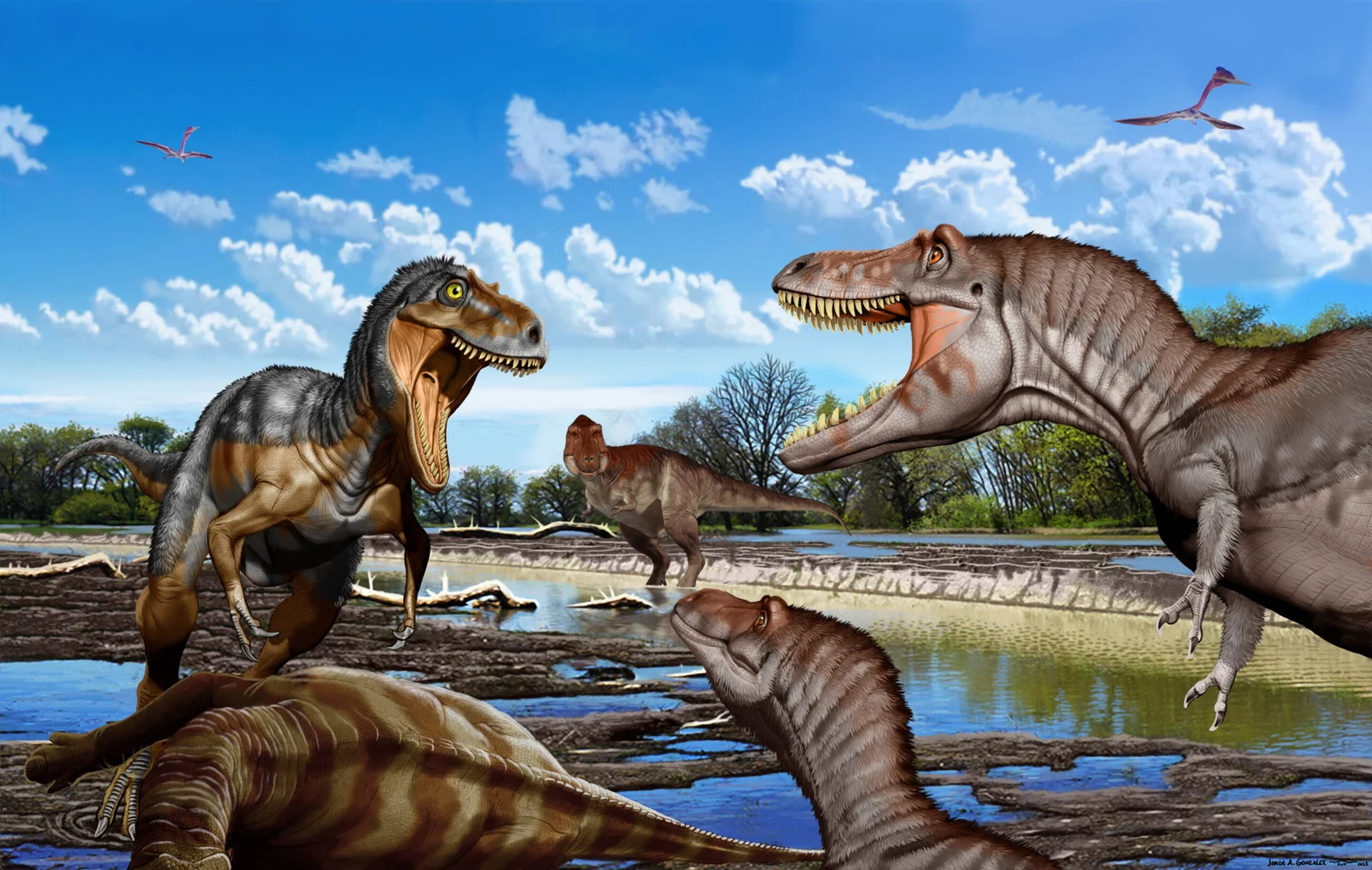
The discovery paints a richer, more complex image of Late Cretaceous ecosystems. Rather than a landscape dominated by a single apex predator, the new findings suggest multiple tyrannosaur species shared the terrain, hunting and competing with one another. Nanotyrannus, though smaller, appears to have been a fully fledged predator that coexisted alongside juvenile T. rex in a dynamic and diverse environment.
“It is remarkable that our study matches findings from other independent lines of evidence, including an analysis published last month, demonstrating that multiple species of tyrannosaurs lived alongside one another. It shows that we need to re-evaluate what we think these ecosystems looked like,” said Dr. Morris.
The research also highlights how museum collections continue to shape scientific discovery. Dr. Nate Smith, Gretchen Augustyn Director and Curator of the Dinosaur Institute, praised the work.
“Zach’s expertise in dinosaur growth and development, coupled with his histological skills, was a huge asset to this project. It’s another example of our NHMLAC Post-Docs conducting novel, ground-breaking research,” he said. “This study also highlights the incredible potential of unique museum collections like our T. rex growth series, which not only inform the public but also provide rich ground for new scientific discoveries.”
Why This Discovery Matters
The findings do more than settle a long-running scientific argument. They reveal how studying growth and development can unlock hidden chapters of evolutionary history. They remind us that fossils are not static relics but dynamic records of life, capable of revealing how animals lived, aged, and interacted.
By proving that Nanotyrannus was a distinct, nearly fully grown species, the researchers opened a new window into ancient ecosystems and demonstrated the power of combining innovative techniques with museum collections. They also introduced a valuable new method for analyzing fossil maturity, one that may illuminate the lives of species where traditional bones are missing.
Most importantly, the study shows that even the smallest bones can change the biggest stories—reshaping our understanding of predators that once thundered across ancient North America and reminding us that the past still has secrets waiting to be uncovered.
More information: Christopher T. Griffin, A diminutive tyrannosaur lived alongside Tyrannosaurus rex, Science (2025). DOI: 10.1126/science.adx8706
www.science.org/doi/10.1126/science.adx8706