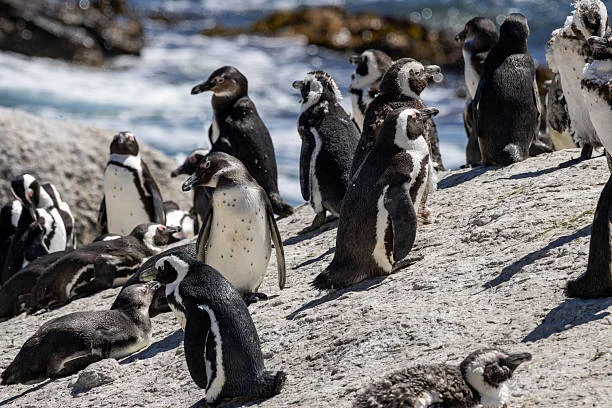
Along the rough, wind-cut coast of South Africa, the annual molt of the African penguin begins as it always has. Feathers loosen, colors fade, and the birds gather on land, waiting for new plumage to grow. For about twenty-one days, they cannot swim. They cannot hunt. They simply endure. In the past, this was a quiet ritual of renewal. But in the early 2000s, something shifted. The food the penguins depended on had begun to vanish, and the ancient rhythm of molt collided with a modern ecological crisis.
The new study published in Ostrich Journal of African Ornithology uncovers how deeply this collision cut into two of the most important penguin colonies on Earth: Dassen Island and Robben Island. What the researchers found was not a slow decline but a catastrophic unraveling. Some ninety-five percent of the birds that bred in 2004 were estimated to have died within eight years, a collapse driven by the starkest force a wild animal can face. Starvation.
“Between 2004 and 2011, the sardine stock off west South Africa was consistently below 25% of its peak abundance and this appears to have caused severe food shortage for African penguins, leading to an estimated loss of about 62,000 breeding individuals,” says co-author Dr. Richard Sherley.
When Fat Reserves Become a Matter of Life and Death
To understand why the food shortage was so devastating, the researchers turned to the molt itself. African penguins rely on this period of enforced fasting to replace their insulation and waterproofing. But because they cannot swim while molting, they must prepare by eating enough beforehand to build thick stores of fat. Only then can they survive the three-week ordeal.
“They are evolved to build up fat and then to fast while their body metabolizes those reserves, and the protein in their muscles, to get them through molt,” explains Dr. Sherley. “They then need to be able to regain body condition rapidly afterwards. So, essentially, if food is too hard to find before they molt or immediately afterwards, they will have insufficient reserves to survive the fast.”
This is exactly the trap the birds fell into. Sardines, their primary food source, had dwindled so dramatically that penguins were entering molt weak and emerging weaker. Many never emerged at all.
A Coastline Transformed by Shifting Seas
The collapse of sardine numbers did not happen in isolation. South Africa’s west and south coasts have been reshaped by changes in ocean temperature and salinity—subtle, invisible processes that ripple through entire ecosystems. As Dr. Sherley notes, “Changes in the temperature and salinity of the spawning areas off the west and south coasts of South Africa made spawning in the historically important west coast spawning areas less successful and spawning off the south coast more successful.”
But even as sardines shifted their spawning grounds, the fishing industry did not. “Due to the historical structures of the industry, most fishing remained to the west of Cape Agulhas,” Sherley says. The result was extreme pressure on a declining resource. In 2006, exploitation rates briefly reached eighty percent. When an already diminished population faces such intense harvest, the effect is devastating.
Counting Feathers, Tracing Ghosts
To capture the scope of this devastation, the research team relied on twenty years of detailed monitoring. They examined counts of breeding pairs and molting adults on Dassen and Robben islands from 1995 to 2015. These islands once supported around 25,000 breeding pairs on Dassen and around 9,000 on Robben—colonies so large they seemed unshakeable.
“These two sites are two of the most important breeding colonies historically,” says co-author Dr. Azwianewi Makhado.
But by analyzing survival rates using capture-mark-recapture data and comparing those rates with a prey availability index, the team saw a pattern that could no longer be ignored. “Adult survival, principally through the crucial annual molt, was strongly related to prey availability,” Sherley says. Where sardines vanished, penguins followed.
A Broader Silence Across Southern Seas
The crisis was not limited to these two islands. “These declines are mirrored elsewhere,” Sherley adds. Across southern Africa, the species has suffered a global decline of nearly eighty percent in thirty years. To trace the availability of prey across regions, the team relied on an index developed from the diet of the Cape gannet, a bird known for its sweeping foraging range. “Cape gannet diet is thought to be a good ‘sampler’ of the availability of sardine and anchovy because they are the most wide-ranging of the seabirds in Southern Africa that feed on these species,” explains Dr. Makhado.
This index confirmed what the penguins’ bodies had already revealed. The food web itself had thinned.
Searching for Hope in a Changed Ocean
Rebuilding penguin populations is possible, but not simple. “However, there are measures we could take,” Sherley says. Fisheries management could lower sardine exploitation when biomass falls below twenty-five percent of its maximum. Reducing mortality among juvenile sardines might also help, he says, though “this is debated by some parties.”
Meanwhile, conservationists are working to shield penguins more directly. Artificial nests help protect chicks from exposure and predation. Rescue and rehabilitation programs give weakened birds a second chance. Recently, commercial purse-seine fishing has been prohibited around the six largest breeding colonies in South Africa, a move Dr. Makhado says “is hoped to increase access to prey for penguins at critical parts of their life cycle, such as during chick rearing and pre- and post-molt.”
Monitoring continues, tracking breeding success, chick condition, foraging behavior, population trajectory, and adult survival. Each new data point carries both weight and hope.
“We hope that the recent conservation interventions put in place, together with reduced exploitation rates of sardine when its abundance is less than the 25% of maximum threshold, will begin to arrest the decline and that the species will show some signs of recovery,” Sherley concludes.
Why This Research Matters
The story of these penguins is more than a regional concern. It is a vivid demonstration of how quickly a species can collapse when environmental change intersects with human pressure. It shows that even well-adapted animals can be overwhelmed when the rhythms they depend on are disrupted.
But it also shows something else. By carefully tracing the ties between ocean conditions, fish populations, and penguin survival, scientists can pinpoint the moments where intervention matters most. The fate of the African penguin now rests on choices made by fisheries managers, conservationists, and policymakers. With accurate science and timely action, starvation need not define the future of one of the world’s most iconic seabirds.
More information: High adult mortality of African Penguins Spheniscus demersus in South Africa after 2004 was likely caused by starvation, Ostrich: Journal of African Ornithology (2025). DOI: 10.2989/00306525.2025.2568382