In the crystal-clear depths of Lake Tanganyika, one of East Africa’s most ancient and diverse aquatic environments, a silent communication is unfolding. Here, among the rocky crevices and sandy floors, the Emperor cichlid reigns as one of the largest and most formidable members of its biological family. To a casual observer, these fish might appear to be simply drifting, but a new study published in the journal Royal Society Open Science reveals that they are actually performing complex social calculations. These fish are watching us, and more importantly, they are watching where we look.
The story of this discovery begins with a fundamental question of survival: how does an animal know when it is being targeted? In many animal societies, the direction of a gaze acts as a silent alarm system. If a bird or a primate notices a predator’s eyes locked onto them, they can alert their peers without making a sound. While this ability to sense where another creature is looking—a skill known as sensitivity to gaze—has been documented extensively in mammals and birds, the underwater world has remained a mystery. Researchers from Japan decided to plunge into the waters of the Great Rift Valley to see if fish, too, could read the intentions hidden behind a pair of eyes.
The Silent Language of the Deep
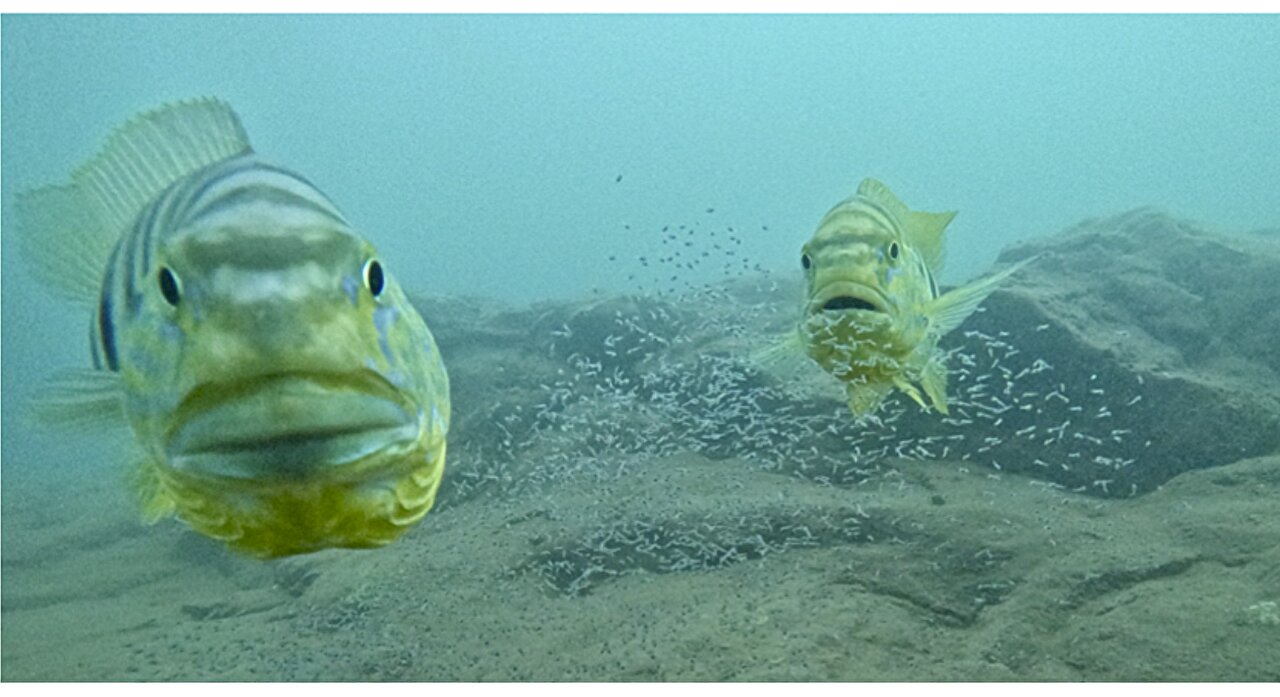
To understand the minds of these aquatic parents, the scientific team focused on breeding pairs of Emperor cichlids. These fish are renowned for their size and their fiercely protective nature when it comes to their offspring. The researchers designed a series of underwater experiments that functioned like a high-stakes game of “stare-down.” Armed with underwater cameras, the scientists observed how these parents reacted to the presence of scuba divers in their territory.
The experiment was built around four distinct scenarios to test the limits of the fish’s perception. In the first setup, a solo diver would swim near the nest and look directly at the eggs or the fry—the tiny, vulnerable babies. In the second, the diver stayed nearby but intentionally looked away from the nest. The third scenario involved the diver turning their body away from the nest entirely, even though their fins remained pointed toward the family. Finally, the diver would ignore the nest altogether and stare directly at the guarding parents. By rotating three different divers through these roles, the team ensured the fish were reacting to the behavior itself rather than a specific person.
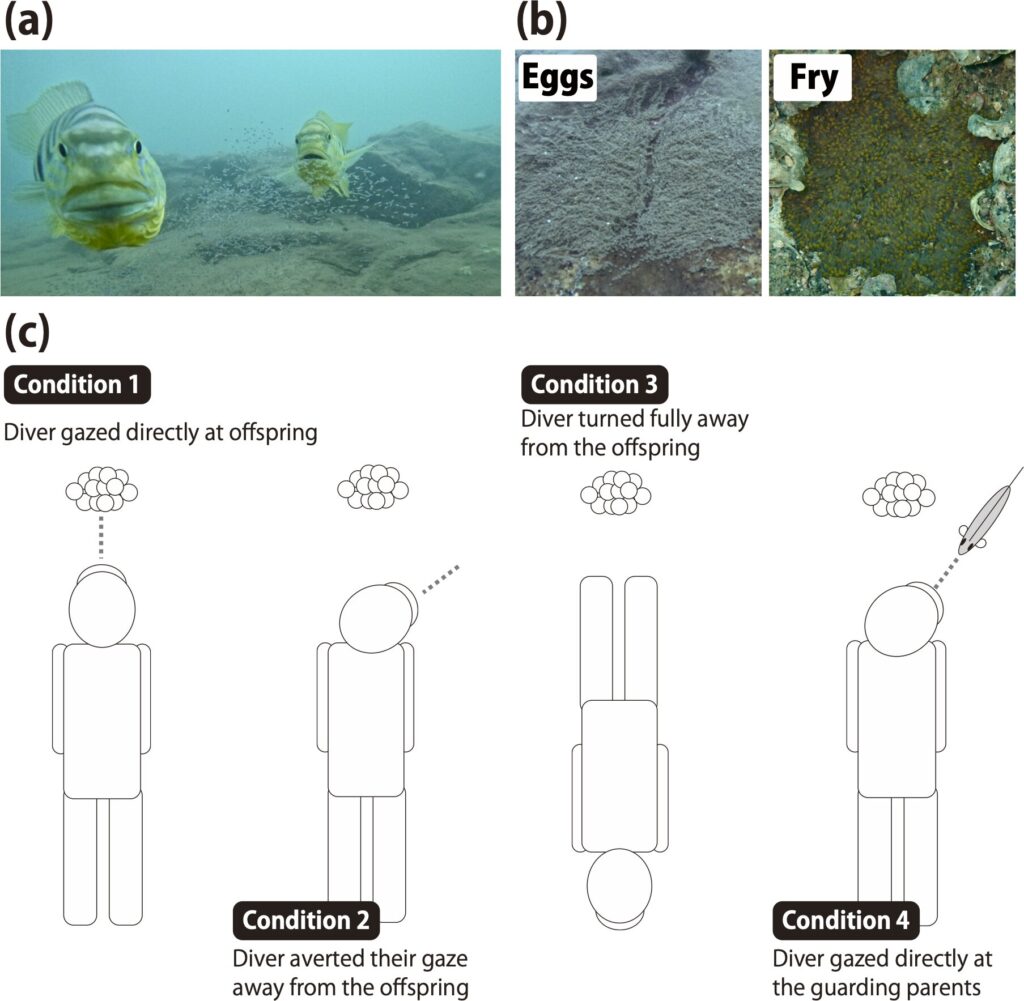
What they found was a sophisticated level of awareness. The Emperor cichlids didn’t just react to the presence of a large intruder; they reacted to the intruder’s focus. The cameras captured a significant spike in aggressive response whenever a diver’s eyes were fixed on the offspring. It wasn’t just about how close the diver was, but where their attention was aimed. If the diver looked away, the parents remained relatively calm. But the moment those eyes drifted toward the nest, the fish prepared for battle.
Reading the Mind of a Predator
This behavior suggests that Emperor cichlids possess a cognitive ability far beyond what many people attribute to fish. The researchers describe this as attention attribution. This is the capacity for one individual to infer exactly where another individual’s focus is directed. When the diver stared at the eggs or the fry, the parent fish seemed to perceive a direct threat to their lineage. Interestingly, the levels of aggression were remarkably similar whether the diver stared at the offspring or at the parents themselves. To the cichlid, a direct gaze is a clear signal of intent, a precursor to an attack that demands a defensive strike.
The parent fish attacked the divers significantly more often when their gaze was locked on the nest compared to when the divers were looking elsewhere or had their bodies turned away. This distinction is crucial because it proves the fish aren’t just reacting to a large shape in the water. They are interpreting the “why” behind the diver’s presence. By distinguishing between a passerby who is looking at the scenery and a predator who is “locking on” to a target, the Emperor cichlids save their energy for the threats that matter most.
Why the Gaze of a Stranger Matters
This research does more than just highlight the hidden intelligence of fish; it serves as a vital warning for how humans interact with the natural world. As scuba diving grows in popularity as a form of marine ecotourism, more people than ever are entering the private homes of these aquatic species. While we often think of our impact in terms of physical damage—like stepping on coral or polluting the water—this study suggests that our mere presence and the way we observe animals can cause significant stress effects.
If a simple look can trigger a defensive attack, it means that well-meaning tourists might be inadvertently exhausting parent fish, forcing them to spend precious energy on defense rather than nurturing their young. The researchers argue that this psychological impact, often referred to as habitat degradation of a different kind, must be evaluated alongside physical environmental damage.
Ultimately, this study reshapes our understanding of the underwater social web. It reminds us that when we look into the water, the inhabitants are looking back, reading our eyes, and judging our intentions. Understanding the flexible cognitive process of these fish allows us to become more empathetic observers, ensuring that our curiosity doesn’t become a burden to the families living beneath the waves.
Study Details
Shun Satoh et al, Watching the watchers: emperor cichlids can perceive attention towards their offspring by divers, Royal Society Open Science (2026). DOI: 10.1098/rsos.251919