On the sun-drenched islands of Hawaii, a persistent and colorful enemy washes up with every tide. It isn’t just the household trash of the residents that clutters the pristine sands, but a relentless influx of derelict fishing gear drifting in from the wider Pacific. For years, the state has grappled with an intensifying plastic problem, facing steep economic and logistical hurdles in trying to recycle waste that often has nowhere to go but overflowing landfills or massive incinerators. However, a group of researchers has begun looking at the very ground beneath their feet for a solution, reimagining the islands’ roads not just as transit routes, but as a final, productive destination for the region’s garbage.
A Heavy Burden from the Deep
The scale of the debris is staggering. While local residential plastic contributes to the pile, the most significant offender in the Hawaiian marine environment is foreign derelict fishing nets. These ghost nets entangle wildlife and choke the ecosystem, presenting a challenge so large it required a dedicated response. To combat this, the Center for Marine Debris Research (CMDR) at Hawaiʻi Pacific University launched the Bounty Project. This initiative provides a financial reward to licensed commercial fishers who remove marine debris from the water. So far, the project has successfully hauled 84 tons of large-scale fishing gear out of the Pacific Ocean.
While removing the nets is a victory, it creates a new dilemma: what do you do with tons of salt-crusty, degraded plastic? Transporting this waste away from the islands is environmentally costly and expensive. Jeremy Axworthy, a researcher at the CMDR, notes that the goal of their current investigation is to determine if it is truly responsible and viable to keep this plastic in Hawaii by turning it into infrastructure. By finding a local use for the waste, the team hopes to bypass the need for dumping or burning, creating a circular life cycle for materials that would otherwise haunt the environment for centuries.
The Secret Ingredient in the Asphalt
The science of modern road building in Hawaii is already quite sophisticated. Since 2020, the state has moved away from standard asphalt in favor of polymer-modified asphalt (PMA). This material is designed to withstand the rigors of a tropical climate, offering high elasticity and resistance to the rutting, cracking, and water damage caused by heat and heavy rains. Traditionally, this high-performance binder is created by melting pellets of a copolymer called styrene-butadiene-styrene (SBS) into a sticky, petroleum-based substance, which is then tumbled with aggregates like sand and rocks until every stone is coated.
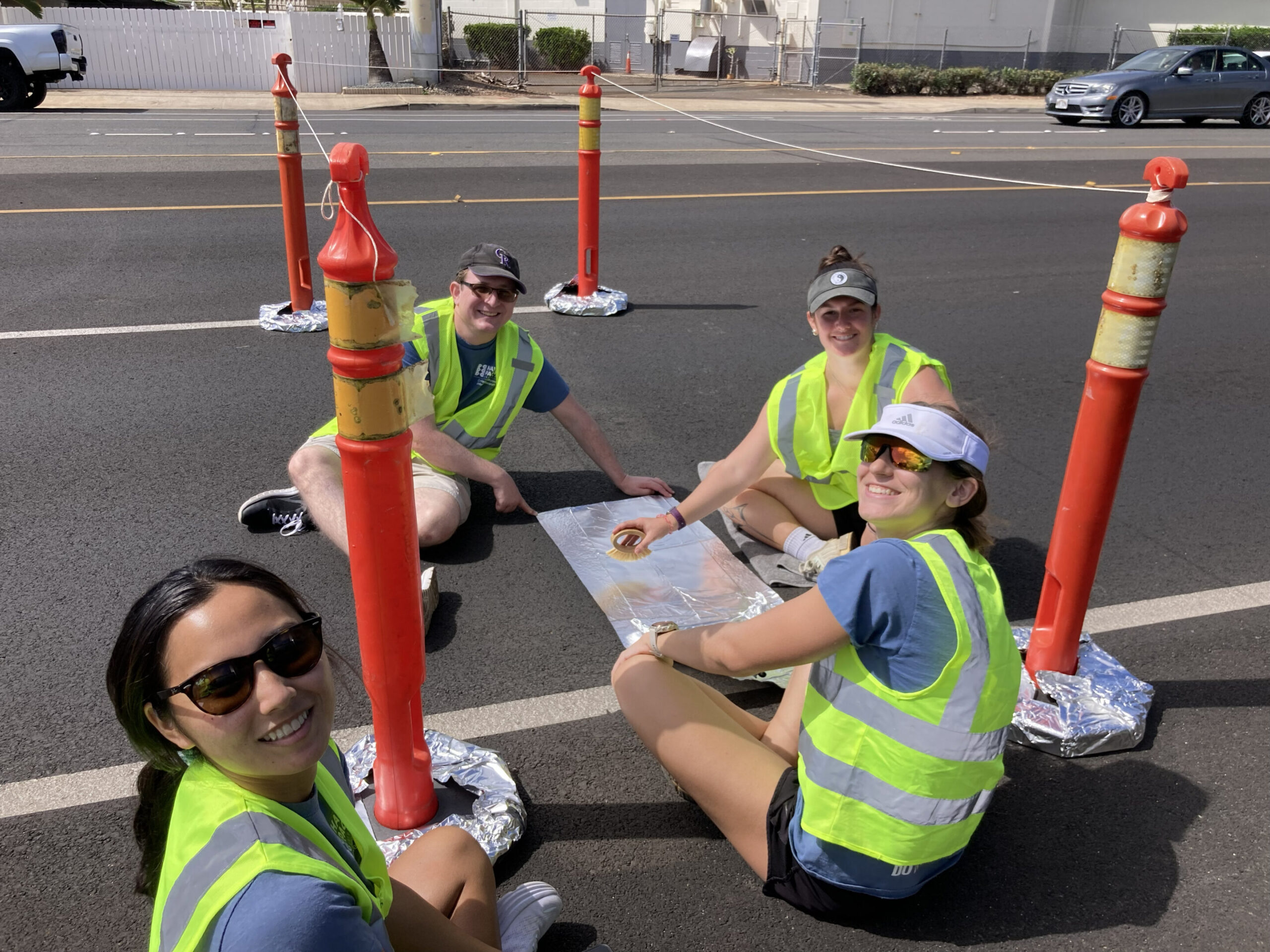
The researchers, led by environmental chemist Jennifer Lynch, wondered if the SBS pellets could be replaced—or at least supplemented—with recycled plastics. The Hawaii Department of Transportation (HDOT) commissioned the team to test this theory using two specific sources: repurposed polyethylene from Honolulu’s residential recycling bins and the polyethylene harvested from recovered fishing nets. After a U.S.-based company processed these waste streams into usable forms, a local paving company took the experimental mixtures to the streets of Oahu. They laid down sections of a residential road, creating a side-by-side comparison of standard asphalt versus the new, plastic-infused varieties.
Searching for Microscopic Evidence
One of the primary concerns with using recycled plastic in infrastructure is the fear of “shedding.” If the road wears down, does it release microplastics into the soil and storm drains? To answer this, the team waited for eleven months, allowing the experimental road sections to endure nearly a year of regular traffic. Then, they returned to collect samples of road dust and simulated stormwater to see what the tires and elements had knocked loose.
Analyzing road dust is a complex task because it is a chaotic mixture of minerals and chemicals. The researchers used a sophisticated technique called pyrolysis gas chromatography-mass spectrometry (Py-GC-MS). This process involves heating samples to break them down into fragments that can be identified and measured. They were looking for specific chemical signatures: styrene and butadiene from the standard roads, and polyethylene from the recycled plastic sections. They also looked for isoprene and butadiene rubber, which are the tell-tale signs of tire wear.
The results were surprising and encouraging. The initial data showed that the pavements made with recycled plastic did not release more polymers than the traditional control pavement. While they did find microplastic-sized particles, very few of them were identified as pure polyethylene. This is likely because the plastic doesn’t remain as distinct “beads” in the road; instead, it melts into the asphalt binder. When the road wears down, the particles that break off are a fused mixture of rock, binder, and polymer chains, rather than raw plastic fragments.
The Giant Signal in the Weeds
Perhaps the most striking discovery made during the chemical analysis was the sheer volume of material coming from an unexpected source. When the scientists looked at the graphs produced by the Py-GC-MS, they didn’t see a massive surge of road-plastic pollution. Instead, the signal from tire wear was so enormous that it “swamped” the signatures of the polyethylene. Jennifer Lynch described the tire rubber data as “gigantic peaks” on the charts, forcing the researchers to search through the “weeds” of the data just to find the faint traces of the plastic used to pave the road.
This finding puts the environmental impact of plastic-modified roads into a new perspective. Compared to the constant shedding of rubber from every car tire that passes over the surface, the amount of plastic escaping from the asphalt itself is minimal. While the team acknowledges that more research is needed to judge the long-term durability of these roads over many years, the early demonstrations suggest that recycled polyethylene is a stable and effective ingredient for Hawaiian infrastructure.
Why This Paving Strategy Matters
This research represents a shift in how society views the lifecycle of waste. It moves beyond the idea of recycling as a simple “bin-to-bottle” process and explores how heavy industry can absorb the most difficult-to-manage pollutants. For Hawaii, the success of this project would mean a significant reduction in the environmental footprint of waste management. Instead of fishing nets being an endless burden on the ocean and the budget, they become a local resource that strengthens the very roads used to transport them.
Ultimately, this work challenges the growing cynicism regarding the feasibility of recycling. By prioritizing sustainability and using state-of-the-art chemical instrumentation to prove safety, the researchers are showing that even the most damaged marine debris can have a second life. If these “trash-paved” roads prove to be as durable as their traditional counterparts, they will offer a blueprint for island nations and coastal communities worldwide to turn a tide of plastic waste into a foundation for the future.