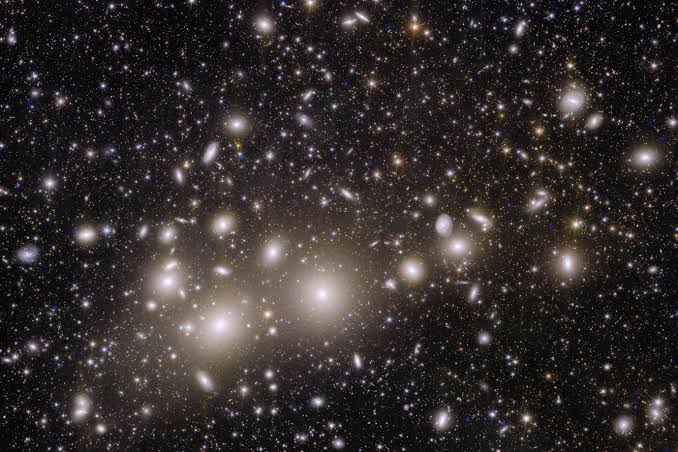
The night sky looks calm, even eternal. Stars seem fixed, galaxies appear serene, and the vast darkness between them gives little hint of motion. Yet beneath this stillness lies one of the most dramatic stories ever uncovered by science: the universe is not static. It is changing, stretching, and evolving on the grandest scales imaginable. For nearly a century, physicists and astronomers have wrestled with a central question that continues to reshape our understanding of reality itself. Is the universe expanding forever, driven apart by a mysterious repulsive force, or is it part of a deeper cosmic rhythm, collapsing and rebounding in a grand bounce that replaces the notion of a singular beginning?
This question is not merely technical. It touches the origin of time, the fate of all matter, and the ultimate meaning of cosmic history. At its heart lies a tension between gravity, which pulls matter together, and a poorly understood repulsive influence that seems to be pushing the universe apart. This cosmic struggle, sometimes described as the “Great Repulse,” challenges our most cherished ideas about space, time, and the beginning of everything.
The Discovery That Shattered a Static Universe
For much of human history, the universe was assumed to be eternal and unchanging. Ancient cosmologies often imagined a cosmos that existed forever, governed by cycles or divine order. Even when modern physics began to take shape, the idea of a static universe remained deeply attractive. Albert Einstein himself initially believed that the universe neither expanded nor contracted. When his equations of general relativity suggested otherwise, he introduced a mathematical modification to keep the cosmos balanced and still.
This illusion of cosmic stability shattered in the early twentieth century, when astronomers began to measure the light from distant galaxies with unprecedented precision. They discovered that this light was systematically shifted toward longer, redder wavelengths. The farther away a galaxy was, the stronger this redshift appeared. The simplest and most profound interpretation was that space itself was expanding, stretching the light as it traveled across the cosmos.
This discovery transformed cosmology from philosophical speculation into a rigorous physical science. The universe was not a static stage on which events unfolded; it was an active participant in its own history, growing and changing over time. Expansion became the central fact around which all modern cosmological theories revolve.
The Big Bang and the Expanding Cosmos
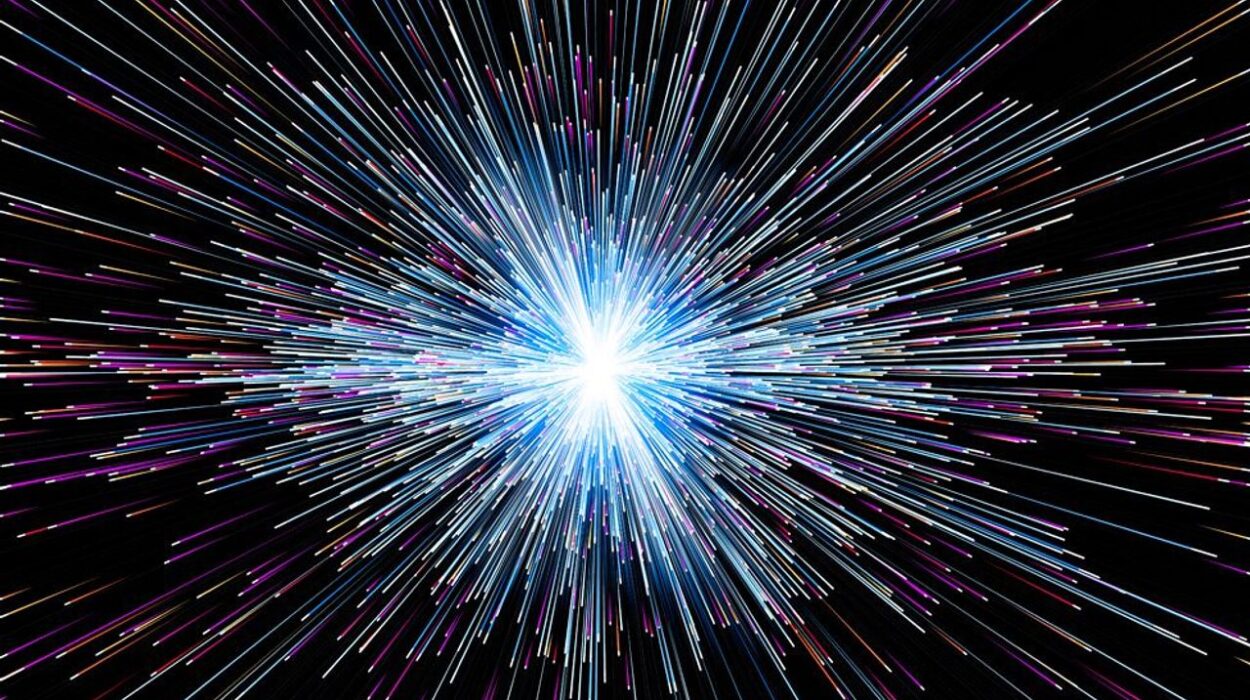
The realization that the universe is expanding led naturally to a startling conclusion. If space is growing today, then it must have been smaller in the past. Tracing this expansion backward in time suggests that the universe emerged from an extremely hot, dense state. This idea became known as the Big Bang, not as an explosion in space, but as an expansion of space itself.
The Big Bang theory gained strong support from multiple lines of evidence. The cosmic microwave background radiation, a faint glow permeating all of space, revealed the universe as it was when it was only a few hundred thousand years old. The observed abundances of light elements such as hydrogen and helium matched predictions made by models of an early, hot universe. Together, these observations painted a compelling picture of a cosmos that began in a state of extraordinary density and temperature.
Yet the Big Bang also raised uncomfortable questions. When physicists traced the equations all the way back, they encountered a singularity, a point at which density and curvature become infinite and the laws of physics break down. This singularity was not merely a technical inconvenience; it signaled a profound gap in our understanding. Did time itself begin at this moment, or was the singularity a sign that our theories were incomplete?
Gravity, Attraction, and the Expectation of Collapse
Gravity is the most familiar force shaping the large-scale universe. It pulls matter together, forms stars and galaxies, and governs the motion of planets. In a universe filled with matter and energy, gravity was long expected to slow the expansion and perhaps reverse it entirely. Many early cosmological models envisioned a cosmos that would expand for a time, then reach a maximum size, and finally collapse back into a “Big Crunch.”
This idea had an intuitive appeal. Gravity seemed irresistible on cosmic scales, and it was natural to imagine that the universe might be bound by its own mass. Whether the universe would expand forever or eventually collapse depended on a delicate balance between the rate of expansion and the total amount of matter and energy it contained.
For decades, astronomers attempted to measure this cosmic balance. They weighed galaxies, mapped clusters, and searched for hidden matter that might tip the scales toward eventual collapse. The fate of the universe appeared to be an open question, awaiting better data and deeper insight.
The Shocking Discovery of Cosmic Acceleration
In the late twentieth century, a new and unexpected discovery overturned these expectations. Observations of distant exploding stars revealed that the expansion of the universe is not slowing down. It is speeding up. Rather than being pulled back by gravity, galaxies are being driven apart at an ever-increasing rate.
This acceleration implied the presence of a repulsive influence permeating space itself. Something was acting against gravity on the largest scales, pushing the universe outward. This phenomenon was named dark energy, a term that reflects both its profound importance and our deep ignorance of its nature.
The discovery of cosmic acceleration was one of the most startling in modern science. It forced physicists to reconsider fundamental assumptions about gravity, energy, and the structure of spacetime. The universe, it seemed, was dominated not by attraction, but by repulsion.
Dark Energy and the Nature of the Great Repulse
Dark energy is often described as a property of empty space. Unlike matter or radiation, it does not clump or dilute as the universe expands. Instead, its energy density remains approximately constant, meaning that as space grows, the total amount of dark energy increases. This leads to a runaway effect in which expansion accelerates over time.
One way to understand this behavior is through Einstein’s equations of general relativity, which relate the geometry of spacetime to its energy content. Certain forms of energy produce not attraction but repulsion, causing spacetime to curve in a way that drives expansion. Einstein’s original modification to his equations, once dismissed as unnecessary, reemerged as a potential explanation for dark energy.
Yet dark energy remains deeply mysterious. It could be a constant feature of spacetime, known as the cosmological constant, or it could arise from a dynamic field that evolves over time. Each possibility carries profound implications for the fate of the universe and for the ultimate question of whether expansion is eternal or reversible.
The Fate of an Ever-Expanding Universe
If dark energy remains dominant and unchanged, the universe will continue to expand forever. Galaxies will drift farther apart, stars will exhaust their fuel, and the cosmos will grow increasingly cold and empty. This scenario, sometimes called the heat death of the universe, represents a slow fading rather than a dramatic end.
In such a future, the Great Repulse would triumph completely over gravity. Structures bound by gravity, such as galaxies and solar systems, would remain intact for vast periods of time, but beyond those scales, space itself would stretch relentlessly. Eventually, even the most distant galaxies would slip beyond the observable horizon, leaving each remaining island of matter isolated in an ever-darkening universe.
This vision of eternal expansion is scientifically plausible and consistent with current observations. Yet it is not the only possibility, nor does it fully resolve the deeper questions raised by the beginning of cosmic history.
Questioning the Singularity: Is the Big Bang the Beginning?
The concept of a singular beginning is deeply unsettling to many physicists. Singularities signal a breakdown of known laws, a point where predictions become impossible. In other areas of physics, such breakdowns usually indicate that a more complete theory is needed.
This realization has motivated alternative models of cosmic origins, including those that replace the Big Bang singularity with a bounce. In a bouncing universe, the cosmos undergoes a phase of contraction before reaching a minimum size, after which it begins to expand again. The Big Bang, in this view, is not the beginning of everything, but a transition from contraction to expansion.
Such models offer a way to avoid the singularity and extend cosmic history beyond what is traditionally considered the beginning of time. They suggest that the universe may be far older than the observable expansion alone would indicate, with cycles or phases that precede our current era.
The Physics of a Bouncing Universe
For a bounce to occur, gravity alone is not enough. In classical general relativity, a contracting universe filled with ordinary matter tends to collapse into a singularity. To reverse this collapse, some form of repulsive effect must become dominant at high densities.
Various theoretical approaches have proposed mechanisms for such a repulsion. Some rely on modifications of gravity itself, suggesting that Einstein’s equations are incomplete under extreme conditions. Others invoke exotic forms of matter or quantum effects that become significant near the point of maximum compression.
In these models, the same fundamental idea appears again and again: under certain conditions, the universe resists infinite collapse. The Great Repulse, rather than being a late-time phenomenon associated with dark energy, may also play a role at the earliest moments of cosmic evolution.
Quantum Gravity and the Promise of a Cosmic Bounce
The deepest attempts to understand a bouncing universe come from efforts to unite general relativity with quantum mechanics. At very small scales and extremely high energies, quantum effects are expected to alter the behavior of spacetime itself. This yet-to-be-completed theory of quantum gravity may hold the key to resolving cosmological singularities.
Some approaches to quantum gravity suggest that space and time are fundamentally discrete rather than continuous. In such frameworks, there may be a minimum possible volume of space, preventing the universe from collapsing to a point of infinite density. As contraction proceeds, quantum effects generate a repulsive pressure that halts collapse and initiates expansion.
In this picture, the Big Bang becomes a Big Bounce, a moment of transition rather than creation. Time extends smoothly through the bounce, and the universe carries information from its pre-bounce phase into the expanding era we observe today.
Observational Clues and the Limits of Evidence
A crucial question is whether bouncing models make predictions that can be tested. Cosmology is an observational science, and any viable theory must ultimately confront data. Researchers have explored whether traces of a pre-bounce universe might be imprinted in the cosmic microwave background or in the distribution of galaxies.
So far, no definitive evidence has emerged that requires a bouncing origin. The standard expanding model, with an early hot phase, remains consistent with observations. Yet the absence of evidence is not evidence of absence. The earliest moments of the universe are shrouded by extreme conditions that challenge observation and interpretation.
Future experiments, including more precise measurements of cosmic radiation and gravitational waves, may provide new windows into the universe’s earliest history. These observations could potentially distinguish between a true beginning and a bounce.
Expansion, Bouncing, and the Arrow of Time
One of the most profound aspects of cosmology is its connection to the arrow of time. The universe we observe evolves from a more ordered state to a more disordered one, a trend associated with the increase of entropy. This directionality gives time its apparent flow from past to future.
In an eternally expanding universe, the arrow of time aligns naturally with cosmic expansion. In a bouncing universe, however, the situation becomes more subtle. Does time reverse during contraction? Does entropy decrease before the bounce, or does it continue to increase through each cycle?
Different bouncing models address these questions in different ways. Some propose that each bounce resets certain conditions, while others suggest that entropy accumulates over cycles, making each expansion larger than the last. These issues are not merely technical; they touch the deepest connections between cosmology, thermodynamics, and the nature of time itself.
Philosophical Implications of Expansion and Bounce
The question of whether the universe is expanding forever or bouncing has philosophical as well as scientific implications. An eternal expansion suggests a universe with a definite beginning but no meaningful end, a cosmos that gradually fades into emptiness. A bouncing universe, by contrast, hints at cyclicality or continuity beyond apparent beginnings.
For some thinkers, the idea of a bounce is appealing because it removes the need for an absolute origin. It suggests that existence does not emerge from nothing, but evolves through transformations. Others argue that even a bouncing universe may require initial conditions that demand explanation, merely shifting the mystery rather than resolving it.
Physics does not answer these philosophical questions directly, but it frames them in precise terms. By exploring the mathematical and observational consequences of different models, physics narrows the range of plausible narratives about cosmic history.
The Great Repulse as a Unifying Theme
Whether in the form of dark energy driving acceleration today or quantum effects preventing collapse in the past, the idea of a cosmic repulsion has emerged as a unifying theme in modern cosmology. It challenges the long-held assumption that gravity’s pull dominates the universe at all times.
This Great Repulse forces physicists to rethink the balance of forces shaping spacetime. It suggests that emptiness itself may have structure and power, capable of influencing the fate of everything within it. The realization that space can push as well as pull is one of the most profound conceptual shifts in the history of physics.
The Open Question at the Heart of the Cosmos
Despite remarkable progress, the ultimate fate and origin of the universe remain open questions. Current observations strongly support ongoing expansion driven by dark energy, yet the fundamental nature of this energy is unknown. Bouncing models offer elegant solutions to theoretical problems, but they await decisive empirical support.
The tension between expansion and bounce reflects the frontier of cosmological research. It is a reminder that even with sophisticated instruments and powerful theories, the universe still holds secrets beyond our grasp. Each answer uncovers new questions, pushing the boundaries of understanding ever further.
Living in an Expanding, Questioning Universe
To contemplate whether the universe is expanding or bouncing is to confront our place in a vast and dynamic cosmos. We exist at a particular moment in cosmic history, able to look back billions of years through telescopes and forward through theoretical insight. The Great Repulse, whether it defines our future alone or also shaped our past, is a testament to the universe’s complexity and subtlety.
Physics does not promise certainty about the ultimate story of the cosmos. What it offers instead is a disciplined way of asking questions, testing ideas, and refining understanding. In that process, the universe reveals itself not as a simple machine, but as a rich and evolving reality.
The question of expansion versus bounce may one day be answered, or it may give rise to deeper questions that transcend the current framework of science. Either way, the pursuit itself reflects the enduring human desire to understand where we come from, where we are going, and what forces shape the grand stage on which existence unfolds.