Seven thousand years ago, the soil of Central Germany was not just fertile. It was contested.
By the mid-6th millennium BC, a profound shift was underway. Newcomers—early Neolithic farmers—arrived on the rich loess soils, bringing with them a radically different way of life. They cultivated crops. They settled. They reshaped the land. In doing so, they displaced the long-established Mesolithic hunter–gatherers who had roamed these forests since the end of the last Ice Age.
At first glance, it sounds like a story of replacement. But archaeology rarely tells stories that are so simple.
Now, at the Neolithic settlement of Eilsleben in Saxony-Anhalt, researchers from the State Office for Heritage Management and Archaeology Saxony-Anhalt have uncovered evidence that complicates this narrative. Their findings, recently published in Praehistorische Zeitschrift, suggest that after displacement came something more nuanced: contact, exchange, and perhaps even spiritual collaboration.
At the center of this story lies a single object—a worked roe deer antler that may once have crowned someone’s head.
A Landscape Transformed by Climate and Culture
To understand the significance of this antler, we must travel further back in time.
Around 9600 BC, the climate of Central Europe warmed significantly after the last Ice Age. Forests spread. Rivers settled into new rhythms. This was the dawn of the Mesolithic period, the Middle Stone Age. Its people hunted roe deer, red deer, European bison, and wild boar with bows and arrows. Fishing and plant gathering grew increasingly important as forests thickened.
One of the most remarkable figures from this era was buried near Bad Dürrenberg, in what is today the Saalekreis district. Approximately 9,000 years ago, a woman aged 30 to 40 was laid to rest in an elaborate grave alongside a child about six months old. She wore a headdress made from a roe deer antler, adorned with pendants of animal teeth.
Archaeologists interpret her as a shaman, a spiritual leader whose role bridged the human and spirit worlds. Her grave, displayed at the State Museum of Prehistory in Halle (Saale), is considered one of Central Europe’s most spectacular archaeological discoveries, rivaled only by iconic finds like the Nebra Sky Disk.
For millennia, her world belonged to hunter–gatherers.
Then came the farmers.
The Arrival of the Linear Pottery Culture
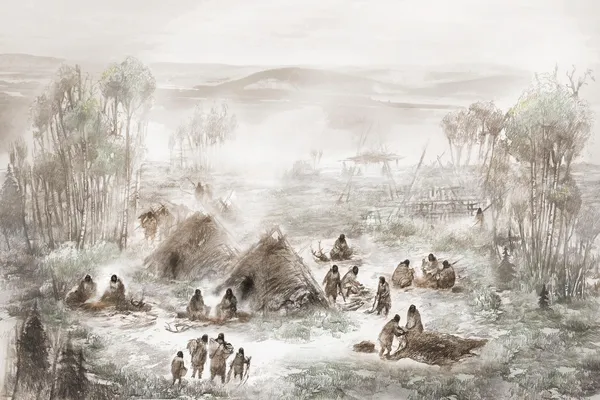
By the mid-6th millennium BC, groups associated with the Linear Pottery culture—genetically descended from populations of Anatolia and the Aegean—moved into Central Germany. These early farmers established permanent settlements, cultivated crops, and claimed the fertile loess soils.
At Eilsleben-Vosswelle, located about 2.5 kilometers southeast of Eilsleben on a gentle slope toward the Aller River, archaeologists uncovered a multi-phase settlement dating to this transformative period. First identified in the 1920s, the site underwent extensive excavations between 1974 and 1989 under Dieter Kaufmann.
What emerged was striking. The settlement appears to have been fortified with a rampart, ditch, and fence—a rare feature for even the earliest Linear Pottery communities. Its exposed position at the northern edge of the loess zone may have made defense necessary. This was, after all, a borderland between worlds.
But walls do not always mean isolation.
Stone and antler tools from Eilsleben show clear affinities to Mesolithic manufacturing techniques and tool forms. Even more intriguing was an object found in an otherwise unremarkable pit excavated in 1987—an object that carried echoes of the forest’s spiritual past.
The Antler in the Pit
The artifact was not immediately dramatic. It was the antler of a roe deer, approximately two to three years old at the time of death. But closer inspection revealed something extraordinary.
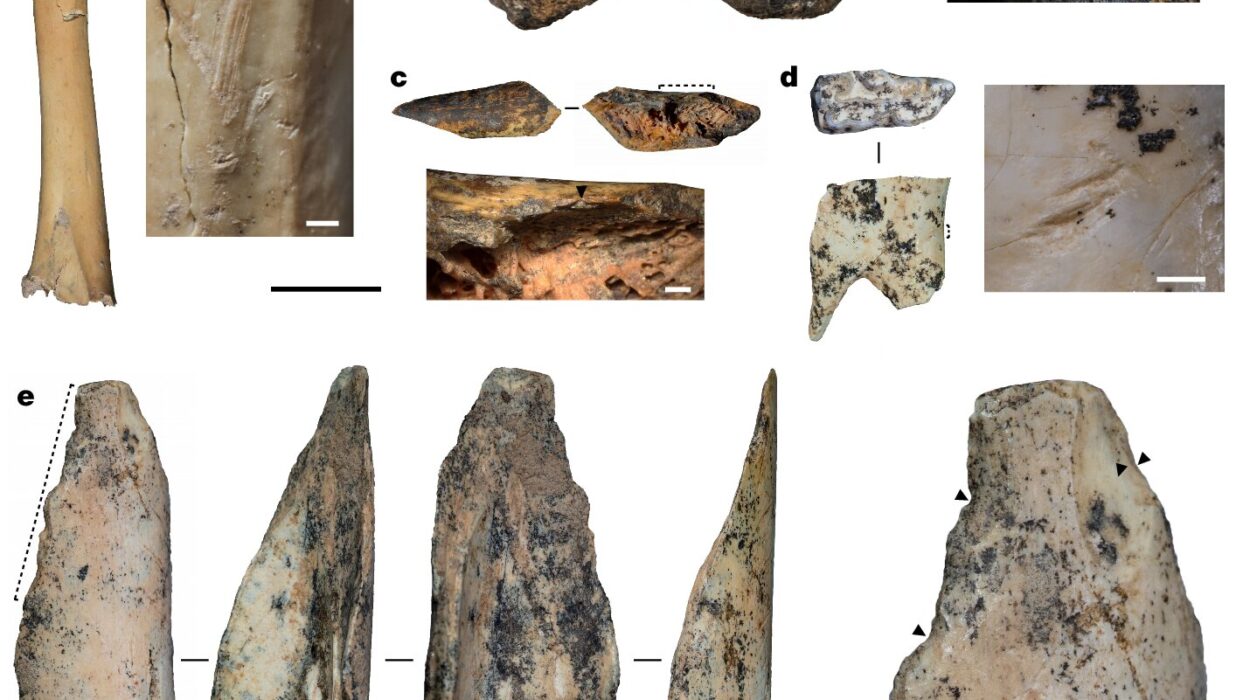
The skull fragment had been carefully worked into a rectangular shape. Cut marks suggested skinning. Near the base of the antler, notches had been carved on both sides—likely for fastening. These modifications indicated that the antler was once worn as a headdress or mask.
Radiocarbon dating placed it between 5291 and 5034 BC.
This was no ordinary hunting trophy.
Similarly worked antlers are unknown from the Neolithic period. Yet they are documented in Mesolithic contexts. Interpretations of these earlier finds range from camouflage for hunters to shamanic headgear. Almost all Mesolithic examples were made from red deer.
The roe deer antler from Eilsleben, however, has only one close parallel. And it lies in the grave of the shaman from Bad Dürrenberg.
The resemblance is striking.
When Worlds Overlapped
What does it mean that a Neolithic farming settlement yielded an object so closely aligned with Mesolithic ritual tradition?
Researchers suggest that the antler may represent evidence of direct contact between farmers and hunter–gatherer ritual specialists. The find hints that interaction went beyond trade in tools or materials. It may have extended into the spiritual realm.
The Neolithic way of life brought profound changes. Agriculture demanded labor-intensive activities like deforestation and field cultivation. Diets shifted toward regular consumption of starchy grains, which could contribute to dental problems. Close contact with domesticated animals introduced new viral and bacterial diseases. Competition over land increased the risk of violent conflict.
In such circumstances, the medical knowledge of early farmers may have been tested to its limits.
It is conceivable that they sought help beyond their own traditions.
Mesolithic shamans were not merely spiritual intermediaries. They likely possessed deep knowledge of the medicinal properties of local plants and the rhythms of the forest environment. Their expertise had developed over thousands of years of intimate engagement with the land.
The antler from Eilsleben may represent a moment when farmers turned to those they had displaced—not as enemies, but as healers.
A Borderland of Exchange
Eilsleben’s position at the edge of the loess zone makes this possibility even more compelling. It was a settlement in a forward position, perhaps even vulnerable. Its fortifications suggest caution. Yet its artifacts speak of connection.
Stone tools echo Mesolithic forms. Antler craftsmanship reflects forest traditions. And now, this roe deer headdress links a farming community to a spiritual lineage rooted in the hunter–gatherer world.
Contact between these groups has long been acknowledged, but direct evidence is rare. Archaeology often preserves fragments of daily life—pottery shards, tool debris, remnants of houses. Ritual objects, especially those that speak to relationships between cultures, are far less common.
That is why this single antler matters.
It embodies not only craftsmanship but encounter.
Why This Discovery Changes the Story
For generations, the transition from hunting and gathering to farming has been framed as a replacement narrative. Farmers arrived. Hunter–gatherers retreated. One way of life gave way to another.
The roe deer antler from Eilsleben suggests something more complex.
It hints at dialogue rather than silence. At collaboration rather than simple displacement. At a moment when communities navigating new challenges may have reached across cultural boundaries for knowledge and healing.
This matters because it humanizes prehistory. It reminds us that even in times of upheaval, people seek connection. They adapt. They borrow. They learn.
Seven thousand years ago, on a gentle slope near the Aller River, someone fastened a worked antler to their head. Whether farmer or forest healer, that person stood at the crossroads of two worlds.
And through a single artifact, we glimpse a truth that resonates across millennia: cultural change is rarely a clean break. More often, it is a conversation.
Study Details
Oliver Dietrich et al, Ritual encounters at the northern periphery of the early Neolithic world. A roe deer antler headdress from Eilsleben, Börde county, Saxony-Anhalt, Praehistorische Zeitschrift (2026). DOI: 10.1515/pz-2025-2030