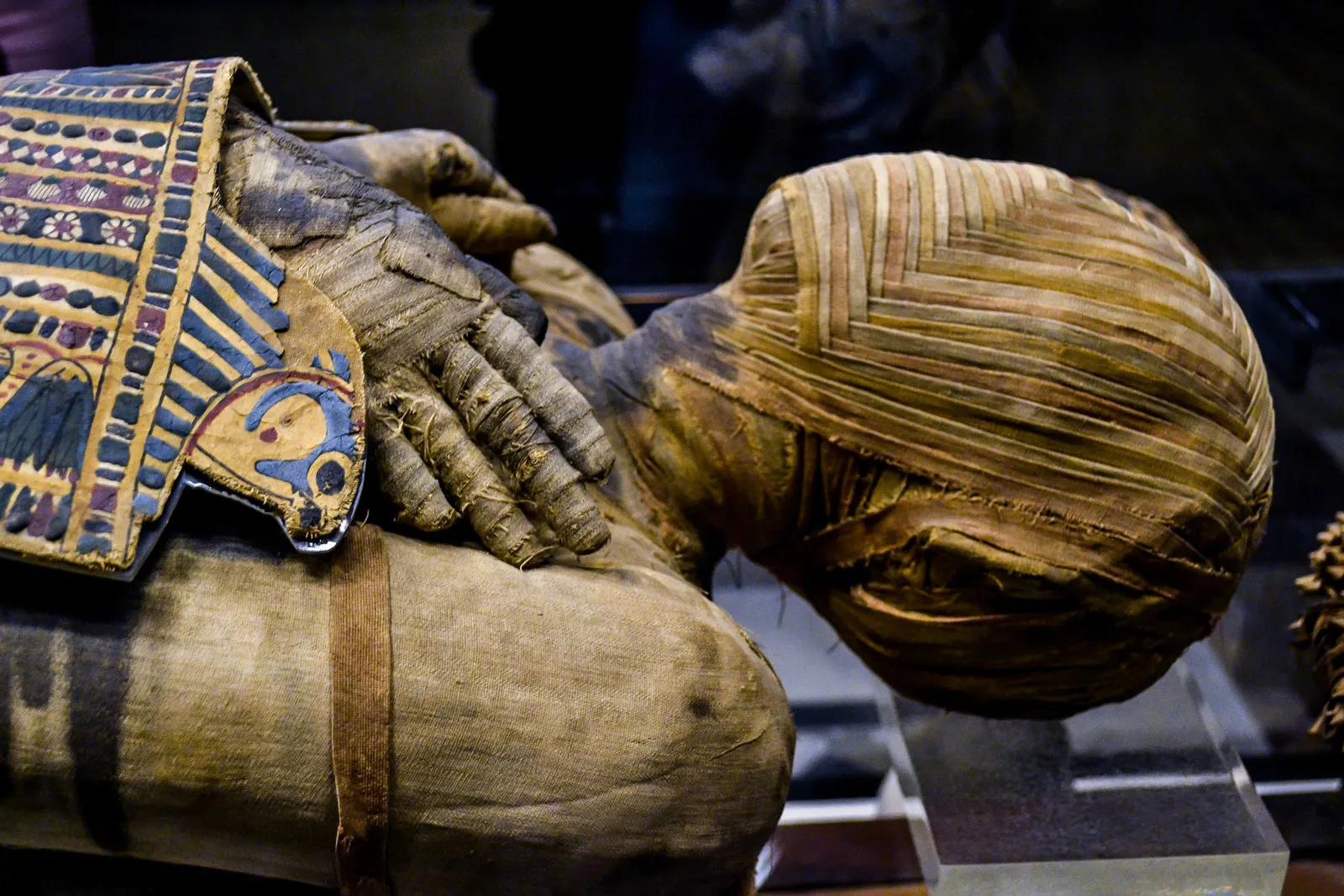
Anyone who has ever stood close to an ancient Egyptian mummy often remembers it not just with their eyes, but with their nose. There is a scent that lingers, something musty and strangely persistent, as if time itself has left a fingerprint in the air. For generations, this odor was quietly dismissed as the simple result of extreme age and slow decay. Old things smell old, after all.
But scientists have now shown that this assumption misses a deeper and far more intriguing story. That familiar aroma is not a single smell of rot. It is a carefully layered chemical message, a mixture of volatile organic compounds, or VOCs, still drifting from bodies prepared thousands of years ago. These invisible molecules carry clues about how the dead were treated, what ingredients were chosen, and even when the mummies were created.
In a sense, the mummies have been speaking all along. We just lacked the tools to listen properly.
When Studying a Mummy Meant Hurting It
Until now, learning what went into an ancient embalming balm came at a painful cost. Researchers typically had to cut away small pieces of bandage or preserved tissue, dissolving them in chemicals to extract information. Even when done carefully, this process caused permanent damage. Each test removed something that could never be replaced.
This created a dilemma. The desire to understand ancient practices clashed with the responsibility to protect fragile remains. Every sample taken was a trade-off between knowledge and preservation. For museums and curators, this was an especially difficult choice, as many mummies are already vulnerable after centuries of survival.
The question lingered in the background of archaeological science: was there a way to learn from mummies without touching them at all?
Listening to the Air Instead of the Body
At the School of Chemistry at the University of Bristol, a team of researchers decided to shift their focus away from the mummy itself and toward the space around it. Instead of cutting into bandages or scraping residue, they wondered whether the answers might already be floating in the air.
Their solution was surprisingly elegant. Every material slowly releases tiny amounts of gas. Oils, waxes, resins, and other substances used in embalming continue to emit VOCs even after thousands of years. By capturing and analyzing these gases, it might be possible to reconstruct ancient recipes without ever making contact.
To do this, the researchers used a method known as HS-SPME-GC/Q-TOFMS, a complex-sounding technique that functions like an extremely sensitive molecular nose. It collects gases from the space above an object, separates the molecules, and identifies them based on their chemical fingerprints.
In simple terms, the team learned how to sniff the past with scientific precision.
Two Thousand Years, Nineteen Mummies, One Invisible Trail
The researchers applied their method to 35 samples of balms and bandages taken from 19 different mummies, spanning more than 2,000 years of history. Instead of physical fragments, they analyzed the air inside containers holding the remains and the space just above the mummified bodies themselves.
As the gases were drawn into the molecular scanner, the invisible became visible. The team identified 81 distinct VOCs, each pointing to specific ingredients once blended by ancient embalmers. These compounds fell into four main groups: fats and oils, beeswax, plant resins, and bitumen.
What emerged was not a single embalming tradition frozen in time, but a dynamic practice that evolved over centuries.
Recipes That Changed With Time
One of the most striking discoveries was how clearly the chemical signatures reflected historical change. Mummies from earlier periods showed simpler compositions, dominated by fats and oils. Their VOC profiles suggested straightforward recipes, possibly focused on basic preservation.
Later mummies told a richer story. Their chemical fingerprints revealed more complex mixtures that included expensive resins and bitumen. These substances left distinct VOC traces, allowing the researchers to distinguish between different eras purely through smell-based analysis.
Without opening a single bandage, the scientists could see time unfolding molecule by molecule. The air itself became a historical record, capturing shifts in materials and techniques across centuries.
One Body, Many Treatments
The scent of a mummy did not always come from a single recipe, either. As the team dug deeper into the VOC data, they noticed something unexpected. Different parts of the same body sometimes released different chemical signatures.
The head, for example, could carry a distinct blend of VOCs compared to the torso. This suggested that ancient embalmers did not rely on a one-size-fits-all mixture. Instead, they may have used different balms for different areas, tailoring treatments to specific organs or regions of the body.
This insight adds a new layer of complexity to our understanding of embalming practices. The process appears to have been more deliberate and nuanced than previously assumed, with careful choices made for different parts of the human form.
A Fast and Gentle Way to Read Ancient Chemistry
In their study, published in the Journal of Archaeological Science, the researchers emphasized how powerful this approach could be. As they noted, VOCs can be used as a fast and sensitive screening tool to indicate the composition of ancient embalming substances.
Speed matters here. Traditional chemical analysis can take significant time and requires irreversible sampling. By contrast, VOC analysis offers a rapid first look, helping researchers decide whether more invasive methods are even necessary.
Equally important is what this technique does not do. It does not scrape, cut, or dissolve. It leaves the mummy exactly as it was found, while still yielding meaningful scientific information.
Protecting What Time Has Spared
For curators, conservators, and archaeologists, this method offers something rare: knowledge without loss. VOC analysis provides a way to study some of the world’s most fragile remains without compromising their integrity.
The researchers are careful not to oversell their discovery. They acknowledge that, at least for now, this sniffing technique works best as a preliminary step. In some cases, physical samples may still be required for deeper analysis.
Even so, the shift is profound. Instead of starting with damage and hoping the results justify it, scientists can now begin with a non-destructive approach and proceed cautiously only when necessary.
Why This Research Matters
This work changes how we think about the relationship between science and the past. It shows that ancient objects do not just sit silently behind glass. They continue to interact with the world, releasing information in subtle ways that modern technology can finally detect.
By reading the chemical whispers of mummies, researchers can trace changes in embalming traditions across 2,000 years, understand how different body parts were treated, and identify the materials that ancient embalmers considered valuable. All of this can be done while keeping irreplaceable remains intact.
Beyond Egyptian mummies, the implications reach further. The idea that air itself can serve as a historical archive opens new possibilities for studying fragile artifacts of all kinds. It encourages a gentler, more respectful approach to scientific inquiry, one that listens before it touches.
In the end, this research reminds us that the past is not completely sealed off. Sometimes, it is still breathing, quietly sharing its story with anyone who knows how to listen.
Study Details
Wanyue Zhao et al, Volatile compounds reveal the composition of embalming materials used in Egyptian mummification, Journal of Archaeological Science (2026). DOI: 10.1016/j.jas.2026.106490