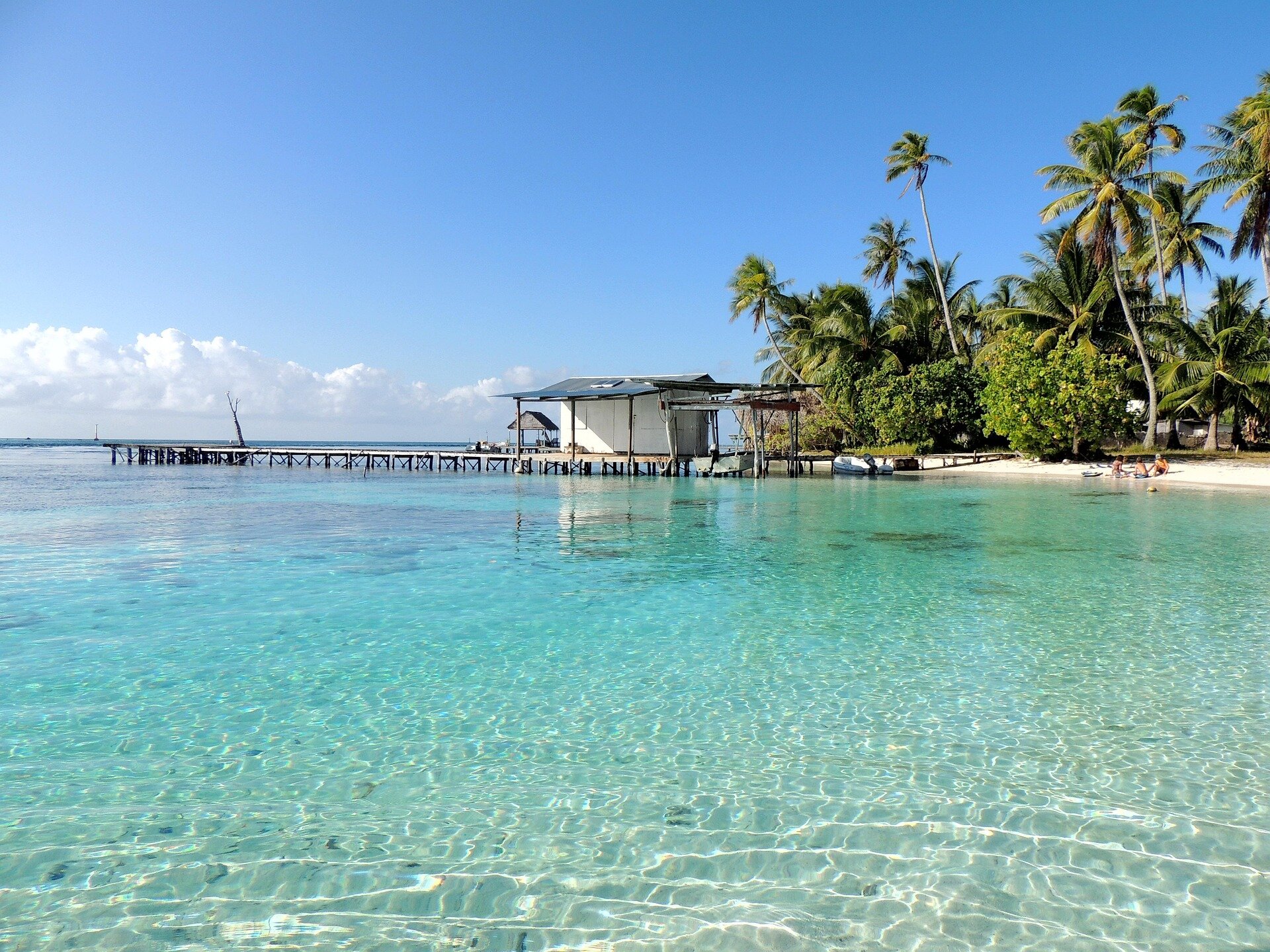
Evidence from ancient mud samples and climate modeling indicates that a prolonged mega-drought in Samoa and Tonga coincided with the end of the Polynesian “Long Pause,” helping drive one of history’s most remarkable waves of ocean migration. Researchers found that worsening drought in the homeland islands and increasing rainfall farther east created powerful environmental incentives for communities to embark on rapid voyages across the Pacific.
For centuries, one of the greatest mysteries in Pacific history has been why Polynesian voyagers suddenly resumed long-distance exploration after roughly 1,700 years of relative stability in Samoa and Tonga. Now, researchers say climate appears to have played a major role.
The new study suggests that a prolonged mega-drought transformed life in the western Pacific just before Polynesians began their rapid eastward expansion around A.D. 900–1050. Within only about 250 years, these skilled navigators settled nearly every remaining island group across the South Pacific, including Tahiti, Hawai’i, and the continental Americas. The paper is published in the Journal of Pacific Archaeology.
The findings also provide historical context for the cultural backdrop that inspired Disney’s “Moana,” whose story centers on a young Polynesian navigator leaving her threatened island in search of a better future.
The climate signal hidden beneath ancient wetlands
To reconstruct environmental conditions from more than a thousand years ago, researchers examined mud collected from deep beneath swamps and lakes in Samoa, Tonga, French Polynesia, and the Cook Islands.
Rather than relying on historical records, the team analyzed biochemical fossils left behind by freshwater algae and plant leaves. These ancient biological markers preserved the hydrogen isotope signatures of rainfall, allowing scientists to estimate how precipitation changed over thousands of years.
Dr. Mark Peaple, a research fellow in paleoclimate at the University of Southampton who carried out the geochemical analysis, explained how the method works.
“Hydrogen in rainwater contains heavier and lighter isotopes—the proportion of which is determined by the amount of precipitation in the tropics—which we were able to analyze in the mud,” he said. “So by analyzing the ancient biomarker fossils, we can reconstruct rainfall changes from thousands of years.”
Across every study location, the evidence pointed toward the same conclusion: Samoa and Tonga experienced a severe, prolonged drought immediately before and during the period when long-distance migration resumed.
By the end of the Long Pause, researchers determined that these islands were experiencing their driest period in 2,000 years.
Why the Long Pause finally ended
The Long Pause began about 3,000 years ago, when the ancestors of today’s Polynesians reached Samoa and Tonga. For roughly 1,700 years, they did not continue farther east across the Pacific despite possessing sophisticated seafaring traditions.
Then something changed.
According to the researchers, environmental conditions deteriorated in the homeland islands while conditions improved farther east. That contrast may have fundamentally altered the balance between remaining at home and undertaking dangerous ocean voyages.
David Sear, professor of physical geography at the University of Southampton and the study’s lead author, said the climate evidence strongly supports this explanation.
“We have confirmed the theory that the end of the Long Pause coincided with a period of mega drought in the homeland islands of Samoa and Tonga—and also a period of increasing rainfall in the receiving islands. As they headed east, they found wetter islands with nobody on them.”
He described the speed of the subsequent expansion as extraordinary.
“There was a huge explosion of migration, and within 250 years they had landed and settled every little dot in the South Pacific, from tiny coral atoll islands to larger lands. It was a very rapid process.”
Climate models explain what caused the drought
The research did not stop with geological evidence. Scientists also used climate modeling to investigate what produced such prolonged dry conditions.
Their simulations indicate that long-term changes in Pacific sea surface temperatures shifted the region’s major tropical rain belt eastward. As rainfall moved away from Samoa and Tonga, those islands became significantly drier while eastern islands received more precipitation.
Professor Manoj Joshi of the University of East Anglia, who led the climate modeling work, said this large-scale shift would have had profound consequences for island communities.
“Our research shows that changes in sea surface temperatures across the Pacific Ocean over many decades drove an eastward shift in the vast rain belt that lies over this whole region, causing the dry conditions found in Samoa and Tonga.”
He added that the environmental changes would have reshaped everyday life.
“The climate changes we identified would have transformed daily life on these islands. Reduced rainfall would have affected freshwater availability, food production and the resilience of communities, creating powerful incentives for people to seek opportunities elsewhere.”
Migration was driven by more than climate alone
Although the study identifies prolonged drought as a major driver, the researchers emphasize that migration was probably influenced by multiple factors.
Sear noted that growing populations would have placed increasing pressure on limited resources during an extended dry period. At roughly the same time, Polynesian mariners also appear to have improved the design of their voyaging canoes.
According to the researchers, advances from U-shaped to V-shaped hulls, together with improvements in rigging, likely made it possible to sail more effectively into prevailing winds. Those technological developments would have reduced some of the risks associated with exploring farther east.
Rather than replacing existing explanations, the study suggests that environmental stress, population pressures, and improved sailing technology combined to create the conditions for one of humanity’s greatest migrations.
Lessons from an ancient climate-driven journey
The findings illustrate how long-term environmental change can influence human decisions on an enormous scale.
Dan Skinner, a research fellow at the University of East Anglia who conducted the climate-modeling experiments, said the evidence now clearly identifies prolonged drought as an important force behind the migration.
“We now know that the climate—and specifically a period of severe drought for many years, even decades—is a definite factor in forcing this impressive migration.”
He added that the study carries a broader message about the relationship between climate and society.
“These findings illustrate how sensitive human societies can be to long-term changes in climate. Even highly skilled and adaptable communities may be driven to undertake extraordinary journeys when environmental conditions deteriorate over many years.”
By combining evidence preserved in ancient mud with sophisticated climate simulations, the researchers have reconstructed a compelling picture of how environmental change may have helped reshape the human history of the Pacific. Their work suggests that one of the world’s greatest episodes of exploration was not simply the result of adventurous seafaring, but also a response to a changing climate that altered where water, food, and opportunity could be found.