The first close-up views of Quest, the last ship of Antarctic explorer Sir Ernest Shackleton, have revealed remarkably preserved sections of the historic wreck resting on the floor of the Labrador Sea. Researchers are now creating a detailed 3D digital model of the vessel while documenting its condition, including damage from fishing nets that partially cover the site.
More than a year after locating the wreck with sonar, an international expedition has finally captured the first close-up images of Quest, the vessel forever linked to the final chapter of Sir Ernest Shackleton’s life.
The expedition, led by the Royal Canadian Geographical Society (RCGS) in partnership with the Woods Hole Oceanographic Institution (WHOI), used WHOI’s Falcon remotely operated vehicle (ROV) and the DSV Alvin human-occupied submersible to examine the ship on the seafloor of the Labrador Sea. The mission marks the first time researchers have directly viewed the wreck since it sank in 1962.
For expedition leader and RCGS CEO John Geiger, descending to the wreck aboard Alvin was an unforgettable moment.
“To see Shackleton’s ship, and to think that Shackleton was standing on that deck a century ago. At first, there was a lot of darkness, but suddenly the bow emerges as you are going toward it. It’s incredible,” Geiger said.
Historic vessel remains largely recognizable
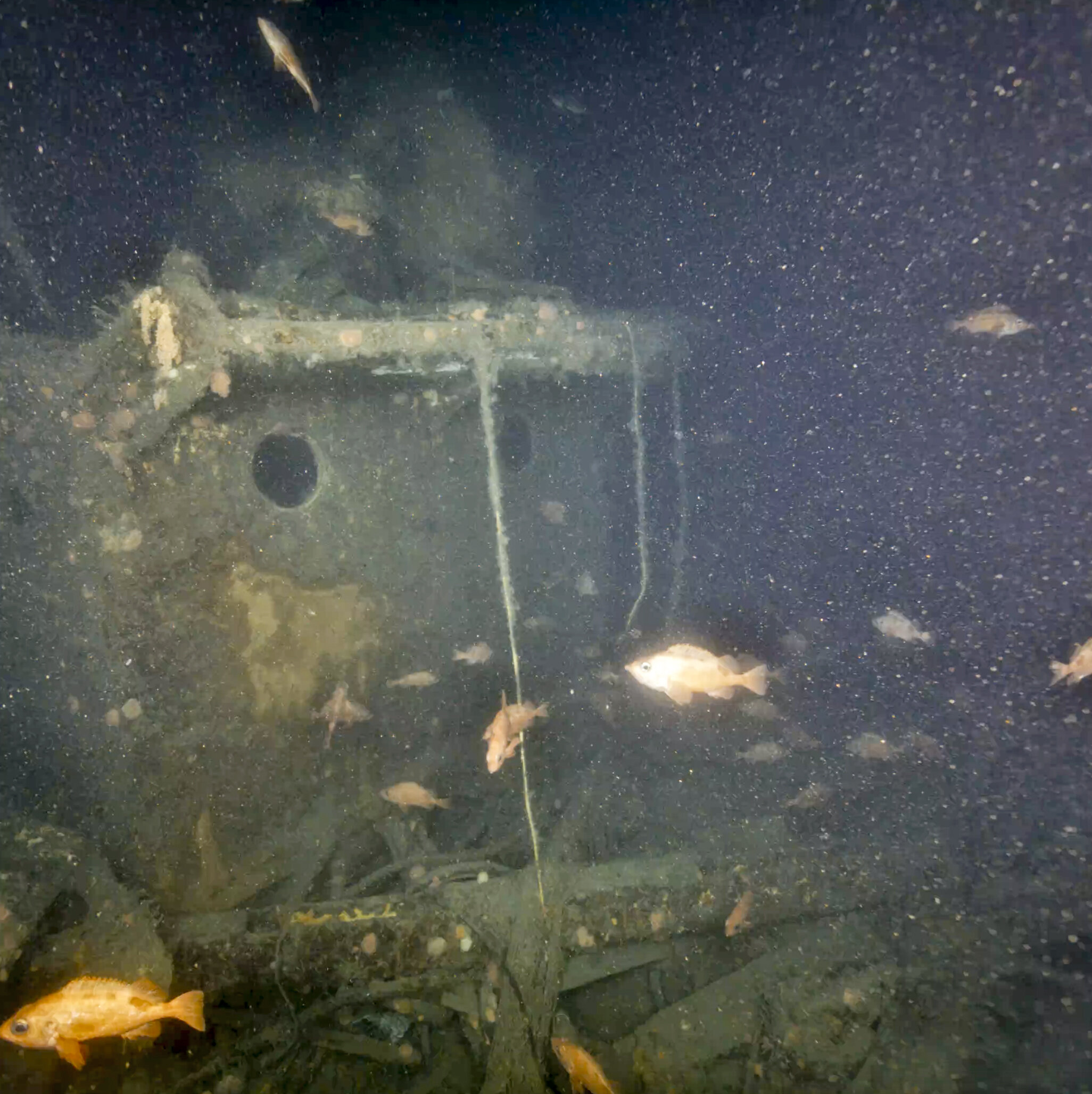
The new images show that much of Quest remains clearly identifiable despite decades beneath the sea. Researchers reported that the bow, deck, and several portholes are still visible, although the ship’s main mast has fallen.
Marine life has also become part of the wreck’s story. Pink corals now cover sections of the vessel, while several fish species—including cod, redfish, and wolffish—were observed around the site.
The expedition provides a far more detailed look than was possible when the wreck was first discovered in 2024. At that time, investigators relied on side-scan sonar, which revealed the ship’s location but not its finer details.
Returning with advanced underwater vehicles and imaging systems allows researchers to examine both the vessel’s condition and its history in far greater detail.
Fishing nets complicate the investigation
One of the first observations made during the dive was less encouraging.
Large fishing nets draped across portions of the wreck, obscuring important features and highlighting the challenges facing researchers studying underwater cultural sites.
“There is a lot of damage to the ship,” Geiger said. “The nets are a sad story, limiting our ability to look at the wreck. I think we have to take responsibility for what we are doing to our oceans; that’s a huge issue.”
The expedition’s documentation of these conditions will become part of the permanent record of the site as scientists continue their survey.
Creating a permanent digital record
Over the course of three days, the research team plans to survey and map the wreck using Canadian-made underwater photogrammetry technology developed by Voyis.
The goal is to produce a highly detailed digital twin of Quest—a three-dimensional virtual reconstruction that can support future scientific study while making the historic ship accessible to the public without disturbing the wreck itself.
“In addition to using Alvin to put the first human eyes on Quest in more than 60 years, we’ll be using the very best imaging technology available to create a digital twin of the ship,” said Dwight Coleman, WHOI co-chief scientist for the expedition.
He noted that this style of 3D modeling has only recently become available in ocean science.
“This type of 3D modeling has only existed in ocean science for the last couple of years, and it’s giving us entirely new ways to explore these historic wrecks and make them real for the public.”
A ship linked to one of exploration’s most famous figures
Quest occupies a unique place in polar exploration history because it was the last ship used by Sir Ernest Shackleton.
Shackleton died aboard the vessel in 1922 at the age of 47 while traveling toward Antarctica on what was intended to be his final expedition. He had already become renowned for leading one of history’s most remarkable survival stories after the loss of his ship Endurance, successfully bringing his entire crew to safety following nearly two years trapped in Antarctic ice.
Although Quest became closely associated with Shackleton, its story continued long after his death.
From expedition ship to Arctic sealer
Following Shackleton’s death, Quest was sold to a Norwegian family and spent approximately 40 years operating as a sealing vessel in Arctic waters.
Its working life ended on May 5, 1962, after being crushed by ice floes in the Labrador Sea at the end of a sealing season. The vessel then sank, remaining undiscovered until the RCGS-led expedition located it in 2024.
The latest mission represents years of planning and brings together specialists in deep-sea exploration from WHOI, including Alvin pilot Bruce Strickrott.
“Exploring any wreck with a human-occupied submersible is a complicated task,” Strickrott said. “Our success today and in the coming days is a direct result of having a group of deep-submergence professionals with extensive experience operating in extremely complicated surroundings.”
Exploration continues beyond Quest
For mission specialist Mark Pathy, who participated in both the 2024 discovery and the latest return to the wreck, the expedition is about more than documenting a historic ship.
“I hope it inspires people to explore the planet and to understand that there are undiscovered wonders to see and experience out there. It really is a magical place, our planet,” he said.
Once work on Quest is complete, the expedition will head northeast toward Greenland to investigate another historically significant vessel, Terra Nova, the last ship used by Shackleton’s rival, Robert Falcon Scott.
The two ships share an unexpected connection beyond Antarctic exploration. Both later served as sealing vessels in Canadian waters, and Shackleton had originally planned to use Quest for an expedition to the Canadian Arctic before redirecting the voyage toward Antarctica.