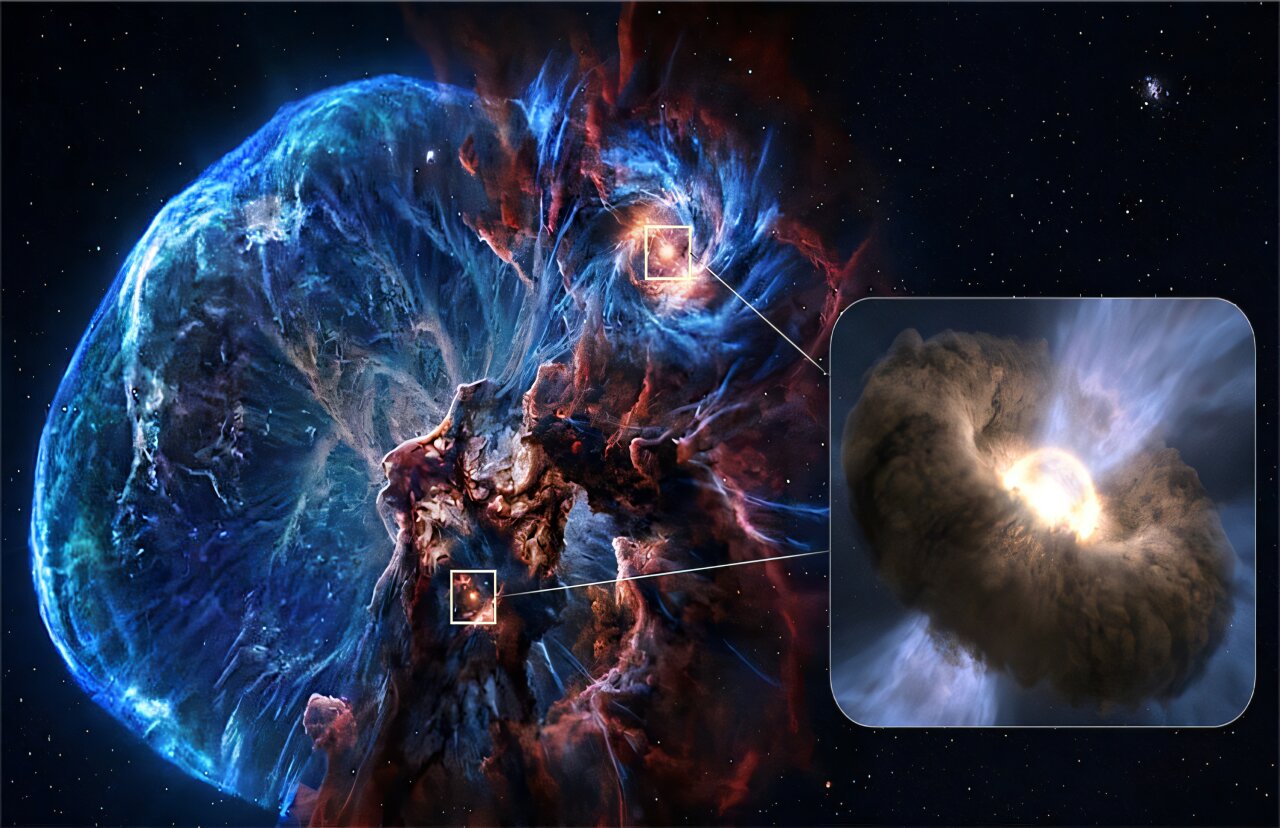
Warm, dense stellar cocoons containing complex organic molecules have been identified inside a supernova remnant for the first time, challenging expectations about how violent stellar explosions affect the chemistry of newborn stars. Observations of the remnant RX J1713.7−3946 suggest that some young stars can remain shielded within their natal gas, preserving the molecular ingredients associated with star and planet formation.
Astronomers have discovered an unexpected pocket of chemical resilience inside one of the universe’s most extreme environments. Using the Atacama Large Millimeter/submillimeter Array (ALMA), researchers identified two warm, dense regions surrounding newborn stars—known as hot cores—within the supernova remnant RX J1713.7−3946, the remains of a massive star that exploded about 1,600 years ago.
The finding marks the first detection of hot cores inside a supernova remnant, revealing that the rich chemistry associated with the birth of stars can survive even after a nearby stellar explosion. The research, conducted by scientists from Niigata University, Gifu University, RIKEN, and Kyoto University in Japan, was published in The Astrophysical Journal on July 1, 2026.
A rare glimpse into star birth after a stellar explosion
Massive stars—those more than about ten times the mass of the Sun—end their lives as supernovas, releasing enormous amounts of energy into surrounding space. These explosions create elements heavier than iron, accelerate high-energy charged particles known as cosmic rays, and may also influence the formation of future generations of stars.
What has remained uncertain is how such violent events affect the chemistry inside nearby star-forming regions. Powerful shock waves and energetic particles could potentially destroy complex molecules, but they might also drive new chemical reactions. Determining which process dominates has been a long-standing question.
To investigate, the researchers turned ALMA toward RX J1713.7−3946 in search of newborn stars still embedded within warm molecular gas. These environments, called hot cores, are considered valuable laboratories for studying the material that eventually contributes to stars and planets.
Unexpected chemical richness
ALMA’s high sensitivity and sharp imaging capabilities enabled the team to detect two hot cores within the supernova remnant. Both regions showed emissions from a rich collection of molecules, including a variety of complex organic molecules.
One of the most striking results came from comparing the chemistry of one newly discovered hot core with that of ordinary star-forming regions located far from supernova explosions. The researchers found that the relative abundances of complex organic molecules were remarkably similar.
That result suggests the surrounding supernova has not significantly altered the molecular inventory inside at least one of these stellar nurseries.
Lead author Takashi Shimonishi, an astronomer at Niigata University, said the observations demonstrate that “even in the harsh environment of a supernova remnant, newborn stars can remain well protected within their natal cocoons, preserving their rich molecular composition.”
He added that environments capable of hosting complex organic molecules—described as potential building blocks of prebiotic chemistry—”may be more diverse than previously recognized.”
Why the molecules may have survived
The study offers several possible explanations for this surprising resilience.
One possibility is simply that the hot cores have only recently begun experiencing the effects of the supernova. If so, energetic particles may not yet have had enough time to significantly change their chemistry.
Another explanation involves magnetic fields. According to the researchers, magnetic fields strengthened by the supernova shock could reduce the penetration of cosmic rays into the dense molecular gas. Such shielding would help protect the hot cores from energetic particles, allowing their complex molecular composition to remain largely intact.
Although the observations cannot yet determine which explanation is correct, both scenarios point to ways that young stellar systems might preserve their chemical environments despite nearby stellar explosions.
Clues to the environment that formed our solar system
The discovery also has implications for understanding the early history of our own solar system.
Analyses of primitive materials from the solar system have suggested that it may have formed in a region strongly influenced by a nearby supernova. If that idea is correct, then understanding how supernova feedback affects star-forming material becomes especially important.
The newly discovered hot cores provide an opportunity to examine how molecular chemistry behaves under conditions that may resemble those experienced during the birth of the solar system. Finding that complex organic molecules can survive inside a supernova remnant raises the possibility that chemically rich environments may persist even in places shaped by powerful stellar explosions.
Questions remain about how common this is
Despite the encouraging evidence for molecular survival, the researchers caution that it is still unknown whether these observations represent the typical outcome of supernova feedback.
The two hot cores identified in RX J1713.7−3946 demonstrate that chemically rich stellar cocoons can exist within a supernova remnant, but additional observations will be needed to determine how frequently such environments occur and how their chemistry evolves over time.
Future studies are expected to provide a broader picture of the physical and chemical conditions in star- and planet-forming regions affected by supernovas. Those observations could help scientists determine whether the environment that gave rise to our own solar system was unusual or one example of a more common pathway for the birth of stars and planets.