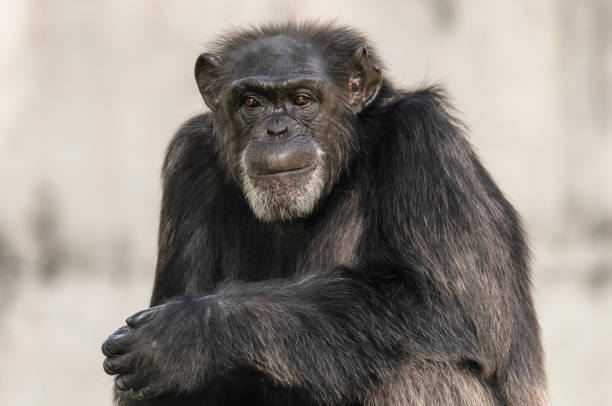
For nearly twenty years, the Ngogo chimpanzees of Uganda’s Kibale National Park were the gold standard for primate cooperation. As the largest known community of wild chimpanzees, they thrived in a massive, cohesive society that seemed to defy the usual limits of animal sociology. They lived by the rules of fission-fusion dynamics, a fluid social system where individuals split into small temporary clusters to forage during the day but always returned to the fold, maintaining deep, decades-long bonds. To the researchers who watched them, the Ngogo group wasn’t just a population; it was a stable, albeit complex, civilization. But as the third decade of observation dawned, the invisible threads holding this empire together began to fray, beginning a transformation that would culminate in a permanent, violent divorce.
The Invisible Bridges Fall
The stability of the Ngogo community was not an accident of nature; it was maintained by a delicate web of social ties and high-ranking individuals who acted as the glue for the entire population. For two decades, these chimpanzees moved between flexible subgroups with ease, grooming and patrolling with neighbors they had known since birth. However, the first cracks appeared in the foundation following a period of significant loss. In 2014, several influential adult males passed away. These individuals were more than just muscle; they were the bridges between different factions of the group, males whose presence and relationships allowed the Western and Central clusters to mingle without friction.
With these peacemakers gone, a shift in the male dominance hierarchy took hold. The absence of the old guard created a power vacuum and a social distance that the remaining chimpanzees couldn’t seem to bridge. By 2015, researchers from the University of Texas at Austin and other institutions began to notice a chilling change in the daily routine. The Western and Central clusters, which once intermingled freely, started to move like repelling magnets. They were no longer choosing to spend time together. This wasn’t the usual temporary separation seen in their species; it was a growing polarization that signaled the beginning of the end for the unified Ngogo community.
A Border Drawn in Blood
What started as quiet avoidance soon hardened into a permanent geographical and social boundary. By 2018, the transition was final. The once-unified empire had officially suffered a permanent fission, splitting into two distinct, sovereign groups: the Western and Central communities. Each group claimed its own territory, and the former neighbors became total strangers. But the tragedy didn’t stop at separation. The most harrowing phase of this split was the eruption of sustained intergroup violence.
Between 2018 and 2024, the researchers documented a series of targeted, lethal attacks. The Western group began a campaign of aggression against their former friends and family members in the Central group. Scientists observed or inferred with high confidence seven attacks on adult males and 17 attacks on infants. These weren’t random acts of nature; they were coordinated, lethal strikes. The most striking aspect of this conflict was that the chimpanzees were killing individuals they had grown up with, groomed, and protected for years. The new group identities had completely overridden the cooperative relationships of the past. The shared history of twenty years was erased by the new, violent reality of “us versus them.”
The Rarity of the Great Divide
To understand why this event is so significant, one must look at the rarity of such occurrences in the wild. While many primate species split into smaller groups to reduce competition for resources, a permanent split in a chimpanzee community is an evolutionary anomaly. Genetic evidence suggests these events only happen roughly once every 500 years. Until Ngogo, the only other documented case was recorded by Jane Goodall in the 1970s at Gombe, Tanzania. However, that event has been debated for decades because the chimpanzees there were provisioned with food by researchers, which some argue might have influenced their behavior.
The Ngogo study offers a much cleaner, more complete scientific picture. These chimpanzees were never provisioned; they were living entirely on their own terms in the wild. Thanks to thirty years of data collected by John Mitani and a dedicated team of Ugandan field staff, this is the first clearly documented permanent fission in a natural wild population. It proves that even without human interference or artificial food sources, the social structures of our closest relatives can collapse into total, segregated warfare.
Beyond Language and Ideology
This research challenges one of our most deep-seated ideas about the origins of human warfare and civil war. For a long time, many scholars believed that large-scale conflict in humans was driven primarily by cultural markers—things like ethnic differences, religious beliefs, or political ideologies. We tell ourselves that we fight because we have different languages or different gods. But the Ngogo chimpanzees don’t have language, religion, or ethnicity. They have only relational dynamics.
If these animals can undergo such extreme polarization and engage in collective, lethal violence based solely on the breakdown of personal relationships, it suggests that the roots of human conflict might be more primitive than we thought. Our cultural markers—the flags we wave and the creeds we follow—might actually be secondary to a much more basic biological drive toward group identity and exclusion. This discovery suggests that the mechanisms of polarization are baked into the primate mind, triggered when the “bridges” between us are broken.
The Hope in the Small Acts
While the violence at Ngogo is a grim reminder of our shared ancestry, the researchers believe there is a message of hope hidden in the data. If the grand collapses of society are driven by the failure of individual relationships, then the solution to preventing such conflicts must lie at that same level. The study concludes that the key to peace might not be found in massive political shifts, but in the small, daily acts of reconciliation and reunion between individuals.
By maintaining the “bridges” in our personal lives and choosing to reunite rather than avoid, we may be able to counteract the biological pull toward polarization. The story of the Ngogo chimpanzees shows us how easily a society can fracture when we stop interacting, but it also highlights exactly what we need to protect: the individual bonds that keep the whole from falling apart.
Study Details
Aaron A. Sandel, Lethal conflict following group fission in wild chimpanzees, Science (2026). DOI: 10.1126/science.adz4944. www.science.org/doi/10.1126/science.adz4944
James Brooks, Civil war among wild chimpanzees, Science (2026). DOI: 10.1126/science.aeg6719 , www.science.org/doi/10.1126/science.aeg6719