An international research team has recovered 42 lost pages of the 6th-century Codex H, a primary witness to the Letters of St. Paul, by digitally extracting “ghost” text from the parchment. Using multispectral imaging to detect chemical “offset” traces, the project has reconstructed nearly double the information previously available from the manuscript’s surviving physical fragments.
The Great Lavra Monastery on Mount Athos, Greece, is home to centuries of silent history, but in the 13th century, a decision was made there that nearly erased one of the world’s most significant biblical records. A sixth-century manuscript containing the Letters of St. Paul, now known to scholars as Codex H, was disassembled. Its precious parchment was stripped, re-inked, and sliced up to serve as humble binding material and flyleaves for newer books. For hundreds of years, these fragments remained hidden in plain sight, scattered across the libraries of Italy, Greece, Russia, Ukraine, and France, their original contents considered lost to the passage of time.
However, a breakthrough led by Professor Garrick Allen at the University of Glasgow has effectively pulled the past back from the brink of erasure. By treating the physical pages not just as surfaces for writing, but as chemical archives, Allen and his team have successfully recovered 42 lost pages of text. This discovery was made possible by the very process that originally obscured the words: the chemical interaction between medieval ink and ancient parchment.
Deciphering the Ghostly Mirror of History
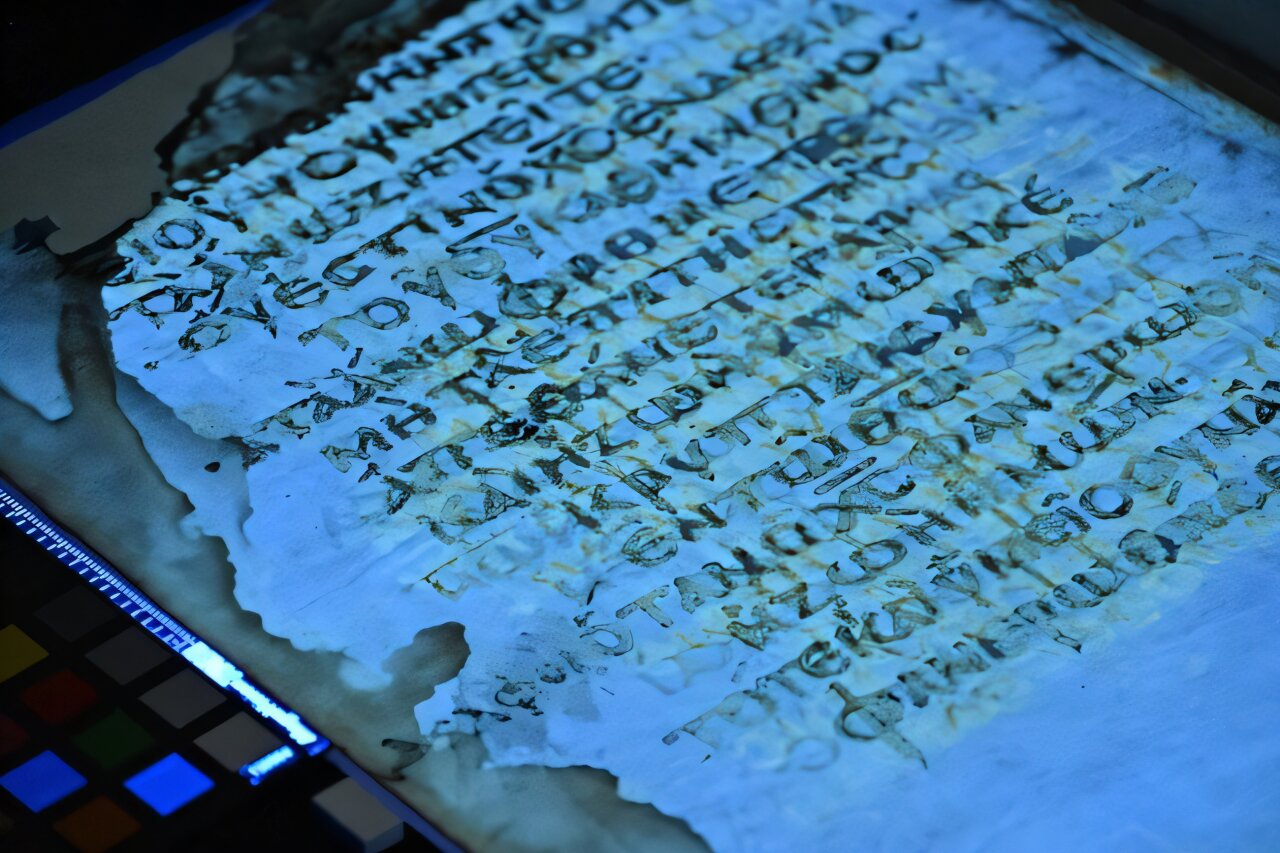
The recovery process relied on a phenomenon known as “offset” damage. When the manuscript was re-inked and repurposed in the medieval period, the chemicals in the fresh ink reacted with the pages they pressed against. This created a mirror image of the original 6th-century text on the facing leaves. While these traces are often “ghosts” that are barely visible to the naked eye, they leave a distinct chemical signature that persists several pages deep into the parchment.
To capture these invisible remnants, the team partnered with the Early Manuscripts Electronic Library (EMEL) to utilize multispectral imaging. This technology captures the manuscript under various wavelengths of light beyond the visible spectrum, allowing researchers to isolate the “ghost” text from the later medieval writing. By processing these images, the team was able to retrieve multiple pages of information from every single physical leaf they examined. To verify the timeline of these findings, researchers in Paris conducted radiocarbon dating, which confirmed that the parchment indeed dates back to the 6th century.
Insights into the Evolution of Sacred Text
Although the recovered text consists of known portions of the Pauline Epistles, the value of the find lies in the physical and structural evidence it provides. Among the most significant discoveries are the earliest known examples of chapter lists for the Letters of Paul. These ancient organizational systems differ drastically from the modern divisions used in Bibles today, offering a rare look at how early Christians categorized and navigated their scriptures.
The fragments also serve as a window into the daily lives of the people who maintained these documents. The recovered pages show clear evidence of 6th-century scribes correcting and annotating the text. These marginalia and interactions reveal that the Bible was not a static object but a living document that was actively debated and refined by its users. The discovery of such a substantial quantity of new evidence regarding the original appearance of Codex H provides a monumental shift in the study of early Christian scripture.
The Economics of Medieval Recycling
Beyond the theological implications, the physical state of the fragments provides a fascinating look at medieval sustainability and necessity. The fact that a “sacred” text like Codex H was cut up and used for bookbinding reveals a pragmatic side of the 13th-century monastery. Once a manuscript fell into disrepair or was no longer deemed useful in its current form, the high cost of parchment made it a prime candidate for medieval recycling.
By studying how these books were reused and repurposed, historians can better understand the lifecycle of ancient libraries. This project has effectively reunited a manuscript that has been fragmented for seven centuries, bridging the gap between the 6th-century scribes and the 13th-century monks who repurposed their work. A new print edition of the reconstructed Codex H is currently in development, while a digital edition has been made freely available to the public, ensuring these “ghosts” are never lost again.
Why This Matters
The recovery of these 42 pages represents a massive leap in our ability to reconstruct the history of the New Testament. Because Codex H is one of the most vital early witnesses to the Letters of St. Paul, every newly recovered word helps scholars track the accuracy and transmission of the Bible over 1,500 years.
Furthermore, this success proves that “lost” history may not be truly gone; it may simply be waiting for the right technology to reveal it. The use of multispectral imaging in this context sets a precedent for investigating thousands of other repurposed manuscripts sitting in global archives, potentially leading to a new era of discovery where “blank” or overwritten pages yield entirely new ancient libraries.