Researchers from ETH Zurich and EPFL have developed a groundbreaking detection system that uses light field camera technology to track elementary particles in three dimensions without the need for complex material segmentation. By combining micro-lens arrays with ultra-fast single-photon sensors, the PLATON project achieves high-resolution imaging in large volumes, potentially overcoming the scalability limits of current neutrino and dark matter experiments.
The hunt for the universe’s most elusive inhabitants—neutrinos and dark matter—often feels like trying to map the path of a ghost through a dense fog. To track these weakly interacting particles, physicists typically rely on massive blocks of scintillating material that flash with light when a particle passes through. However, as the quest for precision grows, the sheer mechanical complexity of these detectors has begun to hit a wall. Modern experiments require millions of individual cubes and tens of thousands of optical fibers to “see” in 3D, creating a logistical and economic bottleneck that threatens the future of large-scale particle physics.
A collaboration between ETH Zurich and EPFL is now proposing a radical departure from this segmented approach. Led by Ph.D. student Till Dieminger, senior scientist Dr. Saúl Alonso-Monsalve, and Professor Davide Sgalaberna, the team has unveiled a prototype that can image particle tracks in high resolution within a single, unsegmented volume of scintillator. Their work, recently published in Nature Communications, suggests that the future of particle detection might not lie in more fibers, but in smarter cameras.
Reimagining the Light Field
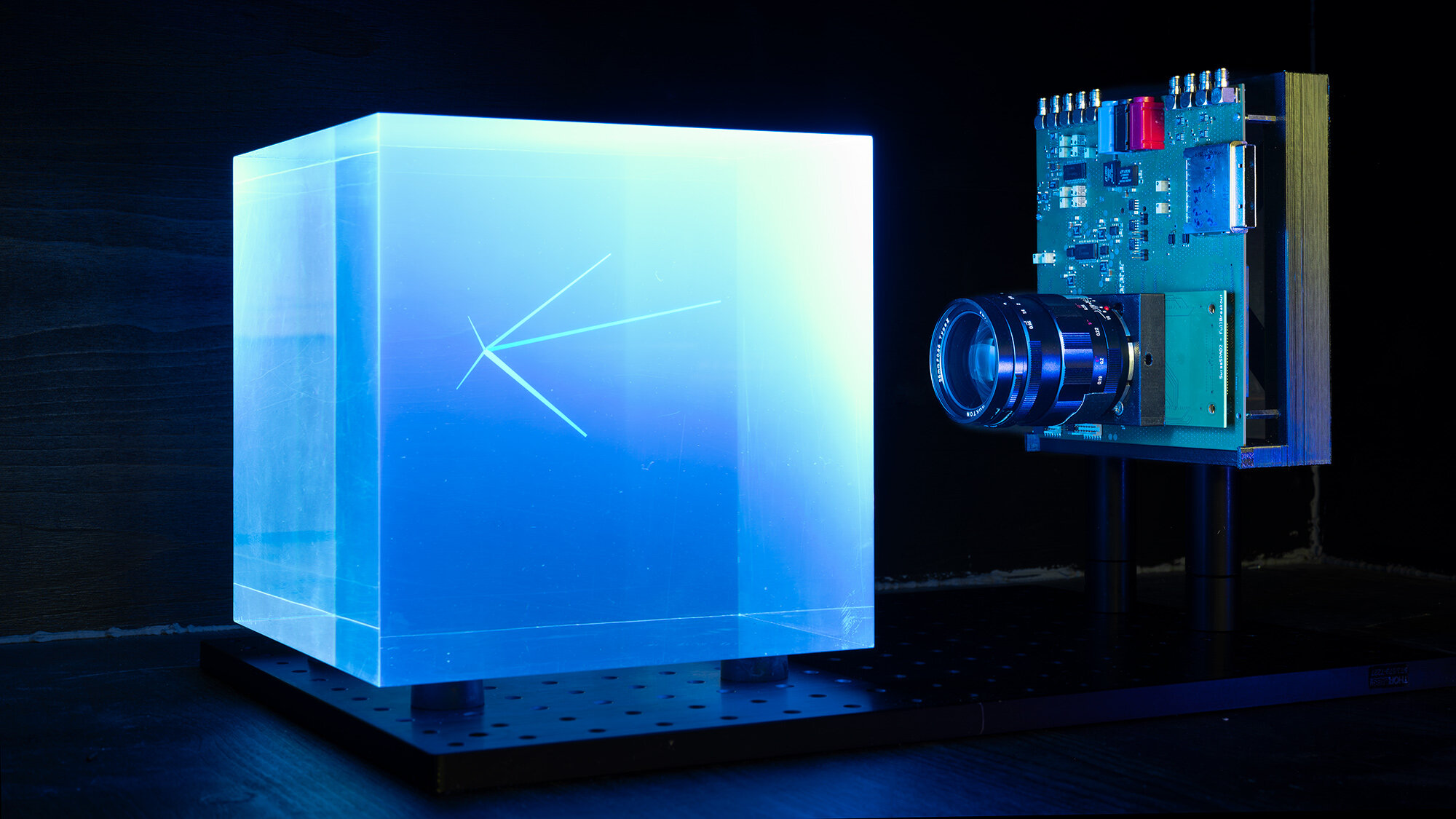
The core of this innovation is a concept familiar to high-end photography: the plenoptic, or light field, camera. Unlike a standard camera that merely records light intensity on a flat plane, a plenoptic camera captures the direction of incoming light as well. By placing a micro-lens array (MLA) between the main objective lens and the sensor, each tiny lens acts as a miniature camera, allowing the system to reconstruct depth and spatial location in 3D.
While light field cameras have been a subject of interest for photography enthusiasts for years, the ETHZ-EPFL team is the first to apply the technology to the high-stakes world of particle tracking. To make this work in the “photon-starved” environment of a particle detector—where a single interaction might only produce a handful of light particles—the researchers paired the MLA with a specialized sensor called SwissSPAD2.
Developed at the Advanced Quantum Architecture Lab led by Professor Edoardo Charbon, the SwissSPAD2 is a single-photon avalanche diode (SPAD) array. This sensor doesn’t just wait for light; it utilizes gated photon detection. By operating within fixed temporal windows, the system can effectively filter out background noise and “spurious counts,” focusing only on the precise moment a particle interacts with the scintillator.
Putting PLATON to the Test
The researchers named their demonstrator PLATON and subjected it to rigorous laboratory testing. They focused on characterizing the system’s spatial resolution across a range of light intensities, from several hundred photons down to a mere five detected photons.
In one key experiment, the team used the PLATON prototype to detect and reconstruct the positions of electrons emitted from a strontium-90 source into a solid block of plastic scintillator. The results were highly encouraging: the physical measurements closely matched the team’s predictive simulations, proving that the light field approach could accurately localize particle activity in a dense, solid medium without internal wiring or segmentation.
Building on this success, the team is already planning upgrades. The next iteration of the SPAD array will move beyond simple time windows to provide sub-nanosecond temporal resolution. This means every detected photon will receive an individual time stamp, significantly sharpening the 3D “picture” of the particle’s path.
Neural Networks and Scalability
As detectors grow in size, the data they produce becomes increasingly complex. To handle this, the researchers integrated a neural network (NN) based on a Transformer architecture—the same type of AI framework that powers modern large language models. This network is designed to recognize and capture the correlations between individual scintillation photons, allowing the system to reconstruct events with high purity.
Simulations of the upgraded PLATON system suggest impressive capabilities:
- In an unsegmented volume of 10x10x10 cubic centimeters, the system can achieve a spatial resolution below 1mm.
- The system can identify neutrino interactions that produce low-momentum protons with high efficiency.
- When scaled to a one-cubic-meter detector, simulations indicate a spatial resolution of a few millimeters, which is competitive with the most advanced segmented detectors currently in use.
The researchers believe that as they continue to optimize the optical design, sub-millimeter resolution will be achievable even in volumes larger than 1 m³, effectively removing the “fiber bottleneck” that hampers current experiments like the T2K neutrino-oscillation experiment in Japan.
Why This Matters
The implications of the PLATON project reach far beyond the quest for dark matter or neutrinos. Particle physics has a storied history of technology transfer—most famously giving birth to the World Wide Web—and this new imaging technique appears poised to follow that path.
The research team has already filed three patents for the application of PLATON technology in positron emission tomography (PET). By applying these high-resolution 3D tracking methods to medical imaging, doctors could potentially gain much clearer views of internal biological processes. Whether it is uncovering the fundamental laws of the universe or improving life-saving medical scans, this shift from complex hardware segmentation to intelligent, light-field-based imaging marks a significant leap forward in how we visualize the invisible.
Study Details
Till Dieminger et al, An ultrafast plenoptic-camera system for high-resolution 3D particle tracking in unsegmented scintillators, Nature Communications (2026). DOI: 10.1038/s41467-026-70918-x