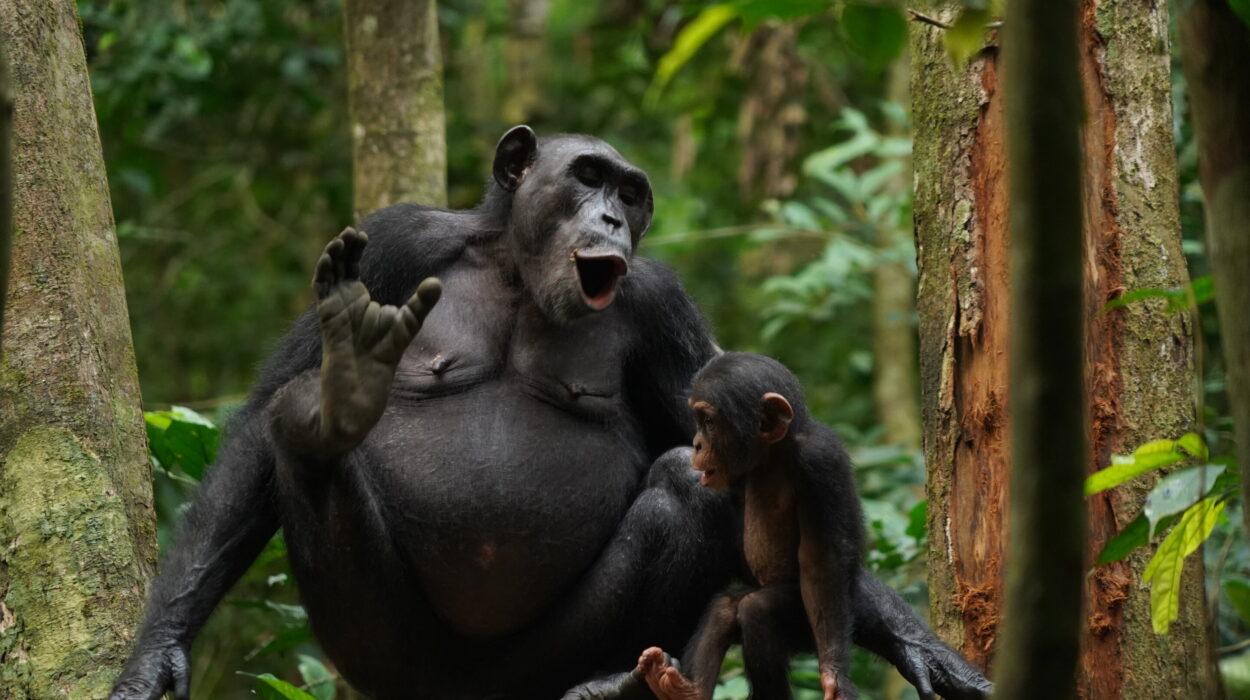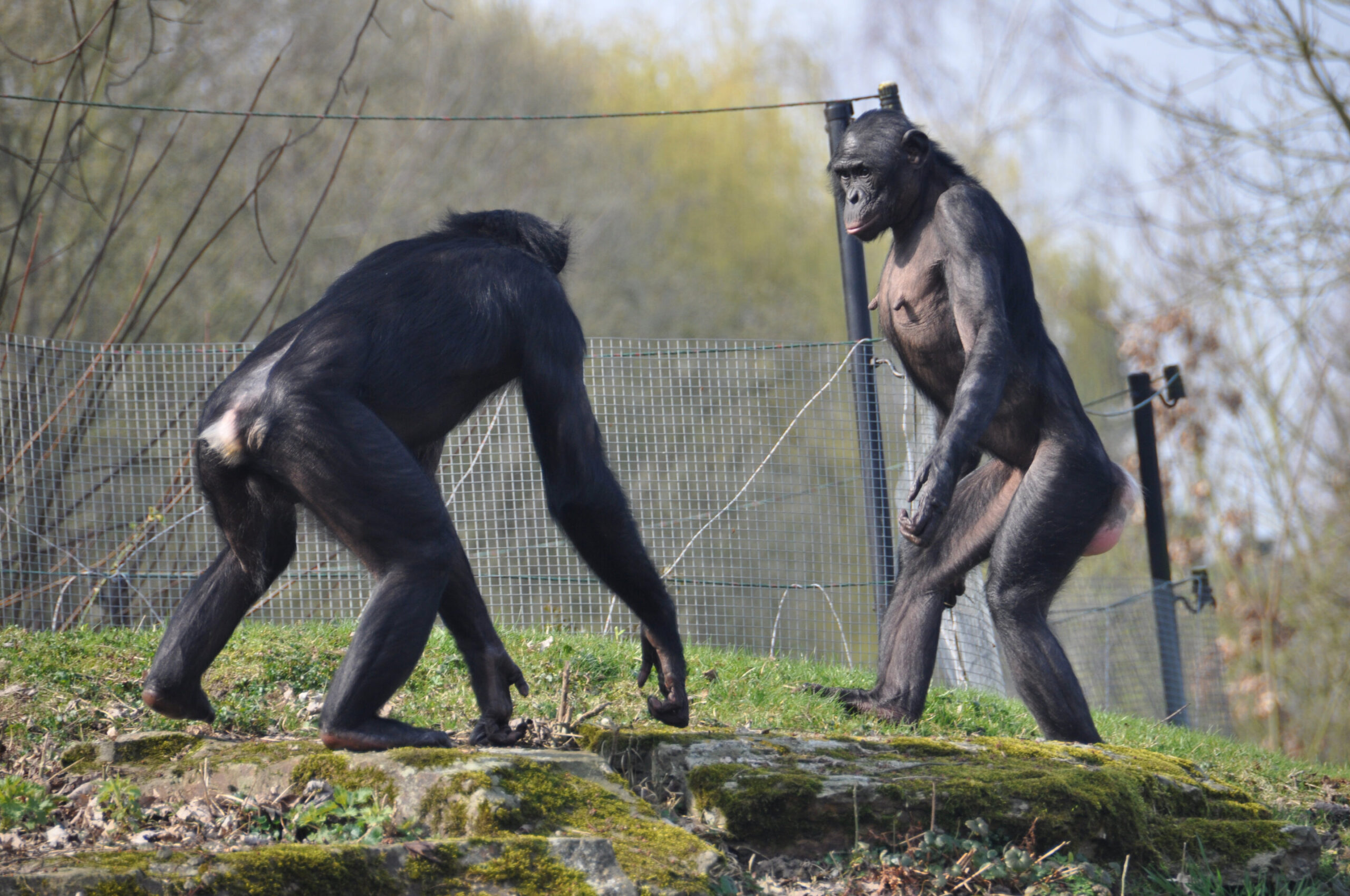
The dense canopy of the African rainforest has long been the backdrop for a tale of two cousins. On one side of the Congo River live the chimpanzees, often portrayed as the warriors of the primate world, capable of “war-like” conflicts and the dark practice of infanticide. On the other side dwell the bonobos, the supposed hippies of the forest, celebrated for their peaceful, female-led societies where tension is dissolved through affection rather than fists. For decades, this dramatic contrast has served as a mirror for humanity, suggesting that we are caught between a biological urge for violence and a potential for grace. However, a new investigation led by behavioral biologists from Utrecht University, including Emile Bryon, Edwin van Leeuwen, and Tom Roth, suggests that this tidy dichotomy is beginning to unravel.
The Myth of the Peaceful Cousin
For years, the scientific community leaned into the idea that chimpanzees were inherently more violent than bonobos. This wasn’t a groundless assumption; wild chimpanzees are known for aggressive territorial disputes and lethal interactions. Because bonobos live only in the Democratic Republic of Congo, a region frequently hampered by conflict, they have been much harder to study. Much of our understanding of them comes from a limited number of groups observed over a shorter timeframe than their famous cousins. This narrow window may have painted an incomplete picture of their true nature.
Recent reports from the wild had already begun to poke holes in the “peaceful bonobo” narrative. While one study confirmed that chimpanzee males were indeed more aggressive, another surprising report found the exact opposite: bonobo males showing higher levels of aggression. Even more startling were recent findings showing that conflicts within bonobo groups could, in fact, be lethal. To get to the bottom of this primate puzzle, the research team, joined by colleagues from the University of Antwerp, turned their attention to 22 groups of zoo-housed apes. By observing these animals in a controlled environment where food is steady and predators are absent, the scientists could strip away the external environmental pressures and look at the core behavioral tendencies of the species.
A Different Kind of Hostility
When the researchers crunched the numbers using advanced statistical methods, they found something that challenged decades of primate lore. There was no meaningful difference in the overall magnitude of aggression between the two species. Whether it was non-contact aggression, such as a sudden chase or a threatening run, or contact aggression, involving the intensity of biting and wrestling, the chimpanzees were not outperforming the bonobos in violence. Instead, the real difference lay not in how much aggression occurred, but in who was doing it and who was catching the brunt of it.
In the world of the chimpanzee, aggression is a male-dominated enterprise. Chimpanzee males are the primary instigators, and they aren’t particularly picky about their targets—aggression is directed at everyone in the group. In bonobo society, however, the dynamic is flipped. While everyone in the group participates in aggressive acts, the targets are almost exclusively male. Because bonobo societies are female-dominant, the males simply cannot afford to be aggressive toward the females. The females, meanwhile, use a mix of strategies to keep the peace among themselves, often relying on sociosexual behaviors to reduce tension. When they do feel the urge to act out, they often divert that aggression away from their female peers and toward the males.
The Great Divide of the Congo River
To understand why these two species developed such different social scripts, scientists often look at the geography of their homes. Chimpanzees live north of the Congo River, an environment where food is less evenly distributed and competition is fierce. They must also contend with the presence of gorillas and a higher threat from predators. These harsh realities are thought to have fostered a more competitive, male-dominated social structure. Bonobos, living south of the river, enjoy a more stable and less dangerous habitat, free from the competition of gorillas.
This environmental stability led to the self-domestication hypothesis. The theory suggests that because bonobo females could form strong coalitions in a resource-rich environment, they were able to dominate larger males. By choosing to mate with “friendlier,” less aggressive males, the females may have essentially “domesticated” the species over generations, selecting for a more social and less violent temperament. This same process is often cited as a key driver in human evolution, helping us build complex, cooperative societies. However, the findings from this new study cast doubt on whether this theory fully explains the bonobo. Since bonobo males were found to be just as aggressive as chimpanzee males in the zoo study, the idea that they were selected for “friendliness” loses some of its weight.
Mirrors of Our Own Nature
The research revealed that the variation between groups of the same species was often greater than the variation between the species themselves. Interestingly, it was the bonobo groups that displayed both the highest and the lowest levels of aggression recorded in the study. This suggests that primate behavior is highly flexible and influenced by group dynamics rather than just being a rigid biological mandate. It highlights the fact that we might not yet have the full story of the bonobo, as their reputation for being “peaceful” may have been a byproduct of the specific, limited groups we happened to observe first.
Understanding the nuances of aggression in our closest living relatives is more than just an exercise in animal behavior; it is a quest to understand ourselves. As Emile Bryon points out, we are equally related to both the chimpanzee and the bonobo. If the gap between the “war-minded” chimp and the “peaceful” bonobo is smaller than we thought, it suggests that the evolutionary origins of human aggression are equally complex. By studying these apes in zoos, where external variables are neutralized, researchers are gaining a clearer view of the shared traits that define our primate lineage.
Why This Research Matters
This study is a vital correction to the simplified narratives we often use to explain human nature. By demonstrating that bonobos are not the purely peaceful outliers they were once thought to be, researchers are forcing a re-evaluation of the self-domestication hypothesis and our understanding of how social hierarchies govern violence. It proves that aggression is not a simple “on or off” switch that varies by species, but a sophisticated social tool that is distributed differently depending on who holds the power. Ultimately, this work reminds us that the roots of our own behavior are not tied to a single “aggressive” or “peaceful” ancestor, but are part of a complex evolutionary heritage shared with both of our closest cousins. As we continue to study these animals, we move closer to understanding how our own social structures might influence the way we manage conflict today.
Study Details
Emile Bryon et al, Chimpanzees are not more aggressive than bonobos, but target sexes differently, Science Advances (2026). DOI: 10.1126/sciadv.adz2433. www.science.org/doi/10.1126/sciadv.adz2433