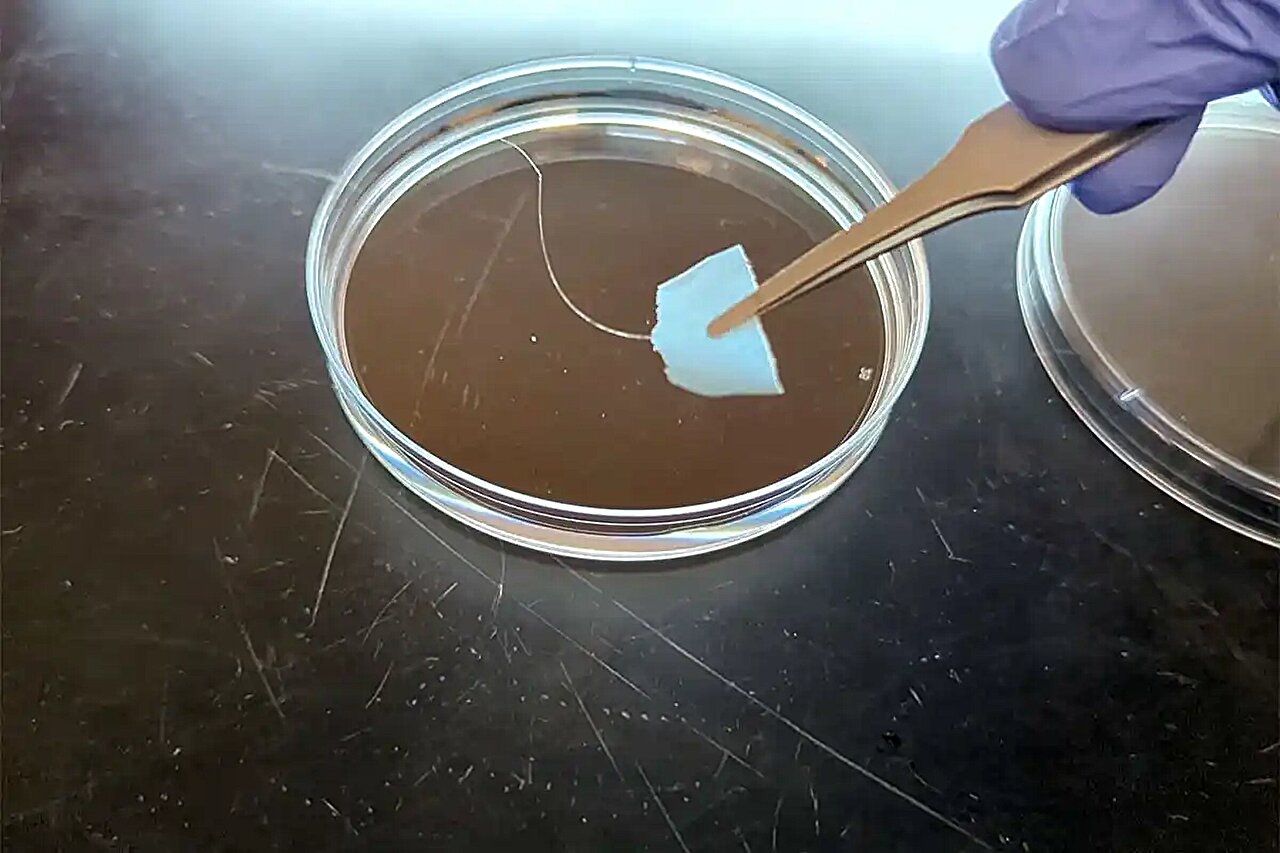
The textile industry generates massive global waste, with only about 12% of fiber materials currently recycled—and synthetic fabrics continue to shed microplastics with every wash. Now, engineers at Washington University in St. Louis have developed a new class of protein-based fibers that can be dissolved and remade repeatedly, potentially offering a true closed-loop alternative to petrochemical textiles.
The modern textile industry is producing an enormous amount of waste, and most of it never gets reused. Only about 12% of fiber materials end up being recycled, leaving the vast majority to pile up in landfills or enter waste streams.
But the problem goes beyond discarded clothing.
Synthetic textiles also contribute heavily to microplastic pollution. During every wash cycle, petrochemical-based fibers shed tiny plastic particles that flow down drains and eventually reach aquatic environments, including oceans. Even if recycling rates improve, these materials still release persistent microplastics throughout their life cycle.
That means the core issue isn’t only about how much textile waste exists—it’s also about what textiles are made of.
A New Fiber Concept Built in a Bioreactor
Engineers from Washington University in St. Louis believe they may have a better answer. In research led by Fuzhong Zhang, the Francis F. Ahmann Professor in the Department of Energy, Environmental & Chemical Engineering at the McKelvey School of Engineering, scientists developed protein-based materials designed for recycling from the start.
Their findings, published in Advanced Materials, describe fibers made using genetically engineered microbes grown in bioreactors—large tanks similar in concept to industrial brewing systems.
Instead of relying on petrochemical polymers, the team created fibers from engineered proteins that can be recovered, reused, and remade into the same material multiple times.
Even more importantly, if any microparticles are released during washing, those particles would be biodegradable, unlike conventional microplastics.
Fibers That Dissolve in Seconds—But Stay Strong in Water
One of the most striking features of the new material is how easily it can be recycled.
“We engineered recyclable protein fibers that dissolve in a formic acid solution within seconds, yet remain stable in water and strong after drying,” said Zhang.
That combination is crucial. If fibers dissolve too easily, they fall apart during normal use. If they’re too stable, they become difficult—or expensive—to recycle.
The researchers found a way to make the fibers resistant during everyday wear while still allowing rapid breakdown under controlled recycling conditions.
Why Formic Acid Makes the Recycling Work
The recycling process depends on a formic acid solution, which is already widely used in industry for animal feed preservation, leather processing, traditional textile dyeing, cleaning, and other applications.
In this case, the solvent plays a very specific role. It breaks down the protein interactions that hold the fiber structure together, but it does not chemically damage the proteins themselves.
That detail changes everything.
After the fibers dissolve, the formic acid can evaporate, leaving behind the raw protein material. That recovered protein can then be used to remake fibers with the same strength and properties as the original.
In other words, the process isn’t just “recycling” in the usual sense—it is a genuine reprocessing system that preserves the material’s performance.
The Recycling Problem That Has Defeated Plastics for Decades
The textile world’s dependence on petrochemical fibers mirrors the broader plastics problem: recycling often degrades the material.
Traditional plastics can be melted and reshaped, but the end product is frequently weaker—especially when additives or contamination are involved. Other advanced recycling approaches break chemical bonds and rebuild polymers through resynthesis, but those methods can raise both cost and emissions.
The central dilemma has remained consistent.
In general, the stronger a material is, the harder it is to recycle. The same molecular bonds that provide durability are often the ones that must be destroyed to recover the material.
That tradeoff has made truly circular materials difficult to achieve.
A Material Inspired by Mussels, Spider Silk, and Amyloids
To overcome that strength-versus-recyclability barrier, the Washington University team turned to biology.
They pulled genetic sequences from three natural protein sources—mussel foot proteins, spider silk, and amyloids (protein aggregations)—and combined them using advanced protein engineering. Their goal was to create a material where strength and recyclability could be adjusted separately.
The result was a hybrid protein-based material called SAM, short for silk–amyloid–mussel.
Each biological component plays a distinct role. The sticky sequences from mussels help determine how easily the fibers dissolve in formic acid. Meanwhile, spider silk and amyloid sequences provide strong interactions that allow the fibers to “reconnect” and regain structure after recycling.
Instead of sacrificing strength to achieve recyclability, the design aims to deliver both.
Engineering Recyclability Without Ruining Performance
The team didn’t just build a new material—they also fine-tuned how it behaves.
“We tune the mussel foot sequences to make SAM fibers recyclable while preventing them from shrinking when they get wet,” said Zhang.
That matters because shrinkage and instability in water would make the fibers unusable in everyday textile applications.
By controlling the mussel-inspired components, the researchers were able to maintain stability during normal exposure to moisture while still allowing rapid dissolution in the recycling solvent.
Multiple Recycling Cycles With Consistent Strength
A major test of any recycling system is whether the material can survive multiple cycles without degrading.
The researchers demonstrated that SAM fibers could be dissolved and remade multiple times while still producing fibers with consistently high strength.
That point is critical because many recycling systems fail after repeated use. Materials either weaken, lose structural integrity, or require increasing amounts of processing to restore performance.
In this case, the recycling process was shown to repeatedly regenerate fibers with the original properties intact.
Not Just Fibers: Recycled Proteins Can Become Hydrogels
The researchers also found that the recycled raw proteins are versatile.
Instead of only being remade into fibers, the recovered material can be repurposed into adhesive hydrogels for various applications. Those hydrogels can then be recycled again—back into fibers or into new hydrogels.
This suggests a broader manufacturing ecosystem where the same core biomaterial can be redirected into different product types without becoming waste.
Closed-Loop Recycling Could Cut the Cost of Biomanufacturing
Biomanufacturing is known to be expensive, and that cost has historically limited the market for bio-based materials. Researchers often had to focus on luxury or niche applications because producing protein-based materials at scale can be costly.
But the Washington University team argues that a closed-loop recycling model changes that economic equation.
If the same product can be recycled repeatedly into new fibers, the long-term material cost begins to drop sharply.
“Recycling the final product for multiple rounds can greatly reduce manufacturing costs over time,” Zhang concluded.
Instead of paying for fresh biomanufacturing each cycle, manufacturers could keep using the same protein resources again and again.
Why This Matters
Textile pollution is not just about overflowing landfills—it’s also about the invisible microplastic contamination created every time synthetic clothes are washed. With only 12% of fiber materials currently recycled, the world is facing both a waste problem and a long-term environmental contamination problem.
This new SAM protein fiber approach offers a different model: a textile material designed for repeated recycling without losing strength, using an industrially common solvent, and producing microparticles that would be biodegradable instead of persistent plastic.
If scalable, this kind of closed-loop fiber could represent a major step toward textiles that don’t just get reused—but are fundamentally engineered to avoid becoming pollution in the first place.
Study Details
Jingyao Li et al, Biosynthesized Silk‐Amyloid‐Mussel Proteins as Dissolution Recyclable Materials With Tunable Supercontraction, Advanced Materials (2026). DOI: 10.1002/adma.73200