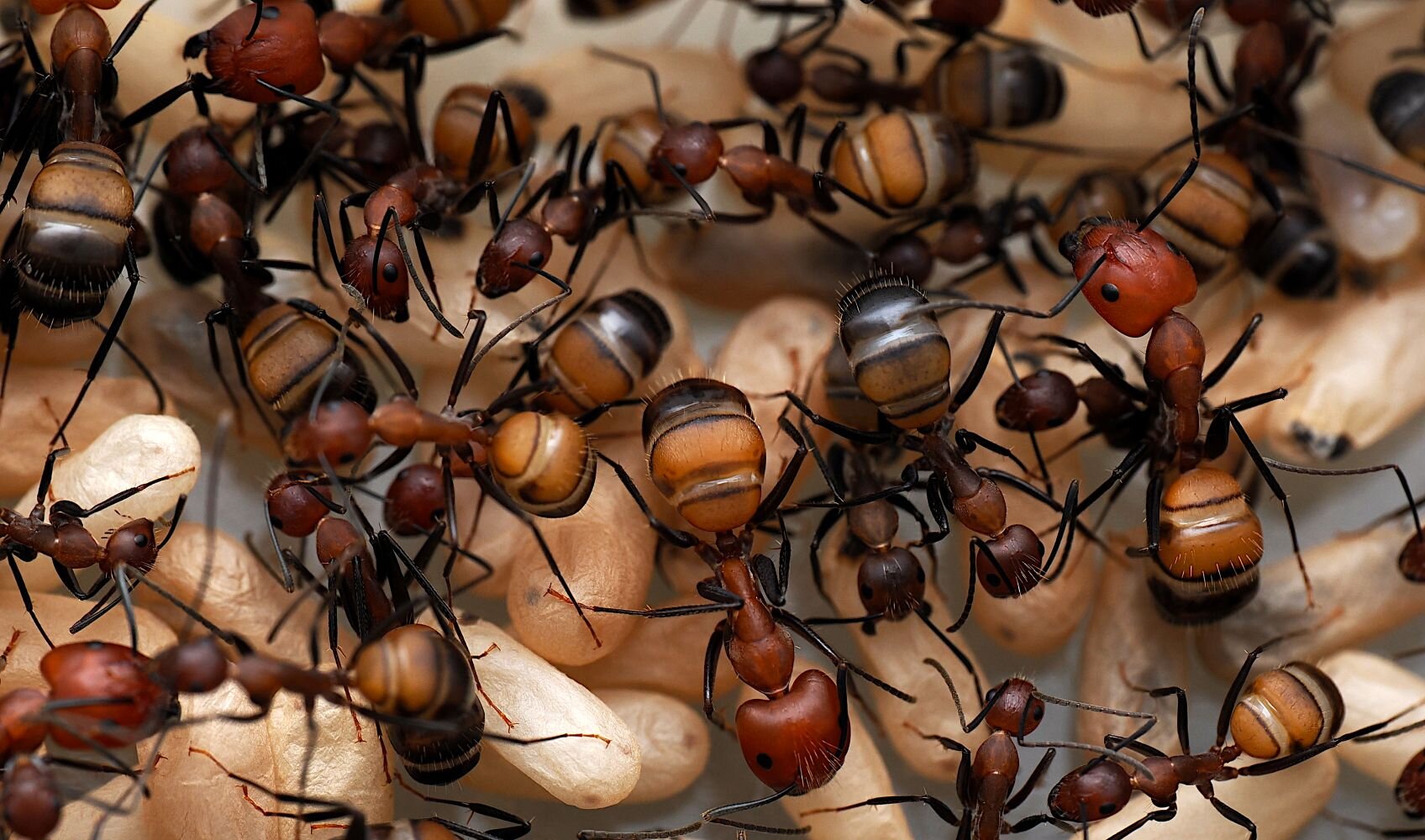
Carpenter ants may be carrying a far more sophisticated chemical arsenal than scientists once believed. A new study finds that their venom contains a diverse mixture of previously overlooked peptides—some with strong antifungal activity—suggesting the venom helps ants disinfect nests and defend their colonies long after formic acid fades.
Carpenter ants have long been known for one primary chemical weapon: formic acid. For centuries, researchers largely treated their venom as simple, predictable, and dominated by this one compound. But a new investigation suggests that assumption may have missed a major part of the story.
A research team led by scientists at Freie Universität Berlin and Martin Luther University Halle-Wittenberg reports that carpenter ant venom is packed with an unexpectedly complex collection of bioactive substances, including dozens of peptide compounds. The findings, published in Science Advances, could expand scientific understanding of insect immunity—and potentially offer new directions for medical research.
A centuries-old assumption gets challenged
Formic acid was first isolated from Formica ants in the seventeenth century, and its discovery shaped how scientists understood ant venom for generations. Since it was clearly toxic and chemically easy to identify, it became the dominant explanation for how these ants defend themselves and protect their colonies.
Although some earlier studies had hinted that peptidic compounds might exist in the venom, those reports were mostly ignored or treated as minor side notes.
That changed when researchers revisited one such overlooked publication.
“In our project, we investigated a decades-old publication that received little attention in its time,” said project leader Timo Niedermeyer, professor of pharmaceutical biology at Freie Universität Berlin’s Institute of Pharmacy. That old paper contained a key claim: carpenter ant venoms might contain peptides.
The new team decided to test that claim directly—and at scale.
Thirty-five venom peptides discovered across eight ant species
To investigate the true chemical composition of carpenter ant venom, the researchers analyzed venom from eight geographically distant species of carpenter ants.
What they found was striking.
Across these species, they identified thirty-five peptides, which they named formicitoxins. These peptides belonged to two gene families, suggesting they are not random chemical byproducts but structured venom components with a genetic basis.
While the exact mix of formicitoxins varied depending on the species, the peptides were widespread. That consistency strongly suggests the peptides are not rare exceptions—they are likely a standard feature of carpenter ant venom.
As Niedermeyer explained, this means carpenter ant venom is “considerably more complex than previously assumed.”
Venom as a colony hygiene tool, not just a weapon
The study also reinforces the idea that ant venom is not only meant for attack or defense. In social insects like ants, survival depends heavily on controlling microbial threats inside crowded nests.
The researchers report that carpenter ants actively spread venom onto their brood and around the nest environment. This behavior suggests venom is used as a sanitation tool.
Formic acid has known antimicrobial effects, but those effects may be short-lived. The newly identified peptides may extend the venom’s protective power well beyond the moment it is applied.
The researchers propose that formicitoxins may strengthen an external immune defense system that continues to function even after the immediate antimicrobial action of formic acid loses potency.
In other words, carpenter ants may be using venom not just as a quick chemical strike, but as a longer-lasting microbial control system.
Some peptides show remarkable antifungal activity
One of the most important findings involves the biological activity of these peptides.
According to the researchers, several of the newly identified peptides showed remarkable antifungal properties. That matters because fungal threats can be especially dangerous in dense social insect communities, where infections can spread quickly through shared spaces and close contact.
Dr. Simon Tragust, project lead at the Institute of Biology at Martin Luther University Halle-Wittenberg, emphasized that these results become even more relevant when viewed through a broader lens.
He pointed to the dangers posed by environmental microbes and pathogens in ant colonies, while also highlighting the growing issue of microbial resistance affecting humans.
The study also notes the enormous scale of potential future discoveries. The Formicinae subfamily includes more than 3,700 species, meaning researchers have barely scratched the surface of what kinds of venom compounds might exist across this group.
Venom with multiple functions inside ant society
The findings also support the idea that carpenter ant venom is multifunctional—designed not just for combat, but for daily colony management.
According to the study, carpenter ants use venom for defense, but also to disinfect their surroundings. The venom also plays a role in acidifying the ants’ gut, which may influence microbial selection. Additionally, venom appears to serve a communication function between ants.
This combination of roles suggests the venom is less like a single-purpose toxin and more like a versatile biochemical toolkit shaped by evolution for life in complex social systems.
How scientists uncovered the hidden chemistry
To reveal the true complexity of the venom, researchers relied on an interdisciplinary approach combining biology, chemistry, and pharmacy.
They used a proteotranscriptomic approach, merging protein data with RNA data from venom and related tissues. This allowed them to identify individual peptides and determine their genetic sequences.
The team also conducted chemical analyses, ran bioactivity assays, and even synthesized formicitoxins themselves in order to test their properties more directly.
To better understand how these venom components evolved and how they are structured, the researchers used biophysical experiments, genome analyses, and computer-assisted modeling.
Because the study examined venom from multiple ant colonies and used a broad range of analytical methods, the researchers describe it as one of the most comprehensive comparative studies of ant venom conducted so far.
Why this matters
This discovery reshapes how scientists understand carpenter ants and their defenses, revealing that their venom is not a simple formic acid spray but a complex chemical system containing 35 newly identified peptides with significant biological activity. Beyond insect biology, these findings open new possibilities for medical research by expanding the catalog of natural bioactive substances—especially those with antifungal properties. Just as importantly, the study offers a clearer view of how social insect communities defend themselves against microbes, providing new insight into immune defense strategies that operate outside the body, at the colony level.
Study details
Lukas Koch et al, Beyond formic acid: Peptides in carpenter ant venoms aid in disease protection, Science Advances (2026). DOI: 10.1126/sciadv.aed4078