Researchers at the University of Pennsylvania have demonstrated a new way to switch light signals using almost no energy, potentially removing one of the biggest obstacles in photonic computing. By using a hybrid quasiparticle called an exciton–polariton, the team achieved all-light switching at just 4 quadrillionths of a joule, a level of efficiency that could be crucial for future AI hardware. The breakthrough may allow photonic chips to handle key computing operations without repeatedly converting light into electricity.
Eighty years after the invention of ENIAC helped launch the modern era of electronic computing, scientists at Penn are now exploring a future where electrons may no longer carry the full burden of computation.
And the reason is simple: today’s computing demands—especially those driven by artificial intelligence—are pushing electronic hardware closer to its practical limits.
The Problem With Electrons in Modern Computing
When Penn researchers J. Presper Eckert and John Mauchly built ENIAC, they unlocked a new era by using electrons to solve complex numerical problems. That breakthrough laid the foundation for the architecture still used in general computing today.
But the very thing that makes electrons useful—their electric charge—also creates growing challenges as computing becomes more powerful and compact.
Because electrons carry charge, they generate heat as they move through materials. They encounter resistance, and they become increasingly difficult to manage as chips pack in more transistors and handle ever-larger streams of data.
With AI accelerating the demand to process, move, and cool enormous amounts of information, researchers are now looking for a better carrier of information—one that avoids the physical bottlenecks of electrical systems.
Why Photons Look Like the Future
Instead of relying entirely on electrons, Penn physicists led by Bo Zhen in the School of Arts & Sciences are turning to photons—the massless particles of light.
Photons have clear advantages.
According to Li He, co-first author of a new study published in Physical Review Letters and a former postdoctoral researcher in the Zhen Lab, photons are charge-neutral and have zero rest mass, allowing them to carry information quickly over long distances with minimal loss.
This is why photons already dominate communications technology.
However, the same properties that make photons efficient for sending data also make them difficult to use for computing.
Because they are neutral, photons barely interact with their environment. That means they don’t naturally perform the strong signal interactions required for the switching logic that computers depend on.
In other words, light is excellent for moving information—but traditionally poor at making decisions with it.
The Key Breakthrough: Making Light Interact Like Matter
Zhen’s team addressed this limitation by creating a quasiparticle designed to bridge the gap between light-speed transmission and matter-based interaction.
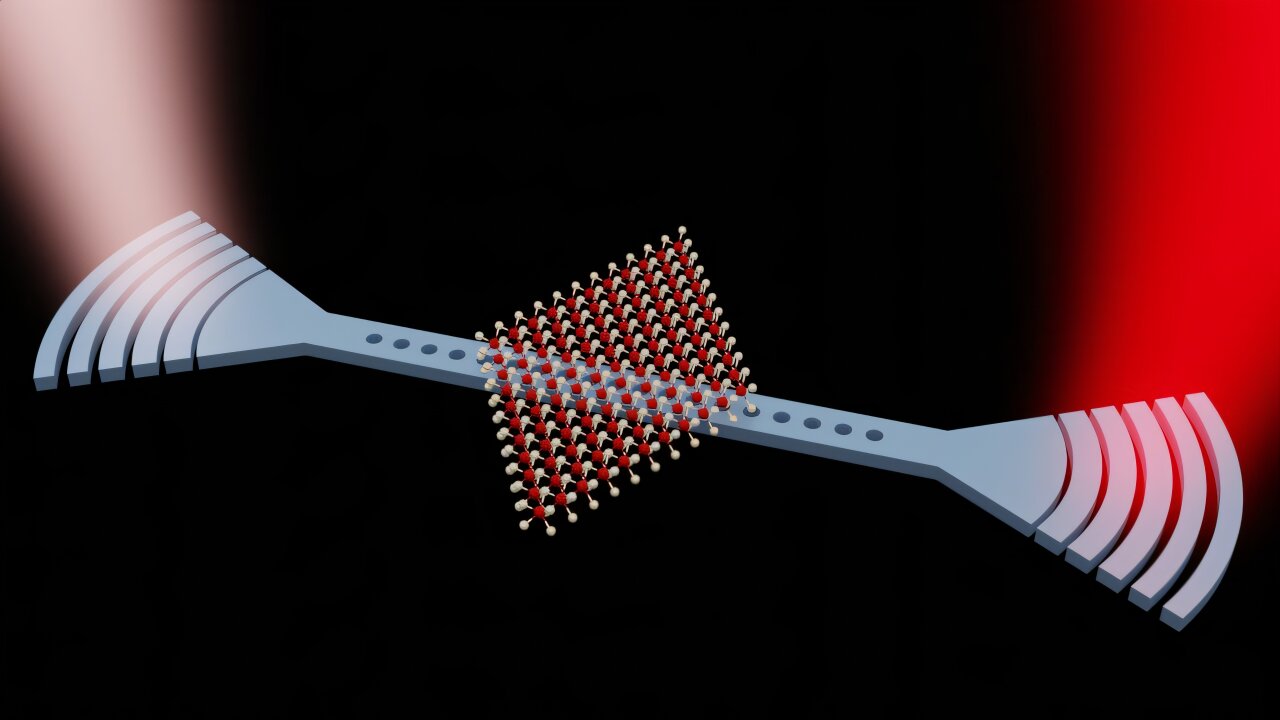
They developed exciton–polaritons, quasiparticles formed by coupling photons with electrons inside an atomically thin semiconductor.
This coupling changes the behavior of light dramatically. Instead of passing through with minimal interaction, photons gain access to the strong interaction properties of matter—allowing them to influence one another in a way that supports switching.
The team describes this quasiparticle as something that “combines the speed of light with the strong interactions of matter.”
That combination is critical, because switching is at the heart of computation. Without reliable switching behavior, light-based processors cannot fully replace electronic ones.
Solving a Major Bottleneck in Photonic AI Chips
The advance may be especially important for artificial intelligence hardware.
Many photonic AI chips can already handle straightforward calculations using light. But Zhen explains that when these chips reach nonlinear activation steps—such as applying decision rules—they often run into a major limitation.
They must convert the light signal back into electronic form.
That conversion is costly.
Once the signal becomes electronic again, it slows down and consumes more energy. Then, if the system continues processing optically, it must convert back to light. This repeated translation between photons and electrons reduces the speed advantages of photonic computing and undermines the energy savings that make it appealing in the first place.
The exciton–polariton approach directly targets that problem by enabling all-light switching, which allows signals to remain in photonic form even during switching operations.
Switching Light Using Only 4 Quadrillionths of a Joule
Using exciton–polaritons, the researchers demonstrated all-light switching at approximately 4 quadrillionths of a joule.
That is an extraordinarily small amount of energy.
The team notes that this is far less energy than what is required to briefly power a tiny LED light. While LEDs are already considered efficient, the comparison highlights just how low this switching energy is.
This level of energy efficiency is particularly significant because switching operations are repeated constantly in computing. Even small improvements per switch can translate into major reductions in power consumption when scaled across large systems.
What This Could Enable If Scaled
If this exciton–polariton platform can be scaled, the implications could be wide-reaching.
One potential advantage is that photonic chips could process light signals directly from cameras. Instead of capturing an image and converting it into electronic data for processing, future systems might keep the information in optical form throughout more of the pipeline.
The platform could also reduce the power demands of large AI systems. With AI workloads growing rapidly, energy consumption and cooling requirements are becoming increasingly central constraints for hardware development.
Beyond AI, the researchers suggest that the same approach could help pave the way for basic quantum computing capabilities on chips.
While the study focuses on photonic switching, the ability to perform complex signal logic in optical systems could become a stepping stone toward more advanced computing architectures.
Why This Matters
The modern world still runs on the same fundamental computing approach introduced during the ENIAC era: electrons moving through circuits. But as AI drives unprecedented computing demand, that architecture is increasingly strained by heat, resistance, and energy loss.
This research offers a possible route toward photonic chips that don’t just transmit data with light, but also compute with light—efficiently and directly.
By demonstrating all-light switching using exciton–polaritons at just 4 quadrillionths of a joule, Penn researchers have shown a way to reduce the need for energy-hungry conversions between optical and electronic systems.
If the technology can be scaled, it could make future AI computing faster, cooler, and far less power-intensive—an advance that could shape the next era of computing just as ENIAC once did.
Study Details
Zhi Wang et al, Strongly Nonlinear Nanocavity Exciton Polaritons in Gate-Tunable Monolayer Semiconductors, Physical Review Letters (2026). DOI: 10.1103/gc15-qsvf