New research published in Physical Review Letters suggests that an ultra-fast neutrino process called fast flavor conversion may determine whether a collapsing massive star successfully explodes as a supernova or collapses without an explosion. Using advanced simulations, researchers found the effect depends strongly on the star’s mass accretion rate—sometimes boosting the explosion and other times suppressing it.
When a massive star dies, the final outcome may hinge on something almost impossible to observe directly: a rapid, microscopic reshuffling of neutrinos happening in fractions of a second and across distances smaller than a human hand.
In new research led by Ryuichiro Akaho of Waseda University in Tokyo, scientists report compelling evidence that a rare and extreme form of neutrino behavior could be a decisive factor in whether a collapsing star erupts into a supernova or collapses quietly without a dramatic blast.
The key player is a phenomenon called fast flavor conversion, and according to the team’s findings, it may be acting like a hidden switch inside one of the universe’s most violent events.
The Strange Physics of Neutrino “Flavors”
Neutrinos are famously elusive particles, but they are produced in enormous quantities during extreme cosmic events. One of their most unusual traits is their ability to spontaneously switch between three different types, known as “flavors,” in a process called neutrino oscillation.
While neutrino oscillation is known to occur, it remains poorly understood under the extreme conditions found inside collapsing stars. Yet those conditions matter, because neutrinos are not just byproducts of a dying star—they can actively shape what happens next.
In a collapsing stellar core, neutrinos play a crucial role in determining whether the star explodes.
What Happens When a Massive Star Collapses
When a massive star runs out of nuclear fuel, it can no longer support itself against gravity. Its core collapses inward and forms an intensely hot and dense object called a proto-neutron star.
This collapse generates a shockwave. But a shockwave alone is not enough to guarantee a supernova explosion. It must be powered and sustained.
That’s where neutrinos come in.
The collapsing core produces neutrinos in huge numbers, and these neutrinos can deposit energy into the surrounding material. If enough energy is delivered, the shockwave gains strength and the star blows apart in a core-collapse supernova.
But there’s a catch: not all neutrino flavors interact with matter in the same way.
Only certain flavors can effectively transfer energy to the material around the proto-neutron star. If neutrinos switch flavors at the wrong moment, the energy transfer weakens, and the explosion can stall.
This means neutrino oscillation is not just a detail—it may be central to whether the star lives out its final moments as a spectacular explosion or a failed collapse.
The “Fast Flavor Conversion” Problem Scientists Couldn’t Easily Study
One specific form of neutrino oscillation has long been suspected to be especially important in supernovae: fast flavor conversion.
In this process, dense swarms of neutrinos trigger collective flavor switching at extraordinary speed. Theoretically, researchers have expected this to be significant during core-collapse events, but it has been extremely difficult to study in detail.
The main challenge is scale.
Fast flavor conversion can occur over distances of just centimeters and on timescales of nanoseconds—far smaller than what most modern supernova simulations can resolve. In other words, the phenomenon may be happening constantly inside collapsing stars, but standard models simply can’t “see” it.
As a result, even though fast flavor conversion has been predicted by theory, its real impact on whether stars explode has remained uncertain.
Building Models That Could Capture the Missing Physics
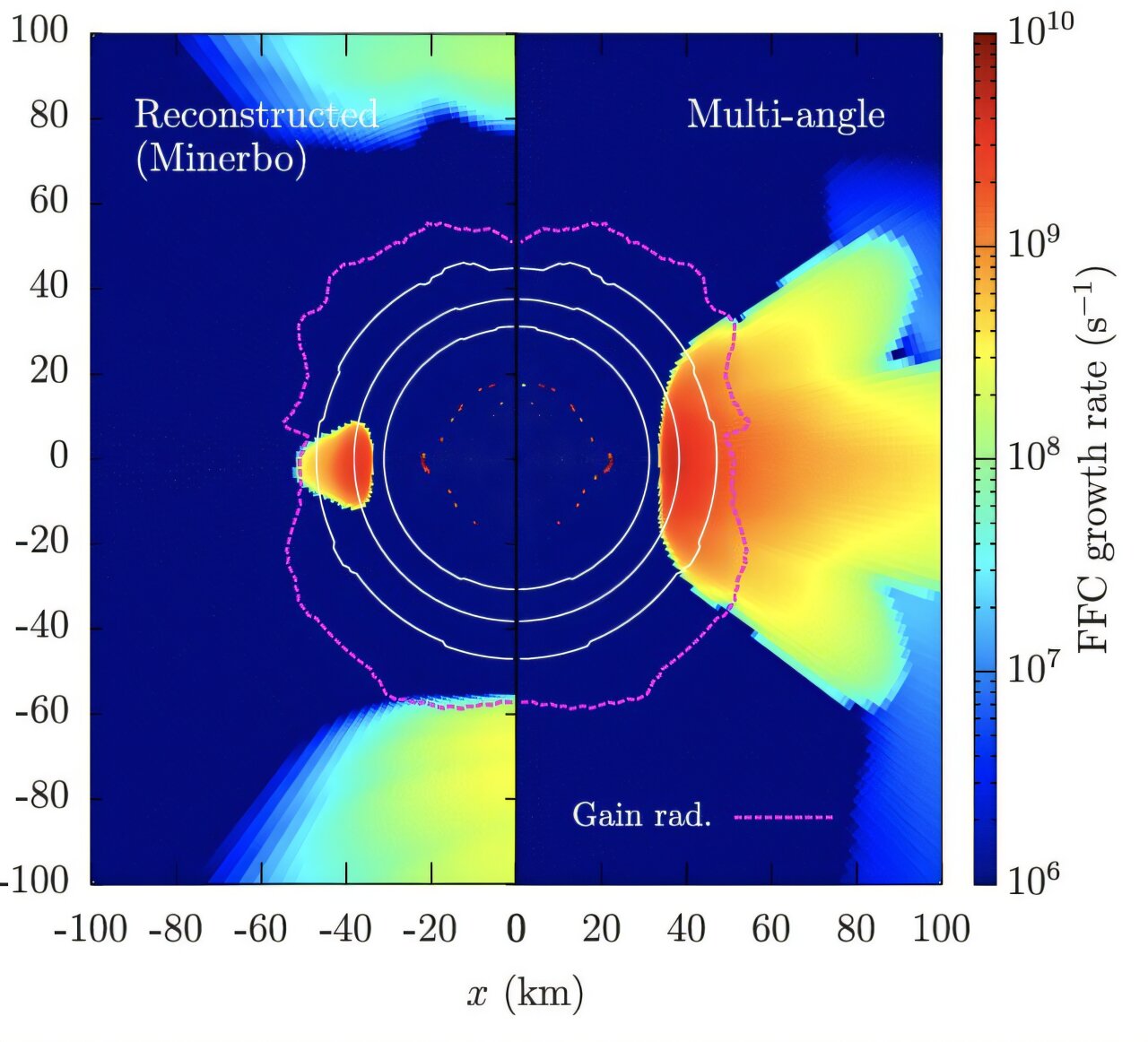
To tackle the problem, Akaho’s team built theoretical models of collapsing stars across a range of masses. The key difference in their approach was that they incorporated a detailed treatment of fast flavor conversion into simulations that track neutrino movement and interactions in all directions.
This was a major computational step beyond standard techniques.
The team’s method required significantly more computing power, but it allowed them to capture neutrino distributions in much greater detail and with fewer simplifying assumptions.
That added realism mattered, because neutrino behavior is highly sensitive to the extreme environment inside a collapsing star.
The Critical Factor: Mass Accretion Rate
After running their calculations, the researchers found a striking pattern: the impact of fast flavor conversion depends heavily on how quickly matter falls inward onto the proto-neutron star.
This quantity is known as the mass accretion rate.
When the mass accretion rate is low, fast flavor conversion increases the amount of energy neutrinos deposit into surrounding material. That extra heating helps power the shockwave, improving the odds that the star will explode.
But when the mass accretion rate is high, the effect flips.
In those cases, fast flavor conversion reduces the star’s overall neutrino output enough to weaken the heating process, suppressing the explosion rather than strengthening it.
In short, the same neutrino phenomenon can either help ignite a supernova or help shut it down—depending on the conditions of the collapse.
Why Simplified Neutrino Models May Mislead Astronomers
Beyond identifying fast flavor conversion as a major influence, the study also delivers a warning about how neutrinos are treated in many simulations.
Akaho’s team found that simpler, less detailed neutrino modeling approaches can fail in two different ways. They can miss genuine fast flavor conversion when it is actually occurring. And they can also falsely predict fast flavor conversion in situations where it does not exist.
Either error could distort predictions of whether a star successfully explodes or collapses silently.
This is not a minor modeling detail. It affects how researchers interpret the fate of massive stars, and how they connect theoretical simulations to real observations of supernovae.
A Computationally Expensive Future for Supernova Science
The results suggest that understanding stellar explosions at a deeper level may require a new generation of computational models—ones that can capture fast neutrino flavor changes with greater realism.
That comes with a cost.
Akaho’s team emphasized that incorporating fast flavor conversion requires more sophisticated calculations and significantly heavier computational workloads than standard simulation methods.
But the study suggests the payoff may be necessary: without capturing this physics accurately, astronomers may not be able to reliably predict which collapsing stars explode and which do not.
Why This Matters
Supernovae are among the most important events in astrophysics, shaping the evolution of stars and galaxies. But scientists still do not fully understand why some collapsing massive stars explode while others fail.
This study points to fast flavor conversion as a critical missing piece—one that can either strengthen or suppress a supernova depending on the mass accretion rate.
If confirmed and incorporated into future simulations, this work could reshape how researchers model stellar death, helping explain why supernova outcomes vary so dramatically. It also highlights a deeper reality: even the most powerful explosions in the universe may be decided by physics unfolding on the tiniest scales imaginable.
Study Details
Ryuichiro Akaho et al, Bifurcated Impact of Neutrino Fast Flavor Conversion on Core-Collapse Supernovae Informed by Multiangle Neutrino Radiation Hydrodynamics, Physical Review Letters (2026). DOI: 10.1103/fksy-1jtw. On arXiv: DOI: 10.48550/arxiv.2601.08269