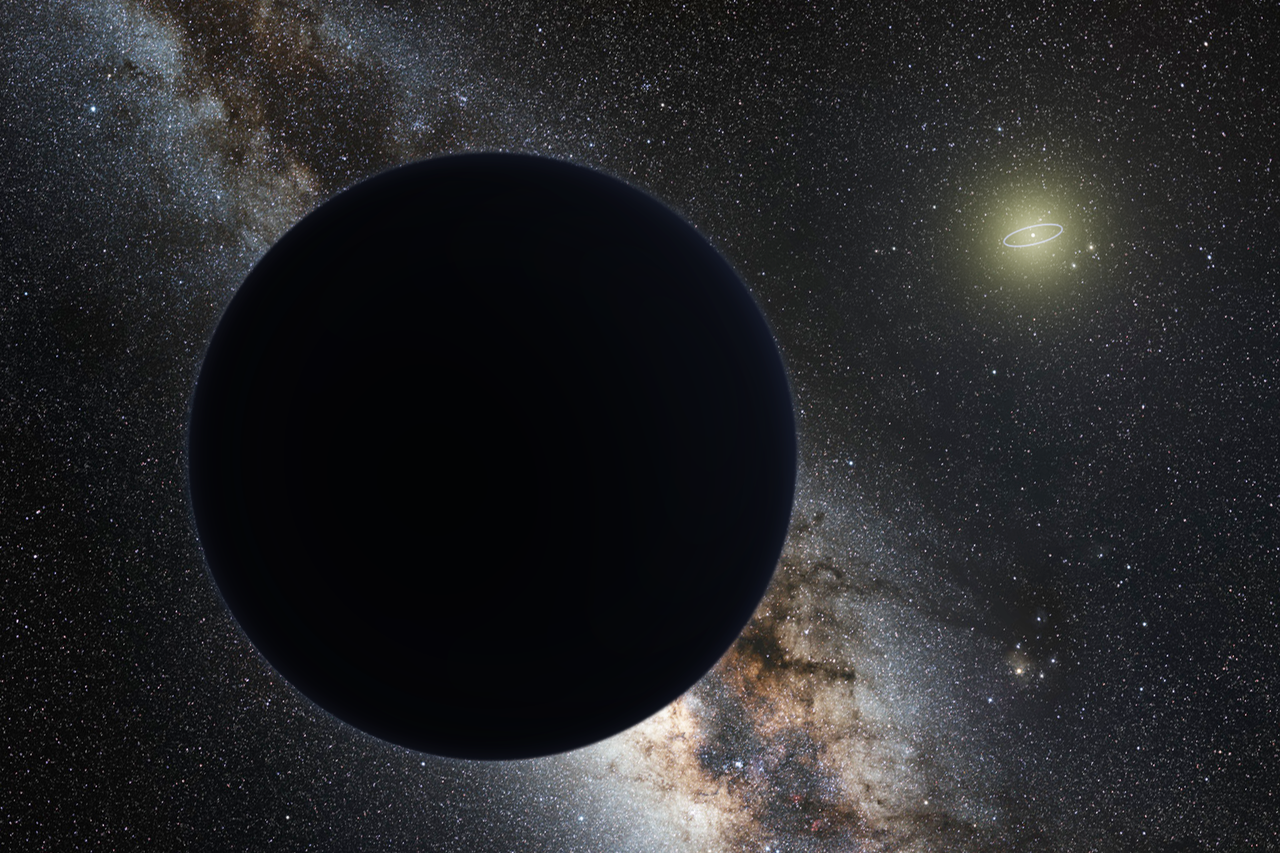
Somewhere far beyond Neptune, in a realm where sunlight is little more than a pale memory, the Solar System may still be hiding a secret. Not a small secret like an undiscovered asteroid or a distant icy rock, but something far more dramatic—a massive planet, possibly several times heavier than Earth, moving silently through the deep freeze at the edge of our cosmic neighborhood.
This hypothetical world is known as Planet 9.
It is not an officially confirmed planet. No spacecraft has photographed it. No telescope has directly seen it. And yet, for nearly a decade, Planet 9 has lingered in scientific discussions like a shadow at the edge of vision, because the Solar System’s most distant objects seem to behave as if something big is out there, shaping their orbits with invisible gravitational hands.
The idea is as thrilling as it is unsettling. Humanity has spent centuries mapping the Solar System, naming planets, and charting their motions with precision. We have landed robots on Mars, flown past Pluto, and sent probes beyond the Sun’s influence. It feels like the era of discovering new planets in our own system should be over.
But physics has a way of humbling certainty. If Planet 9 exists, it would mean the Solar System is still incomplete in our minds, still holding a major piece of its puzzle beyond the limits of ordinary sight.
The Outer Solar System: A Cold Frontier Beyond Neptune
To understand why Planet 9 matters, it helps to understand the landscape where it might be hiding.
Beyond the orbit of Neptune lies the Kuiper Belt, a vast region filled with icy bodies and dwarf planets. Pluto is the most famous member, but it is far from alone. Thousands of Kuiper Belt Objects, or KBOs, orbit the Sun at distances that can range from about 30 to over 50 astronomical units. One astronomical unit is the average distance between Earth and the Sun.
Beyond even the Kuiper Belt is the scattered disk, where objects have much more stretched-out orbits. Some swing relatively close to the Sun and then dive far outward into darkness. Still farther out is the hypothesized Oort Cloud, a gigantic spherical shell of icy debris that may extend tens of thousands of astronomical units away.
This is not empty space. It is a deep cosmic wilderness, where frozen worlds drift slowly in immense orbits that can take centuries, thousands of years, or even longer to complete.
And it is here, in this vast frozen territory, that the possibility of Planet 9 was born.
The Strange Clues: Why Scientists Began Suspecting a Hidden Planet
Planet 9 is not an idea pulled from imagination alone. It emerged because astronomers noticed something peculiar about a group of distant Solar System objects.
Some of the most extreme trans-Neptunian objects—small worlds far beyond Neptune with unusually elongated orbits—seemed to cluster in a strange way. Their orbits were not randomly oriented, as one might expect from objects scattered by gravitational interactions over billions of years. Instead, several appeared to have orbital paths aligned in a similar direction.
In a Solar System shaped only by the known planets, such alignment should not last long. Over time, gravitational nudges from the giant planets should randomize their orientations. The fact that multiple objects seemed to point in roughly the same direction suggested something was keeping them organized.
The leading explanation was gravity. Something massive, distant, and unseen might be shepherding these objects, shaping their orbits and preventing them from spreading out into random patterns.
In 2016, astronomers Konstantin Batygin and Michael E. Brown published research arguing that the observed clustering could be explained by a planet roughly five to ten times the mass of Earth, orbiting far beyond Neptune on a highly elongated path.
The concept immediately captured attention, partly because it was scientifically plausible and partly because it sounded like a return to the romantic era of discovery, when new planets were still being found in our own backyard.
But Planet 9 is not a simple story of “we think there’s a planet out there.” It is a story of gravitational fingerprints, statistical debates, observational challenges, and the unsettling possibility that our Solar System is more complex than we believed.
What Planet 9 Might Be Like
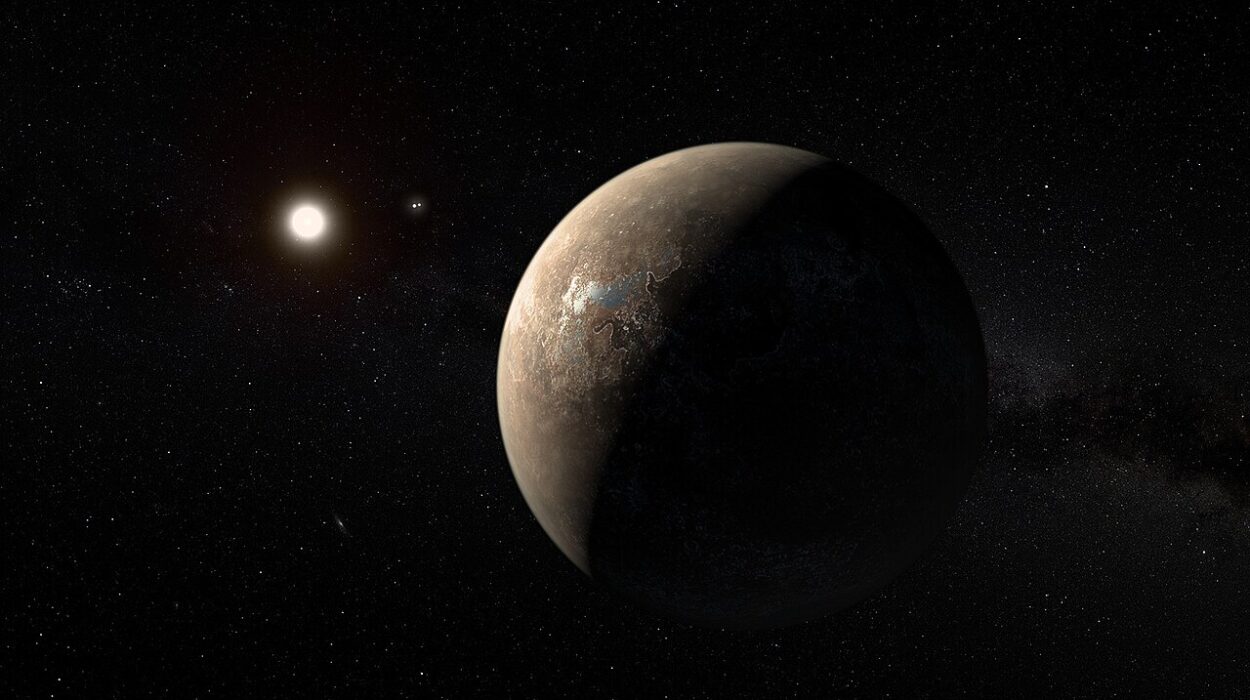
If Planet 9 exists, it is likely not a gas giant like Jupiter or Saturn. It would probably be something in between—a type of planet astronomers call a super-Earth or mini-Neptune.
A super-Earth is a planet larger than Earth but smaller than Uranus and Neptune. These worlds are common in other planetary systems, but interestingly, our Solar System does not have one. Earth is the largest rocky planet here, and then the next jump in size is Neptune, which is about 17 times Earth’s mass.
Planet 9, if it exists, might fill this missing category.
Scientists have estimated that it could have a mass around five to ten Earth masses, possibly with a thick atmosphere of hydrogen and helium. It might have an icy or rocky core wrapped in deep layers of gas. Or it could be a frozen, dense planet with a strange chemistry shaped by extreme cold.
Its orbit would likely be far from circular. Instead, it may follow an elongated path that carries it hundreds of astronomical units away from the Sun, perhaps as far as 600 to 1,000 astronomical units at its most distant point.
At those distances, sunlight is incredibly weak. The sky would still be black even at “daytime.” The Sun would appear as an unusually bright star, not a blazing disk. Temperatures would be unimaginably low, colder than anything on Pluto.
If Planet 9 is real, it would not be a world of oceans and clouds like Earth. It would be a silent, frozen giant, drifting in near-total darkness.
Yet even in that darkness, its gravity could still dominate the architecture of distant orbits, like a hidden conductor shaping a cosmic symphony.
Gravity as Evidence: How an Invisible Planet Can Reveal Itself
One of the most remarkable aspects of physics is that you can detect something without seeing it, simply by observing how it affects other things.
This is how Neptune itself was discovered. In the 19th century, astronomers noticed that Uranus’s orbit did not match predictions. Something was pulling on it. By calculating the likely source of the disturbance, scientists predicted the location of a new planet. Neptune was later observed almost exactly where it was expected to be.
Planet 9 is a similar kind of hunt, but much more difficult.
Neptune’s influence on Uranus was relatively strong and measurable because Neptune is large and not extremely far away. Planet 9, if it exists, would be far more distant and much dimmer than anything previously discovered through such methods.
Still, its gravitational influence could explain several puzzling orbital features in the outer Solar System.
The strongest evidence suggested so far is the apparent clustering of orbital elements among a set of extreme trans-Neptunian objects. In addition, some objects appear to have unusual inclinations, orbiting at angles tilted relative to the plane in which most planets orbit. A distant massive planet could potentially explain why such tilted orbits exist.
If Planet 9 is there, it would be shaping the Solar System not through brightness, but through force.
It would be an object that reveals itself not by light, but by motion.
The Controversy: Is the Clustering Real or an Illusion?
The Planet 9 hypothesis is exciting, but it is not universally accepted. Many astronomers have raised an important objection: what if the clustering is not real?
Detecting distant objects in the outer Solar System is extremely difficult. These objects are faint, slow-moving, and often only visible with powerful telescopes under ideal conditions. Observations are also biased. Telescopes tend to scan certain parts of the sky more than others, and researchers may detect objects preferentially in regions that are easier to observe.
This creates what is known as observational bias. If astronomers are more likely to find objects in certain areas of the sky, then it might look like those objects are clustered even if, in reality, their orbits are randomly distributed.
Some studies have suggested that the evidence for clustering may weaken when observational bias is properly accounted for. Other studies argue that the clustering remains significant even after such corrections.
This debate is central to the Planet 9 story. It is not just a question of whether a planet exists, but whether the evidence is truly pointing to something real, or whether we are seeing patterns that are partially created by the limitations of our surveys.
In science, excitement is never enough. The universe does not care what we want to be true. Planet 9 must be proven, not imagined.
Alternative Explanations: Could Something Else Be Causing the Strange Orbits?
If Planet 9 does not exist, then something else must explain the orbital oddities in the distant Solar System.
One possibility is that the combined gravitational effects of many smaller objects could create a similar pattern. Instead of one massive planet, perhaps there is a disk of icy bodies beyond Neptune with enough total mass to influence the orbits of extreme objects.
Another possibility involves the early history of the Solar System. Perhaps long ago, the Sun passed near another star in its birth cluster. Such a close encounter could have disturbed the outer Solar System and left behind strange orbital alignments that persist today.
Some researchers have also explored the possibility that the Sun captured an object from another star system. In the chaotic early days when stars were forming close together, gravitational interactions could have allowed the Sun to steal a planet-sized body from a neighbor. That captured object could now be Planet 9, orbiting far away on a stretched path.
There are even more exotic proposals, including the idea that the apparent effects could come from modified theories of gravity rather than an unseen planet. However, such ideas are generally less favored, because the laws of gravity have been tested extremely well within the Solar System.
The simplest explanation remains a planet. But science does not reward simplicity alone. It rewards explanations that match evidence.
Why Planet 9 Would Be a Major Scientific Revolution
If Planet 9 is confirmed, it would be one of the most significant discoveries in planetary science in modern history.
For one thing, it would be the first major planet discovered in our Solar System since Neptune in 1846. Pluto was discovered in 1930, but it was later reclassified as a dwarf planet. Planet 9, by contrast, would likely be massive enough to be unquestionably planetary.
It would also reshape our understanding of how planets form.
Current models of Solar System formation suggest that planets formed from a rotating disk of gas and dust around the young Sun. Close to the Sun, rocky planets formed. Farther out, giant planets formed by collecting gas and ice. But forming a super-Earth far beyond Neptune would be difficult under standard models, because the material out there would have been too sparse and too spread out.
So if Planet 9 exists, it raises a deep question: how did it get there?
Did it form closer in and get thrown outward by gravitational interactions with Jupiter or Saturn? Did it form in place through some unusual mechanism? Was it captured from another system?
Each possibility would force scientists to rethink the Solar System’s early evolution.
Planet 9 would not just be a new planet. It would be a new chapter in the Solar System’s origin story.
The Search: Why Haven’t We Seen It Yet?
If a planet several times Earth’s mass exists out there, why hasn’t anyone found it?
The answer is brutally simple: distance makes everything hard.
Even a large planet reflects very little sunlight when it is hundreds of astronomical units away. Light fades dramatically with distance. The brightness of an object decreases with the square of its distance from the Sun, and then again with the square of its distance from Earth. This means a distant planet becomes incredibly dim very quickly.
Planet 9 could be so faint that even powerful telescopes would struggle to detect it unless they were looking in the right place.
And that is another major challenge: we do not know where it is.
The predicted orbit is large and elongated, meaning Planet 9 could currently be anywhere along a vast path that spans a huge region of the sky. Searching for it is like searching for a moving needle in a cosmic haystack.
To make matters worse, the planet would move very slowly against the background stars. Objects close to Earth show noticeable movement over hours or days. A distant planet might require weeks or months of observation to confirm that it is not just a faint star.
Modern sky surveys have improved dramatically, but the search remains difficult and time-consuming.
The planet could be hiding in a part of the sky that has not yet been thoroughly scanned, or it could be in a region crowded with stars from the Milky Way, where faint objects are harder to distinguish.
It is not that Planet 9 is impossible to see. It is that the Solar System’s outskirts are enormous, and our eyes, even with advanced technology, are still limited.
The Role of Modern Telescopes and Sky Surveys
The hunt for Planet 9 is closely tied to modern astronomical technology.
Large telescopes equipped with sensitive digital detectors can scan the sky and search for faint moving objects. Surveys such as Pan-STARRS and the Dark Energy Survey have already discovered many distant trans-Neptunian objects, helping refine the debate.
But the most anticipated tool for the Planet 9 hunt is the Vera C. Rubin Observatory, formerly known as the Large Synoptic Survey Telescope. Rubin is designed to repeatedly scan the entire visible sky with extraordinary sensitivity, creating a detailed time-lapse record of the heavens.
This kind of survey is ideal for detecting faint moving objects, including distant planets.
If Planet 9 exists and is within Rubin’s detection range, it may be found not through a single dramatic photograph, but through patient, systematic scanning—an algorithm quietly noticing that a faint dot shifted slightly over months.
In a way, Planet 9 represents a modern kind of discovery. It is not an astronomer peering through an eyepiece and spotting a new world. It is a combination of physics, statistics, massive data sets, and computational analysis.
The romance of discovery remains, but the method has evolved.
What Would Planet 9 Mean for Pluto and the Kuiper Belt?
The existence of Planet 9 could explain many mysteries in the Kuiper Belt and beyond.
For decades, Pluto seemed like an odd outlier—a small world with an unusual orbit, tilted relative to the planets. Then astronomers began discovering many other objects with similar characteristics, revealing that Pluto is part of a larger population.
If Planet 9 is real, it could be one of the architects of this region. Its gravitational influence might explain why some Kuiper Belt objects have highly eccentric orbits, why some have strange inclinations, and why the distant Solar System looks so dynamically sculpted rather than random.
It could even influence the distribution of comets that occasionally enter the inner Solar System.
In other words, Planet 9 could be the missing gravitational ingredient that helps make sense of the Solar System’s outer structure.
The Kuiper Belt might not just be a leftover debris field. It might be a system shaped by a hidden giant.
The Emotional Power of a Hidden Planet
Beyond the science, Planet 9 has captured public imagination because it touches something ancient in human nature: the belief that the map is not complete.
We like to think we know where we are. We like to think the Solar System is familiar territory. Children memorize the planets as if the story is finished, as if the list is closed.
But Planet 9 suggests that the Solar System is still alive with mystery.
There is something deeply unsettling—and deeply beautiful—about the idea that a massive planet could be orbiting out there, unseen, like a ghost of formation-era chaos. It would be a reminder that space is not empty, and that our knowledge is always smaller than reality.
It would mean that even in the age of satellites and deep-space probes, the Solar System still holds surprises large enough to change textbooks.
A hidden planet would be a message from the cosmos: you have not found everything yet.
Could Planet 9 Be Habitable?
The short answer is almost certainly no, at least not in the Earth-like sense.
At such enormous distances, the Sun’s warmth is too weak to support liquid water on the surface. Temperatures would be far below freezing, and any atmosphere would likely be extremely cold and thin unless the planet retained internal heat.
However, habitability is a tricky concept. Some moons in our Solar System, like Europa and Enceladus, may contain subsurface oceans warmed by tidal heating and internal energy. If Planet 9 is a mini-Neptune with a thick atmosphere, it might have moons, and some of those moons could potentially have internal heating.
Even so, this remains speculative. Planet 9 is already hypothetical, and discussing habitability adds another layer of uncertainty.
But the idea is still fascinating because it reminds us of something important: life does not always require sunlight in the way we once assumed. The universe is capable of creating warmth in strange ways, deep beneath ice and far from stars.
Planet 9, even if barren, could expand our understanding of what kinds of worlds exist.
How Planet 9 Fits Into the Bigger Universe
One reason Planet 9 is scientifically compelling is that super-Earths appear to be common around other stars.
When astronomers discovered thousands of exoplanets, they found that many planetary systems contain worlds larger than Earth but smaller than Neptune. These planets are rare in our Solar System, which makes our system seem slightly unusual compared to the galactic average.
If Planet 9 exists, it could make the Solar System feel more typical. It would mean we do have a super-Earth after all—it is simply hidden in the far outskirts.
This possibility connects Planet 9 to the larger story of planetary science. It suggests that our system may not be as neatly organized as it appears. It may have a more chaotic history, including scattering events and gravitational upheavals that sent a large planet outward.
Planet 9 could be a survivor of ancient cosmic turbulence, still orbiting today as evidence of how violent the early Solar System may have been.
What Confirmation Would Look Like
The confirmation of Planet 9 would not come from indirect evidence alone. It would come from direct detection.
Astronomers would need to find an object in the sky whose motion clearly indicates it is orbiting the Sun at a great distance. They would need to measure its brightness, estimate its size and mass, and track its orbit over time.
If its mass could be determined through gravitational effects, and if its orbit matches predictions, the Planet 9 hypothesis would become a discovery.
At that point, it would no longer be “Planet 9.” It would receive an official name, likely drawn from mythology, following the tradition of other planets.
It would become a new world on the map, a new object for scientists to study, a new destination for future spacecraft dreams.
And the Solar System would suddenly feel bigger than it did the day before.
The Current Reality: Planet 9 Is Still a Hypothesis
As of now, Planet 9 remains unconfirmed.
The evidence is intriguing, but not decisive. The orbital patterns of distant objects continue to be studied, and new discoveries continue to reshape the statistical arguments. Some astronomers remain convinced that a planet is the best explanation. Others argue that the data is still too limited and too biased to justify such a conclusion.
This is not a weakness of science. It is one of its strengths.
Science is cautious by design. It does not declare victory because an idea is exciting. It demands proof.
Planet 9 sits in that thrilling space between possibility and certainty. It is a reminder that the universe does not reveal its secrets easily, and that even in our own cosmic backyard, mystery can survive.
A Solar System That Still Holds Secrets
Whether Planet 9 exists or not, the search itself has already changed planetary science. It has led to deeper surveys of the outer Solar System. It has encouraged the discovery of new trans-Neptunian objects. It has forced researchers to improve models of Solar System dynamics.
And it has reminded humanity of something profound.
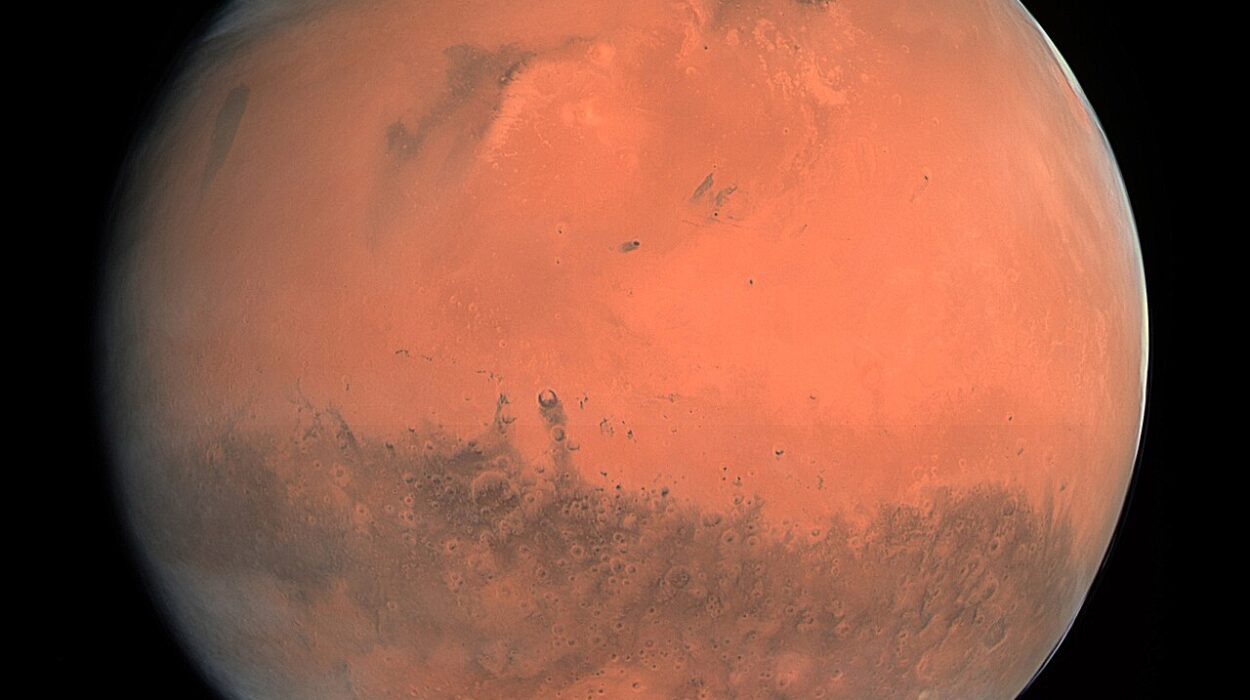
We are living in an era where we can see galaxies billions of light-years away, yet still struggle to fully understand the edges of our own Solar System. We can map the surface of Mars in detail, yet still suspect a massive planet could be hiding in darkness beyond Neptune.
That contrast is almost poetic. It shows that the universe is not just large—it is layered. Some mysteries are far away. Others are right next door, waiting quietly beyond the limits of our vision.
Planet 9 is not just a hypothesis about a planet. It is a symbol of unfinished knowledge.
If it exists, it is out there right now, moving slowly through a frozen sea of space, circling the Sun on a path so vast that a human lifetime would barely measure a fraction of its year.
And if it does not exist, then the Solar System is still challenging us with a different mystery: why do the outer worlds dance the way they do?
Either way, the message is the same.
The Solar System is not a completed story. The final chapter has not been written. The darkness beyond Neptune is not empty. It is a frontier.
And somewhere in that cold frontier, the universe may still be hiding something big enough to change how we see our place among the planets.