There are moments when the sky seems to pause, when the familiar glow of the Moon transforms into something ancient, mysterious, almost otherworldly. A lunar eclipse is one of those rare events. It unfolds slowly, quietly, without the drama of thunder or the violence of storms. Yet its impact is profound. The Moon, usually bright and comforting, darkens and turns a deep, haunting red—as if the universe itself is whispering a secret.
For thousands of years, humans have watched lunar eclipses with awe and fear. Ancient civilizations saw them as omens. Kings trembled. Priests performed rituals. Stories were told of celestial creatures devouring the Moon. Today, we understand the science behind these events with remarkable precision. We can predict eclipses centuries into the future. We know the geometry, the physics, the orbital mechanics.
And yet, even with all that knowledge, a lunar eclipse still feels magical.
Beneath its beauty lies a set of astonishing truths—subtle, complex, and deeply revealing about the nature of Earth, light, and the cosmos. Here are five stunning facts about lunar eclipses that most people never fully realize.
1. A Lunar Eclipse Is Earth’s Shadow Painted Across the Moon
At its core, a lunar eclipse is a story of alignment.
It occurs when Earth moves directly between the Sun and the Moon, casting a shadow that falls upon the lunar surface. This alignment can only happen during a full Moon, when the Sun, Earth, and Moon form a near-perfect straight line.
But the geometry is more intricate than it first appears.
Earth’s shadow is not a simple, uniform darkness. It has two main parts: the penumbra, where sunlight is only partially blocked, and the umbra, where Earth completely blocks direct sunlight. When the Moon passes through the penumbra, the dimming is subtle and often difficult to notice. But when it enters the umbra, the transformation becomes dramatic.
The Moon does not vanish. Instead, it begins to darken from one edge, as though an invisible brush is sweeping across its surface. Gradually, it slips deeper into shadow, until it is fully engulfed.
This shadow is enormous—far larger than the Moon itself. At the distance of the Moon, Earth’s umbra is roughly 9,000 kilometers wide, more than twice the Moon’s diameter. That is why total lunar eclipses can last for hours, unlike the brief moments of totality during a solar eclipse.
What makes this even more fascinating is that you are, in a sense, watching your own planet in action. The shadow crossing the Moon is the outline of Earth itself, projected into space.
A lunar eclipse is not just something happening “out there.” It is Earth revealing its presence in the cosmic dance.
2. The Moon Turns Red Because of Earth’s Atmosphere
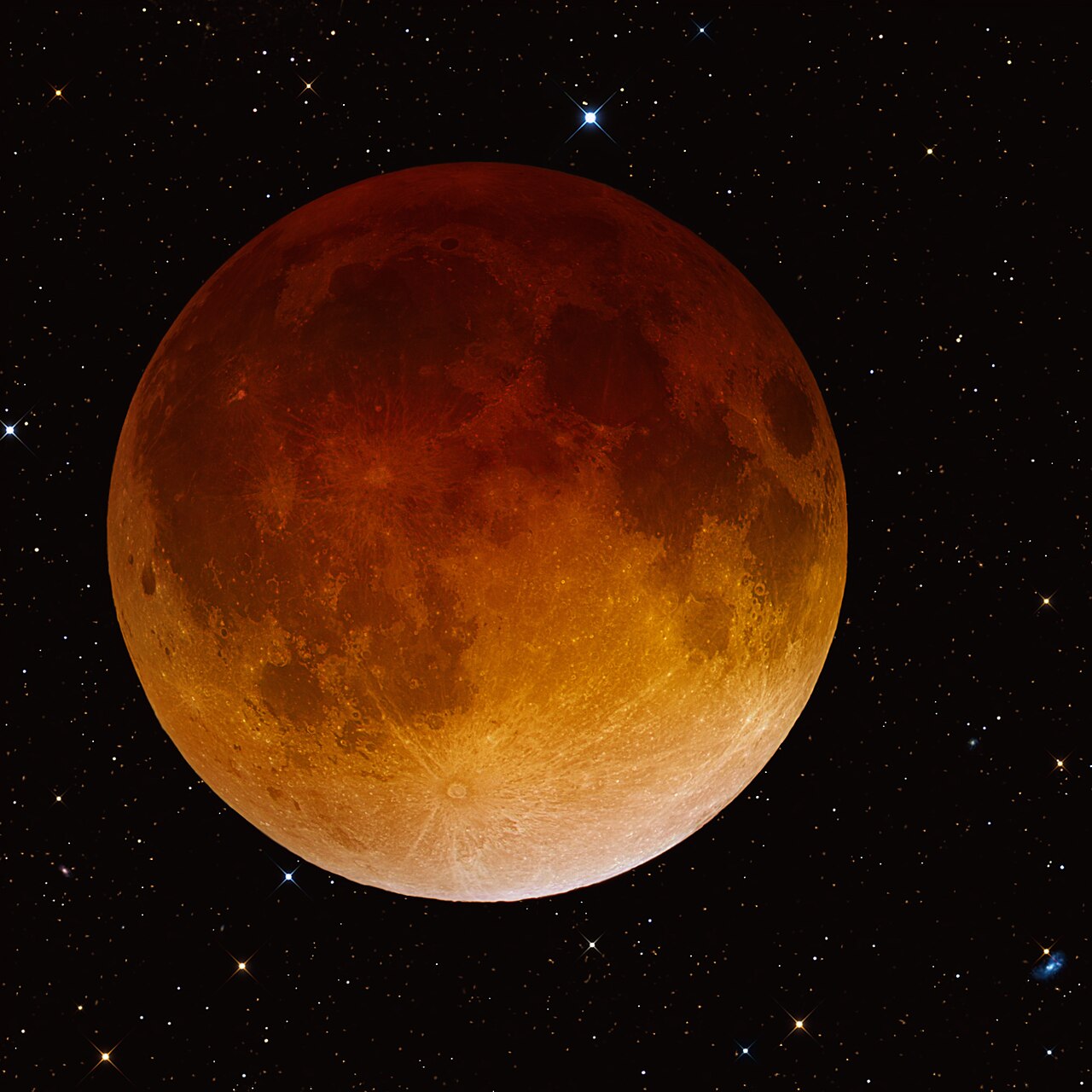
One of the most captivating aspects of a total lunar eclipse is the transformation of the Moon into a deep red or coppery hue. This phenomenon is often called a “Blood Moon,” a name that captures both its beauty and its ancient mystique.
But the reason behind this color is purely scientific—and even more beautiful because of it.
As sunlight passes through Earth’s atmosphere, it is filtered and bent. Shorter wavelengths of light, such as blue and violet, are scattered in all directions by molecules in the atmosphere. This is the same process that makes the sky appear blue during the day.
Longer wavelengths, such as red and orange, pass through more easily.
During a lunar eclipse, sunlight that would normally illuminate the Moon is blocked by Earth. However, some of that light is refracted—bent—around the edges of Earth’s atmosphere and redirected into the shadow. By the time it reaches the Moon, most of the blue light has been scattered away, leaving primarily red wavelengths.
In essence, every sunrise and sunset occurring around Earth at that moment contributes light to the eclipsed Moon. The red glow you see is the combined effect of sunlight passing through the atmosphere of the entire planet.
It is as if the Moon is illuminated by all the world’s horizons at once.
The exact shade of red can vary depending on atmospheric conditions. Dust, volcanic ash, and pollution can deepen the color, making the Moon appear darker or more intensely red. After major volcanic eruptions, lunar eclipses can become dramatically dim.
So when you see a red Moon during an eclipse, you are not just witnessing a shadow—you are seeing a global fingerprint of Earth’s atmosphere projected into space.
3. Lunar Eclipses Are Visible to Half the Earth at Once
Unlike solar eclipses, which are visible only along a narrow path on Earth’s surface, lunar eclipses are remarkably inclusive events.
If the Moon is above the horizon during a lunar eclipse, you can see it.
This means that roughly half of the planet—the entire night side—has the opportunity to witness the event simultaneously. From different continents and oceans, millions of people can look up and share the same celestial experience.
This global visibility arises from the nature of the event. A lunar eclipse is not about the Moon’s shadow falling on Earth, but rather Earth’s shadow falling on the Moon. As long as you can see the Moon, you can see the eclipse.
This shared visibility has given lunar eclipses a unique cultural significance throughout history. Ancient observers from different regions, unaware of one another, would witness the same darkening Moon and interpret it through their own beliefs and traditions.
Today, the same phenomenon brings people together in a different way. Scientists, astronomers, and skywatchers across the world observe, photograph, and study the event, often sharing data and images in real time.
There is something profoundly unifying about a lunar eclipse. It reminds us that we all live beneath the same sky, connected by the same celestial rhythms.
For a few hours, the world looks up together.
4. Not Every Full Moon Produces a Lunar Eclipse
At first glance, it might seem that a lunar eclipse should occur every month. After all, a full Moon happens roughly every 29.5 days. If a lunar eclipse requires a full Moon and alignment with Earth and the Sun, why don’t we see eclipses all the time?
The answer lies in the tilt of the Moon’s orbit.
The orbit of the Moon around Earth is inclined by about 5 degrees relative to Earth’s orbit around the Sun. This means that most of the time, during a full Moon, the Moon passes slightly above or below Earth’s shadow.
Only when the full Moon occurs near one of the points where the Moon’s orbit crosses Earth’s orbital plane—known as nodes—does a lunar eclipse become possible.
These alignments do not happen every month. Instead, they occur in cycles, leading to periods when eclipses are more frequent and periods when they are absent.
This orbital geometry is why eclipses seem rare and special rather than routine.
It also leads to predictable patterns, such as the Saros cycle—a period of about 18 years after which similar eclipses repeat. Ancient astronomers, even without modern technology, recognized these cycles and used them to predict eclipses with impressive accuracy.
The rarity of perfect alignment adds to the sense of wonder. A lunar eclipse is not just a coincidence—it is the result of precise cosmic timing.
5. A Lunar Eclipse Is a Window Into Earth’s Future and Past
A lunar eclipse is more than a beautiful event. It is also a scientific tool.
By studying the light that reaches the Moon during an eclipse, scientists can learn about Earth’s atmosphere. The color and brightness of the eclipsed Moon provide information about atmospheric composition, including the presence of dust, aerosols, and gases.
In this way, lunar eclipses act like natural experiments, allowing researchers to observe how light interacts with Earth’s atmosphere on a global scale.
But the significance goes even deeper.
The same principles used to study lunar eclipses are applied in the search for life beyond Earth. When astronomers observe distant exoplanets passing in front of their stars, they analyze the starlight filtering through those planets’ atmospheres. By studying how the light changes, they can infer the presence of gases like oxygen, methane, or carbon dioxide.
A lunar eclipse is essentially a nearby example of this process. It shows how a planet’s atmosphere can leave a signature in the light that passes through it.
In other words, when we observe a lunar eclipse, we are not only learning about Earth—we are refining techniques that could one day reveal life on other worlds.
At the same time, lunar eclipses connect us to the past. They have been recorded in ancient texts, used to date historical events, and incorporated into myths and traditions across cultures.
They are moments where science, history, and human experience converge.
A lunar eclipse is not just an astronomical event. It is a bridge between knowledge and wonder.
The Quiet Drama of Shadow and Light
A lunar eclipse does not demand attention. It does not roar or blaze or shake the ground. It unfolds slowly, patiently, as if inviting you to pause and watch.
And in that stillness, it reveals something profound.
It shows us the geometry of the solar system—the alignment of Sun, Earth, and Moon. It reveals the presence of our atmosphere, bending light in delicate ways. It connects observers across continents. It demonstrates the precision of orbital motion. It even helps us search for life beyond our planet.
All of this is contained in a simple shift of light and shadow.
The next time the Moon begins to darken, take a moment to look up. Watch as the familiar becomes unfamiliar, as brightness fades into red, as Earth’s shadow stretches across space.
You are witnessing a cosmic interaction billions of years in the making—a quiet reminder that even the most ordinary objects in our sky are part of a vast, intricate universe.
And for a brief time, that universe becomes visible in a single, glowing, shadowed Moon.