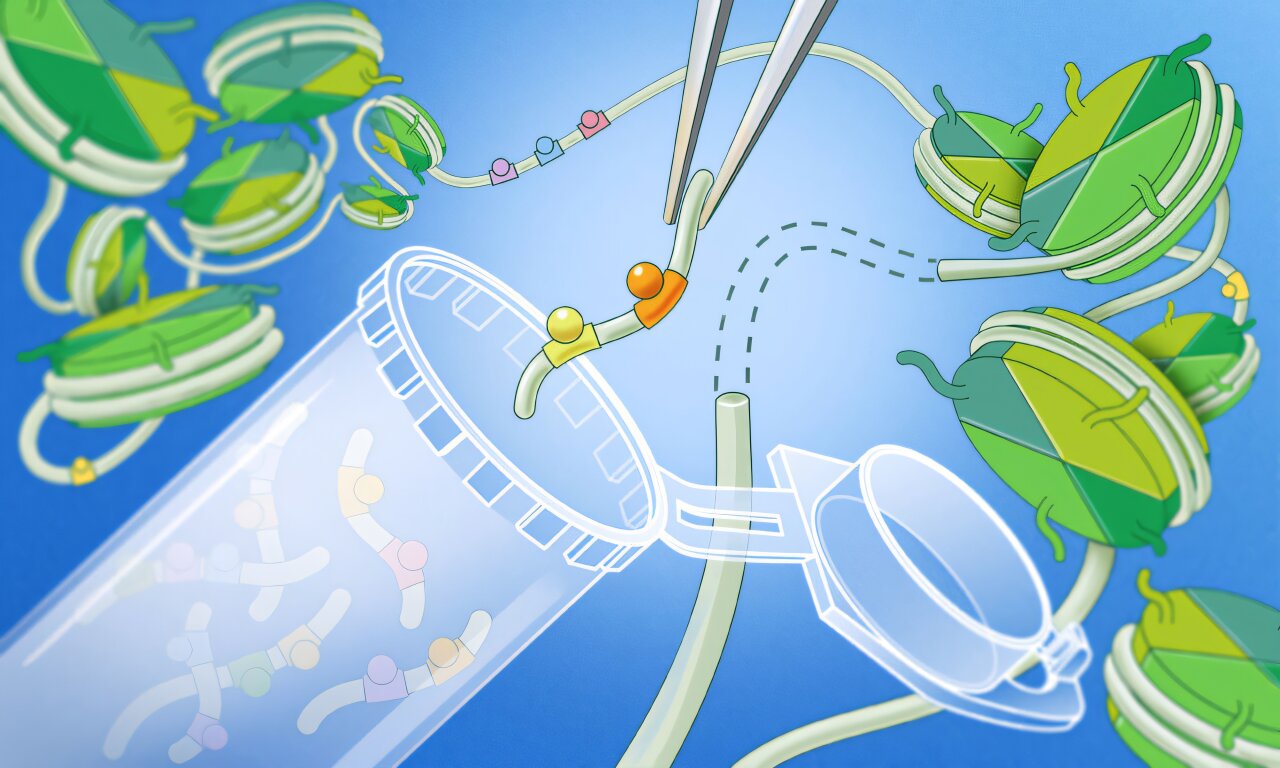
Across a population of seemingly identical cells, many of the DNA switches that control genes are not continuously available for use. Instead, they repeatedly alternate between accessible and inaccessible states, meaning that at any given moment an enhancer may be open in only a fraction of cells. By tracking individual DNA molecules rather than population averages, researchers found that this variability is shaped by the cumulative activity of multiple transcription factors and further amplified by p300-mediated histone acetylation, helping explain how often enhancers become active enough to recruit the machinery needed for transcription.
Genes are controlled by regulatory DNA elements such as enhancers and promoters, where proteins known as transcription factors bind to influence transcription. Before those proteins can do their jobs, however, they must compete with nucleosomes—the protein complexes around which DNA is wrapped—for physical access to the DNA.
This competition creates an important challenge for understanding gene regulation. Traditional methods that measure chromatin accessibility, including assays such as ATAC-seq and DNase-seq, reveal which regulatory regions are generally open across a population of cells, but they do not directly show how frequently a particular enhancer is actually accessible in individual cells.
The researchers wanted to answer a different question: instead of asking whether an enhancer is accessible on average, they asked how often it is accessible across a cell population, and what determines that frequency.
To investigate this, they studied mouse embryonic stem cells using single-molecule footprinting (SMF), a technique capable of examining chromatin accessibility one DNA molecule at a time. They also developed an unsupervised computational approach called FootprintCharter to classify DNA molecules according to whether they were occupied by transcription factors, nucleosomes, or accessible chromatin.
Active enhancers proved far less consistently open than promoters
The single-molecule measurements revealed striking differences among regulatory elements.
Promoters and regions bound by the protein CTCF were accessible in more than 70% of DNA molecules, typically across stretches of roughly 180 base pairs.
Enhancers behaved very differently.
Across active enhancers, the median accessibility was only 48% of molecules, and the accessible regions were shorter, around 150 base pairs. Many enhancers therefore spent much of their time occupied by nucleosomes rather than remaining continuously open.
The data also showed that some short accessible stretches likely represented linker DNA between nucleosomes rather than fully opened regulatory regions. These linker-length accessible segments were particularly common at enhancers.
Examining individual enhancers illustrated this variability. At one enhancer containing binding sites for SOX2 and OCT4, approximately 45% of DNA molecules displayed broad accessible chromatin, while 40% remained covered by nucleosomes and another 15% exhibited only short linker-length accessibility. In contrast, an examined promoter showed broad accessibility across about 76% of molecules.
Together, these observations indicated that even active enhancers often exist in accessible states in fewer than half of cells at any given moment.
Individual transcription factors contributed surprisingly little on their own
The researchers next asked whether certain transcription factors were primarily responsible for opening chromatin.
They analyzed binding sites for 18 transcription factors active in mouse embryonic stem cells.
Only five factors—including CTCF, REST, BANP, NFY, and NRF1—were consistently associated with high chromatin accessibility across their binding sites.
Most other transcription factors, including well-known pluripotency regulators such as OCT4 and SOX2, were associated with accessibility in only about 22% to 54% of molecules.
Even the strength of many transcription-factor binding motifs did not consistently predict accessibility, suggesting that motif quality alone could not explain why some enhancers opened more frequently than others.
Instead, another pattern emerged.
Accessibility increased as more transcription factors worked together
Rather than depending on one dominant transcription factor, chromatin accessibility rose steadily as more transcription-factor binding sites accumulated within a regulatory element.
Enhancers containing increasing numbers of validated transcription-factor binding sites showed progressively greater accessibility frequencies and broader accessible chromatin regions.
The same trend appeared when examining individual transcription factors. For example, KLF4 binding sites became progressively more accessible when located alongside additional bound transcription factors. NRF1, which already tended to produce relatively high accessibility, also showed cumulative effects, although these reached saturation with fewer binding sites.
Individual enhancer examples illustrated the same progression, with enhancers containing one, three, or seven bound transcription-factor motifs exhibiting increasingly frequent chromatin accessibility.
These observations suggested that multiple transcription factors combine their effects rather than relying on a single specialized factor to keep chromatin open.
Removing one transcription factor usually produced only a modest change
To directly test this idea, the researchers exploited naturally occurring genetic differences between mouse species.
They generated hybrid embryonic stem cells containing DNA inherited from different mouse lineages, allowing them to compare two versions of the same regulatory sequence within the same nucleus. Some naturally occurring single-nucleotide variants weakened specific transcription-factor binding motifs on one chromosome while leaving the other unchanged.
For most transcription factors, disrupting a single binding site produced only modest reductions in chromatin accessibility.
Typically, accessibility declined by less than 10 percentage points, while complete loss of accessibility was uncommon.
The effect was remarkably consistent.
If an enhancer normally contained three active transcription-factor binding sites, disrupting one shifted its accessibility to approximately the level expected for an enhancer naturally containing only two functional sites.
The researchers confirmed this behavior experimentally using rapid degradation of SOX2. Within two hours, more than 90% of SOX2 protein had been removed.
Even after this substantial depletion, accessibility at SOX2-bound enhancers usually fell only modestly. Nucleosome occupancy rarely increased by more than about 10% of molecules.
However, enhancers containing multiple SOX2 binding sites experienced larger accessibility losses than those with only one site, reinforcing the idea that repeated contributions from the same factor can also accumulate.
Overall, the experiments supported a model in which each transcription factor contributes only part of the accessibility, while the combined activity of many factors determines how frequently an enhancer remains open.
Testing hundreds of enhancers in the same chromatin environment
DNA sequence alone does not exist in isolation inside cells. Every enhancer operates within a surrounding chromatin environment that includes histone modifications and neighboring regulatory features.
To separate the influence of DNA sequence from its chromatin context, the researchers developed a Multiplexed Chromatin-Integrated Reporter Assay (MCHIRA).
The system allowed hundreds of different promoters and enhancers to be inserted into exactly the same neutral genomic location lacking active or repressive chromatin marks. Chromatin accessibility at these inserted sequences could then be measured directly with single-molecule footprinting and compared with accessibility at their original genomic locations.
The library included 831 regulatory elements with sufficient coverage for analysis.
Almost all inserted sequences—94%—displayed accessibility above background levels.
However, only 47% achieved accessibility comparable to their native genomic locations. The remaining 53% showed reduced accessibility after relocation.
This indicated that while a regulatory DNA sequence often retained the ability to open chromatin, it usually did not reach its original level of accessibility when removed from its native chromatin environment.
Only CTCF-binding regions consistently reproduced their original accessibility almost completely.
For nearly every other transcription factor examined—including NFY and NRF1, which normally exhibited relatively high accessibility—the inserted sequences remained less accessible than their endogenous counterparts.
The researchers also engineered systematic mutations into selected regulatory elements.
Deleting individual binding sites for YY1, NRF1, or MYC caused partial accessibility losses, with different transcription factors contributing different amounts. Combining multiple mutations produced progressively larger decreases. Similar cumulative effects appeared when increasing numbers of KLF4 binding sites were disrupted within another enhancer.
These experiments reinforced the conclusion that regulatory DNA contains important information for opening chromatin but does not completely determine how frequently chromatin becomes accessible.
p300-mediated histone acetylation supplied an additional boost
The researchers then investigated whether chromatin modifications help explain why endogenous regulatory elements often outperform identical DNA sequences placed elsewhere.
They focused on H3K27 acetylation, a histone modification deposited by the enzyme p300.
At native genomic locations, chromatin accessibility increased alongside higher H3K27 acetylation levels.
That relationship largely disappeared when the same DNA fragments were examined after insertion into the neutral chromatin environment.
This observation suggested that p300 activity might enhance accessibility beyond what DNA sequence alone can achieve.
To test the idea directly, the researchers chemically inhibited p300, reducing H3K27 acetylation across thousands of regulatory elements.
At endogenous genomic sites, reductions in acetylation were accompanied by corresponding decreases in chromatin accessibility.
At the ectopic insertion sites, however, the same regulatory DNA fragments largely maintained their accessibility despite p300 inhibition.
Promoters and enhancers that naturally depended on p300 lost accessibility only in their original chromatin environments, not after relocation into the neutral genomic site.
These findings indicate that transcription-factor binding establishes much of chromatin accessibility, while p300-mediated acetylation further increases how often regulatory elements become accessible under their normal genomic conditions.
More accessible enhancers recruited RNA polymerase II more frequently
The researchers also examined whether differences in chromatin accessibility translated into differences in enhancer activity.
Using precision nuclear run-on sequencing (qPRO-seq), they measured recruitment of transcriptionally active RNA polymerase II.
Allele-specific reductions in chromatin accessibility caused by weakened transcription-factor binding were accompanied by decreases in RNA polymerase II recruitment at both enhancers and promoters.
Even relatively small accessibility differences produced measurable changes in enhancer activity.
These results support the idea that accessibility frequency directly influences how often enhancers recruit the transcription machinery.
A model built from many small contributions
Taken together, the experiments point toward a view of enhancer activation that differs from one dominated by individual “master” transcription factors.
Instead, most transcription factors appear to make relatively modest contributions on their own. The accessibility of an enhancer increases as more transcription factors participate, and p300-mediated histone acetylation further raises that accessibility within the native chromatin environment.
The authors note that several questions remain unresolved. Their experiments establish that p300 activity enhances chromatin accessibility, but the precise molecular mechanism responsible for this effect remains unknown. They also suggest that acetylation could potentially influence transcription-factor binding or recruit additional chromatin-modifying proteins, although these possibilities remain to be tested.
The work therefore presents enhancer activation not as an all-or-nothing event, but as a probabilistic process in which the combined activity of numerous transcription factors—and the surrounding chromatin landscape—determines how frequently an enhancer becomes available to help initiate transcription.
Publication details
Valentina Baderna et al, Cumulative transcription factor binding and p300-mediated histone acetylation drive enhancer activation frequency, Nature Genetics (2026). DOI: 10.1038/s41588-026-02703-x