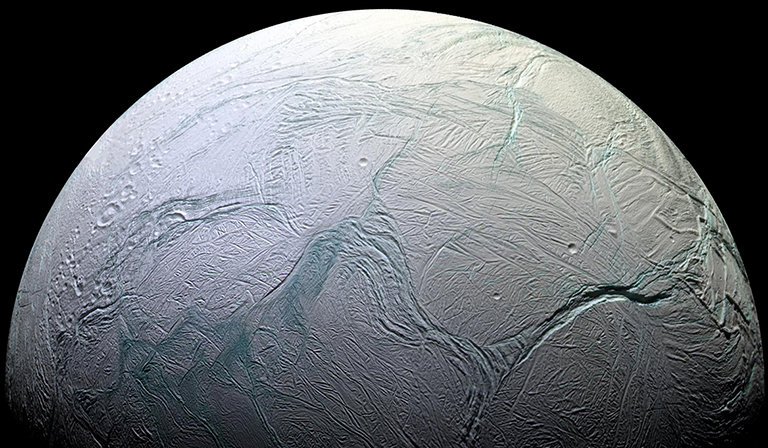
Above Enceladus’ hidden ocean, droplets of salty water may freeze slowly as they rise through ice vents, separating different salts into distinct regions before collisions break the frozen droplets into the tiny grains detected by the Cassini spacecraft. The process offers a possible explanation for a puzzling pattern in the chemistry of ice particles escaping into space.
When Cassini flew through the diffuse ring of material surrounding Saturn, its Cosmic Dust Analyzer captured individual grains of ice that had escaped from Enceladus. Among those particles was a group with unusually strong salt signatures.
The instrument recorded 7,353 E-ring grain spectra during 15 favorable observation periods between 2004 and 2008. Of those, 961 were classified as Type 3 grains, a category distinguished by strong signatures of salts compared with the water-related ions normally produced when the ice particles strike the detector.
The Type 3 grains were not chemically identical. Instead, their mass spectra separated into several subtypes characterized by different combinations of sodium, potassium, chloride, hydroxide and other salt-related signals.
That separation presents a problem for explaining how the grains formed.
If a salty droplet from Enceladus’ subsurface ocean simply froze into a uniform particle, its different dissolved constituents would be expected to remain more thoroughly mixed. The observed grains instead suggest that different chemical components can become concentrated in different parts of a larger frozen particle.
The researchers investigated whether ordinary freezing could produce that kind of chemical segregation and whether the resulting larger particles could subsequently be broken apart into the much smaller grains Cassini detected.
Their experiments and modeling point to a possible sequence in which both processes are important.
Freezing can separate the salts
The researchers began with laboratory experiments designed to reproduce the freezing of salty water under conditions relevant to Enceladus.
As water freezes, the growing ice crystals do not incorporate every dissolved substance equally. Water molecules become part of the ice, while dissolved salts can become concentrated in the remaining liquid. As freezing proceeds, different compounds can reach the conditions needed to precipitate as solid minerals.
The experiments showed that slow freezing can therefore create spatially separated chemical regions inside a single frozen droplet.
Rather than producing a chemically uniform piece of ice, a slowly freezing salty droplet can develop areas enriched in particular salts. Which compounds appear, and where they become concentrated, depends on the composition of the starting fluid and the rate at which the droplet cools.
The laboratory results reproduced qualitative features of the chemical segregation seen in the Cassini Type 3 spectra.
The researchers then used thermodynamic calculations to examine how the dissolved constituents should behave as the water freezes. These calculations provided another way to test whether the sequence of precipitation inferred from the experiments was physically plausible.
Together, the experiments and calculations indicate that freezing can account for at least part of the unusual chemical organization.
But the laboratory droplets were larger than the individual particles measured by Cassini. That raised another question: how could a chemically segregated parent droplet produce the small, compositionally distinct grains observed in space?
The parent droplets may be much larger than Cassini’s grains
The proposed answer begins with the way material escapes from Enceladus.
The moon’s south polar region contains vents through which water vapor and ice particles emerge from the subsurface environment. Bubble bursting above the underlying ocean is proposed as a way of producing droplets of liquid water that can enter these vents.
Because Enceladus has very low gravity, droplets produced in this environment can remain suspended and travel upward through the vents rather than immediately falling back.
The researchers considered parent droplets ranging from roughly 20 to 1,000 micrometers in size. Such droplets are substantially larger than many of the individual particles ultimately detected by Cassini.
That difference in size is important.
A large droplet has enough volume for freezing to organize its chemical components into separate regions. A small fragment produced later from that parent can then contain only one of those regions.
In this picture, Cassini would not necessarily be sampling intact frozen droplets. Instead, the spacecraft could be detecting fragments of larger particles whose internal chemistry had already been separated during freezing.
The cooling has to be slow enough
For this mechanism to work, the droplets cannot freeze too quickly.
The researchers found that the strongest chemical segregation in their experiments occurred during relatively slow cooling, with cooling rates on the order of 10 kelvins per minute. More generally, the conditions needed for the proposed process correspond to cooling rates below about 20 kelvins per minute over much of the relevant freezing stage.
Slow cooling gives the dissolved constituents time to respond as ice forms and as different salts reach their precipitation conditions.
The experiments also indicate that freezing must continue far enough for phosphate and carbonate salts to precipitate. Under the modeled experimental fluid, slow cooling needs to continue to temperatures around 255 kelvins, or about −18 degrees Celsius, for nahcolite, a sodium bicarbonate mineral, to precipitate.
The precise temperature at which carbonate precipitation begins is not universal. The researchers note that fluids with different pH or starting concentrations could cause carbonate precipitation at higher temperatures.
That qualification matters because the experiments do not reproduce every chemical detail of Enceladus’ ocean. Instead, they test whether the physical process of slow freezing can generate the kind of segregation required by the spacecraft observations.
The calculations suggest that the minimum time required for the slow-cooling stage is on the order of a minute.
The question then becomes whether droplets traveling through an Enceladus vent could actually cool at those rates.
The vents can provide the required cooling conditions
To examine that question, the researchers modeled how droplets and gas would behave inside an ice vent.
Their model treats the gas and droplets as interacting with the colder ice walls. The walls can cool the material as it rises, while evaporation also affects the thermal balance.
For a representative 200-micrometer droplet initially at 270 kelvins surrounded by walls at 269 kelvins, the researchers found that evaporative adjustment occurs extremely rapidly, in a fraction of a second. Radiative cooling is much slower, at roughly 1 kelvin per minute under the modeled conditions.
The rapid evaporative adjustment removes only about 0.1 micrometer from the droplet’s diameter in that example.
The broader vent model produced a temperature profile in which the walls become progressively colder from the region near the water table toward the surface. In the modeled 1,500-meter-long vent, wall temperatures fall from near the water triple-point conditions toward temperatures of 195 kelvins or lower near the surface.
The gas begins moving at about 10 meters per second and accelerates strongly as it approaches the outlet. Near the upper part of the modeled vent, its speed exceeds 350 meters per second, while gas temperatures fall below 250 kelvins.
Most importantly for the freezing mechanism, the calculated cooling rate begins at roughly 3 kelvins per minute and remains below 20 kelvins per minute through the lower roughly three-quarters of the modeled vent.
That range overlaps the cooling conditions under which the laboratory experiments produced chemical segregation.
The model therefore provides a physical route by which droplets could remain in the slow-freezing regime long enough for different salts to separate.
The researchers caution, however, that the modeled 1,500-meter vent may be somewhat longer than current estimates of the ice shell beneath Enceladus’ south polar terrain. Actual three-dimensional flow through the vents could also change the cooling rates.
The model is consequently evidence that the required conditions are physically possible, not a direct reconstruction of an individual vent on Enceladus.
Freezing may happen in two stages
The researchers propose that the droplets could undergo a two-stage thermal history.
During the first stage, relatively slow cooling allows phosphate and carbonate compounds to precipitate and become spatially segregated within the freezing droplet.
Later, after the material experiences a pressure drop and moves toward the vent outlet, evaporative cooling could become much more important.
That second stage could produce additional chemical changes. In particular, rapid pressure and temperature changes may promote the loss of carbon dioxide from the remaining liquid. The researchers propose that this could leave the residual sodium-potassium-chloride-rich brine locally enriched in hydroxide.
This provides a possible route to another feature of the Cassini data.
Some Type 3 spectra contain associations between chloride and hydroxide, while more than 20% of the regular Type 3 spectra are characterized by sodium hydroxide without the corresponding carbonate signal.
The thermodynamic equilibrium calculations alone did not produce sodium hydroxide or potassium hydroxide under the modeled conditions. The hydroxide formation instead appears to require a departure from equilibrium associated with rapid carbon dioxide degassing near the final stages of freezing.
The researchers therefore treat this explanation as a proposed mechanism rather than a demonstrated process occurring inside Enceladus’ vents.
Potassium remains harder to explain
Not every feature of the spacecraft data is reproduced by the laboratory experiments and calculations.
The behavior of potassium is one of the remaining complications.
At sufficiently slow cooling rates, the experiments indicate that potassium can become associated with carbon, suggesting the formation of potassium carbonate. Such a product is not apparent in the Cassini data.
The thermodynamic calculations provide a different result under the modeled concentrations and conditions. They indicate that potassium should occur primarily as potassium chloride.
The experiments and calculations also do not fully reproduce the degree of sodium segregation or the high potassium levels associated with the potassium-rich Type 3 group.
Those discrepancies limit how closely the laboratory system can be treated as a direct chemical model of Enceladus’ ocean and vents.
They do not eliminate freezing as a mechanism for producing segregation, but they leave parts of the observed chemistry unresolved.
The absence of a clearly corresponding potassium-hydroxide-only subtype is another feature the proposed process does not fully explain.
The frozen droplets can then break apart
Chemical segregation alone does not explain why Cassini sees so many small grains rather than large frozen droplets.
The researchers propose that fragmentation inside the vents provides the missing step.
A frozen droplet moving through a dilute gas does not necessarily travel at exactly the same speed as the gas around it. As the gas accelerates through a vent, the difference between gas and particle velocity can become substantial.
The model predicts relative velocities ranging from a few meters per second near the bottom of the vent to hundreds of meters per second nearer the outlet.
The geometry of the vents provides another source of collisions. Material moving through nonstraight passages can strike the surrounding ice walls.
Those impacts can fracture larger frozen particles.
Previous experiments on impacts involving ice provide a physical basis for this part of the proposed process. At impact velocities around 100 meters per second, particles roughly 9 micrometers and larger begin to fragment, while particles larger than about 50 micrometers can be completely shattered. At approximately 300 meters per second, fragmentation can begin for particles smaller than 1 micrometer.
The velocities calculated for the vent therefore fall within a range in which collisions could break frozen particles apart.
The effect would be particularly important after the parent droplet had already developed chemically distinct regions.
A collision that fragments such a particle does not need to mix those regions together. Instead, different fragments can inherit different portions of the parent droplet.
One fragment could therefore be enriched in one salt combination, while another carries a different combination.
That provides a potential explanation for why the Type 3 population is divided into chemically distinct groups.
Fragmentation can preserve the chemical separation
The proposed sequence is consequently more specific than simply saying that salty water freezes in Enceladus’ vents.
First, liquid droplets produced above the subsurface ocean enter the vent system. As they rise, they cool slowly enough for ice to form while dissolved salts become increasingly concentrated in the remaining liquid.
Different salts precipitate at different stages, producing chemical segregation within the growing frozen particle.
The particle then encounters increasingly rapid flow and temperature changes. Some of the remaining liquid may undergo further evaporation and carbon dioxide loss, potentially producing local hydroxide enrichment.
Finally, collisions with the vent walls and other processes fragment the larger frozen particles.
The resulting pieces retain portions of the parent particle’s chemically segregated structure.
Some of those fragments can then escape from Enceladus and become the small ice grains sampled by Cassini.
This sequence would also help explain why the spacecraft detects distinct compositional subtypes rather than a much larger population of grains containing every salt combination in roughly mixed proportions.
If the observed particles were simply individual, independently frozen droplets, the degree of chemical separation would be more difficult to reproduce. If they are fragments of larger, chemically organized parent particles, the separation is a natural consequence of the proposed formation process.
What Cassini directly saw, and what remains a model
The Cassini measurements provide the direct evidence for the unusual salt-rich grain population and its chemical subtypes.
The laboratory experiments demonstrate that freezing salty water can produce spatial chemical segregation under appropriate cooling conditions.
The thermodynamic calculations show how precipitation of different compounds can occur as the fluid freezes.
The vent model shows that cooling rates within the range needed by the experiments can be physically obtained under the modeled conditions, while the predicted gas and particle velocities provide opportunities for fragmentation.
But no spacecraft observed an individual Enceladus droplet slowly freezing, chemically separating, striking a vent wall and breaking into the exact Type 3 grains later measured by Cassini.
That complete chain is the researchers’ proposed formation scenario, assembled from spacecraft observations, laboratory experiments, thermodynamic calculations and a physical model of the vents.
Several details remain uncertain, including the exact vent geometry, the true cooling history of individual droplets, the chemical composition of the starting fluid, and the processes responsible for some of the potassium and hydroxide patterns.
The proposed mechanism therefore does not remove every question raised by the Type 3 spectra. Instead, it provides a way to connect several otherwise separate observations through the behavior of salty water as it freezes and is subsequently fragmented.
The study was published in Science Advances.