Astronomers have used the natural magnifying power of a massive galaxy cluster to peer inside Misty Moons, a galaxy that existed just 370 million to 410 million years after the Big Bang. The unusually detailed observations reveal seven compact concentrations of young stars, each containing about 10 million times the mass of the Sun. Together, these clumps account for at least 80% of the galaxy’s estimated stellar mass, offering a rare look at how stars may have formed in tightly packed groups during the universe’s earliest era.
Seeing individual structures inside a galaxy from the early universe is a difficult task, even for the powerful James Webb Space Telescope (JWST). These galaxies are so distant that their light has traveled for most of cosmic history before reaching Earth. Their small features are normally impossible to distinguish.
But gravity can provide an unexpected advantage.
When a massive galaxy cluster lies between Earth and a distant galaxy, its gravitational pull bends the light traveling toward us. This effect, known as gravitational lensing, can make the background galaxy appear much brighter and larger. It effectively turns the foreground cluster into a natural telescope, revealing details that would otherwise remain hidden.
Astronomers used this effect to investigate Misty Moons, an extremely distant galaxy whose internal structure offers clues about how stars formed when the universe was still very young.
A rare look inside an early galaxy
The discovery came from observations of a galaxy cluster called MACS0257-2325. Researchers led by Minami Nakane of the University of Tokyo examined images taken by JWST’s Near-Infrared Camera (NIRCam) through 10 different color filters. They also used earlier observations from the Hubble Space Telescope, which covered the same field in three filters.
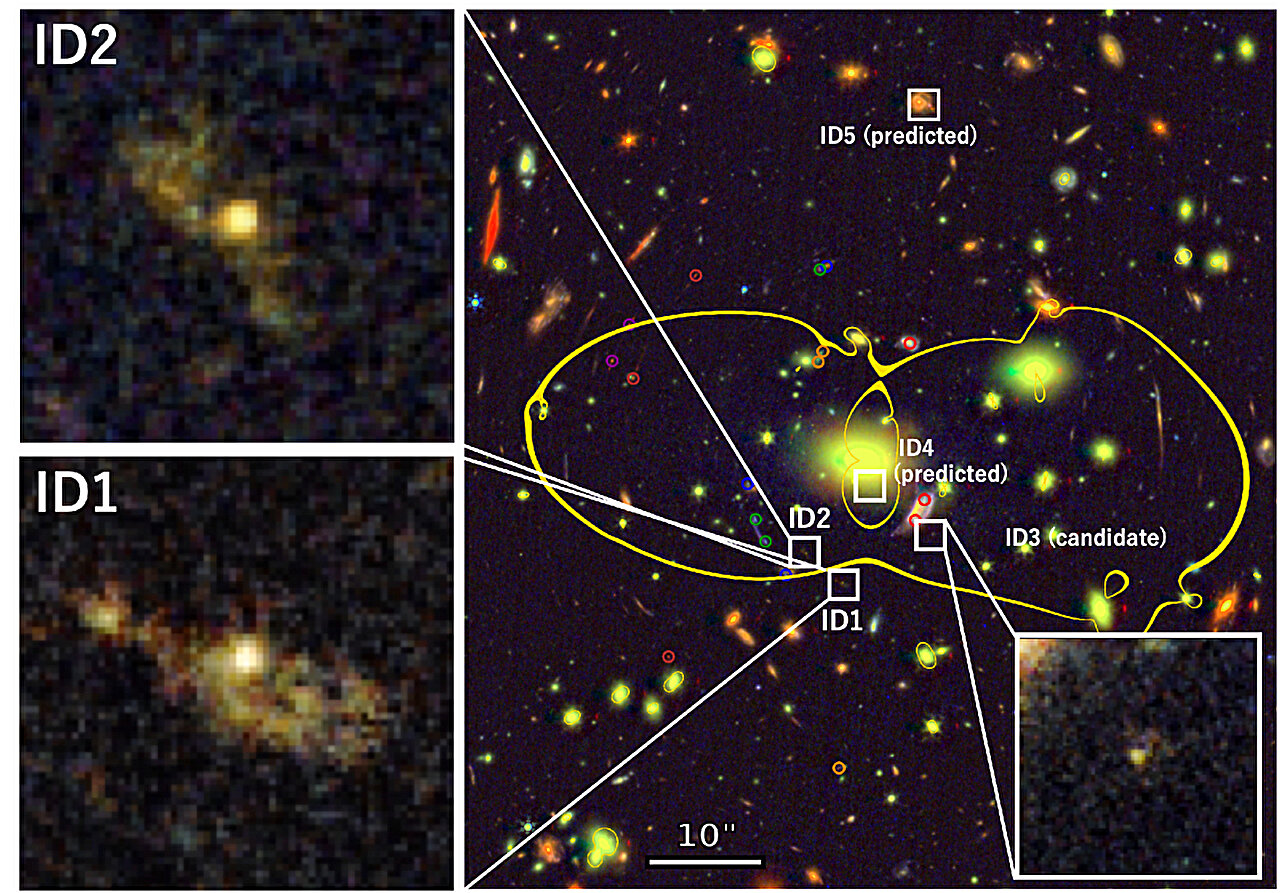
The distant galaxy appeared as two separate bright patches, labeled ID1 and ID2. The researchers identified them as two lensed images of the same object rather than two independent galaxies.
Its estimated redshift is between 11 and 12. Redshift describes how much the expansion of the universe has stretched light during its journey through space. The higher the redshift, the farther back in cosmic history astronomers are looking.
In this case, the observations place Misty Moons at a time when the universe was only about 370 million to 410 million years old.
The galaxy’s light was strongly magnified by the foreground cluster. To work out what the original galaxy looked like, the team developed two independent mathematical models of the cluster’s gravitational lens.
Both models predicted that the lens should produce five images of Misty Moons. Two bright images were visible at roughly 20 to 30 times their normal brightness. A third possible image was also identified, while the other two were too faint to detect.
This magnification made it possible to investigate the galaxy’s structure at a level of detail that would otherwise have been out of reach.
Seven bright clumps of young stars
The two visible images initially looked like collections of bright spots. To examine them more closely, the astronomers processed the images to smooth out the background and remove blurring, making smaller bright features easier to distinguish.
They identified four clumps in ID1 and three in ID2.
After accounting for the distortions caused by gravitational lensing, the researchers found that both images showed the same underlying structure. The seven apparent features therefore represent repeated views of the same galaxy, not seven separate objects in the sky.
Each clump contains an estimated 10 million solar masses of young stars. A solar mass is simply the mass of our Sun, so each concentration holds roughly 10 million times as much stellar material as our star.
The stars are estimated to be between 40 million and 70 million years old, and the clumps contain relatively little dust.
Their sizes and masses resemble those of nuclear star clusters and young massive star clusters found in the nearby universe. The researchers suggest that they could be early forms of globular clusters, dense collections of stars that remain gravitationally bound together.
The most striking feature is how much of the galaxy’s stellar material appears to be concentrated in these small regions. The seven clumps together account for at least 80% of Misty Moons’ estimated stellar mass.
That suggests the galaxy’s star formation was not spread evenly throughout its structure. Instead, much of its stellar material appears to have accumulated in a handful of compact concentrations.
Why early galaxies may have been so clumpy
The structure of Misty Moons connects to a larger question about the way galaxies formed in the young universe.
Astronomers have found that some early galaxies are surprisingly bright despite their small sizes. Some also contain unusually large amounts of nitrogen. Their properties have raised questions about whether intense star formation and the formation of massive star clusters played a particularly important role in the early stages of galaxy development.
One useful measure in this research is called cluster formation efficiency. It describes the fraction of a galaxy’s newly formed stars that end up in gravitationally bound star clusters rather than remaining distributed throughout the galaxy.
Studies of nearby galaxies have found a relationship between this efficiency and the rate of star formation. Since galaxies in the early universe were forming stars rapidly, astronomers have considered whether their cluster formation efficiency could have been especially high.
The clumps in Misty Moons provide an opportunity to investigate that possibility.
The researchers found that its star formation density was between 100 and 10,000 times higher than that of nearby dwarf galaxies. Star formation density measures how much new stellar material is produced within a given area.
Such an intense rate of star formation could help explain why so much of the galaxy’s stellar mass is concentrated in compact clumps.
The team also compared the galaxy’s structure with observations and simulations of galaxies at different stages of cosmic history. Their results point to a trend in which galaxies at higher redshifts tend to have more uneven, clumpy structures.
“The comparisons of the clumpiness among the observed and simulated galaxies across cosmic time suggest that the galaxies at higher redshift tend to be more clumpy, which is consistent with the observations of many clumpy galaxies at z > 6,” the team writes in the paper.
Interestingly, this pattern differs from what astronomers see in nearby dwarf galaxies.
The researchers also note that high star formation rates alone cannot explain the difference. Some massive galaxies in the local universe form stars rapidly but have a much smaller fraction of their stars concentrated in clusters.
They therefore argue that the early galaxies may have experienced a different pattern of star formation, involving both unusually high activity and short, intense bursts.
As the team concludes, “high-z clumpy galaxies are likely distinct from the local dwarf galaxies not only in their high SFR surface densities but also in their short, bursty star formation during the early formation phase of the galaxy.”
A possible black hole complicates the picture
There is still an important uncertainty in interpreting the bright central regions of Misty Moons.
The researchers cannot rule out the possibility that an actively feeding supermassive black hole contributes to their brightness. Such a black hole can release large amounts of energy as surrounding material falls toward it.
If one is present, some of the observed light attributed to the galaxy’s young stars could instead come from material falling into the black hole. That would also affect estimates of how much star formation is taking place.
This possibility matters because the researchers’ interpretation of the galaxy depends partly on how much of its light comes from stars rather than other sources.
Even with that uncertainty, the observations offer a rare opportunity to study the internal structure of a galaxy from the universe’s earliest few hundred million years. Gravitational lensing has made it possible to examine stellar concentrations that would otherwise be too faint and distant to distinguish.
The research was published in The Astrophysical Journal.