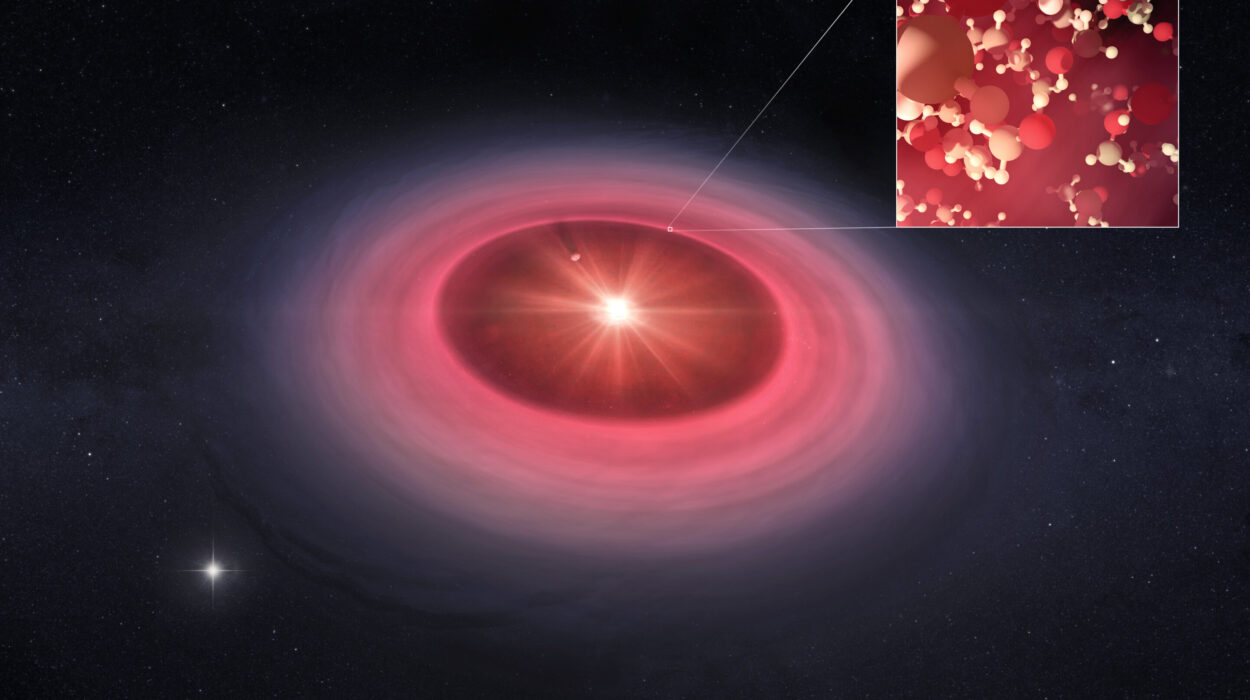
Deep infrared observations have uncovered Garro 04, a previously unknown group of stars about 10,000 light-years away whose motions, chemistry and orbit mark it as a genuine stellar cluster. Its age of about 5 billion years places it in an unusual range between the young open clusters and much older globular clusters.
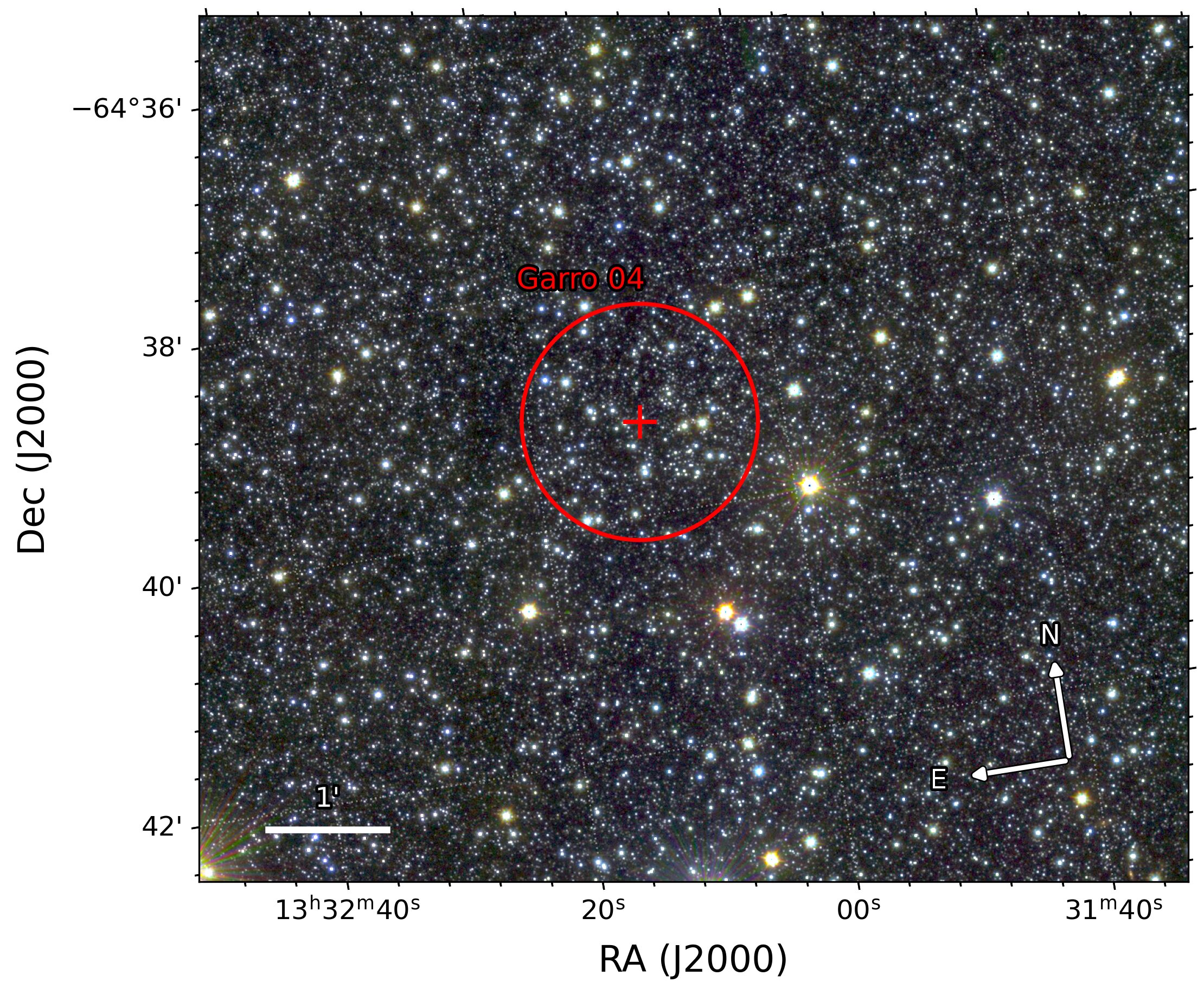
Garro 04 first appeared as a conspicuous concentration of red giant stars in the VISTA Variables in the Vía Láctea eXtended, or VVVX, survey. The object lies toward the Galactic disk at Galactic coordinates and .
The initial image alone could not establish whether the concentration was a real cluster or simply a chance grouping of stars produced by the crowded stellar field. The region is particularly difficult to study because dust and the enormous number of foreground and background stars can obscure genuine stellar systems.
The researchers therefore combined near-infrared VVVX observations with data from Gaia DR3 and the Two Micron All Sky Survey. VVVX is especially useful in this part of the Milky Way because its infrared observations can penetrate some of the dust that makes optical observations difficult.
They first looked for a common motion among the stars. After applying quality cuts to the Gaia data, they determined a mean proper motion of about −7.08 milliarcseconds per year in right ascension and −1.36 milliarcseconds per year in declination.
The proper-motion analysis substantially reduced the field contamination. Within about 3 arcminutes of the cluster center, 613 of the 2,145 stars that passed the initial quality cuts had membership probabilities above 50 percent. That left about 29 percent of the stars as likely members.
The concentration became stronger closer to the center. Within the central 0.5 arcminutes, the fraction of likely members rose to about 41 percent.
That spatial concentration provided another indication that the stars were not simply scattered field stars.
The cluster has a measurable structure
Using the cleaned member sample, the researchers recalculated the cluster’s center and constructed a radial density profile. They estimated the background stellar density at 1.2 ± 0.2 stars per square arcminute and fitted the cluster’s density profile with a King model.
The resulting core radius was 1.88 ± 0.20 arcminutes. At the derived distance of about 10.07 kiloparsecs, or roughly 32,800 light-years, that corresponds to a physical core radius of 5.5 ± 0.6 parsecs.
The analysis adopted a tidal radius of 10 arcminutes because the available catalog did not extend far enough from the cluster center to determine the tidal radius independently. That corresponds to a physical extent of about 29.3 parsecs.
Changing the assumed background density over the range tested by the researchers altered the fitted core radius by less than 1.2 standard deviations, indicating that the structural result was not highly sensitive to that particular uncertainty.
The resulting concentration parameter was about 0.73, which the authors describe as consistent with a moderately concentrated, tidally evolved old open cluster.
The cleaned color-magnitude diagrams provided another piece of the picture.
Its stars trace an intermediate-age population
The researchers used the positions of red-clump stars to estimate the amount of dust extinction and the cluster’s distance. Two infrared approaches gave distances of 10.36 ± 0.52 and 9.77 ± 0.46 kiloparsecs, while an optical estimate gave 10.08 ± 0.81 kiloparsecs.
Combining those three estimates produced a final heliocentric distance of 10.07 ± 0.36 kiloparsecs. The corresponding Galactocentric distance was 8.29 ± 0.20 kiloparsecs.
With the distance and extinction constrained, the researchers compared the observed stellar sequences with PARSEC+COLIBRI stellar-evolution models.
The best-fitting models gave an age of 5 ± 2 billion years and a global metallicity of [M/H] = −0.4 ± 0.2. Here, metallicity describes the abundance of elements heavier than hydrogen and helium relative to the Sun.
The authors note an important limitation: the cluster’s main-sequence turnoff is poorly sampled. That makes age and metallicity harder to separate because different combinations of age and chemical composition can produce similar positions in a color-magnitude diagram.
The photometric metallicity was converted to an iron abundance of [Fe/H] = −0.55 ± 0.20 by assuming an alpha-element enhancement of +0.20.
So the photometry pointed toward a roughly 5-billion-year-old, moderately metal-poor stellar population. But the researchers wanted an independent spectroscopic measurement.
Nineteen stars provided a chemical and velocity check
The cluster was observed with the K-band Multi Object Spectrograph, or KMOS, on the Very Large Telescope.
The researchers selected 19 red giant stars with high proper-motion membership probabilities. The observations used the H-band configuration and accumulated 60 minutes of exposure time.
The resulting spectra had signal-to-noise ratios between 16 and 28 per pixel. Because the KMOS spectra have a resolving power of about 4,000, they were not considered precise enough for detailed elemental-abundance measurements. They could, however, provide radial velocities accurate to a few kilometers per second and allow the researchers to test whether the stars were actually moving together.
They were.
All 19 observed targets fell around a well-defined radial-velocity peak. The authors therefore classified all of them as members. Three stars differed from the main velocity concentration, but their differences remained within about 1.5 standard deviations, so they were retained.
The weighted mean radial velocity was 29.24 ± 0.25 kilometers per second. The adopted systemic velocity used in the paper’s subsequent analysis is 28.3 ± 0.7 kilometers per second.
The measured velocity dispersion was 3.60 ± 0.88 kilometers per second. Excluding the star with a radial velocity of 41.5 kilometers per second reduced the estimate to 2.69 ± 0.48 kilometers per second.
The authors caution that this dispersion should not yet be treated as a definitive measurement because only a small number of stars were observed and the spectra have moderate resolution. More radial-velocity measurements are needed.
Still, the agreement in radial velocities provides an independent line of evidence that the stars belong to a common system.
The spectra also support the cluster’s metallicity
The researchers developed a full-spectrum method to estimate iron abundance from the KMOS observations.
Rather than relying on a small number of individual absorption lines, the method uses information distributed across the H-band spectrum. The model was trained using APOGEE DR17 spectra of red giant stars with known ASPCAP metallicities.
The original APOGEE spectra have much higher spectral resolution than KMOS observations, so the researchers degraded them to approximately the KMOS resolution and added artificial noise to make the training data more representative of the observations.
The final training set contained 294 stars spanning [Fe/H] values from −2.10 to +0.55 dex. A spectrum-only model using 12 principal components achieved a root-mean-square error of 0.193 dex in five-fold cross-validation, with a mean residual of −0.002 dex.
An augmented version that also supplied effective temperature and surface gravity performed slightly better, with an overall RMSE of 0.185 dex. But the researchers chose the spectrum-only version for the final KMOS analysis because the atmospheric parameters available for the KMOS stars came from a discrete PHOENIX template grid and might not be directly comparable with the APOGEE parameters used to train the model.
As an external check, the method was applied to independently selected members of the globular cluster M22. It recovered [Fe/H] = −1.67 ± 0.02 statistical ± 0.19 calibration dex, consistent with the literature value used by the authors.
Applied to Garro 04, the model produced a mean spectroscopic metallicity of [Fe/H] = −0.52 ± 0.04 statistical ± 0.19 calibration dex.
That agrees closely with the photometric estimate.
The individual stellar measurements were not perfectly uniform. Two stars were about 0.48 dex more metal-rich than the cluster mean, roughly a 2-sigma deviation. Their radial velocities were consistent with the cluster, however, and their individual metallicity uncertainties were large, so the researchers retained them as members while treating the measurements cautiously.
The measured star-to-star metallicity scatter among the members was 0.09 dex.
Taken together, the photometric and spectroscopic measurements point to essentially the same overall iron abundance.
Its orbit keeps it close to the Galactic disk
The researchers next asked how Garro 04 moves through the Milky Way.
They used the GravPot16 Galactic model, which includes a rotating boxy/peanut-shaped Galactic bar. They integrated one million possible orbits backward for 2 billion years, varying the measured positions, distance, proper motions and radial velocity within their uncertainties.
The simulations produced an orbit with relatively low eccentricity, . Its estimated perigalactocentric distance is 7.6 ± 0.6 kiloparsecs, while its apogalactocentric distance is 9.4 ± 1.9 kiloparsecs.
Its maximum vertical excursion from the Galactic plane is about 0.6 ± 0.3 kiloparsecs.
The simulated motion is prograde, meaning the cluster travels around the Galaxy in the same general rotational sense as the Galactic disk. The orbit also remains close to the region around the Sun’s Galactic orbit.
The authors describe Garro 04 as being confined to a disk-like orbit with low eccentricity and relatively little motion away from the plane.
They further find that its orbital energy allows it to remain trapped around the solar orbit and propose that orbital trapping associated with resonances created by the Galactic bar may contribute to this configuration. That explanation is a model-based interpretation rather than a directly observed mechanism.
An unusual boundary between cluster types
The combined evidence establishes Garro 04 as a genuine stellar cluster rather than a statistical fluctuation or simple chance grouping of field stars.
Its distance, common proper motion, concentrated spatial structure, shared radial velocities and broadly consistent metallicities all point to a coherent stellar population.
Its age, however, leaves its precise classification less straightforward.
At about 5 ± 2 billion years old, Garro 04 is substantially older than the age range the authors associate with most open clusters, while remaining younger than the roughly 10-billion-year threshold commonly associated with globular clusters in the paper’s discussion.
The authors therefore describe it as likely an old open cluster or an object that lies near the boundary between the conventional open- and globular-cluster categories.
They emphasize that a full characterization is still needed to determine whether Garro 04 should ultimately be classified as an open cluster, a globular cluster or an intermediate-class object.
The current observations also leave some important questions unresolved. The main-sequence turnoff is not sufficiently well sampled to make the age determination highly secure, and the moderate KMOS spectral resolution prevents precise elemental-abundance measurements. The velocity-dispersion estimate is likewise limited by the small spectroscopic sample.
The researchers plan a follow-up study focused on the cluster’s chemical composition and on distinguishing more clearly between these possible classifications. They also point to the broader need for additional spectroscopy to characterize newly identified clusters in the inner Milky Way.
For Garro 04 itself, the present evidence identifies a previously unknown stellar system about 10,000 kiloparsecs? No, about 10 kiloparsecs from the Sun, with an age of roughly 5 billion years, an iron abundance near [Fe/H] = −0.5, and an orbit that keeps it moving within the Galactic disk.
The study was published in Astronomy & Astrophysics.