Deep Euclid images have revealed a faint concentration of stars near the Fornax dwarf spheroidal galaxy that contains only a few hundred solar masses of stars. Its estimated size, age and distance point to an extremely faint, compact, old system, but current observations cannot establish whether it is a remote globular cluster, an ultra-faint dwarf galaxy, or an unrelated object in the Milky Way’s outer halo.
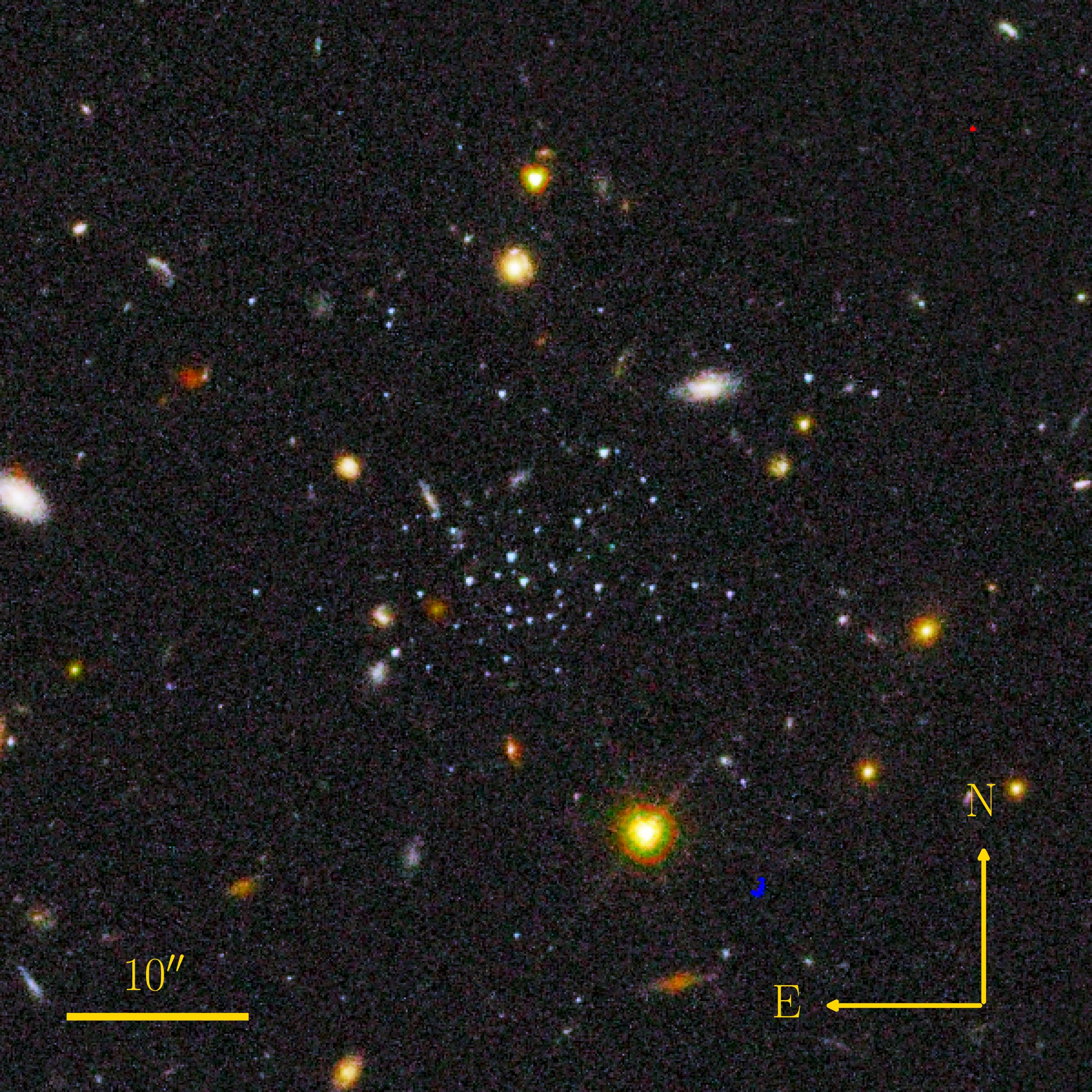
Fornax-7 first appeared as an excess of point sources in data from the Euclid space telescope and was subsequently identified through a systematic search for dwarf-galaxy candidates. The object lies in the direction of the Fornax dwarf spheroidal galaxy, or Fornax dSph, and about 2.8 kiloparsecs from its center in projection if it is at the same distance as Fornax.
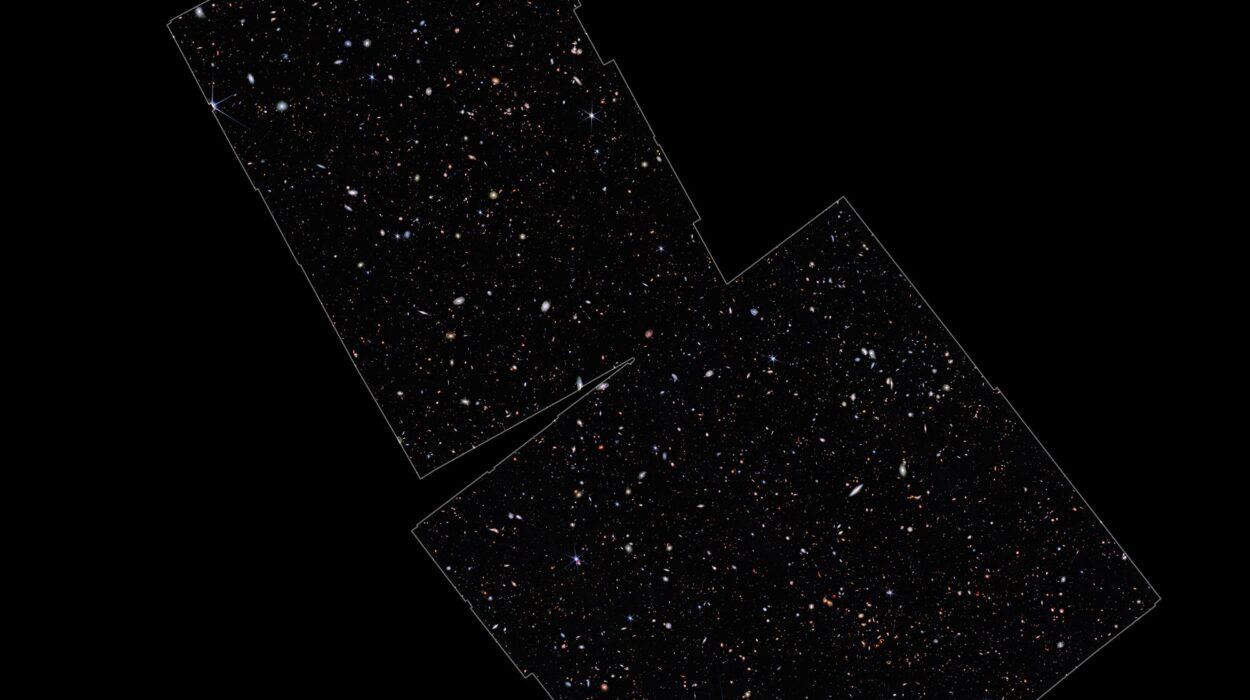
The detection depended strongly on the depth and resolution of the Euclid observations. The telescope’s VIS instrument observed the region in the broad IE band, while its NISP instrument provided near-infrared measurements in the YE, JE and HE bands. Euclid’s IE imaging reaches a 5-sigma point-source depth of about 26.2 magnitudes, compared with roughly 24.3 to 24.5 in the near-infrared bands. Its pixels are 0.1 arcseconds across, with an effective angular resolution of about 0.18 arcseconds.
Those characteristics made the difference for Fornax-7. The stellar overdensity is apparent in the deep IE images, while it is not readily visible in the near-infrared data beyond a handful of the brightest stars. The same pattern appears when the object is compared with ground-based images. The candidate member stars can be seen in the Legacy Survey and KiDS data, but the broader stellar overdensity becomes apparent only in the deeper, higher-resolution Euclid imaging.
The object is therefore not simply a bright, easily resolved cluster. Much of its stellar population lies close to the detection limits of the available observations.
The system is only about 5 parsecs across
The researchers measured the spatial distribution of point-like sources around Fornax-7 and fitted its structure using a maximum-likelihood analysis that included a constant foreground and background population.
They obtained a half-light radius of 7.12 ± 1.49 arcseconds. If Fornax-7 lies at the distance of the Fornax dSph, this corresponds to a projected half-light radius of 5.0 ± 1.0 parsecs.
The measured ellipticity is 0.02, with an upper uncertainty extending to 0.35. Within those uncertainties, the system is consistent with a nearly circular shape, although its ellipticity is not tightly constrained. The fitted position angle is 116 degrees, with uncertainties of +22 and −30 degrees.
Its small size is one of the features that makes Fornax-7 difficult to classify. The researchers place it among extremely faint and compact stellar systems whose observed properties overlap those of globular clusters, the faintest dwarf galaxies and other ambiguous systems.
Its total IE-band magnitude was estimated by combining the light from resolved stars with a diffuse component below the direct source-detection limit. The resulting apparent magnitude is IE = 20.8 ± 0.2. The corresponding absolute V-band magnitude is estimated as MV = +0.3 ± 0.3.
The surface brightness is extremely low. Within its half-light radius, the measured diffuse component has a mean surface brightness of about 27.7 magnitudes per square arcsecond in the IE band.
That faint diffuse light matters because many of the stars are not individually detected. The estimate assumes that the unresolved faint stars have the same spatial distribution as the brighter resolved stars and does not account for possible mass segregation.
Only six bright stars provide the clearest population clues
The stellar population is particularly difficult to characterize because so few individual stars are bright enough to provide reliable measurements across multiple bands.
The researchers constructed color-magnitude diagrams using Euclid measurements and modeled the expected contribution from foreground Milky Way stars. Sources with IE − HE greater than 0.5 were treated as consistent with foreground contamination and excluded.
Two especially bright objects initially present in the region were also removed. Gaia astrometry showed that they have significant parallaxes and proper motions, indicating that they are foreground Milky Way stars rather than members of Fornax-7.
After these exclusions and other quality cuts, six candidate member stars, referred to as BEST-6, remained as the brightest sources with reliable IE − HE colors. These six stars form an important part of the stellar-population analysis.
Their optical colors provide another constraint. Direct integrated photometry gives g − r = 0.25 ± 0.1 and g − i = 0.4 ± 0.1, while the median colors of the six selected stars are approximately g − r = 0.38 and g − i = 0.49. The researchers therefore adopted representative values of g − r = 0.3 ± 0.1 and g − i = 0.45 ± 0.1 for their modeling.
Additional color-magnitude diagrams using IE − YE and IE − JE were also examined with the same six stars. The authors describe these additional combinations as an independent consistency check on the inferred stellar-population properties.
Thousands of synthetic populations were tested
With only a handful of bright candidate members, ordinary isochrone fitting alone would provide limited information. Instead, the researchers used stochastic forward modeling.
They generated synthetic stellar populations by randomly sampling stellar masses from either a Kroupa or Chabrier initial mass function. The simulations used PARSEC stellar-evolution isochrones and explored combinations of stellar age, metallicity and distance modulus.
The main analysis restricted the metallicity to −2.2 ≤ [M/H] ≤ −2.0. The age range covered log10(age/yr) from 9.83 to 10.13, while the distance modulus ranged from 19.8 to 21.8.
For every combination of age, metallicity and distance, the researchers generated many random realizations of the stellar population. Each realization contained between zero and 2,000 stars, with stellar masses sampled down to 0.1 solar masses.
The modeling was designed to reproduce several different properties of Fornax-7 at once. A successful realization had to account for the absence of bright stars, match the luminosity of stars between IE = 23 and 26.5, and reproduce the faint unresolved luminosity. The researchers then compared the surviving models with the color-magnitude diagram, the IE-band luminosity function and the integrated optical colors.
The first three conditions were treated as hard constraints. The probability that a random stellar population satisfied them was called the occurrence probability, Pocc. The remaining three comparisons were quantified with separate chi-squared statistics.
These quantities were combined into a single metric, Q, with lower values corresponding to models that better reproduced the observed properties while also satisfying the hard constraints.
The modeling was repeated until either 1,000 successful realizations had been obtained or 5,000 unique realizations had been generated for a given point in parameter space. The authors also give a Bayesian interpretation of the metric under simplifying assumptions, while noting that the priors arise from the way the simulations themselves were sampled.
The population appears to be old
The resulting models consistently point to an old stellar population.
With the restricted metallicity range, the best-fitting age is 10.4 ± 1.9 billion years. When the allowed metallicity range is expanded from −2.2 ≤ [M/H] ≤ −2.0 to −2.2 ≤ [M/H] ≤ −1.0, the best-fitting age shifts slightly younger, to 9.2 ± 1.8 billion years.
The researchers attribute that shift to the age-metallicity degeneracy, in which different combinations of age and metallicity can produce similar observed stellar colors.
Despite that shift, both analyses indicate that Fornax-7 is an old system, with an age of roughly 9–10 billion years.
The broader metallicity analysis gives a best-fitting [M/H] of about −1.4 ± 0.3. But the researchers explicitly caution that the metallicity is not well constrained by the current observations.
In particular, below about [M/H] = −1.5, differences between the model isochrones become increasingly small. The PARSEC models used in the analysis also extend only down to [M/H] = −2.2. If Fornax-7 is intrinsically more metal-poor than that, the modeling could not recover the lower value.
For that reason, the authors treat the metallicity analysis primarily as a way to test whether the inferred age and distance remain stable when the metallicity assumption is relaxed, rather than as a precise metallicity measurement.
Its distance matches the Fornax dwarf galaxy
The distance estimate is more stable.
With the Kroupa initial mass function and the restrictive metallicity range, the inferred distance modulus is 20.86 ± 0.37. With the broader metallicity range, it is 20.82 ± 0.33.
The Fornax dSph has a distance modulus of 20.8 ± 0.1 in the comparison adopted by the researchers.
The agreement strongly suggests that Fornax-7 is at approximately the same distance as the Fornax dSph. But that does not establish that the two systems are gravitationally bound to each other.
That distinction is central to the interpretation of the object. Distance alone cannot tell whether Fornax-7 is a satellite of Fornax or simply happens to lie along the same line of sight.
The researchers say that radial-velocity measurements from future spectroscopy will be needed to determine whether Fornax-7 is dynamically associated with the Fornax dSph.
The stellar mass is only a few hundred Suns
The stochastic models also place Fornax-7 at an exceptionally low stellar mass.
For the Kroupa initial mass function, the inferred stellar mass is 170 +50/−62 solar masses. Repeating the analysis with a Chabrier initial mass function produces a mass only a few percent lower.
Relaxing the metallicity constraint likewise leaves the result nearly unchanged, giving 163 +50/−49 solar masses.
The agreement between the different modeling choices indicates that the system contains only a few hundred solar masses in stars. The researchers therefore classify it among the least massive known old stellar systems.
The comparison between the Kroupa and Chabrier models is important because the two initial mass functions distribute low-mass stars somewhat differently. Yet the inferred properties of Fornax-7 remain highly consistent between them.
The authors also estimate that the system has an effective IE-band surface brightness of 26.50 magnitudes per square arcsecond, with a corresponding V-band value of 26.80 magnitudes per square arcsecond.
Its properties do not identify what kind of object it is
The combination of very low luminosity, small size, old age and uncertain metallicity leaves Fornax-7 in an unusual region of parameter space.
In the luminosity-size relation, the system lies close to the sequence occupied by dwarf galaxies but within a region containing ambiguous stellar systems. In the luminosity-metallicity relation, it falls closer to metal-poor globular clusters and other ambiguous systems than to the expected relation for dwarf galaxies.
The researchers caution that this comparison cannot settle the issue because the metallicity itself is poorly constrained.
The question is therefore not simply whether Fornax-7 is faint. It is what kind of stellar system can have these properties and still exist where it is observed.
One possibility is a remote globular cluster
If Fornax-7 is a globular cluster belonging to the Fornax dSph, its present-day mass of about 170 solar masses would be far below the mass with which such a cluster would have formed.
The researchers estimate that a cluster with the present-day properties of Fornax-7 would be expected to dissolve completely within a few billion years through dynamical evaporation. Using an assumed evaporation timescale of 13 billion years, they estimate an initial stellar mass of roughly 10,000 solar masses for its progenitor. If the cluster was initially more compact, its starting mass could have been several times higher.
That raises a second question: could such a cluster have remained in the outer regions of the Fornax dSph for most of its lifetime?
Fornax-7 is at least 2.8 kiloparsecs from the center in projection. The researchers note that this places it in the outer region of Fornax, near the galaxy’s estimated tidal radius of about 3 kiloparsecs.
Simple dynamical estimates suggest that its present structure would not be strongly affected by the current tidal field. Under a star-cluster assumption, with no dynamically important dark matter component, the estimated internal crossing time is about 18.1 million years. An estimated orbital period around Fornax is about 690 million years, giving an orbital-to-crossing-time ratio of roughly 38.
The estimated present-day tidal radius of Fornax-7 is about 20.5 parsecs, compared with its 5.0-parsec half-light radius. The researchers therefore conclude that its present stellar distribution is expected to lie well within its tidal boundary.
They emphasize, however, that these are simple analytical estimates. The orbital properties and dynamical history of Fornax-7 are unknown, and the calculations do not account for possible changes in its orbit or past tidal interactions.
Within those limitations, the authors consider a remote globular-cluster interpretation plausible.
It could instead be a satellite of the Fornax dwarf
The other major possibility is that Fornax-7 is an ultra-faint dwarf galaxy orbiting the Fornax dSph.
Under that interpretation, the researchers use stellar-to-halo mass relations to estimate that Fornax-7 could reside in a dark-matter halo of roughly 100 million solar masses, although they stress that this is only an order-of-magnitude estimate because the relation is being extrapolated into an extremely low-mass regime. Halo masses as low as roughly 10 million solar masses are also possible within the range of models they discuss.
Such a system would represent an unusually small satellite of a dwarf galaxy. Whether such a satellite should exist depends on the halo mass of the Fornax dSph and on how galaxy formation behaves at very low halo masses.
The researchers note that simulations predict that dwarf galaxies comparable to Fornax can host between zero and two subhaloes of roughly 100 million solar masses, depending on the assumed halo mass. Other models predict substantially different behavior as galaxies approach the transition between luminous and dark haloes.
Fornax-7’s estimated stellar mass of only about 170 solar masses puts it deep in that low-mass regime.
But the dwarf-galaxy interpretation creates another dynamical issue. A dark-matter-dominated satellite with a halo mass of around 100 million solar masses would experience stronger dynamical friction than a purely stellar cluster. The resulting orbital decay could bring it toward the center of Fornax on a timescale of a few billion years.
The authors discuss several mechanisms that could alter that simple picture, including interactions involving the Milky Way and possible past interactions in the Fornax system. They also note that a substantially lower halo mass would reduce the problem.
These possibilities remain scenarios rather than demonstrated histories for Fornax-7.
The system could also be unrelated to Fornax
The distance analysis provides strong evidence that Fornax-7 lies at approximately the distance of the Fornax dSph, but the researchers do not consider that sufficient to establish a physical association.
If spectroscopy eventually shows that Fornax-7 does not share the Fornax system’s dynamics, the object would instead be an ultra-faint dwarf-galaxy candidate in the outer halo of the Milky Way.
In that case, its combination of extremely low stellar mass and old age would place it among the most distant and least massive systems of this type discussed by the authors.
For now, however, the available data cannot distinguish this possibility from the two Fornax-associated scenarios.
The decisive observation would be dynamical. Measuring Fornax-7’s radial velocity would allow its motion to be compared with that of the Fornax dSph and provide a test of whether the two systems are gravitationally associated.
Deeper photometry or spectroscopy would also help resolve the age-metallicity degeneracy and provide stronger constraints on the stellar population. The researchers note that future N-body simulations could then be used to investigate the system’s possible evolutionary history once its properties are better established.
For now, the observations define Fornax-7 more clearly than they define its identity: it is an old, extremely faint and compact stellar system, with an estimated stellar mass of about 170 solar masses and a distance consistent with the Fornax dwarf spheroidal galaxy, but its present data do not uniquely establish whether it is a remote globular cluster, an ultra-faint dwarf satellite, or an unrelated system in the Milky Way halo.
The study was published in Astronomy & Astrophysics.