A massive black hole at the center of a distant, compact galaxy may have grown from a much smaller object formed in the early universe, without producing the large population of stars usually associated with such growth. A theoretical study examining the origins of Little Red Dots suggests that gas falling onto an ancient primordial black hole could help explain the properties of one particularly unusual object, while two other proposed growth pathways face significant obstacles.
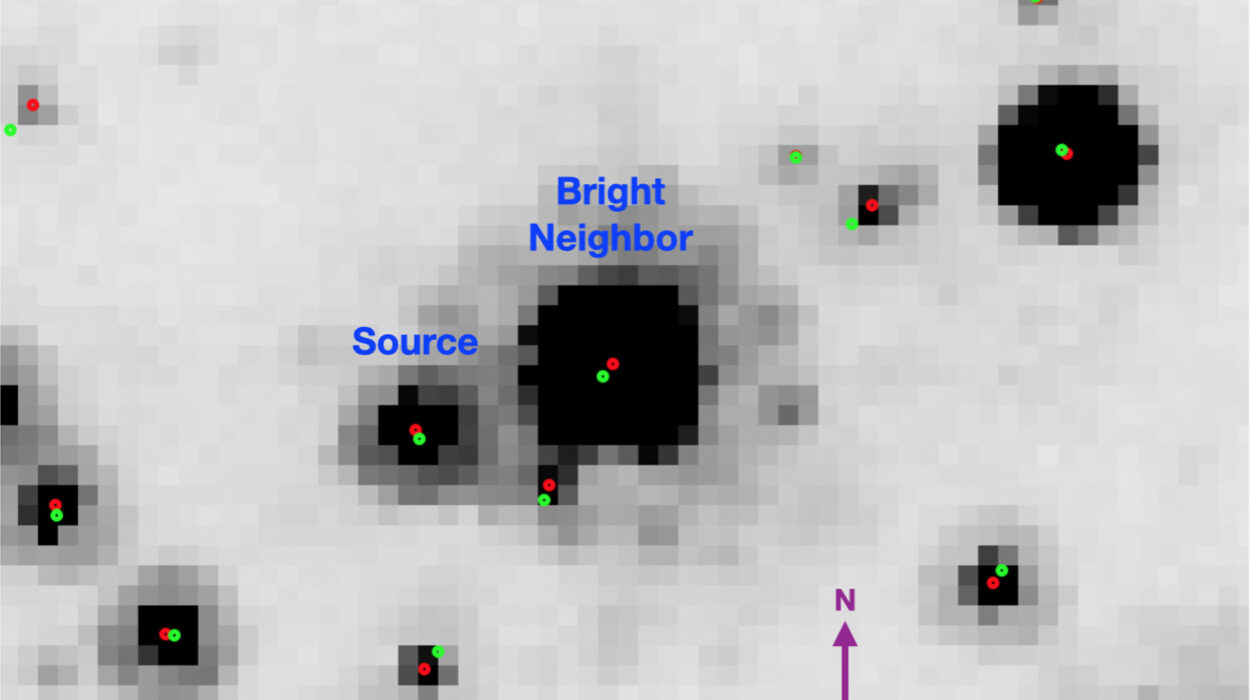
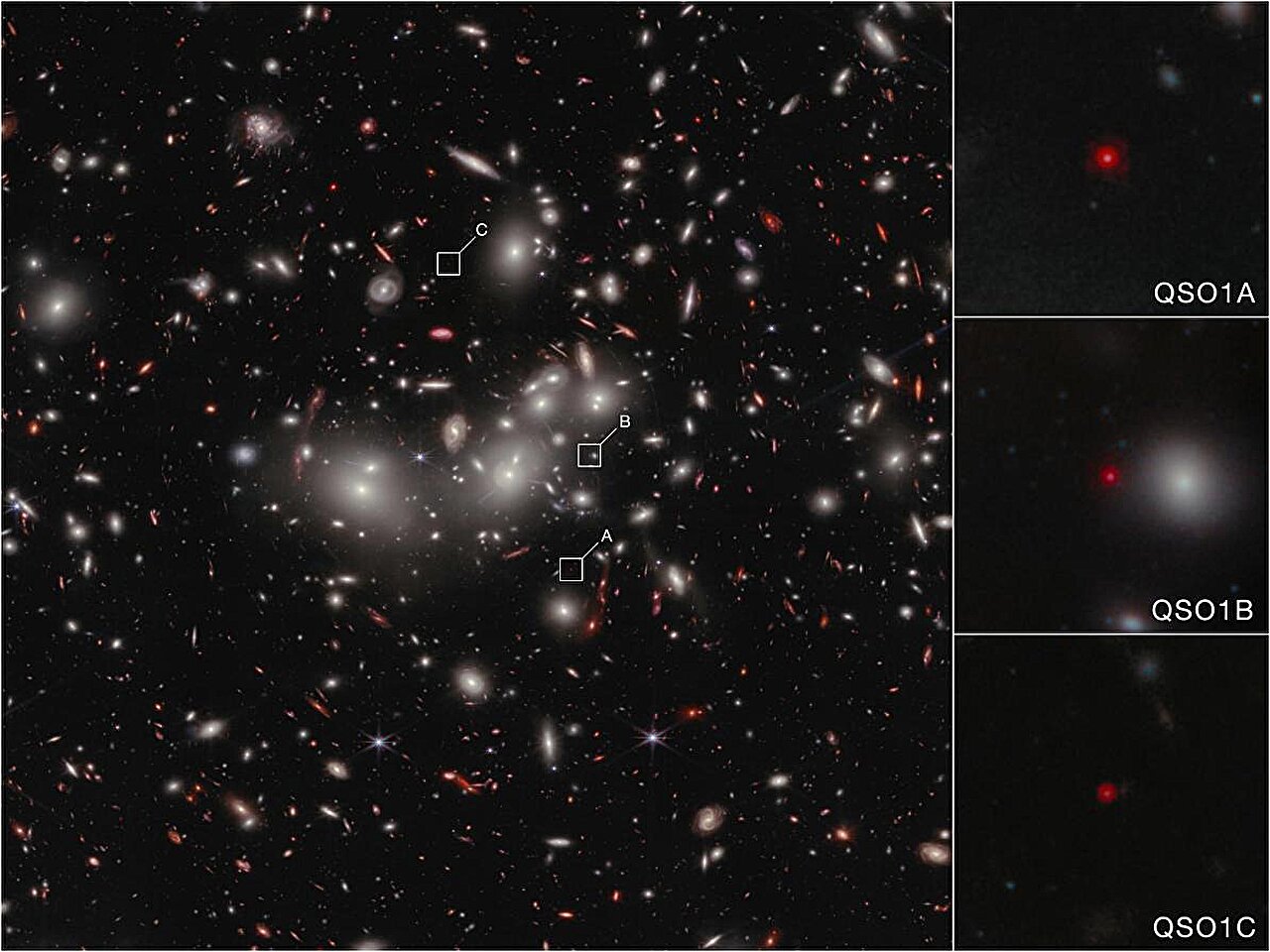
Little Red Dots are compact, unusually red objects found in the distant universe by the James Webb Space Telescope. Their small sizes, bright emission and broad spectral features have made them difficult to explain. Many appear to contain massive black holes, yet their inferred black hole masses can be surprisingly large compared with the stellar masses of their host galaxies.
That combination is especially striking in QSO1, a Little Red Dot at a redshift of 7.04. Its inferred black hole mass is about 50 million times the mass of the Sun, while its black hole-to-stellar mass ratio exceeds 2. The object also has a reported metallicity of less than 1% of the Sun’s metallicity, indicating a relatively low abundance of elements heavier than helium.
These properties raise a question about how such a massive black hole could have formed and grown so early in cosmic history, particularly if relatively few stars formed around it.
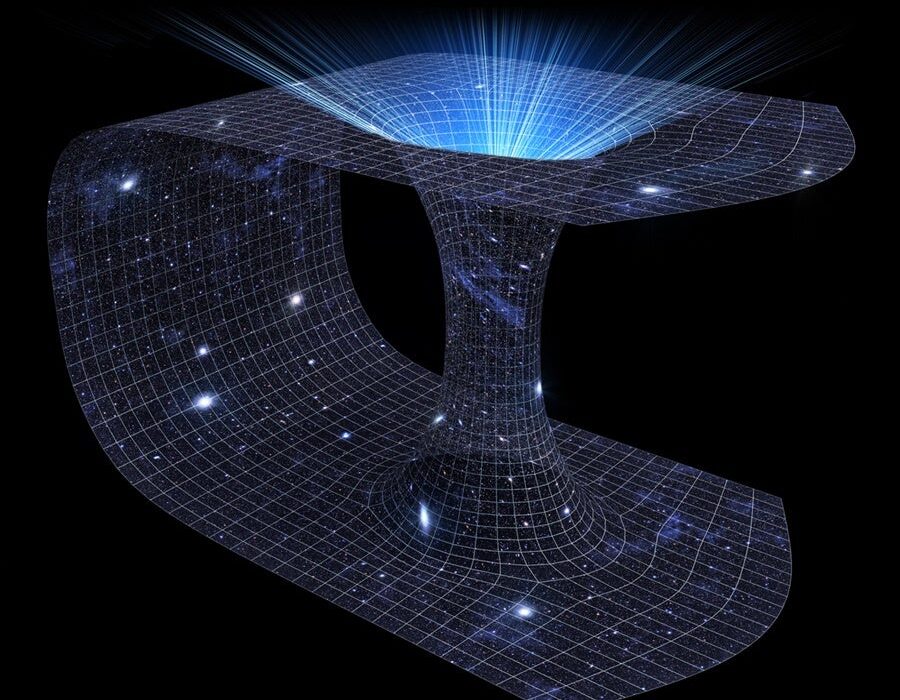
Valerio De Luca and colleagues investigated whether primordial black holes could provide an explanation. Unlike black holes formed when massive stars collapse, primordial black holes would have originated from the collapse of unusually dense regions in the early universe. The researchers examined three possible routes from these early objects to the massive black holes associated with Little Red Dots: forming very massive black holes directly, building them through repeated mergers, or growing smaller seeds by accreting gas.
Their calculations point to gas accretion as the most promising of the three pathways they considered. But that route comes with a demanding condition. The growing black hole must convert only a small fraction of its surrounding gas into stars, or the resulting stellar activity could produce more heavy elements than are observed in QSO1.
The challenge of growing massive black holes so early
Little Red Dots are among the compact sources identified in the early universe with JWST. They have distinctive, V-shaped spectra across ultraviolet and optical wavelengths, compact appearances and broad emission features.
Their inferred black hole masses generally fall between about a million and 100 million solar masses. In some cases, the estimated black hole mass is unusually large relative to the stellar mass of the surrounding galaxy.
The objects also appear relatively abundant. Reported estimates suggest that Little Red Dots could account for roughly 10% to 20% of galaxies within a particular ultraviolet-magnitude range. Their abundance makes it important to consider not only whether a proposed formation process can produce an individual massive black hole, but also whether it can produce enough of them.
Their properties do not fit neatly into a simple picture of ordinary active galactic nuclei. Little Red Dots often show weak signs of hot dust emission and lack detectable X-ray signatures, despite the possibility that massive black holes power their brightness. Other explanations have also been proposed, including compact galaxies, nuclear star clusters, supermassive stars and several forms of unusual black hole activity.
QSO1 provides a particularly useful test case because its estimated black hole mass, low metallicity and large black hole-to-stellar mass ratio place several constraints on possible formation histories.
The black hole mass is not entirely free of uncertainty. Estimates based on the widths of broad emission lines can be unreliable if electron scattering, rather than the gravitational motion of gas around the black hole, contributes substantially to those widths. The study therefore treats the inferred properties as observational targets for its models, not as measurements without uncertainty.
Direct formation runs into a cosmic microwave background limit
One possibility is that a primordial black hole formed with a mass already close to the tens of millions of solar masses inferred for QSO1. That would avoid the need to build up the black hole through later growth.
Primordial black holes could form when sufficiently large density fluctuations in the early universe collapse under gravity. The mass of a resulting black hole is connected to the size of the region that collapses. Producing a black hole as massive as the one inferred for QSO1 would therefore require very large primordial fluctuations.
But those fluctuations cannot be increased without limit. The early universe left behind the cosmic microwave background, whose properties place constraints on the conditions that existed when the first black holes could have formed.
In particular, large primordial fluctuations can produce distortions in the cosmic microwave background spectrum. These include so-called μ-distortions, which arise when energy is released into the radiation field before the universe becomes transparent to light. Measurements from the COBE Far Infrared Absolute Spectrophotometer, or FIRAS, place strong limits on such distortions.
The researchers compared the primordial fluctuations needed to produce black holes of different masses with these observational constraints. Under the assumptions considered, the limits exclude direct formation of primordial black holes in the approximate mass range of 10⁴ to 10¹¹ solar masses.
That range includes the masses needed to explain the black hole inferred for QSO1. Directly forming a primordial black hole with a mass comparable to the observed black hole is therefore not viable in the model.
The conclusion is not entirely independent of assumptions about the early universe. Extremely non-Gaussian primordial fluctuations could, in principle, change the constraints. Such fluctuations would differ substantially from the usual statistical description of primordial density variations, however, and the authors note that producing the required non-Gaussianity is difficult in realistic scenarios.
The researchers instead identify primordial black holes with initial masses around 1,000 solar masses as the heaviest seeds that remain viable under the constraints they consider. Even these objects could account for only a small fraction of dark matter, with an allowed abundance of roughly 10⁻⁴ to 10⁻⁷ of the total dark matter density.
That leaves a substantial gap between the possible initial seed and the black hole mass inferred for QSO1. The remaining question is whether the seed could grow quickly enough through later cosmic processes.
Repeated mergers face a shortage of suitable environments
A second possibility is that many smaller primordial black holes merged over time, gradually building a much larger black hole.
The researchers examined this process using initial seeds of about 1,000 solar masses. Repeated mergers would need to combine enough of these objects to produce a remnant with a mass of roughly 10⁷ solar masses.
They considered two idealized ways this could happen.
In a democratic merger history, black holes of comparable mass repeatedly merge with one another. Each generation produces larger remnants, which then merge with other objects of similar mass.
In an oligarchic history, the most massive black hole repeatedly merges with smaller, lighter seeds. This allows one object to grow through a series of unequal-mass mergers.
The distinction matters because black hole mergers can produce gravitational waves that carry away momentum. The resulting black hole remnant can receive a recoil kick, potentially sending it out of the gravitational environment in which it formed. If it escapes, it cannot continue growing through mergers in that same environment.
For a merger-built black hole to reach the mass inferred for QSO1, it must remain in a sufficiently deep gravitational potential well. The researchers therefore examined whether dark matter halos at high redshift could retain the merger remnants.
They modeled the halos using a Navarro-Frenk-White, or NFW, density profile, a commonly used description of how dark matter is distributed within a halo. They considered a range of halo concentrations, from 0.1 to 1, to account for uncertainty in the halo structure.
The calculations also account for the tendency of black holes to move toward the centers of their host halos through mass segregation. The researchers then used simulations to estimate the efficiency of producing a black hole of around 10⁷ solar masses while retaining it against gravitational-wave recoil.
The results show why the merger pathway is difficult. Reaching the required mass in their model calls for at least about 10,000 primordial black holes within a single dark matter halo. A halo must therefore be massive enough to contain a large population of these seeds, even though primordial black holes are allowed to make up only a small fraction of dark matter.
The rarer the primordial black holes, the more massive the host halo must be to contain enough of them. At the redshifts relevant to QSO1, such massive halos are themselves uncommon.
The researchers combined their estimated merger efficiencies with the abundance of dark matter halos at high redshift to calculate how frequently suitable environments might occur. They compared the resulting number densities with the observed abundance of Little Red Dots.
The two merger histories produced different results. Oligarchic growth was more efficient because mergers between unequal-mass black holes generally produce smaller recoil kicks than mergers between comparable-mass objects. That makes it easier for the growing remnant to remain in its host halo and continue merging.
Even so, the predicted abundance approaches the observed Little Red Dot density only in the most optimistic case: oligarchic growth combined with a primordial black hole abundance near the upper end of the allowed range, around 10⁻⁴ of dark matter.
For lower primordial black hole abundances, the predicted number of suitable systems falls substantially. The merger pathway could therefore produce massive black holes in principle, but the researchers’ calculations suggest that it has difficulty producing enough QSO1-like objects to account for the observed population.
Gas accretion offers another route from a small seed to a massive black hole
The third possibility does not require thousands of primordial black holes to merge. Instead, a smaller primordial black hole could grow by drawing in gas from its surroundings.
The researchers modeled the growth of an initial black hole seed of roughly 1,000 solar masses, following its evolution from a very early stage of the universe toward the epoch when QSO1 is observed.
Gas accretion is not equally effective at all times. At very high redshifts, the time needed for the black hole to accrete significant amounts of material can exceed the age of the universe. Growth becomes more effective later, as conditions around the black hole change.
To describe this process, the researchers used a simplified model that tracks how much material enters the black hole’s surroundings and how much is lost or converted into stars.
The model accounts for several competing processes. Gas can fall toward the black hole, some of it can be expelled from the system, and some can become stars if the accretion disk breaks apart under its own gravity. Gas can also accumulate around the black hole rather than immediately reaching it.
The balance is represented by an equation for the black hole’s mass growth:
Ṁₚᵦₕ = Ṁᵢₙ𝒻 − Ṁ★ − Ṁₒᵤₜ − Ṁ𝓰
Here, Ṁᵢₙ𝒻 represents the inflow of gas, Ṁ★ the rate at which gas turns into stars, Ṁₒᵤₜ the rate at which material leaves the system, and Ṁ𝓰 the change associated with gas accumulating within the black hole’s surrounding region.
The model begins with Bondi accretion, which describes how an object draws in gas from its surroundings under gravity. The amount of gas available depends partly on its density and sound speed, as well as the relative motion between the black hole and the surrounding gas.
The black hole is assumed to sit inside a dark matter minihalo. The researchers use a prescription for the halo’s enclosed mass that evolves with the black hole’s mass and redshift.
They also introduce an effective parameter, λ, to describe how efficiently gas can flow inward compared with the idealized Bondi rate. This parameter represents the suppression of accretion by effects such as cosmic expansion, interactions between the cosmic microwave background and gas, and gas viscosity.
The calculations find that values of λ between roughly 10⁻³ and 1 can allow a seed of about 1,000 solar masses to grow to around 10 million solar masses.
But the growth process changes when the black hole begins to strongly affect its surroundings.
Radiation feedback changes the flow of gas
As gas falls toward the black hole, the resulting radiation can heat and ionize the surrounding material. In the model, this feedback becomes important at a stage called the Bondi instability.
Radiation ionizes gas along the polar direction around the black hole, increasing the sound speed of the surrounding material to approximately 10 kilometers per second. Because hotter gas resists gravitational inflow more strongly, this change reduces the rate at which material can fall inward.
After this stage, the model limits the infall rate to a value set by the sound speed and the gravitational constant, rather than allowing the original Bondi rate to continue unchecked.
The researchers also examine whether the accretion disk can fragment. A disk that becomes gravitationally unstable may break into dense regions that form stars instead of allowing all its gas to reach the black hole.
This is particularly important for QSO1. Its low measured metallicity places a limit on how much star formation could have occurred in the material surrounding the growing black hole.
Stars produce heavier elements and can release them into their surroundings. If too much gas in the accretion disk turns into stars, the resulting metal enrichment could exceed the level inferred for QSO1.
To track this effect, the researchers model the disk’s fragmentation through the fraction of incoming gas converted into stars, represented by f_frag. They also follow the evolution of metallicity using an effective metal yield of roughly 10⁻², together with the gas inflow and the amount of gas available.
The model does not include metals produced by ordinary later structure formation. As a result, the calculated upper limit on disk fragmentation should be understood as a constraint within this simplified model, rather than a complete accounting of every possible source of metals.
QSO1’s low metallicity limits star formation around the black hole
The researchers varied the accretion efficiency, the fraction of gas expelled from the system and the disk-fragmentation fraction to determine which combinations could reproduce QSO1’s inferred black hole mass and metallicity.
They compared the model with central values of approximately 10⁷·⁷ solar masses for the black hole and 10⁻²·⁰⁸ times the Sun’s metallicity.
The results indicate that the disk-fragmentation fraction must remain below roughly 10⁻². In other words, no more than about 1% of the incoming gas can be converted into stars under the model conditions that reproduce QSO1’s properties.
With fragmentation kept this low, the model also predicts a relatively small stellar mass, no greater than about 1% of the black hole mass. That is consistent with the unusually high black hole-to-stellar mass ratio inferred for QSO1.
This connection between low metallicity and limited star formation is central to the proposed accretion pathway. The black hole can grow substantially only if most of the available gas does not become stars or leave the system before reaching the black hole.
The researchers find that the model can reproduce the observed properties of QSO1 across a range of accretion parameters. The result does not establish that QSO1 actually formed from a primordial black hole, but it demonstrates that gas accretion onto a relatively small primordial seed can provide a possible route to its inferred mass while keeping the surrounding stellar population small.
The accretion history may also help explain some of the object’s unusual emission properties. Depending on the value of λ, the black hole can enter a super-Eddington accretion phase near the onset of instability and may remain in that state at a redshift of about 7.
The Eddington limit describes the balance at which the outward pressure of radiation can counteract the inward pull of gravity during accretion. In super-Eddington accretion, material is supplied faster than the conventional Eddington rate.
The researchers suggest that photon trapping could occur during this phase. In that process, radiation becomes trapped in the rapidly flowing gas and is carried inward rather than escaping efficiently. This can reduce the radiative efficiency of the accretion flow.
For QSO1, the model predicts a luminosity of about 10⁻² times the Eddington luminosity, assuming a radiative efficiency of roughly 10⁻³ to 10⁻⁴. The authors note that this is consistent with predictions from slim-disk models, which describe accretion flows in which radiation trapping can be important.
Such a low radiative efficiency could help account for the weak X-ray and variability signatures associated with some Little Red Dots. It remains a proposed explanation within the model, not a direct measurement of photon trapping in QSO1.
The accretion pathway remains dependent on uncertain physics
Although gas accretion performs best among the three pathways examined, the researchers emphasize that their model is deliberately simplified.
Accretion onto a black hole in the early universe involves complex interactions among gas dynamics, radiation, feedback and star formation. The study uses a phenomenological prescription to represent these processes rather than a full hydrodynamic simulation of the surrounding environment.
The parameter λ captures several effects that can suppress gas inflow, while the model’s treatment of disk fragmentation and outflows simplifies processes that could depend on the detailed structure and evolution of the accretion flow.
The assumption about the gas reservoir is also simplified. The model sets the gas mass at the onset of Bondi instability to approximately the black hole mass at that time and then holds it constant. The authors omit a possible contribution from continued gas accumulation, noting that it would be degenerate with the model’s outflow parameter.
The metallicity constraint also has a specific limitation. Because the calculation neglects metals from ordinary later structure formation, the maximum allowed fragmentation fraction is an upper bound within the model. Including additional sources of metals could make the permitted amount of star formation smaller.
The conclusions about direct formation and hierarchical mergers also depend on their respective assumptions. Direct formation could be affected by unusual primordial non-Gaussianity, while merger-built growth depends on the abundance of primordial black holes, the properties of their host halos and the ability of those halos to retain merger remnants.
The study focuses on QSO1 as a benchmark rather than demonstrating that the same formation history explains the full population of Little Red Dots. The authors identify further work on the broader population, more detailed accretion modeling and scenarios combining gas accretion with mergers as important directions for testing the proposed pathways.
Among the three possibilities examined, the researchers regard accretion onto an intermediate-mass primordial black hole seed as the most viable explanation for QSO1-like objects. In their model, a seed of roughly 1,000 solar masses can grow to the required mass if gas inflow is sufficiently efficient and disk fragmentation remains very low.
The study was published in Physical Review Letters.