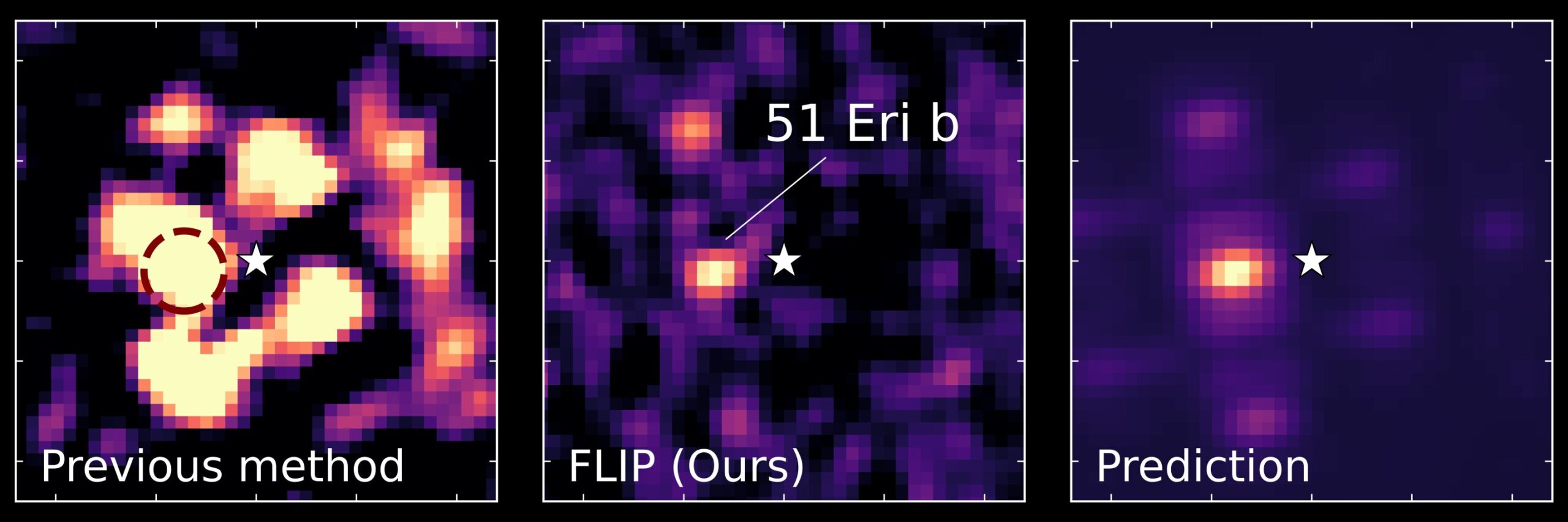
The James Webb Space Telescope has captured its first image of the giant exoplanet 51 Eridani b at a wavelength of 4.3 micrometers, recovering a planetary signal that earlier observations could not detect. The breakthrough came from a new image-processing method that models the telescope’s optics and corrects for small changes in the instrument, allowing astronomers to separate much fainter planetary light from the glare of a host star. Tested on four JWST observation datasets, the method improved exoplanet detection sensitivity by as much as 15 times compared with a widely used technique.
Directly imaging an exoplanet is difficult because its host star is overwhelmingly brighter than the planet. Even young, bright giant planets can be about 100,000 times fainter than their stars in near-infrared light. The telescope must therefore suppress the star’s light with a coronagraph and remove the remaining stellar glare through image processing before astronomers can identify the planet.
One of the main obstacles is that the telescope does not remain in exactly the same optical state between observations. Small pointing errors, changes in the telescope’s mirrors and other instrumental effects alter the shape of the star’s image. These differences make it difficult to construct an accurate model of the stellar light using observations taken at another time or of another star.
Astronomers have traditionally addressed this problem by collecting reference images and combining them to estimate the unwanted starlight. However, when the telescope changes between the reference observations and the observation of the target, the resulting images no longer match perfectly. Residual starlight can then obscure a faint planet.
A research team led by Rodrigo Ferrer-Chavez developed a different approach called Physics-based Learning for Imaging Planets, or FLIP. Instead of relying primarily on reference images to reproduce the star’s appearance, the method builds a physical model of the telescope’s optical system and adjusts that model to match the actual observations.
The researchers tested FLIP on observations from the James Webb Space Telescope’s Near-Infrared Camera (NIRCam). Their results included the recovery of 51 Eridani b in a wavelength range where previous processing had produced no detection.
Why conventional starlight removal reaches a limit
A coronagraph blocks much of a star’s light before it reaches the detector, making it possible to observe objects much closer to the star than would otherwise be practical. However, the remaining stellar light still produces a pattern known as a point spread function, or PSF.
The PSF describes how an optical system distributes light from a point-like source across an image. Its shape depends on the telescope’s optics, the alignment of its components and the detector’s response.
Even small changes in these conditions can alter the PSF. For example, a slight shift in the star’s position behind the coronagraph mask or a change in the telescope’s optical path can produce a different pattern of residual light.
The commonly used method in the study, called Karhunen–Loève Image Processing (KLIP), constructs a model of the stellar PSF from reference observations. It uses mathematical components called Karhunen–Loève modes to represent the dominant patterns in those images and subtract them from the science observation.
This approach works well when the reference images adequately represent the stellar pattern in the target observation. But differences between the telescope’s state during the two observations can leave behind unwanted light.
Those residuals are particularly troublesome close to the star, where the planet’s signal is already difficult to distinguish from the much brighter stellar background.
The challenge is especially relevant to future observatories designed to image Earth-like planets around Sun-like stars. The Habitable Worlds Observatory, for example, is being developed with the ambitious goal of observing planets with an approximate brightness contrast of one part in 10 billion relative to their host stars. Achieving such observations requires extremely precise control of instrumental effects.
FLIP takes a different route by attempting to reproduce the stellar image through a model of the instrument itself.
A physical model that adjusts to the actual telescope image
The researchers built FLIP around three main elements: physical modeling of the telescope, automatic differentiation and a multistage optimization process.
The physical model begins with the nominal optical models used by the Space Telescope Science Institute’s open-source software STPSF, which simulates point spread functions for JWST instruments.
These models provide the starting description of how light travels through the telescope and its coronagraph. However, the researchers note that existing optical models are imperfect, particularly for NIRCam coronagraphic observations.
Rather than treating the initial model as an exact representation of the instrument, FLIP adjusts several groups of parameters to make its simulated stellar image match the observed one.
The researchers identified four groups of parameters that were sufficient to reproduce the PSF at the contrast levels examined in their experiments.
These included the star’s brightness and precise position behind the coronagraph mask, the optical path difference before the mask, the optical path difference after the mask, and the detector’s response at individual pixels.
Optical path difference describes differences in the distance light travels through an optical system. Such differences affect the phase of light waves and can change the resulting image pattern.
The two optical path difference components allow FLIP to account for changes on either side of the coronagraph mask. The detector parameters address pixel-level variations that cannot be adequately reproduced by changing the optical model alone.
The researchers implemented the model in PyTorch, a software framework that supports automatic differentiation. This technique calculates how changes in model parameters affect the difference between a simulated image and the actual observation.
Those calculations allow an optimization algorithm to adjust large numbers of parameters efficiently.
In the experiments, FLIP optimized approximately one million free model parameters using an Adam optimizer. The complete optimization took around 35 minutes on a single NVIDIA A30 graphics processing unit.
The researchers also found that the model could reproduce the effects of several other instrumental systematics through its adjustable parameters, even when those effects were not explicitly represented as separate physical processes.
This distinction is important. The fitted parameters provide an effective model capable of reproducing the observed stellar pattern. They do not necessarily represent the telescope’s actual physical state or provide precise measurements of its underlying instabilities.
Calibration helps prevent the planet from disappearing
One of the main difficulties in model-based starlight subtraction is that the optimization process can accidentally remove the planet along with the star.
The researchers encountered this problem when applying their physical model directly to real observations. The nominal optical models were not accurate enough to reproduce the actual JWST images without substantial adjustments, and the flexible model could mistake planetary light for part of the stellar pattern.
To address this, they developed a two-stage optimization strategy.
In the first stage, FLIP calibrates its optical model using a reference star. The reference is generally similar to the science target and is selected from observations that would also be useful in conventional PSF subtraction.
The model adjusts its parameters to reproduce the reference star’s observed image. This calibration helps compensate for inaccuracies in the nominal optical model and provides a better starting point for processing the actual science observation.
In the second stage, FLIP uses the calibrated model on the science target. It adjusts a smaller selection of parameters to account for differences between the reference and science observations, including changes in telescope pointing and optical path differences.
The researchers divided both stages into smaller optimization steps to reduce interference between parameters that can produce similar effects in the final image.
They also used artificial planets to monitor the risk of over-subtraction.
These synthetic planets were created by simulating an off-axis stellar image with the nominal STPSF model and adding it to the science observation at a known position and brightness.
FLIP then processed the image while the researchers tracked the signal-to-noise ratio, or SNR, of the artificial planet.
Initially, the recovered signal generally became stronger as the optimization improved the stellar subtraction. However, after a certain number of iterations, the SNR began to decrease as the algorithm started removing some of the planet’s light.
The researchers therefore stopped the optimization when the injected planets reached their maximum SNR or a plateau.
They measured the injected planets’ SNR approximately every 300 iterations. Their tests included planets at different separations and brightness levels, allowing them to examine how the optimization affected signal recovery across the image.
For the final science-image optimization, they also reduced the strength of the parameter updates and adjusted only a subset of the model parameters. These steps further reduced the risk of removing real planetary signals.
Four JWST datasets test the method
The researchers evaluated FLIP using four JWST NIRCam datasets representing three stellar systems.
Two systems contained known exoplanets: HIP 65426 and 51 Eridani. The third, TYC 5899, was part of a planet-search survey and had no known planetary companions.
The observations covered three filters: F444W, F410M and F430M. They also included two different coronagraph configurations, different stellar spectral types and different strategies for collecting reference observations.
HIP 65426 and TYC 5899 were observed using the round 335R coronagraph mask in the F444W filter. The 51 Eridani observations used the bar-shaped LWBAR coronagraph in its NARROW position, with observations in both F410M and F430M.
The three host stars also represented different spectral types. HIP 65426 is an A2V star, 51 Eridani is an F0IV star, and TYC 5899 is an M3 star.
For comparison, the researchers processed all four datasets using both FLIP and KLIP. They selected the KLIP settings according to the published analyses of the respective observations to reproduce the established performance of the conventional method.
The two approaches were not applied in exactly the same way. KLIP used reference differential imaging and angular differential imaging across both science-observation roll angles, while FLIP was applied to one roll per dataset for simplicity.
The researchers nevertheless obtained KLIP results comparable to those reported in the original publications.
The comparison showed that FLIP improved performance across all four datasets.
A previously undetected image of 51 Eridani b
The clearest demonstration came from 51 Eridani b, a giant exoplanet orbiting the star 51 Eridani.
Earlier observations had detected the planet in the F410M filter, but standard processing had not produced a detection in the F430M filter.
Using FLIP, the researchers recovered the planet in both filters.
In F410M, the planet’s signal-to-noise ratio increased from 6.7 with KLIP to 14.2 with FLIP, an improvement of approximately 2.1 times.
In F430M, KLIP produced no detection, whereas FLIP recovered the planet with an SNR of 6.3. The researchers estimated that sensitivity at the planet’s position improved by approximately a factor of four.
After accounting for small-sample statistical effects, the F430M detection had a reported confidence of 5.3 sigma.
The observation represents the first image of 51 Eridani b at 4.3 micrometers.
That wavelength is particularly relevant because it lies within a carbon dioxide absorption band. Ground-based observations cannot access this part of the spectrum for the same measurements because Earth’s atmosphere absorbs light in this wavelength range.
The researchers point out that carbon dioxide can serve as a tracer of atmospheric metallicity. The new detection therefore provides a measurement opportunity that was unavailable from the earlier observations.
They describe future work using the 4.3-micrometer photometry to investigate the planet’s atmosphere and assess previous evidence suggesting that its metallicity may be approximately five times that of its host star.
The new image does not itself establish that atmospheric metallicity. Rather, it provides an additional observation that can be used in further atmospheric characterization.
The improvement was also apparent for HIP 65426 b, another known giant exoplanet.
Its SNR increased from 82.5 with KLIP to 130.1 with FLIP, corresponding to approximately 1.6 times better SNR.
The researchers also compared the recovered planetary images with ideal simulated point spread functions. This helped distinguish genuine point-like planetary signals from residual structures and side lobes in the stellar PSF.
Artificial planets test sensitivity around a star with no known companions
The third system, TYC 5899, offered a different kind of test.
Unlike the other two systems, TYC 5899 had no known planetary companion in the observations used for the analysis. This allowed the researchers to introduce artificial planets with known brightness and positions and directly compare how well the two methods recovered them.
The observing strategy also presented a particular challenge. TYC 5899 was part of a self-referenced survey in which science observations of different stars were collected into a shared library of reference images.
Unlike dedicated reference-star observations taken close in time to a science observation, this strategy can involve substantial delays between the reference data and the target observation.
In this dataset, the science observation was taken four months after the reference-star sequences.
Such a delay can increase differences in the telescope’s optical state, making conventional reference-based subtraction more difficult.
The researchers selected an observation of HIP 17695 from the survey library as FLIP’s calibration reference because it had the most similar spectral type to TYC 5899 among the available targets.
They then injected artificial planets into the science image before processing it with both methods.
The artificial planets were placed at different separations and given fluxes equal to 20 times the fundamental 5-sigma noise limit at their respective positions.
FLIP recovered the injected signals with substantially higher significance than KLIP. One example shown in the main comparison was recovered with an SNR of 8.8 using FLIP, while KLIP did not detect it.
The researchers also observed a bright nearby background star in the TYC 5899 field. Although the star remained visible after FLIP processing, its image was distorted.
The sensitivity measurements showed particularly large improvements at smaller angular separations from the host star.
At 0.5 arcseconds, FLIP achieved approximately 15 times better sensitivity than KLIP. At 1 arcsecond, the improvement was about five times.
These comparisons are especially relevant because faint planets close to their host stars are difficult to distinguish from residual stellar light.
The researchers also conducted additional artificial-planet recovery experiments using a range of positions and brightness levels. These tests showed that FLIP generally outperformed KLIP, particularly at smaller separations.
However, the comparison was not uniformly favorable at every distance. At larger separations in some cases, FLIP produced greater signal loss than KLIP. This helps explain why the KLIP sensitivity curve was deeper in some of those regions.
The authors note that these larger separations are often limited more by background noise and exposure time than by imperfect starlight subtraction.
Sensitivity improves beyond the estimated telescope stability limit
Beyond comparing the recovered planets, the researchers measured how faint a companion each method could detect at different angular separations.
They calculated contrast curves using artificial-planet injection and recovery tests. These curves describe the brightness of a planet relative to its host star that can be detected at a given distance from the star.
The analysis also included a fundamental noise limit based on the combined uncertainty from detector read noise, photon noise and flat-field noise in the JWST data.
This limit represents an optimistic estimate of the sensitivity that could be achieved with perfect stellar subtraction, assuming no additional noise from the reference observations.
The researchers compared the measured performance with an estimated stability-limited sensitivity for KLIP.
To calculate that limit, they generated simulated observations using the STPSF optical models and introduced realistic variations in telescope pointing and optical path difference.
They performed 50 realizations of each observing sequence, randomly varying the star-to-coronagraph misalignment and optical path difference drift. The simulations deliberately excluded additional noise sources such as photon noise and detector noise to isolate the effects of telescope instability.
The simulated star-to-coronagraph misalignment followed a normal distribution with a mean of zero and a standard deviation of 10 milliarcseconds.
For observations involving telescope slews, the researchers also introduced optical path difference drifts with a randomly selected root-mean-square amplitude drawn from a normal distribution with a mean of 4 nanometers and a standard deviation of 1 nanometer.
They then processed the simulated observations using KLIP and measured the resulting sensitivity.
The estimated stability-limited performance was consistent with KLIP’s sensitivity on the real observations to within a factor of two.
In most cases, FLIP performed substantially better than this estimated stability limit.
Across the four datasets, the study reported sensitivity improvements ranging from approximately four to 15 times in some regions of the images.
For the F430M observations of 51 Eridani, FLIP improved sensitivity by about five times at 0.5 arcseconds and approximately 2.5 times at 1 arcsecond.
The TYC 5899 dataset produced the largest reported improvement, reaching approximately 15 times at 0.5 arcseconds.
These results indicate that the physical-model approach can compensate for some of the instrumental changes that limit conventional reference-image subtraction.
However, the improvements did not mean that FLIP had reached the fundamental photon-noise limit. The researchers explicitly reported that none of the observations reached that limit.
Where the method still needs improvement
Although FLIP substantially improved the recovered signals, the researchers identified several limitations.
One important issue is that the model does not yet provide systematically calibrated measurements of the actual telescope instabilities.
It can adjust optical and detector parameters to reproduce the observed stellar image, but the resulting parameter values do not necessarily describe the telescope’s true physical condition. The model is designed to reproduce the effects of multiple instrumental systematics, some of which are not explicitly represented in its physical description.
The researchers also noted that the detector model could be made more sophisticated. Imperfectly corrected hot pixels, dead pixels and variations in individual pixel responses can create difficulties for model-based subtraction because those effects cannot simply be canceled by subtracting another observation with the same detector characteristics.
Another challenge is the potential for overfitting. If the optimization continues too long, it can begin to remove genuine planetary signals. The artificial-planet monitoring strategy reduces this risk, but the appropriate stopping point depends on the observational circumstances and the planets being targeted.
The learning rates used during optimization also require careful selection. Tests showed that increasing them by several orders of magnitude could make the optimization unstable or cause substantial overfitting. Reducing them too much could leave excessive stellar light in the final image or make the model less effective at compensating for differences between the reference and science observations.
The researchers further noted that FLIP’s sensitivity performance at larger separations was not always better than KLIP’s. In some cases, greater signal loss in FLIP reduced its advantage in those regions.
The HIP 65426 observations also presented a specific limitation. A bright feature in the planet’s own PSF prevented the researchers from measuring FLIP sensitivity within 0.6 arcseconds of the star. The corresponding KLIP measurements used a separate planet-subtraction procedure to account for this contamination.
The current framework was also tested on a limited selection of JWST observations. Although the four datasets covered different stars, filters, coronagraphs and reference-observation strategies, the results do not establish identical performance across every possible observing configuration.
The authors identify improvements in detector modeling, parameter optimization, computational efficiency and the handling of larger datasets as important areas for further development.
The study was published in Nature.