The dream of walking across the crimson plains of Mars has long been a staple of our imagination, yet the reality of the Red Planet is a hostile, frozen nightmare. To a human traveler, Mars is a world of extremes where the average surface temperature sits at a bone-chilling -55°C, and during the planet’s relentless, months-long dust storms, the mercury can plummet to -125°C. The air is a ghostly thin veil of carbon dioxide, lacking an ozone layer to shield pioneers from blistering ultraviolet radiation and deadly solar flares. In this landscape, all the water is locked away, frozen and mingled with CO2 ice. For the first explorers, survival will likely mean retreating into the dark safety of underground habitats, hidden away from a surface that is fundamentally incompatible with life as we know it.
The Quest to Thaw a Frozen World
To transform this wasteland into something even remotely hospitable, scientists have long debated the possibilities of terraforming. The most immediate hurdle is the greenhouse effect—or rather, the lack of one. If we could somehow thicken the atmosphere and trap heat, we might begin to melt the ice caps and bring the planet to life. Some have suggested bold, even violent, interventions. Elon Musk famously proposed using low-fallout nuclear explosions to create “artificial suns” over the poles, hoping to jump-start a warming trend. However, scientific critiques have thrown cold water on that explosive idea. Research suggests such a nuclear nudge would only raise the atmospheric pressure to 20 mbar and increase the temperature by about 10°C. That is a far cry from the 30°C increase needed to allow liquid water to flow freely across the Martian dust.
Tiny Sculptors of a Global Climate
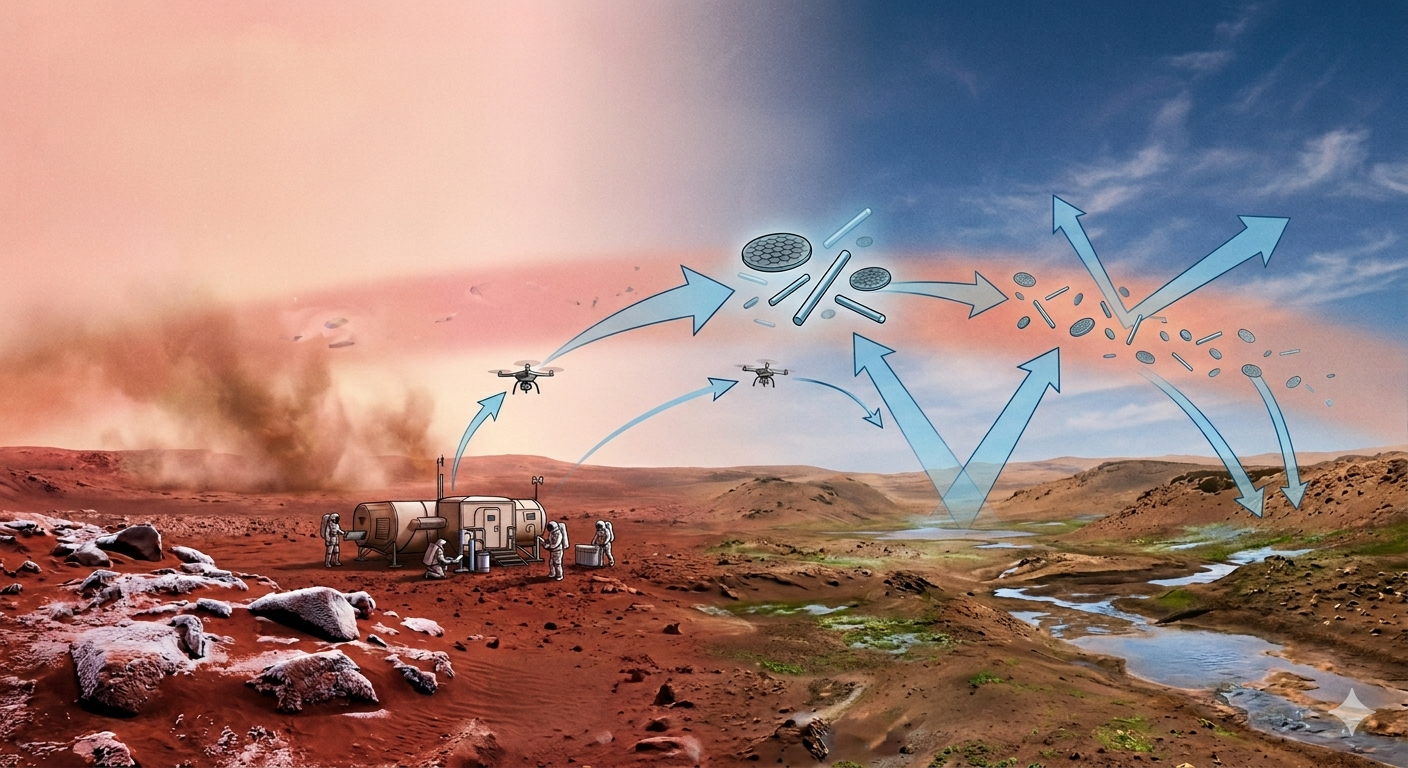
As the dream of nuclear warming faded, a more subtle and sophisticated strategy emerged: the use of engineered aerosols. Rather than relying on brute force, scientists from the United States, the United Kingdom, and Brazil have begun exploring how microscopic particles could act as a thermal blanket for the planet. Previous theories on this were a bit too simple, assuming these particles would just sit still in the air. But a new study published in Geophysical Research Letters has taken a much closer look, using a 3-dimensional model to track how these particles would actually move. The researchers looked at two specific shapes: graphene disks only 250 nm wide and aluminum rods about 8 microns long. These aren’t just random bits of glitter; they are specifically designed to interact with thermal infrared radiation.
The magic of these nanoparticles lies in their ability to let sunlight in while trapping the heat trying to escape from the surface. The research team, led by Mark I. Richardson, simulated what would happen if a single, continuous source began pumping these particles into the atmosphere at a rate of up to 60 liters per second. Unlike natural dust, which settled or moved predictably in older models, these engineered particles created powerful radiative-dynamical feedbacks. They were lofted by local winds and carried globally, creating a self-sustaining warming loop that traditional models had missed.
A Fifteen Year Springtime
The timeline for this transformation is surprisingly fast in cosmic terms. The simulation showed that regardless of how fast the particles were released, the atmosphere would become saturated with them in less than 7.5 Earth years, or about 4 Martian years. By tracking the release of aluminum particles over time, the researchers watched as the planet’s climate reached a tipping point. For the first several years, the temperature change was modest, rising only about 3–4°C. But then, around the eighth Martian year, the climate system hit a sudden surge. The temperature jumped to 25°C above the baseline. By the fifteenth year of the project, the warming stabilized at a remarkable 35°C increase. This shift represents the difference between a frozen desert and a world where the surface temperature finally climbs above the freezing point of water.
This warming wasn’t a fleeting seasonal change; the model showed it remained relatively stable throughout the Martian year, fluctuating by only about 5°C as the seasons turned. However, this climate engineering requires commitment. If the release of these aerosols were to stop just before that critical temperature jump, the thin Martian air would shed its heat rapidly, reverting to its original, frozen state in just about 4 Martian years. The planet is a stubborn patient, and the treatment must be sustained to take hold.
The Invisible Ripples of Change
While the prospect of a warmer Mars is exciting, the researchers are quick to point out that the Martian atmosphere is a tangled web of complex feedbacks. Thawing the surface would likely trigger a rise in water vapor, which is itself a potent greenhouse gas. This could lead to even more warming—a runaway success for terraforming. But nature is rarely that simple. These same engineered aerosols might also serve as ice nuclei or cloud condensation nuclei, essentially causing the particles to be washed out of the sky by new weather patterns. There is also the question of the wind; as the planet warms, stronger surface winds could kick up more natural dust, which might either help or hinder the warming process depending on how it interacts with the light.
Why This Scientific Leap Matters
This research marks a pivotal shift from science fiction to atmospheric science, proving that we may not need to move mountains or detonate bombs to change a world. By understanding the radiative-dynamical feedbacks of nanoparticles, we have discovered a potential “volume knob” for the Martian climate. It matters because it provides a scientifically grounded pathway toward making Mars a place where humans can do more than just survive in bunkers—it offers a glimpse of a future where we might actually walk on the surface of another world. These findings challenge us to think of planetary engineering not as a feat of raw power, but as a delicate, calculated interaction with the physics of an entire atmosphere. It brings us one step closer to answering the ultimate question of whether we can truly call another planet home.
Study Details
Mark I. Richardson et al, Atmospheric Dynamics of IR‐Active Particles Released From Mars’ Surface, Geophysical Research Letters (2026). DOI: 10.1029/2025gl121051