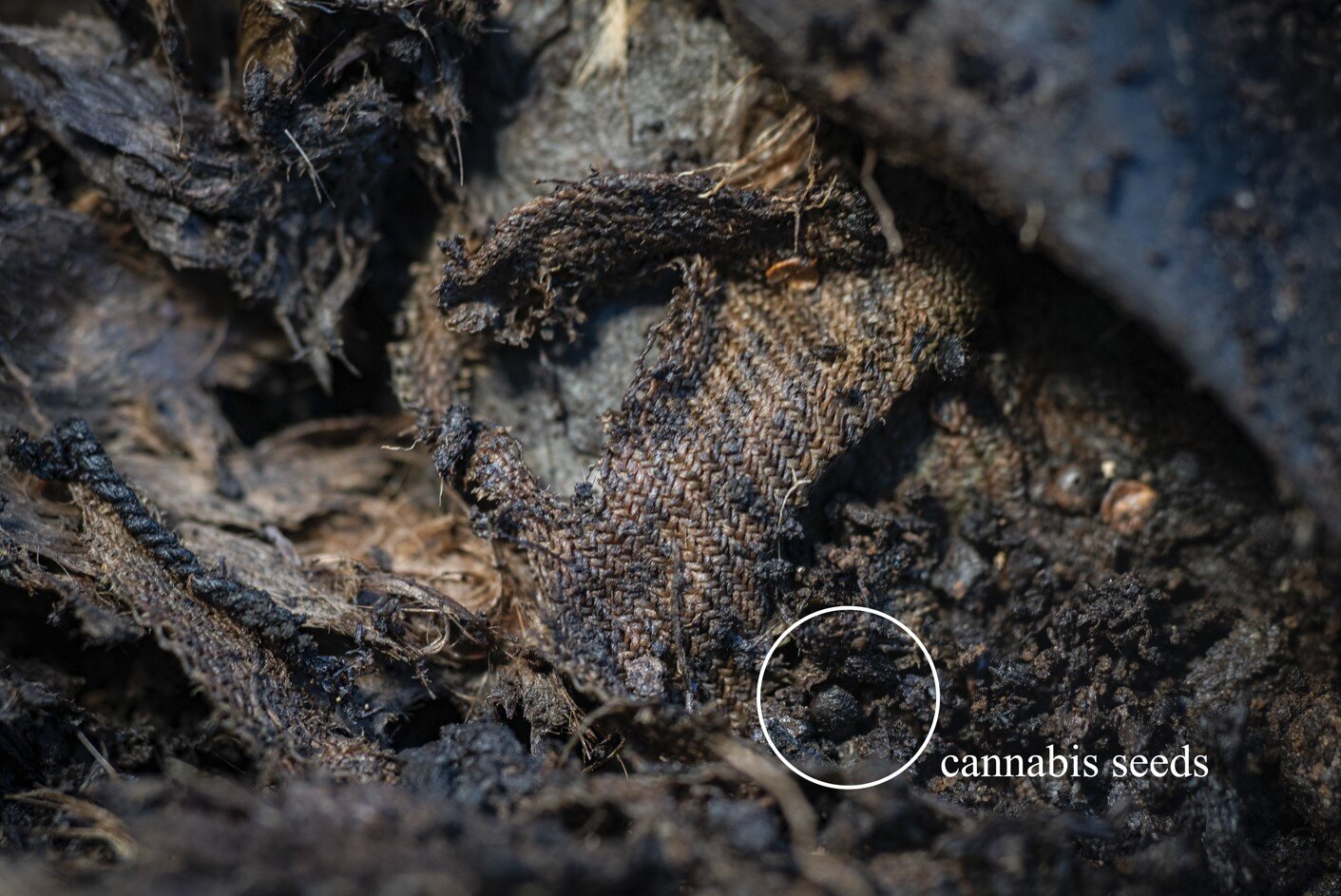
Nearly 1,000 cannabis seeds found in a 2,800-year-old princely tomb in southern Siberia, combined with chemical traces in human hair, provide the oldest currently known directly dated archaeological evidence of cannabis use for its intoxicating properties. The findings suggest that cannabis played a role in burial rituals among members of the ancient Scythian society, although researchers cannot determine exactly how the plant was consumed.
Cannabis has a long history of human use, but figuring out how ancient people used the plant is not easy. Flowers, leaves and resins decay over time, leaving little archaeological evidence. Seeds can survive, but their presence alone cannot reveal whether people used cannabis for its fibers, oil or mind-altering effects.
A remarkable burial site in the Republic of Tyva, in southern Siberia, has now offered a rare opportunity to investigate that question.
An international research team examined a princely tomb belonging to members of Scythian society, an ancient horse-riding culture of the Eurasian steppe. Inside, archaeologists recovered about 1,000 cannabis seeds. More importantly, they found chemical traces associated with cannabis in preserved human hair from the same burial chamber.
Together, the discoveries provide evidence that cannabis was used for its intoxicating properties in this ancient society, rather than serving only practical purposes such as making oil or fiber.
Seeds and human hair tell two parts of the story
The cannabis seeds provided the first clue. Researchers directly radiocarbon-dated six of them, a method that estimates the age of once-living material by measuring the decay of radioactive carbon.
Combined with other dating results, the analysis indicates that the seeds were placed in the tomb in the early eighth century B.C.
That makes the burial roughly 2,800 years old.
However, the seeds could not answer the most important question: Were people using cannabis for its psychoactive effects?
The researchers noted that the seeds likely came from wild plants. Their presence in the grave does not establish whether the plants had been selected or cultivated for their intoxicating properties. Nor does finding cannabis in a burial automatically mean that anyone consumed it.
To investigate further, the team turned to preserved human hair recovered from the tomb’s central burial chamber.
Using several analytical techniques, including high-resolution mass spectrometry, the researchers examined the hair for chemical traces associated with cannabis.
The results revealed clear signals consistent with cannabinol, or CBN, in several samples. CBN can form when tetrahydrocannabinol, better known as THC, undergoes oxidation. THC is the main compound responsible for cannabis’s intoxicating effects.
The team also detected weaker chemical signals consistent with THC itself, based on their measured mass.
These findings provide a second, independent line of evidence. While the seeds establish that cannabis was present in the burial, the chemical traces in human hair point to actual cannabis use.
“The seeds show that cannabis played an important role in the rituals surrounding the burial,” says Caspari, an archaeologist and the study’s lead author.
What the chemical evidence can—and cannot—reveal
Finding cannabis-related compounds in ancient human hair is significant because it offers evidence of exposure that plant remains alone cannot provide.
But the chemical results come with important limitations.
The researchers can infer that cannabis was used, but they cannot reliably determine how much was consumed. They also cannot establish precisely how the active compounds entered the body.
For example, the available evidence cannot distinguish between inhaling cannabis smoke and consuming the plant in food or another preparation.
This distinction matters because archaeological evidence from other Central Asian sites has revealed cannabinoid residues in vessels and on heated stones, pointing more clearly to inhalation. Those discoveries, however, come from later archaeological contexts and cannot establish how people used cannabis in the Siberian tomb.
The current findings therefore support cannabis use for its intoxicating properties without identifying a particular method of consumption.
“The molecular traces in the hair and the cannabis seeds come from the same grave and suggest that cannabis was used for its intoxicating properties,” says Caspari, who conducts research at the Institute of Archaeological Sciences at the University of Bern and the Max Planck Institute of Geoanthropology in Jena (Germany).
Cannabis was part of an elaborate burial ceremony
The setting of the discovery adds another important dimension to the findings.
The tomb belonged to high-ranking members of Scythian society, and the burial involved elaborate rituals. According to the researchers, the dead were accompanied by extensive horse sacrifices and probably human sacrifices as well.
Earlier investigations by the team had identified the remains of 18 horses that had once been arranged on the burial mound. Since then, several dozen additional horse sacrifices and scattered human bones have also come to light.
The cannabis seeds and chemical traces in human hair place the plant within this broader ritual setting.
The researchers interpret the combined evidence as suggesting that cannabis was used for its intoxicating effects during the burial practices of this ancient community.
However, the findings do not establish exactly who consumed it, how it was prepared or what role intoxication played in the ceremony. Those questions remain open.
DNA could reveal how ancient cannabis spread
Beyond documenting early cannabis use, the discovery raises questions about the plants themselves.
The seeds appear to have come from wild cannabis, but researchers have not established whether ancient people deliberately selected particular plants for stronger psychoactive effects.
The chemical analyses also cannot reveal how much THC the plants contained. Finding traces of THC-related compounds in human hair does not provide a measurement of the original plants’ potency.
To investigate the plant’s history more closely, the research team has begun sequencing DNA from some of the recovered plant samples.
The researchers report that DNA preservation in the tomb is excellent, offering an opportunity to study the plants’ genetic characteristics.
“We have already begun sequencing some of the plant samples,” says Caspari. “DNA preservation is excellent in this case. This will help us learn more about the history of the domestication and spread of this crop soon.”
The results could help clarify whether the ancient plants were wild or connected to early cultivation, adding another piece to the still-incomplete history of how humans developed and spread cannabis varieties.
The research was published in Science.