An alternative theory of the universe’s history, which puts its age at 26.7 billion years and explains cosmic observations without dark matter or dark energy, has passed several major tests involving the early universe, galaxy ages and the motion of stars within galaxies. The model, known as CCC+TL, offers a different explanation for some of the biggest mysteries in cosmology, although important questions remain before it can challenge the standard picture of the universe.
For decades, astronomers have relied on two mysterious ingredients to explain how the universe behaves. Dark matter is thought to provide the extra gravity needed to hold galaxies together, while dark energy is used to explain why the universe’s expansion is accelerating. Neither has been directly detected.
But what if these effects do not come from unseen forms of matter and energy at all?
A research team at the University of Ottawa is investigating an alternative explanation. Their model, called covarying coupling constants plus tired light, or CCC+TL, suggests that changes in the fundamental constants governing how particles and forces interact could account for observations usually attributed to dark matter and dark energy.
The researchers say their model has now passed several important checks against astronomical observations, including tests involving the chemical ingredients produced shortly after the Big Bang and measurements of the universe’s expansion.
The work is part of a broader effort to determine whether the universe can be understood without relying on the two dark components that dominate the standard cosmological model.
Rethinking the rules behind the expanding universe
The leading explanation of cosmic history is known as Lambda Cold Dark Matter, or ΛCDM. It describes a universe containing ordinary matter, dark matter and dark energy. Although it has successfully explained many astronomical observations, some discoveries have raised questions about how well it accounts for the earliest stages of cosmic history.
One challenge comes from observations of surprisingly large and developed galaxies in the distant universe. Their apparent maturity has prompted astronomers to reconsider how quickly galaxies could have formed under the standard model.
CCC+TL takes a different approach. Rather than adding dark matter and dark energy, it proposes that fundamental physical constants have changed over cosmic time, potentially producing effects that resemble those attributed to these mysterious components.
The model also modifies the equations developed by Albert Einstein and later used to describe the expansion of the universe. These changes affect both the mathematical framework and the calculations needed to compare predictions with observations.
As a result, researchers Rajendra Gupta, an adjunct professor in the University of Ottawa’s Department of Physics, and postdoctoral researcher Nikolaos Samaras had to develop new equations and computer code specifically for CCC+TL rather than simply adjusting existing tools designed for the standard model.
“Most emerging models explain only a limited set of observations,” Gupta says. “A new model must not conflict with the pillars of cosmology and astrophysics, and our findings meet that challenge, including the yet-to-be-published cosmic microwave background challenge.”
Testing the model against the universe’s earliest chemical elements
One important test of any cosmological model concerns what happened during the first few minutes after the Big Bang.
During this period, the universe was hot and dense enough for nuclear reactions to produce the first light elements, mainly hydrogen and helium, along with small amounts of other elements.
The predicted amounts of these elements provide an important check on theories describing the early universe. A model that cannot account for their observed proportions would face a serious problem.
The CCC+TL calculations produced predictions for the quantities of hydrogen, helium and other light elements that matched those of the standard cosmological model.
The researchers also compared their model with cosmic chronometers. These measurements use the ages of galaxies to estimate how quickly the universe expanded at different points in its history.
Here, too, the model’s predictions agreed with the available observations.
These results are important because they show that CCC+TL can reproduce some observations that already place strong constraints on explanations of cosmic history. However, agreement with individual tests does not establish that the alternative model is correct or that it can explain every feature of the universe.
Can galaxies rotate without dark matter?
The question of dark matter becomes particularly interesting when astronomers examine how stars move inside galaxies.
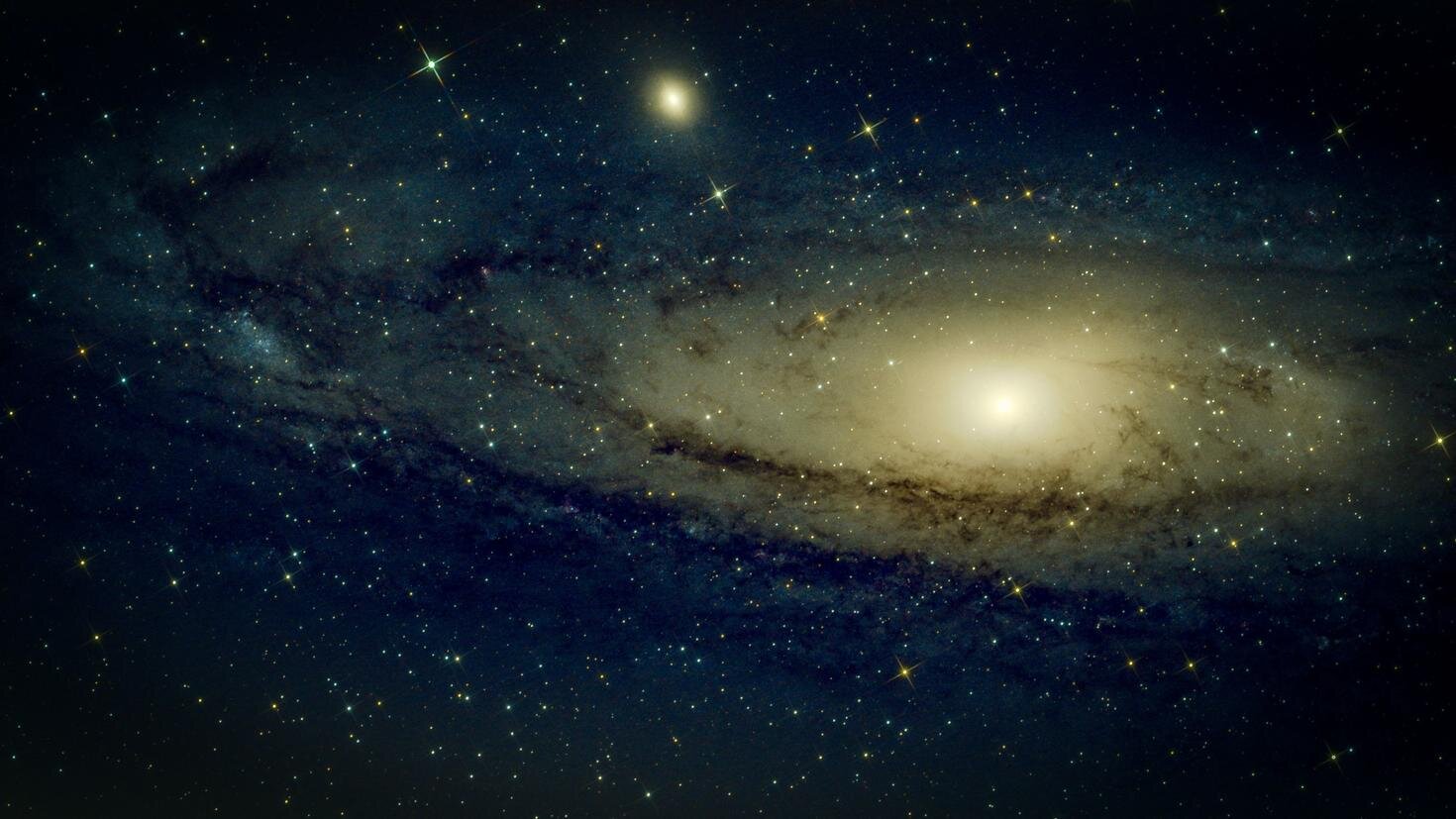
Stars farther from a galaxy’s center often move faster than expected from the gravitational pull of the visible matter alone. In the standard explanation, an invisible halo of dark matter supplies the additional gravity needed to account for these motions.
CCC+TL attempts to explain the same effect without adding dark matter.
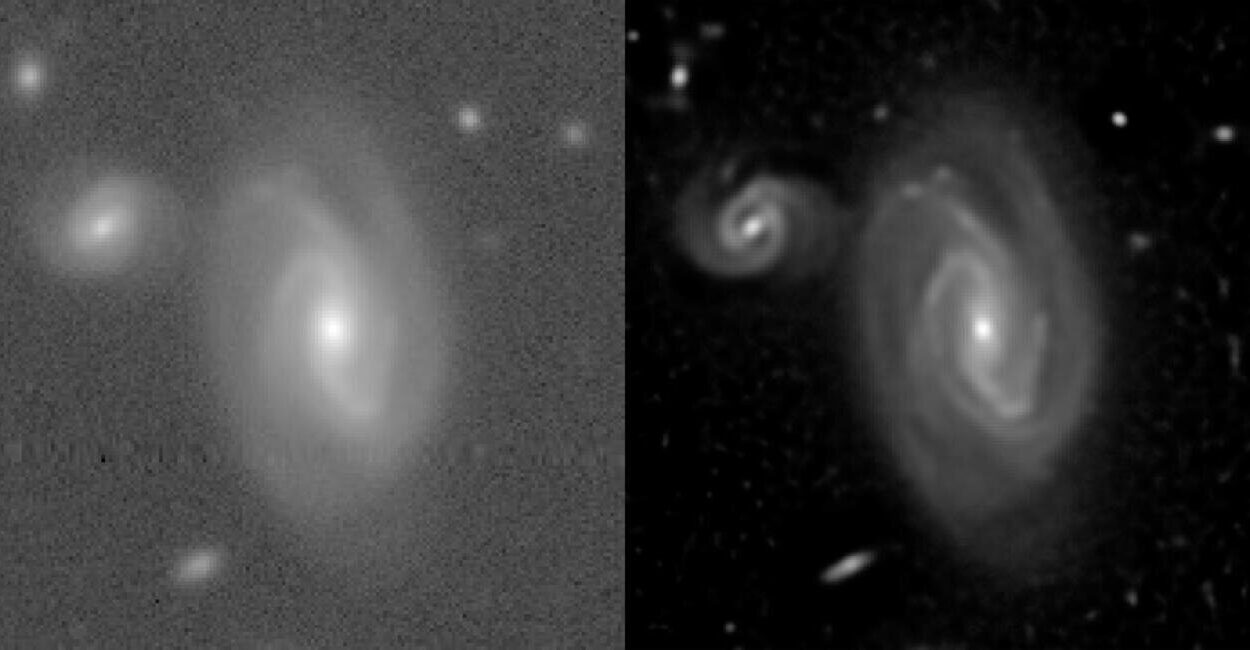
In a separate study, Gupta and Samaras examined all 175 galaxies in the SPARC database, a collection of galaxies with measurements used to study their rotation. They found that their model could reproduce the observed rotation curves, which describe how orbital speeds change with distance from a galaxy’s center, without requiring dark matter.
Another investigation examined time dilation in supernova observations. Time dilation is the stretching of the time between observed events as light travels across the expanding universe. The researchers reported results supporting CCC+TL, although that paper remains under review.
The team also examined the Bullet Cluster, a system formed by the collision of galaxy clusters that has been used in discussions of dark matter.
According to their analysis, the additional gravitational effect predicted by CCC+TL follows the galaxies rather than the hot gas that emits X-rays. The researchers describe this result as an early proof of concept that requires further investigation.
Taken together, these studies suggest that the model may offer a different way to explain several observations traditionally associated with dark matter. They do not, however, establish that dark matter does not exist.
“Observations attributed to dark matter and dark energy likely originate from covarying coupling constants,” adds Gupta, whose paper on the origin of dark matter and dark energy explores the idea.
Why the model gives early galaxies more time to grow
Perhaps the most striking difference between CCC+TL and the standard cosmological model concerns the age of the universe during its earliest observable stages.
Astronomers using the James Webb Space Telescope have identified surprisingly mature galaxies at very great distances. Because light takes time to travel, observing distant galaxies allows astronomers to look back into the universe’s past.
Under the standard model, the universe was approximately 300 million years old during cosmic dawn, the period when the first stars and galaxies began to emerge.
CCC+TL gives a very different estimate. At the same observed redshift, a measure of how much the universe’s expansion has stretched light, the model places the universe’s age at about 4.6 billion years.
That difference provides considerably more time for galaxies to grow and develop.
In calculations reported by the researchers, early galaxies under CCC+TL are about 12 times larger in both size and mass than those predicted by the standard model.
The proposal offers a possible explanation for why some early galaxies appear more developed than expected. Instead of requiring galaxies to grow extraordinarily quickly within a relatively short period, the alternative model gives them a much longer period in which to form.
“Impossible early galaxies become predictable galaxies,” Gupta explains. “We predict that galaxies exist well beyond the distances the James Webb Space Telescope has reached.”
Future observations could put the prediction to the test
The model’s predictions about extremely distant galaxies offer another opportunity to compare the two cosmological explanations.
The James Webb Space Telescope’s GLIMPSE program plans to search for galaxies at redshifts that may exceed 50. Such observations could be particularly interesting because the standard model may not provide enough time for massive galaxies to develop at those early stages.
CCC+TL, by contrast, does not impose the same limit in the researchers’ calculations.
Finding galaxies at the predicted distances and studying their properties could therefore provide useful evidence for evaluating the model. Whether those observations will support CCC+TL remains an open question.
The researchers’ results also need to be considered alongside the broader set of observations that any successful theory of cosmology must explain. Passing several tests is an important step, but it is not the same as establishing a replacement for the standard model.
“The success should encourage astronomers to take the new model seriously. It is challenging to understand and apply, but we believe it extends the physics of the universe beyond ΛCDM limits,” concludes Gupta.
The study was published in Universe.