The quark-gluon plasma that filled the universe moments after the Big Bang may have left behind clues about its microscopic structure in the unpredictable motion of particles passing through it. Physicists at MIT and the University of California, Santa Barbara, have developed a theory showing that heavy particles moving close to the speed of light can experience unusually large, uneven changes in momentum—an effect that Einstein’s century-old description of Brownian motion cannot fully explain.
In the universe’s earliest moments, matter existed in an extraordinary state. Temperatures reached trillions of degrees, leaving quarks and gluons—the fundamental building blocks involved in forming protons and neutrons—free to move through an intensely hot fluid.
This state of matter, known as quark-gluon plasma, survived for only a few microseconds before the particles began combining into more familiar forms of matter.
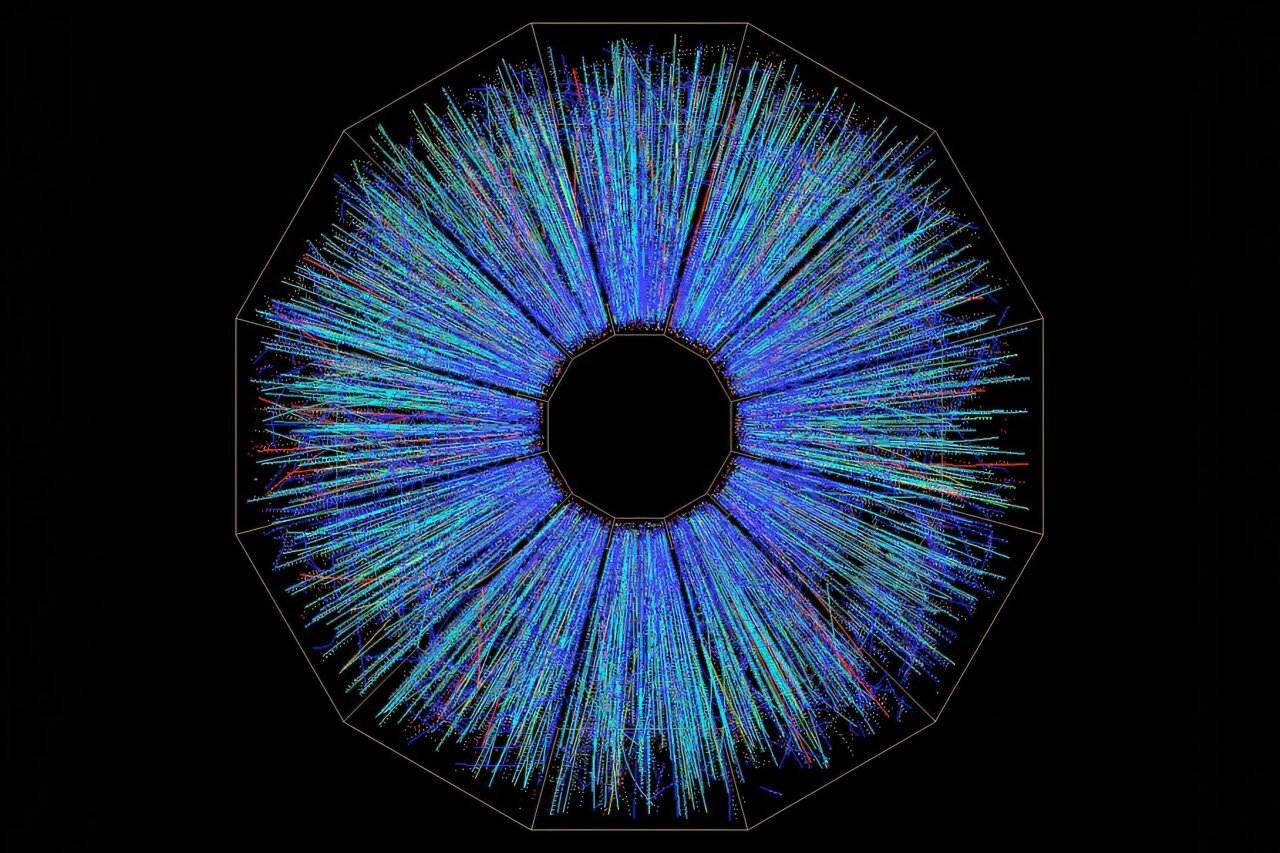
Recreating this primordial fluid is now possible in powerful particle accelerators. Scientists smash atomic nuclei together at nearly the speed of light, producing tiny droplets of quark-gluon plasma that survive for only tens of septillionths of a second.
Although these droplets disappear almost instantly, particles traveling through them can provide valuable clues about their properties.
One particularly useful probe is the heavy quark, a subatomic particle that can move through the plasma while interacting with its constituent quarks and gluons. By studying how its motion changes, physicists hope to learn about the forces and microscopic activity inside the fluid.
But there is a problem: The familiar theory scientists have used to understand how particles move through fluids does not fully describe what happens at nearly the speed of light.
A new framework developed by physicists Jean Du Plessis of MIT and Bruno Scheihing-Hitschfeld of the University of California, Santa Barbara, offers a way to address that gap.
Why Einstein’s theory needs an update
The story begins not with particle accelerators, but with pollen.
In 1827, botanist Robert Brown noticed that tiny grains of pollen suspended in apparently still water moved around in a seemingly random way. The particles appeared to jiggle and wander without any visible cause.
The phenomenon became known as Brownian motion. In 1905, Albert Einstein developed a theory explaining what was happening: The pollen grains were being struck by the invisible atoms and molecules making up the water.
These microscopic collisions produce random pushes that constantly change a particle’s motion. At the same time, the surrounding fluid creates drag, a force that resists the particle’s movement and slows it down.
Einstein showed that these two effects—the random pushes and the resistance from the fluid—are connected. Their balance determines how a particle eventually reaches the same temperature as its surroundings.
This relationship became a powerful tool for understanding fluids. By examining how larger particles move through a liquid or gas, scientists can learn about the microscopic particles and forces operating inside it.
The same general approach has also been applied to quark-gluon plasma.
However, particles moving through this extremely hot environment can travel at relativistic speeds, meaning speeds close to that of light. Under these conditions, the familiar Brownian motion picture becomes incomplete.
“Einstein showed that the drag and the random kicks must balance in just the right way for a particle eventually to come to the same temperature as its surroundings,” Du Plessis explains. “For the types of fluids he was thinking about, he was correct. But for particles that are moving at relativistic velocities, this relationship breaks down. And we’ve known for 20 years that something is missing. So we have to go beyond the work that Einstein did.”
The challenge is to understand what replaces the familiar balance when particles move so quickly that the usual description no longer captures their interactions with the surrounding fluid.
When the random kicks are not so random
To investigate, Du Plessis and Scheihing-Hitschfeld calculated how a heavy quark would respond to the strong nuclear force while traveling through a fluid at nearly the speed of light.
The strong nuclear force is the fundamental interaction responsible for holding quarks and gluons together.
The researchers began with a relatively simple theoretical setting: a gas containing weakly interacting quarks and gluons. This provided a manageable starting point for calculating how the force would change a heavy quark’s momentum as it passed through the gas.
Momentum describes an object’s motion, taking into account both its mass and velocity. A change in momentum therefore provides a way to measure how strongly the surrounding particles have pushed or pulled on the heavy quark.
The calculations produced a probability curve showing how likely different changes in momentum were to occur.
For small changes, the results looked familiar. The curve had the familiar bell-shaped form associated with Brownian motion, indicating that moderate kicks were more common than very large ones.
But the resemblance to Einstein’s picture did not extend to the extremes.
The researchers found that the curve was tilted, with uneven tails. This meant that unusually large changes in momentum were not equally likely in opposite directions.
In particular, a heavy quark was more likely to receive a strong kick that slowed it down beyond what would be expected from the fluid’s ordinary drag than to receive an equally large kick that made it move faster than expected.
“The usual Brownian picture assumes that large kicks become exceedingly rare,” Du Plessis says. “For heavy quarks, however, these rare kicks are more common than the bell curve predicts, and are not equally likely in opposite directions: A large kick that slows the quark down more than expected from drag is more likely than an equally large kick that leaves it moving faster than expected.”
This imbalance is important because it reveals information that would be missed by looking only at the average effect of the fluid on a passing particle.
Instead of treating a heavy quark’s motion as a series of ordinary, randomly distributed nudges, the new theory accounts for the possibility of unusually strong interactions that produce larger-than-expected changes.
A pattern that appears across different plasmas
The researchers next examined whether this unusual probability pattern depended on the particular particles making up the fluid.
They repeated their calculations for plasmas containing different particle types. The tilted probability curve remained, suggesting that the structure was not limited to one specific mixture of particles.
They also found the same general pattern hidden in an earlier calculation involving a strongly coupled plasma—a system in which its constituent particles interact strongly.
That finding is especially interesting because the microscopic physics of a strongly coupled plasma differs from that of the weakly interacting gas used as the starting point for the researchers’ calculations.
Together, these results suggest that the uneven distribution of large momentum changes may be a more general feature of how relativistic heavy particles interact with fluids.
“This is the first time that this seemingly universal structure was realized and really formalized,” Du Plessis says. “This gives a concrete path forward for how to better understand the quark-gluon plasma, using heavy quarks.”
The researchers’ work does not directly reveal the precise microscopic structure of the plasma that existed after the Big Bang. Instead, it provides a theoretical framework for interpreting how heavy quarks move through such extreme environments.
What heavy quarks could reveal about the early universe
The next step is to connect the new theoretical predictions with observations from particle accelerator experiments.
Scientists can study how heavy quarks change their momentum as they travel through experimentally created quark-gluon plasma. Comparing those observations with the new calculations could help researchers determine whether the plasma’s microscopic behavior matches particular theoretical descriptions.
The frequency and direction of unusually large momentum changes may be especially useful. Because these events depend on the microscopic nature of the surrounding fluid, they could offer information that ordinary measurements of particle motion do not capture.
The possibility also raises an important question about the nature of the universe’s earliest fluid.
Based on the theoretical results, Du Plessis suggests that primordial quark-gluon plasma may have behaved less like a gas of weakly interacting particles and more like a strongly interacting liquid.
As he puts it, the primordial fluid was likely “more strongly interacting than this Brownian motion way of modeling it would suggest. It’s more like a liquid and less like a gas.”
Whether measurements of heavy quarks can confirm this picture remains to be established. But the new theory gives physicists another way to investigate a state of matter that existed only briefly at the beginning of the universe.
The findings were reported in Physical Review Letters.