In the silent, microscopic world of quantum particles, individuality is often a recipe for weakness. A single particle, flickering in the void, can only produce a signal so faint it is nearly impossible to detect. However, when these particles begin to work in unison, they undergo a transformation. This collective phenomenon is known as superradiance, a powerful example of cooperation at the most fundamental level of reality. For decades, scientists viewed superradiance as something of a double-edged sword. While it showcased the strength of unity, it was primarily known for causing quantum systems to shed their energy far too quickly. It was a flash of brilliance that burned out before it could be put to use, posing a constant hurdle for those trying to build the next generation of technology.
But a groundbreaking new study has turned this long-standing narrative on its head. Researchers have discovered that the very forces once thought to be the enemy of stability are actually the key to a self-sustaining power. Instead of a fleeting burst of energy that vanishes into the background noise, they found that collective effects can produce long-lived, stable microwave signals. It is a discovery that suggests the quantum world is far more organized than we ever dared to imagine. As Dr. Wenzel Kersten, the first author of the study, explains, “What’s remarkable is that the seemingly messy interactions between spins actually fuel the emission. The system organizes itself, producing an extremely coherent microwave signal from the very disorder that usually destroys it.”
Finding Order Within the Chaos
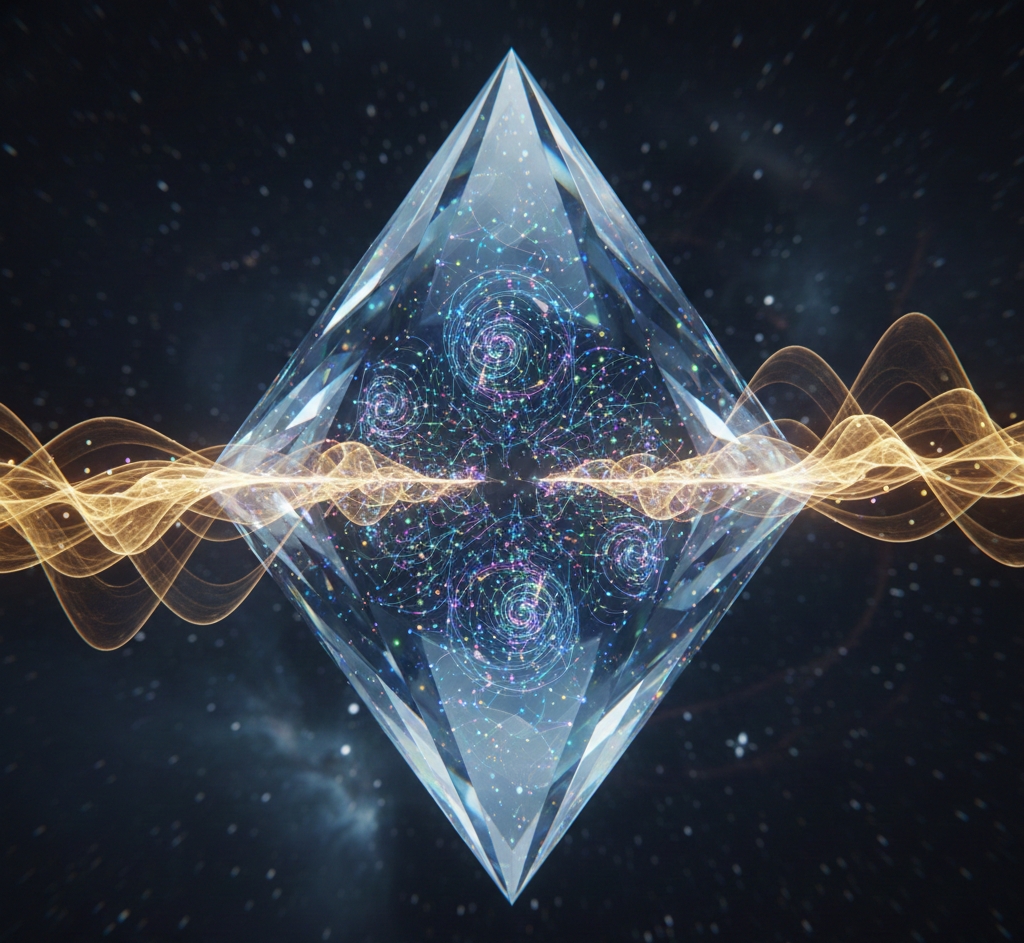
To witness this phenomenon, a collaborative team from TU Wien and the Okinawa Institute of Science and Technology (OIST) looked toward the heart of a diamond. Within the crystal lattice of the diamond, they focused on nitrogen-vacancy centers—tiny atomic defects that act as miniature magnets. These centers host electron spins that can be flipped between quantum states, creating a playground for quantum interactions. The researchers took a dense ensemble of these centers and coupled them to a microwave cavity, creating a controlled environment where they could observe how these “miniature magnets” behaved when packed closely together.
The experiment was designed to see how these spins would talk to one another. In the past, the “messiness” of these interactions—the way spins tug and pull on their neighbors—was seen as a source of decoherence, the process that breaks down quantum states and turns them into ordinary, classical matter. However, when the team looked at the data, they didn’t see the expected breakdown. Instead, they witnessed the birth of something entirely new: self-induced superradiant masing. This is a process where the system generates spontaneous, long-lived bursts of microwave emission without any external force pushing it along.
“We observed the expected initial superradiant burst—but then a surprising train of narrow, long-lived microwave pulses appeared,” explains Professor William Munro, a co-author of the study. This was not the typical behavior of a quantum system. Usually, after the first big burst of energy, the system would fall silent. But here, the pulses kept coming, like a steady heartbeat echoing through the diamond. The researchers had found a way to make the quantum world “sing” on its own, creating a rhythmic, stable signal from a place where scientists expected only silence or chaos.
The Engine That Drives Itself
The mystery of why these pulses continued led the team to perform large-scale computational simulations. They needed to understand what was fueling this “quantum heartbeat” if no external energy was being pumped into the system. The simulations revealed a fascinating truth: the system was driving itself. The source of the pulsing was the self-induced spin interactions that had previously been dismissed as disruptive disorder.
In a traditional setup, you might expect the spins to flip once and then stop. But in this dense environment, the interactions between the spins were so dynamic that they were constantly repopulating the energy levels of the system. As one spin released its energy, it triggered its neighbor, creating a feedback loop that sustained the emission. “Essentially, the system drives itself,” Professor Munro adds. “These spin–spin interactions continually trigger new transitions, revealing a fundamentally new mode of collective quantum behavior.”
This discovery marks a profound shift in perspective. For years, the goal in quantum physics was to isolate particles and protect them from their environment to keep them from “leaking” energy. Now, it appears that by leaning into the interactions and the density of the system, researchers can unlock a new level of performance. Professor Kae Nemoto, Center Director of the OIST Center for Quantum Technologies, notes the significance of this shift: “This discovery changes how we think about the quantum world. We’ve shown that the very interactions once thought to disrupt quantum behavior can instead be harnessed to create it. That shift opens entirely new directions for quantum technologies.”
A New Era of Precision and Light
The implications of this “self-driving” quantum signal reach far beyond the laboratory. Because these microwave signals are incredibly stable and precise, they could serve as the foundation for the technologies that keep the modern world running. We live in an era defined by invisible signals—the GPS that guides our cars, the telecommunications that connect our phones, and the radar that keeps our skies safe. All of these systems rely on the stability of microwave frequencies. By harnessing self-sustained superradiance, scientists could create ultra-precise clocks and communication links that are far more reliable than what we have today.
Furthermore, the ability to generate these signals spontaneously could revolutionize how we sense the world around us. Professor Jörg Schmiedmayer of the Vienna Center for Quantum Science and Technology suggests that these principles could enhance quantum sensors. Such sensors would be capable of detecting the most minute changes in magnetic or electric fields, offering a level of sensitivity that was previously unreachable. This isn’t just about faster internet or better maps; it’s about seeing the unseen.
Why This Quantum Discovery Matters
This research matters because it challenges the fundamental limitations we thought existed in the quantum realm. By proving that “disorder” can actually be a source of “coherence,” the team has provided a new blueprint for building quantum devices. Instead of struggling to eliminate every imperfection and interaction, scientists can now look for ways to make those interactions work in their favor.
The practical benefits of this work are vast. In medicine, more sensitive sensors could lead to breakthroughs in medical imaging, allowing doctors to see biological processes in unprecedented detail. In environmental monitoring and materials science, these tools could help us understand the world’s hidden structures and changes with pinpoint accuracy. Ultimately, this study demonstrates that deep insights into the collective behavior of the smallest particles can lead to the biggest leaps in innovation. As Professor Schmiedmayer puts it, “this work shows how deep insights into quantum behavior can translate into new tools and technologies to shape the next generation of scientific and industrial innovation.” The quantum symphony has only just begun, and its music promises to power the future.
More information: Self-induced superradiant masing, Nature Physics (2025). DOI: 10.1038/s41567-025-03123-0