When divers began clearing a cluster of magnetic anomalies beneath the Bay of Greifswald in 2023, they expected to encounter objects that might interfere with construction of a new underwater gas pipeline. Instead, they found fragments of wooden hull timbers, rigging, leather shoe soles and a large iron anchor with its wooden stock still preserved. The scattered remains turned out to belong to a previously unknown 17th-century shipwreck, buried beneath the seabed and surviving only in fragments.
The wreck was found about 3 kilometers north of the gas transmission facility near Lubmin, during preparatory work for the Ostsee Anbindungsleitung, a 50-kilometer underwater pipeline connecting the LNG terminal at Mukran on Rügen with the gas transmission system on the southern shore of the Bay of Greifswald.
The discovery came at an awkward moment for archaeology. Dredging associated with the pipeline was approaching, leaving little time for a conventional investigation. After clearance divers recovered objects that clearly indicated a shipwreck, work at the site was stopped and the relevant heritage authority in Mecklenburg-Western Pomerania was notified.
A fuller archaeological campaign began in early July 2023. Over 12 days, a five-person team carried out 22 dives from a 30-meter working vessel. Divers used surface-supplied air, tethered communications and an ultra-short baseline positioning system that allowed their locations to be tracked in real time and integrated with geographic information system data.
The team investigated the area around the magnetic anomalies and excavated test trenches. During the first dive, wooden structural remains were found about 50 centimeters below the seabed.
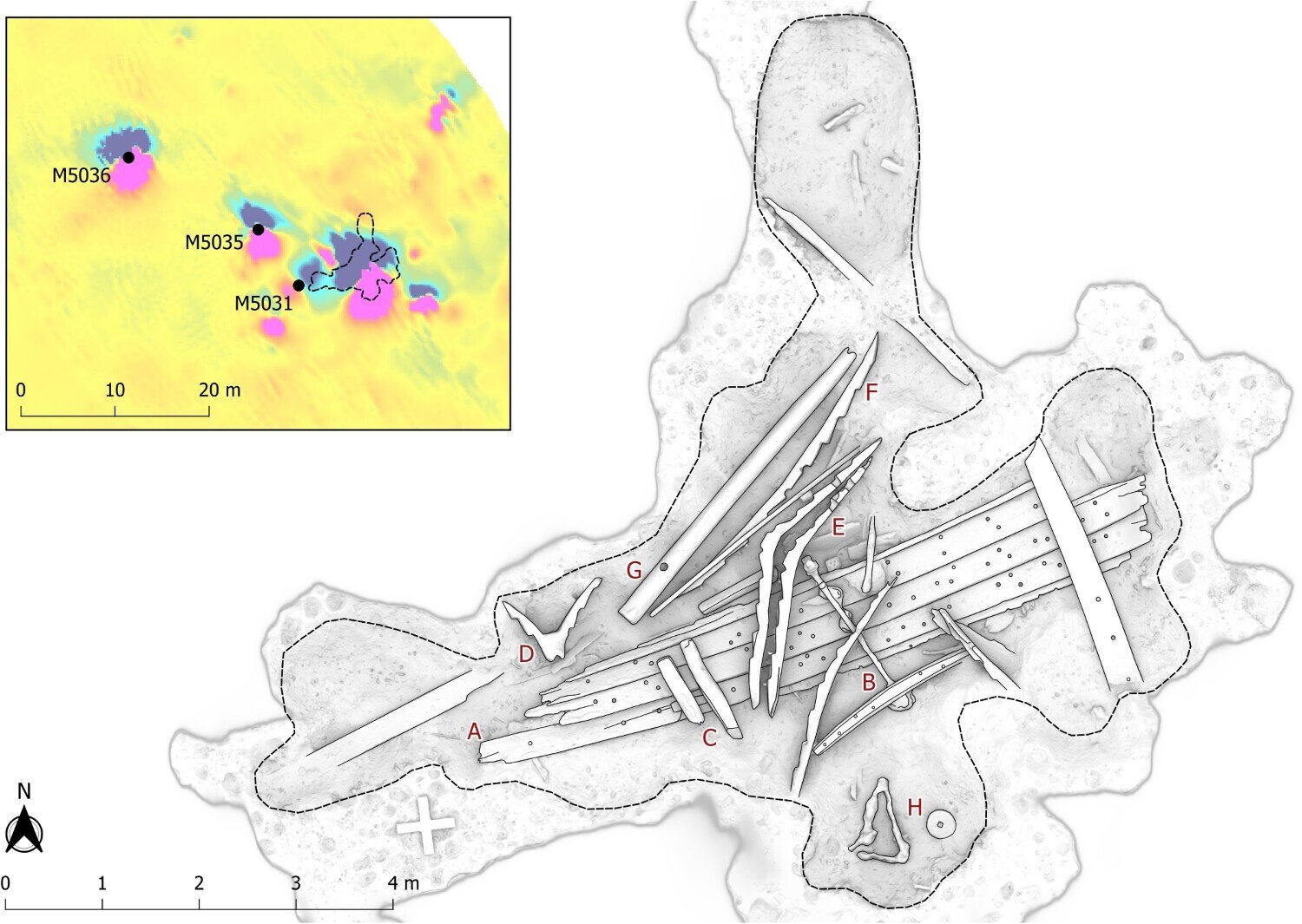
The wreck itself was far from intact. At an average depth of 7.5 meters, most of it remained buried in soft silt. The surviving material was widely dispersed and disarticulated. Only one substantial section of hull remained together.
That fragment measured about 7.5 by 1 meter and consisted of five overlapping outer planks along with several frame members. The preserved shape of the plank ends and the arrangement of their scarfs indicated that the fragment came from the aft portion of the vessel’s starboard side.
Around it were loose frames, planks and pieces of equipment, including a bilge pump tube and a stock anchor.
The surviving hull shows how the ship was built
The outer hull planks were constructed in clinker fashion, meaning each plank overlapped the one below it rather than meeting it edge to edge.
The planks were tangentially sawn and were generally 31 to 39 centimeters wide, narrowing to 25 to 29 centimeters near their ends. They averaged about 4 centimeters thick. The overlaps between neighboring planks were about 4 to 5 centimeters wide and were secured with square-shafted iron nails measuring about 7 by 7 millimeters. Inside the hull, the nails were clenched over square iron roves.
The nails were regularly spaced at roughly 24 to 27 centimeters. Individual planks within a strake were joined with diagonal scarfs and additional iron nails. The ends of the planks had been attached to the sternpost with heavier 12-by-12-millimeter iron nails.
Between the overlapping planks, the builders had used a mixture of tar and animal hair as waterproofing.
Only two short frames were still attached to the preserved hull section, but six additional loose timbers helped reveal something about the ship’s internal construction. The frames appeared to belong to different parts of the hull. Some were gently arched floor timbers, while others were associated with the aft section.
The longest loose floor timber measured 347 centimeters from end to end, providing a minimum indication of the width of the lower hull. The frames were about 17 centimeters in sided dimension, while their molded dimensions varied according to their position and shape.
Their outer faces had stepped joggles that allowed them to fit closely against the overlapping hull planks. Small openings at the bottoms of the floor timbers, known as limber holes, allowed bilge water to move through the hull.
The distribution of holes in the surviving planking suggests that the floor timbers were attached with pairs of wooden trenails about 30 to 35 millimeters in diameter. The estimated spacing between neighboring floors was 45 to 55 centimeters.
Taken together, these construction details are consistent with a shell-first building sequence, in which the outer hull shell was established before the framing was completed. The researchers stress, however, that the evidence comes from only a small surviving section of the ship.
A 3.6-meter pump hints at the ship’s size
One of the most informative objects was not part of the hull itself but a long wooden tube used as a bilge pump.
The tube had been hollowed from a single oak trunk and measured 360 centimeters long. Its diameter increased from about 16 centimeters at the lower end to 23 centimeters at the upper opening. A small trapezoidal opening near the bottom probably served as the intake for bilge water.
Another opening, 8 centimeters across and positioned 65 centimeters below the upper end, most likely served as the discharge outlet, directing pumped water toward a scupper in the side of the ship. Two surviving metal fittings near the upper opening were probably associated with the handle that operated the pump.
The vertical distance between the intake and discharge openings was about 3 meters. Because the discharge point would normally have been near deck level, the measurement provides an indication of the vessel’s internal depth.
The evidence is not enough to reconstruct the entire hull precisely. One loose floor timber that was probably from the middle of the vessel measured 247 centimeters, while the hull’s curvature suggests that its beam exceeded 4 meters.
The author compared those measurements with selected Baltic Sea wrecks dating from the 16th through 19th centuries. The comparison suggested that the Peenemündung vessel belonged to a general group of ships roughly 19 to 22 meters long, with an estimated beam of 6 to 7 meters and a depth of about 3 meters.
Those dimensions are comparative estimates rather than a direct measurement of the wreck. The paper emphasizes that the fragmentary remains make any reconstruction of the vessel’s overall dimensions uncertain.
More than 60 objects survived around the wreck
The hull was only part of the archaeological evidence. More than 60 artifacts connected with the ship’s equipment and personal belongings were recovered.
Two large wrought-iron stock anchors were among the most substantial finds. Both had wooden stocks and were similar in size. Their iron shanks were about 1.8 meters long, with angled arms roughly 70 centimeters long. Their wooden stocks measured about 2.2 meters.
The similarity between the anchors suggests they may have formed a matched pair, possibly the bow anchors used during ordinary operations. But the investigation could not establish whether these were the vessel’s only anchors or part of a larger set.
Near one of the anchors was an unusual cylindrical wooden object. It was carved from pine, measured about 60 centimeters long and 31 centimeters across, and had a lug at one end with a 55-millimeter hole that still contained traces of rope.
The object showed considerable wear, including cuts, marks and areas where rope had rubbed against the wood. The researchers interpret it as a solid wooden buoy used to mark the position of an anchor.
The location of the buoy is potentially important. The paper notes that similar solid wooden buoys from other historic wrecks were used with anchors. Because the buoy and one of the anchors were found together, the author suggests that the vessel may have been anchored before it sank.
That interpretation remains tentative. The evidence does not establish exactly what happened to the ship.
The wreck carried its own tools
The collection also provides clues about work performed aboard the vessel.
Wooden running blocks and deadeyes were found among the rigging remains, along with fragments of rope. The blocks were single-sheaved types made mostly from ash and, in some cases, oak.
Carpentry tools formed another distinctive group. A brace handle and two separate knobs or chest pads suggest that more than one hand brace may originally have been aboard. Most of the artifacts identified as carpentry tools were concentrated around a single magnetic anomaly.
Nearby were numerous fragments of wooden containers, including barrel staves and lids. Some of the lids measured only 21 to 25 centimeters across. Several container fragments were found with large iron nails or bolts, some about 45 centimeters long, which may have been stored as spare fasteners.
Another unusual object was a flat piece of yellowish clay brick enclosed in a heavy oak casing. The brick measured about 13 by 7 centimeters and was 3 centimeters thick. It contained four conical holes, with another partly preserved hole indicating that the original object was longer.
No direct parallel or definitive function has been identified for it. The preliminary interpretation is that it may have been an improvised sharpening device for drill bits or chisels, perhaps made by reusing a damaged object and placing it in a newly constructed wooden casing.
That interpretation is explicitly provisional.
A 30-centimeter-diameter grinding stone adds to the evidence for onboard maintenance work. It had a square central hole for a rotating pin, and a corroded metal fitting found beside it may have belonged to its mounting.
Together with the carpentry tools, the grinding stone led the author to interpret the wreck as having contained a well-equipped onboard workshop. Its position slightly away from the surviving hull may reflect the later loss of upper hull structures, since such grinding devices are known from other Baltic shipwreck contexts to have been placed on an upper deck.
A few personal objects put people aboard the ship
Only a small number of finds could be identified as personal belongings.
Three such objects were recovered: two shoe soles and part of a stitched leather strap. The two soles came from different pairs of shoes. One had a maximum preserved length of about 23 centimeters and retained part of the heel and midfoot. The other was smaller, measuring about 17 centimeters, with a midfoot width of about 7.5 centimeters.
Six fragments of animal bone were also recovered. They belonged to pigs and small members of the Bovidae family, such as sheep or goats. None showed clear cutting marks, but the paper considers them potentially associated with food preparation and consumption aboard the vessel.
These objects do not reveal who the crew were or how many people were aboard. But they add another layer to a wreck otherwise dominated by structural remains and working equipment.
Tree rings place the ship in the 17th century
The age of the wreck was investigated through dendrochronology, a method that compares patterns of tree rings.
Five oak samples were analyzed. Three came from structural elements of the hull, including two outer planks and one frame. Two others came from barrel staves.
One of the outer planks contained sapwood, allowing the tree-felling date to be estimated to between AD 1626 and 1639. Another plank produced a date that establishes AD 1615 as a terminus post quem, meaning the timber must have been cut after that date.
The barrel-stave samples contained too few tree rings to provide reliable dates.
The wood also produced an unresolved clue about where the vessel may have been built. One datable sample showed its closest match with a master chronology from northeastern Germany, in the region between Stralsund and Güstrow. Another matched a chronology from southern Norway.
The latter result is consistent with documented Norwegian timber exports and shipbuilding, according to the paper, but the available evidence is not sufficient to identify the vessel’s place of origin.
The wreck can therefore be identified confidently as a clinker-built vessel from the first half of the 17th century, but its builder, home port and intended destination remain unknown.
What happened when the ship sank remains uncertain
Some of the wreck’s most intriguing evidence concerns its final moments.
Several timbers showed clear traces of burning. The author notes that this could point to a disruptive event associated with the vessel’s loss, but the available evidence does not establish what that event was.
The two anchors and the nearby wooden buoy provide another possible clue. Their association may indicate that the vessel had been deliberately anchored before sinking.
If that interpretation is correct, the location of the wreck could fit a broader pattern of maritime activity in the Bay of Greifswald. The wreck lies about 7 kilometers from the entrance to the Peene Strait, which was an important navigable connection between the Oder River estuary and the Baltic Sea until the late 18th century.
The western entrance to the strait was only about 400 meters wide. The area included fortified positions and harbor facilities, while larger vessels navigating the shallow sections farther inland would likely have transferred cargo to smaller craft.
The paper also points to an 18th-century sea chart by the Dutch cartographer Gerard van Keulen. The chart shows anchorages around Ruden Island, including one near the approximate location of the wreck.
These historical circumstances provide a possible context for the vessel’s presence in the area, but the author stresses that the interpretation remains tentative and cannot be considered a conclusive explanation for why the shipwreck lies where it does.
The pipeline project changed the archaeological picture
The investigation was shaped throughout by the construction project that led to the discovery.
Because the wreck lay close to the planned pipeline corridor, archaeologists could investigate only a restricted part of the seabed. The eastern area around the wreck was not systematically examined with geophysical surveys or targeted diving.
That leaves open the possibility that additional portions of the vessel remain buried nearby.
During the 2023 campaign, archaeologists excavated test pits along the western perimeter of the site. Because the results were negative in the revised corridor, the pipeline trench was moved 26 meters southwest, away from the wreck, with a safety buffer maintained around it.
The exposed archaeological remains were temporarily protected beneath several layers of sandbags that brought the surface back to approximately the original seabed level. After construction, the site was revisited in 2024. The sandbags were removed and divers examined the area again to assess whether pipeline work had caused damage.
The result is an unusual archaeological record: a ship whose equipment and fragments can reveal considerable detail about its construction and working life, even though most of the vessel itself is missing.
The surviving evidence points to a relatively substantial clinker-built ship with a bilge pump, anchors, rigging equipment, carpentry tools, a grinding stone and other workshop materials. The authors conclude that the vessel appears to have been prepared for prolonged voyages. But without more of the hull, cargo or other evidence, its precise appearance, origin, destination and the circumstances of its sinking cannot be established.
Further remains may still lie beyond the narrow area investigated during the pipeline project. For now, the Peenemündung wreck remains a fragmentary but unusually detailed record of a 17th-century working vessel in the Bay of Greifswald.
The study was published in International Journal of Nautical Archaeology.