Charge pairs began forming at the two edges of a quantum string, close to the static charges holding it in place. As the string tension increased, those newly formed pairs spread inward toward the center rather than remaining confined to the boundaries. The pattern emerged as researchers tracked the real-time evolution of a one-dimensional gauge theory in a trapped-ion quantum simulator, where a string initially stretched between two static charges was suddenly driven out of equilibrium.
The experiment starts with a simple version of a problem that sits at the heart of quantum field theory: what happens when two charges are connected by a string whose energy grows as the charges are separated?
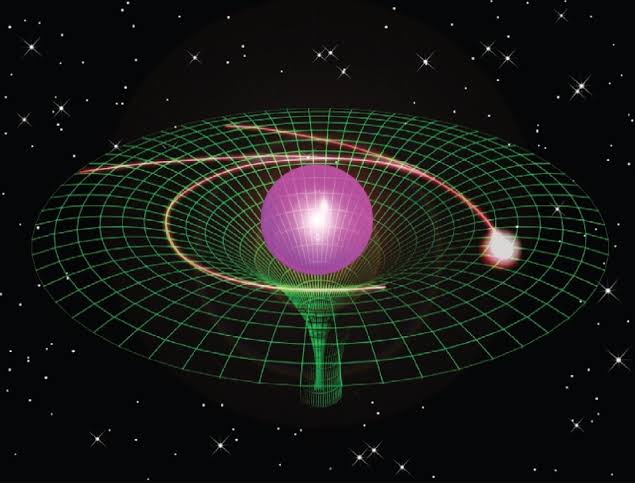
In quantum chromodynamics, quarks and antiquarks are confined inside hadrons by the strong interaction. A useful conceptual picture is a string of energy connecting a pair of charges. If the string becomes sufficiently energetic, the energy can instead be converted into new particle-antiparticle pairs, allowing the original string to break into smaller pieces.
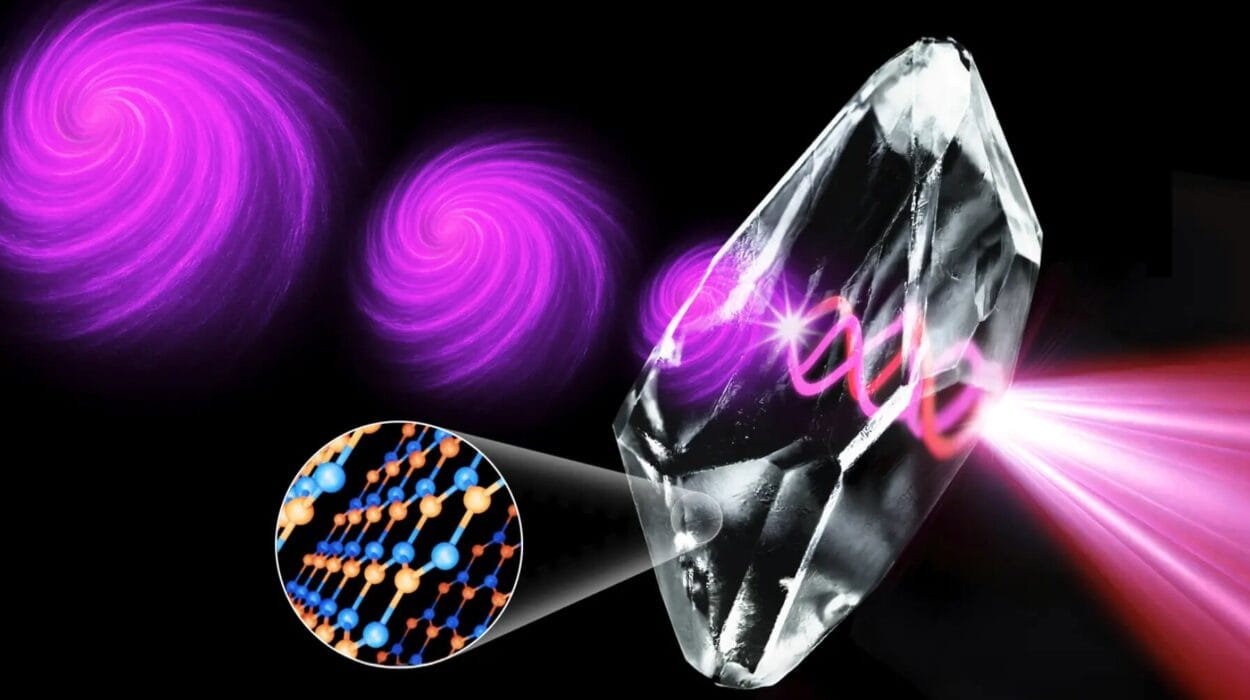
Directly following such a process is difficult because it involves strongly interacting quantum matter evolving far from equilibrium. The experiment therefore used a programmable quantum simulator to realize a simpler one-dimensional version of a confining gauge theory, a lattice gauge theory. The system contains matter on the sites of a one-dimensional lattice and gauge fields on the links between them.
The researchers used an exact mapping that converts the gauge-theory problem into the dynamics of an interacting quantum Ising spin chain. In this mapping, a charge corresponds to a kink between neighboring spins, while a string corresponds to a region of aligned spins with the appropriate electric-field configuration. That made it possible to represent the gauge-theory dynamics using controllable spins in a trapped-ion system.
The simulator contained a linear array of 15 ytterbium-171 ions in a microfabricated surface trap. Thirteen central ions formed the physical spin chain used in the simulation. The ions were cooled, prepared in a well-defined spin state and then allowed to evolve under programmable interactions before their final spin states were measured.
The experiment was designed to give the researchers control not only over interactions between neighboring spins but also over longer-range interactions and local magnetic fields. Two independently controlled arrays of focused laser beams provided that flexibility. The resulting spin-spin interaction was approximately translationally invariant and decayed exponentially with distance, with an experimentally determined decay parameter of about 0.78. The average nearest-neighbor interaction strength was kHz.
This control also allowed the researchers to imitate regions of the gauge theory that were not physically represented by the finite ion chain. Site-dependent longitudinal fields could reproduce the effect of semi-infinite static spin chains surrounding the simulated region. That was important because it allowed the experiment to create an isolated charge or a string bounded by two static charges without simply ending the simulated system at a hard boundary.
An isolated charge first spreads, then becomes confined
The first experiment examined what happens to a single localized charge.
The researchers prepared the central region so that one charge sat in the middle of the physical chain. On one side was a vacuum configuration and on the other was a semi-infinite string. They then abruptly changed the coupling strength and string tension and watched the charge evolve in space and time.
With little or no string tension, the charge was free to spread through the chain. Increasing the string tension changed the motion qualitatively. Instead of continuing to spread, the charge became localized around its initial position and underwent coherent oscillations.
The behavior can be understood in terms of the energy cost of extending the string. When the tension is absent, moving the string endpoint does not impose the same growing energetic penalty. Once the tension is present, moving the charge farther away requires more energy, restricting its motion. The experiment therefore directly observed the localization of a string endpoint as the confining tension increased.
For a regime in which the dynamics can be approximated by a single charge, the researchers predicted a maximum propagation speed of , where is the coupling that allows the charge to move. When the string tension is present, the predicted spatial amplitude of the coherent oscillations is , while their period is , with representing the string tension.
The measured dynamics agreed well with those predictions, including for values of the parameters beyond the perturbative regime in which the simple approximation is expected to work most directly. Numerical simulations using the experimental interaction profile also agreed with the measurements.
That experiment separated two effects that are important for understanding what came next. A confining string can restrict the motion of an existing charge, but genuine string breaking requires something more: new charge pairs must appear.
Stretching a string between two static charges
To isolate that process, the researchers prepared a different configuration. Two static charges were placed at the boundaries of the physical region, with a string stretched between them and a vacuum outside.
The physical spins were initially placed in a classical string configuration, meaning that the system had no quantum fluctuations from the interaction and string-tension terms. The researchers then abruptly switched on both the coupling and the string tension. This sudden change drove the system far from equilibrium and gave the initially static string an opportunity to break dynamically.
The experiment covered nine combinations of coupling strength and string tension. For each setting, the researchers measured the charge distribution as it evolved across the chain. Each experimental measurement was averaged over 300 repetitions. Numerical simulations were performed alongside the experiment to test the observed dynamics.
The resulting space-time patterns contained the central observation of the study.
New charge pairs did not initially appear uniformly throughout the interior of the string. Instead, charge-pair formation repeatedly occurred near the two string edges, close to the static charges that bounded the string.
At weak or vanishing string tension, the newly generated charges remained near the edges and underwent coherent oscillations. When the string tension was increased, the charge pairs began propagating away from the edges and spreading toward the bulk of the string.
The change was visible directly in the evolution of the charge density. The experiment could follow not only whether charges appeared but where they appeared and how their distribution moved with time.
That spatial information is important because a conventional picture of Schwinger string breaking involves spontaneous charge-pair production in the bulk. Here, the earliest charge formation was concentrated at the boundaries of the string instead.
Why the edges matter
The researchers developed a theoretical description to understand why the string edges were favored.
In the weak-coupling regime, the dominant contribution to the early-time dynamics can be described in terms of a single pair of dynamically generated charges. Immediately after the quench, the corresponding two-charge wavefunction has its largest weight near the two configurations in which the pair is created at the left or right edge of the string.
The surrounding static regions change the energy cost of creating a pair at those locations. As a result, the string edges provide preferred starting configurations for the subsequent quantum evolution.
The researchers represented this behavior using an effective two-charge potential landscape. The two charge positions define a two-dimensional configuration space. At different string tensions, the landscape changes shape, and trajectories connecting the edge configurations to configurations deeper inside the string become available.
As the string tension increases, the calculations show approximate equipotential paths extending from the edges into the bulk. These paths provide a route for the initially edge-localized charge pair to propagate through the string rather than remaining confined to the boundary.
This produces the characteristic sequence seen in the experiment: charge pairs are generated close to the string boundaries, remain localized there when the tension is weak, and spread inward when the tension is stronger.
The mechanism therefore differs from the conventional Schwinger picture described in the study. The researchers emphasize that their observation is not characterized by the same spatially uniform bulk production process or the same strong parameter dependence expected for the nonperturbative Schwinger mechanism. Instead, the early dynamics are facilitated by the string edges.
Watching the string turn into larger vacuum regions
The researchers also looked for a way to characterize the breaking process beyond simply tracking the average charge density.
They examined the largest contiguous spin-up domain, which they describe as the largest dynamically generated “vacuum bubble.” At the beginning of the evolution, the probability distribution was concentrated at small domain sizes.
As the system evolved, a second peak developed and moved toward larger domain sizes whenever the string tension was nonzero. The motion of this second peak provided a nonperturbative measure of the growth of the regions produced as the string dynamics unfolded.
This domain-size measurement was performed for the same nine combinations of coupling strength and string tension used in the main string-breaking experiment. Its behavior supported the interpretation obtained from the spatially resolved charge measurements: the dynamics were consistent with charge formation beginning near the string edges and subsequently developing into larger regions within the string.
The supporting calculations also extended the analysis beyond the simplest weak-coupling description. Numerical calculations in a continuum-limit treatment retained the characteristic edge-facilitated trajectories. Additional calculations introduced a dynamically fluctuating exterior vacuum rather than the fully static environment used in the experiment. Those calculations continued to produce the edge-facilitated mechanism, indicating that the effect was not simply a consequence of fixing the external regions completely.
The string remains out of equilibrium during the observed dynamics
The researchers also tested whether the observed evolution might already represent the system settling into thermal equilibrium.
The abrupt change in the Hamiltonian parameters injects energy into the system. In an interacting many-body system, the long-time evolution can lead toward thermal equilibrium. To examine where their observations fell on that path, the researchers compared the measured electric-field evolution with the electric-field profiles expected in thermal equilibrium at the same total energy.
For relatively weak quantum fluctuations, the string-like character of the initial state persisted throughout the measured evolution, with small changes associated with motion near the edges. With stronger quantum fluctuations, the string character disappeared more quickly, indicating faster relaxation toward equilibrium. Even in those cases, however, the system remained out of equilibrium throughout the observation period.
That distinction matters for interpreting the observed charge patterns. The experiment was not simply measuring the final equilibrium state of a heated spin chain. It was following the transient many-body dynamics produced immediately after the sudden change in the Hamiltonian.
A controlled view of confinement and string breaking
Taken together, the two experiments connect the motion of individual charges with the later breaking of a string.
When a single charge was introduced, increasing the string tension halted its free spreading and confined it to coherent oscillatory motion. When a string was prepared between two static charges and then driven out of equilibrium, newly created charge pairs first appeared near the string boundaries. Their subsequent motion depended on the tension: weak tension kept the dynamics near the edges, while stronger tension allowed the charge pairs to spread into the interior.
The trapped-ion system made it possible to follow those processes with spatial and temporal resolution while independently controlling the interaction strength and local fields. The experiment used 13 physical spins, while programmable fields reproduced the effect of the surrounding static regions needed for the charge and string configurations.
The resulting dynamics provide an experimental realization of string breaking in a one-dimensional gauge theory and, according to the authors, identify an edge-facilitated mechanism for transient charge formation that is distinct from the conventional Schwinger mechanism. The paper also notes that the present experiment does not reach the large-system, near-critical continuum regime that would require a much larger hierarchy of length scales than the apparatus can currently provide.
The study was published in Nature Physics.