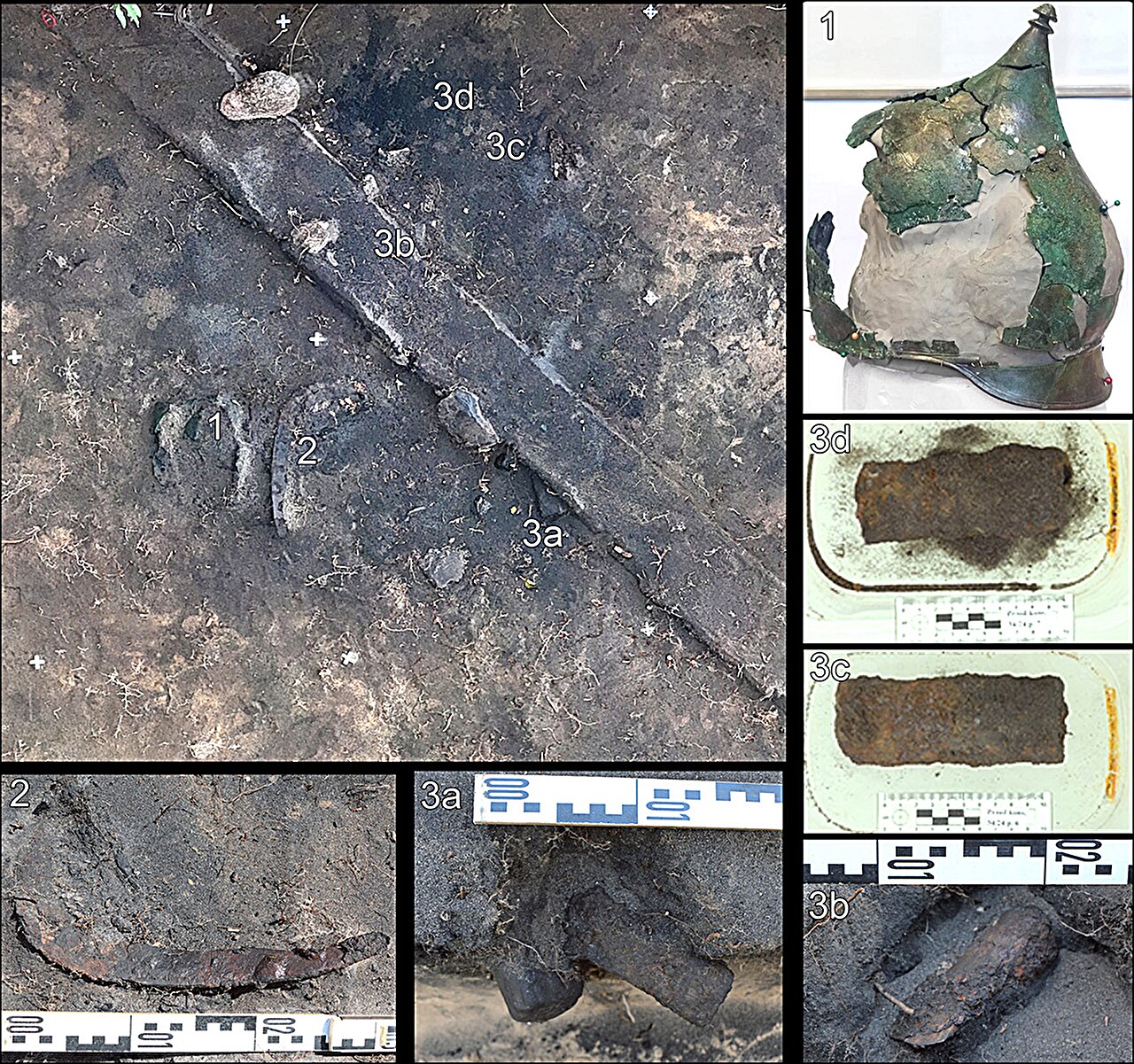
About 2,400 years ago, someone deliberately crushed a bronze helmet, broke it into pieces and buried it in a pit at Łysa Góra in northeastern Poland. The helmet, a rare type associated with Celtic warrior elites, is the only known example of its kind found outside the Celtic homeland from the 4th century B.C. Its discovery is raising new questions about the people who lived at this Iron Age settlement and their connections to distant parts of Europe.
The helmet was found during excavations of a ritual pit containing charred remains, iron adzes and a scythe. At first, archaeologists did not recognize what they had uncovered.
The bronze object appeared to be a vessel made from thin metal sheets. Only after exposing its tip did the team realize it was a helmet of a particularly rare type, known as a Berru-type helmet.
Similar helmets have been found at Celtic sites, including Dürrnberg in Austria and locations in the Champagne region of France. They are sometimes associated with lavish burials of high-status Celtic warriors.
Finding one so far northeast, in present-day Poland, is unusual. Its condition also raises questions about why someone would deliberately damage an object associated with power and elite status before placing it in a pit with other tools.
The helmet was recovered from a site called Łysa Góra, an Iron Age settlement whose archaeological importance has become clearer through recent excavations.
A settlement with a complicated past
Łysa Góra stood on a sand dune between the Orzyc River and a lake. It was fortified and inhabited between the 6th and 4th centuries B.C. Its residents may have belonged to the West Baltic Barrow Culture.
Archaeologists have known about the settlement for decades. Excavations took place intermittently between 1971 and 1992, but much of the material recovered during those campaigns was never published.
The site also had a reputation for being badly disturbed, making researchers uncertain about what further excavation might reveal.
That changed when the team began investigating the pit containing the helmet.
The discovery adds to a growing collection of objects linking Łysa Góra to the Celtic world. Researchers have identified nearly 80 La Tène artifacts at the settlement, including around 31 mostly fragmented brooches and ring ornaments.
La Tène artifacts are associated with Celtic material culture. Their presence alongside the helmet provides evidence of connections between the settlement and communities much farther south.
But the researchers believe the relationship may have involved more than the movement of goods.
Did Celtic people live at Łysa Góra?
One possibility is that the helmet arrived through trade. However, the researchers consider this explanation unlikely.
The object was associated with powerful Celtic warriors, whose social position and status differed considerably from those of the local population in northeastern Poland. The study suggests that its owner may have personally stayed at Łysa Góra.
The broader collection of Celtic objects strengthens that possibility. Their variety suggests that a group of Celts may have lived at the settlement for approximately two generations, according to archaeologist Bartłomiej Kaczyński of the State Archaeological Museum in Warsaw.
That interpretation offers a different picture of the settlement. Rather than simply receiving occasional foreign goods, Łysa Góra may have hosted people from distant communities who brought their own objects and cultural traditions.
The helmet is particularly important because its type is so rarely found beyond the Celtic homeland.
Amber may have drawn distant visitors north
The researchers suggest that Łysa Góra may have served as a trading post.
Its location offered access to the amber-rich Kurpie region and routes running north toward the Sambian Peninsula. These connections may have made the settlement a useful place to control and facilitate the movement of amber and other goods toward central Europe.
The archaeological evidence points to substantial activity at the site. Ongoing excavations have uncovered nearly 350 metal objects, amber beads, an unfinished amber ring and a bronze coin possibly belonging to Seuthes III, a Thracian king.
The possibility of a wider trading network also raises questions about what else may have changed hands there.
Kaczyński said ancient written sources do not allow researchers to rule out the possibility that enslaved people were traded at the settlement as well. However, this remains a possibility rather than an established finding.
More unusual discoveries at the settlement
The helmet is not the only unusual object recovered from Łysa Góra.
In 2025, archaeologists uncovered a trepanation tool, an instrument used to drill holes into the skull. Kaczyński suggested that its presence could indicate that someone in the community had medical knowledge, possibly a druid.
The discovery adds another element to the picture emerging from the excavations, although the identity and role of the person who may have used the instrument remain uncertain.
For Kaczyński, the combination of artifacts makes Łysa Góra an especially promising archaeological site. The rare helmet, Celtic ornaments, metalworking objects and evidence of amber-related activity are helping researchers investigate who lived there and how the settlement connected with communities across Europe.
The study was published in Antiquity.