Black holes are among the most terrifying objects ever discovered—not because they are evil, but because they are honest. They reveal what gravity can truly do when it is given enough mass and enough time. They are regions of space where matter is crushed beyond familiar limits, where light itself cannot escape, and where the laws of physics are pushed into a realm we still struggle to fully understand.
It is natural to look at something so extreme and wonder: could it get worse? Could a black hole grow endlessly? Could it swallow everything? Could one black hole, born in the heart of a dying star or hidden in the center of a galaxy, eventually consume all existence?
In short, could a black hole destroy the universe?
The question feels like science fiction, but it touches on real physics—gravity, cosmic expansion, quantum theory, and the structure of spacetime itself. The truth is both reassuring and deeply fascinating. Black holes are powerful, but the universe is larger, stranger, and far more resilient than most people imagine.
What a Black Hole Really Is
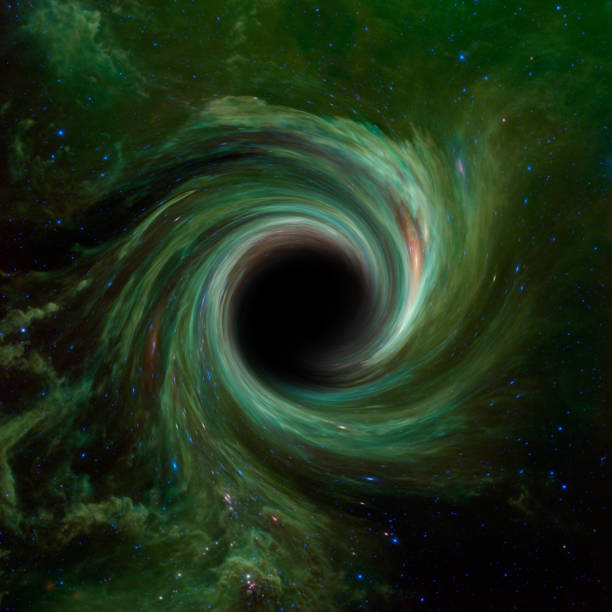
A black hole is not a hole in the ordinary sense. It is not a tunnel, a drain, or an empty void. A black hole is a region of spacetime where gravity becomes so strong that escape is impossible once you cross a certain boundary.
That boundary is called the event horizon.
If you fall inside the event horizon, you cannot return. Not because something blocks your path, but because spacetime is curved so severely that every possible future direction leads deeper inward. Even light, the fastest thing in the universe, cannot climb out.
At the center of a black hole lies what is called a singularity, a point where density becomes infinite according to general relativity. Whether singularities truly exist or whether quantum physics replaces them with something else is still unknown. But from the outside, what matters is the event horizon. That is the border between the universe that can still communicate with you and the universe that cannot.
A black hole is not a cosmic vacuum cleaner sucking everything in from far away. It is simply an object with intense gravity. From a distance, a black hole’s gravitational pull behaves like any other object of the same mass.
If the Sun were replaced by a black hole of the same mass, Earth would continue orbiting almost exactly as it does now. The solar system would freeze and darken, but it would not be swallowed. Gravity at Earth’s distance would remain the same.
This single fact already tells us something important: black holes are not automatically universe-destroyers.
How Black Holes Form
Black holes form when matter becomes compressed beyond the ability of any known force to resist gravity.
The most common type is the stellar-mass black hole, formed when a massive star runs out of nuclear fuel. Without outward pressure from fusion, the star’s core collapses. If the remaining mass is high enough, not even neutron degeneracy pressure can halt the collapse, and a black hole forms.
There are also supermassive black holes, which can be millions or billions of times more massive than the Sun. These exist at the centers of most galaxies, including the Milky Way. How they formed is still debated, but they likely grew from smaller black holes and dense matter over cosmic time.
There may also be intermediate-mass black holes, and hypothetical primordial black holes that could have formed in the early universe from dense fluctuations shortly after the Big Bang.
Black holes are not rare cosmic accidents. They are part of the universe’s natural evolution.
But their existence raises an unsettling possibility: if black holes can form and grow, could they keep growing until they consume everything?
The Fear: A Black Hole That Never Stops Growing
The idea of a black hole devouring the universe comes from a simple and frightening mental picture. A black hole swallows matter. Swallowed matter increases the black hole’s mass. A more massive black hole has stronger gravity. Stronger gravity allows it to swallow more. So why wouldn’t it grow endlessly until nothing remains?
It sounds like a runaway process, like a fire that feeds itself until the entire forest is ash.
But physics does not allow this to happen so easily. The universe is not arranged like a neatly packed pantry for black holes. Most of space is empty, galaxies are separated by enormous distances, and cosmic expansion is constantly pulling large-scale structures apart.
Black holes can grow, but they do not grow without limits or without access to fuel. In fact, most black holes spend most of their existence doing almost nothing.
The universe is not a buffet. It is a desert.
Black Holes Don’t “Suck” Like a Vacuum Cleaner
One of the biggest misconceptions about black holes is that they act like cosmic drains, pulling in everything around them automatically.
In reality, objects only fall into a black hole if they get extremely close. Gravity decreases with distance. Far from a black hole, gravity behaves just like the gravity of any other object with the same mass.
If you were near a black hole, you could orbit it safely, just as you can orbit a star or planet. Astronauts could theoretically orbit a black hole without falling in, provided they stayed outside the event horizon and avoided unstable regions too close to it.
Matter does not automatically spiral inward unless it loses energy, such as through friction, collisions, or radiation. In space, objects often maintain stable orbits for billions of years.
This means a black hole does not simply “reach out” and consume everything around it. It must wait for matter to come close enough or be driven inward by other forces.
This greatly limits its ability to grow.
How Fast Can a Black Hole Eat?
A black hole can only consume matter at a certain rate. Even when surrounded by gas and dust, the feeding process is messy.
Matter falling toward a black hole often forms an accretion disk, a swirling structure of superheated gas orbiting at enormous speeds. Friction and compression heat the disk until it glows brightly, emitting X-rays and other radiation.
Ironically, black holes can be some of the brightest objects in the universe because the matter around them releases energy before crossing the event horizon.
This radiation creates pressure that can push incoming matter away, limiting how much can fall in. There is even a theoretical limit called the Eddington limit, which describes the maximum stable rate at which a black hole can accrete matter before radiation pressure balances gravitational attraction.
So black holes are not limitless eaters. They can be powerful, but their own feeding process fights against itself.
This is one reason why even supermassive black holes take billions of years to reach their size.
The Universe Is Expanding, and Expansion Wins on Large Scales
The strongest reason a black hole cannot destroy the universe is cosmic expansion.
The universe is not static. Since the Big Bang, space itself has been expanding. Galaxies are moving away from one another not because they are flying through space like bullets, but because the space between them is stretching.
On the largest scales, this expansion dominates gravity.
Even if a black hole were extremely massive, it would still be limited by the fact that distant galaxies are being carried away by expanding space. At large enough distances, the expansion rate exceeds the gravitational influence of any single object.
In fact, due to dark energy, the expansion of the universe is accelerating. This means that over time, galaxies will become increasingly isolated. Eventually, most galaxies will move beyond the observable horizon of each other, separated by distances so vast that no signal traveling at the speed of light could ever cross.
In such a universe, black holes will not have access to infinite matter. Their potential food supply shrinks in practical terms, because the universe is pulling everything apart.
Black holes are powerful locally, but the universe is structured so that they cannot easily reach everything.
Could a Supermassive Black Hole Swallow an Entire Galaxy?
This is a more realistic question than swallowing the universe.
A supermassive black hole sits at the center of most galaxies. Our own galaxy’s black hole, Sagittarius A*, has a mass about four million times that of the Sun. That sounds enormous, but it is tiny compared to the Milky Way’s total mass, which is on the order of a trillion solar masses when including dark matter.
Sagittarius A* is not swallowing the Milky Way like a monster in the dark. It is relatively quiet. It consumes small amounts of gas and dust, but the galaxy remains stable.
Even in active galaxies where the central black hole is feeding aggressively, the black hole does not “eat” the galaxy quickly. Stars are spread far apart. The distances between stars are so enormous that collisions are rare. Most stars orbit the galactic center in stable paths.
A black hole can consume nearby stars if they wander too close, but this is not a rapid process. It is slow and occasional.
In some cases, galaxies merge. When that happens, their central black holes may eventually merge too, producing gravitational waves. Over cosmic time, this can create larger black holes.
But even then, the black hole does not instantly devour the galaxy. Most matter remains in orbit.
A galaxy is not a tight cluster of objects. It is a vast, sparse system. Even the largest black hole cannot easily clean it out.
What Happens If Black Holes Merge and Grow Larger?
Black holes can merge when they collide, usually after two galaxies merge. This is a real phenomenon confirmed by gravitational wave detections. When two black holes spiral together, they release energy in the form of gravitational waves, ripples in spacetime.
The merged black hole becomes larger, but it also loses some mass-energy in the form of gravitational radiation. This means the final black hole’s mass is slightly less than the combined mass of the two originals.
Black hole growth through mergers is significant, but it is not infinite. Mergers require black holes to actually encounter each other, which becomes less likely as the universe expands and galaxies drift apart.
In the distant future, galaxy mergers will slow down. The universe will become more isolated. Black holes will still exist, but opportunities for growth will become rarer.
So even the process of black holes merging does not naturally lead to universe-wide consumption.
Could One Black Hole Eventually Swallow All Matter in the Observable Universe?
Even if we imagine the most extreme scenario—a black hole that somehow becomes unimaginably massive—the universe still presents obstacles.
Matter is not all falling toward a central point. The universe has no central location in the usual sense. The Big Bang did not happen at a single point in space; it happened everywhere at once, with space expanding in all directions.
Because of this, there is no natural “center” for everything to fall into. The universe is not shaped like a collapsing sphere around one cosmic drain.
To swallow all matter, a black hole would need to gravitationally dominate the entire cosmos. But cosmic expansion prevents that dominance from extending infinitely. At large distances, space expands too quickly for gravity to pull objects inward.
The universe’s structure is fundamentally not arranged for a single object to consume everything.
Black holes are not cosmic endgame predators. They are local gravitational traps.
What About the Ultimate Black Hole: Could the Universe Collapse Into One?
This question connects to the concept of the Big Crunch, a hypothetical scenario where the expansion of the universe reverses, and gravity causes everything to collapse back into an extremely dense state.
If that happened, one might imagine that the universe could collapse into a giant black hole-like condition, perhaps ending in a singularity.
But current evidence suggests this will not happen. Observations indicate the universe’s expansion is accelerating, driven by dark energy. This makes a Big Crunch extremely unlikely under our current understanding.
Instead of collapsing inward, the universe seems to be stretching outward faster and faster.
So the universe is not moving toward becoming a single black hole. It is moving toward becoming emptier.
The Strange Truth: Black Holes Actually Shrink Over Time
One of the most surprising discoveries in modern physics is that black holes are not eternal.
In the 1970s, Stephen Hawking showed that black holes should emit radiation due to quantum effects near the event horizon. This is now called Hawking radiation.
The idea is deeply strange. Quantum fluctuations in empty space can create particle-antiparticle pairs. Near the event horizon, one particle may fall in while the other escapes. To an outside observer, it looks like the black hole is emitting particles and losing energy.
Over immense time scales, this causes the black hole to lose mass. Eventually, it evaporates completely.
For stellar-mass black holes, the evaporation time is unimaginably long—far longer than the current age of the universe. For supermassive black holes, it is even longer, possibly up to 10¹⁰⁰ years or more depending on their mass.
But the key point is this: black holes are not permanent monsters that grow forever. In a universe with no new matter falling in, black holes slowly decay.
This flips the entire fear upside down.
Instead of black holes destroying the universe, the universe will likely outlast black holes.
Could a Black Hole Destroy the Universe Through Hawking Radiation?
Hawking radiation is extremely weak for large black holes. In fact, the bigger the black hole, the colder it is. A supermassive black hole has a temperature close to absolute zero.
This means Hawking radiation from large black holes is harmless in the present-day universe. It does not pose a threat to planets or galaxies.
However, in the unimaginably distant future, after stars burn out and galaxies fade, black holes may become some of the last remaining energy sources. As they evaporate, they will release energy back into space.
Even then, this energy would be spread across enormous distances and would not “destroy” the universe. It would simply be another stage in cosmic evolution.
The final evaporation of a black hole might be dramatic on a local scale, releasing a burst of radiation. But it would not threaten the universe as a whole.
Could a Black Hole Tear Apart Spacetime Itself?
Some people imagine black holes as cosmic wounds—tears in reality that could spread until spacetime collapses.
This is not how physics describes them.
Black holes are solutions to Einstein’s equations of general relativity. They are extreme, but they are still part of the normal structure of spacetime. They do not infect the universe like a disease. They do not spread just by existing.
Spacetime around a black hole is curved, but curvature is not destruction. Curvature is geometry. The universe can contain black holes the way Earth can contain mountains. Mountains deform the surface, but they do not cause the entire planet to collapse.
Black holes warp spacetime intensely, but the effect decreases rapidly with distance.
Even if singularities exist, they remain hidden behind event horizons. They do not leak outward into the universe.
So black holes do not threaten reality itself in the way many fictional stories suggest.
Could a Black Hole Trigger a Vacuum Collapse?
This is one of the rare scenarios where physics allows something genuinely universe-ending, though it is speculative.
In quantum field theory, the vacuum is not simply empty space. It is the lowest energy state of fields that fill the universe. Some theories suggest our universe may exist in a metastable vacuum, meaning it is stable for now but not in the absolute lowest possible energy state.
If the vacuum were to transition to a lower-energy state, it could create a bubble of “true vacuum” expanding outward at nearly the speed of light, rewriting the laws of physics as it goes. Such an event would destroy everything, not through explosion, but through transformation.
Could black holes trigger such a vacuum decay?
Some physicists have explored this idea, but there is no evidence that black holes can cause vacuum collapse. If they could, then the universe would likely have already been destroyed, because black holes have existed for billions of years.
Furthermore, the universe contains far more extreme conditions than anything near Earth, including black holes and high-energy cosmic events. If vacuum decay were easy to trigger, it probably would have happened long ago.
So while vacuum collapse is a theoretical possibility, black holes are not considered a realistic threat in that sense.
The universe appears remarkably stable.
Could a Tiny Black Hole Form and Consume Everything?
Another fear comes from the idea of microscopic black holes, sometimes discussed in connection with particle accelerators like the Large Hadron Collider. Could a high-energy collision create a tiny black hole that begins eating Earth, then the solar system, then the universe?
Physics says no.
Even if tiny black holes could form in particle collisions—which is not supported by standard physics and would require exotic extra dimensions—they would evaporate almost instantly through Hawking radiation. They would not have time to consume anything.
Also, cosmic rays collide with Earth’s atmosphere at energies far higher than those produced in human-made accelerators. If microscopic black holes could be created and survive, nature would have already made them countless times. Earth is still here.
So this scenario is not a serious concern.
The Universe Is Not Easily Destroyed
The deeper you go into cosmology, the more you realize that the universe is not fragile. It contains forces capable of unimaginable destruction on local scales—supernovae, gamma-ray bursts, neutron star collisions, black hole mergers.
Yet the universe persists because it is enormous and because its structure distributes energy and matter across vast distances.
A black hole can destroy a star. It can destroy a planet. It can tear apart a solar system if it comes close enough. A supermassive black hole can disrupt the heart of a galaxy.
But destroying the universe requires something far beyond gravity.
The universe is not a single object that can be swallowed. It is space itself, expanding and evolving. Black holes exist inside it. They do not sit outside it waiting to consume it.
In a sense, asking if a black hole could destroy the universe is like asking if a whirlpool could drain the entire ocean. A whirlpool can pull in ships. It can be deadly. But it cannot consume the sea because the sea is the environment in which it exists.
Black holes are whirlpools in spacetime, not cosmic vacuum cleaners.
What Is the Most Likely Fate of the Universe Involving Black Holes?
If current cosmological models are correct, the universe will continue expanding forever. Stars will eventually burn out. Gas clouds will thin. Star formation will slow and then stop. Galaxies will grow dark as their stars die.
Over immense time scales, gravitational interactions will cause some stars to be ejected from galaxies, while others may fall into black holes. Black holes will slowly consume nearby matter, not in a violent rush but in a gradual quiet process.
Eventually, black holes may become some of the last major structures left.
And then, over timescales so long they almost defy meaning, black holes will evaporate through Hawking radiation.
After that, the universe will likely be filled with extremely low-energy photons, neutrinos, and particles spread thinly across a vast, cold cosmos.
This scenario is sometimes called the heat death of the universe, where entropy reaches near-maximum and usable energy becomes scarce.
In that future, black holes do not destroy the universe. They fade away like dying embers.
Could Black Holes Destroy the Universe in Any Realistic Sense?
If we stay grounded in established science, the answer is no.
Black holes cannot grow infinitely because they are limited by available matter. The universe’s expansion isolates regions of space and prevents one object from collecting everything. Black holes do not actively suck matter from across the cosmos. They require close encounters or inward energy loss.
Even more importantly, black holes are not immortal. Quantum physics predicts they lose mass over time.
So rather than being the universe’s ultimate destroyers, black holes may actually be temporary features in cosmic history—long-lived, terrifying, but ultimately finite.
They are not the final fate of everything.
The Real Meaning Behind the Fear
When people ask if a black hole could destroy the universe, they are often expressing something deeper than scientific curiosity. They are touching the ancient human fear of being swallowed by the unknown.
A black hole represents the limit of visibility. It is a place where information disappears from our reach. You cannot see inside. You cannot know what happens beyond the horizon. It is the ultimate symbol of nature’s secrecy.
But physics teaches something surprisingly comforting: the universe is governed by laws, and even its most extreme objects obey those laws. Black holes are not supernatural. They are not cosmic monsters. They are consequences of gravity and geometry.
The universe is not waiting to be destroyed. It is unfolding.
Final Answer: Could a Black Hole Destroy the Universe?
A black hole cannot destroy the universe in any realistic physical scenario. It can consume matter in its vicinity, grow through accretion and mergers, and dramatically reshape its local environment. But it cannot swallow everything across the cosmos, because the universe is expanding, matter is widely dispersed, and gravity’s reach is not infinite in an accelerating universe.
Even in the far future, black holes are expected to evaporate through Hawking radiation, meaning they will eventually disappear rather than dominate.
Black holes are among the most extreme objects nature has created, but they are not the end of everything.
If anything, the universe is more likely to die not by being swallowed, but by slowly fading—stars burning out, galaxies drifting apart, and the cosmos cooling into darkness over unimaginable time.
The universe will not be destroyed by a black hole.
But black holes remind us of something profound: even the brightest stars can die, even spacetime can twist into impossible shapes, and reality is far deeper than our instincts ever prepared us for.
And yet, the universe endures.