Black holes are among the most terrifying objects the universe has ever produced. They are not monsters in the mythological sense, yet their reality is far more unsettling than fiction. A black hole is a region of space where gravity becomes so extreme that nothing—not even light—can escape once it crosses a boundary called the event horizon. It is the ultimate trapdoor in the fabric of the cosmos.
The idea of a black hole drifting toward Earth triggers an instinctive fear. People imagine a giant cosmic vacuum cleaner swallowing planets whole, pulling oceans into space, tearing the Sun apart, and ending everything in an instant. The mental image is dramatic, and Hollywood has made sure it stays that way.
But the real physics is even more fascinating. A black hole near Earth would not behave like a vacuum cleaner. It would behave like gravity—relentless, mathematical, and deadly in a far more precise way.
If a black hole got too close to Earth, the results would depend on one main factor: its mass. A black hole the mass of a mountain would be very different from one with the mass of the Sun, and both would be very different from a supermassive black hole like the one at the center of the Milky Way. In each case, Earth’s fate would unfold in a different way, but none of them would be good.
To understand what would happen, we must strip away the myths and look directly at the science.
What a Black Hole Really Is
A black hole is not an object in the usual sense. It is a region where matter has been crushed into such a small volume that gravity becomes extreme. Most black holes form when massive stars die. After a supernova explosion, the core may collapse into a neutron star, or if it is massive enough, collapse even further into a black hole.
The defining feature of a black hole is the event horizon. This is not a physical surface like a planet’s crust. It is a boundary in spacetime. Once something crosses it, escape becomes impossible because the gravitational pull is so strong that the required escape velocity exceeds the speed of light.
At the center lies the singularity, a point where density becomes infinite according to classical physics. In reality, quantum physics likely prevents true infinity, but we do not yet have a complete theory of quantum gravity to describe what happens there. The singularity remains one of the deepest mysteries in science.
Black holes have mass, and therefore they exert gravity like any other object. The difference is that their mass is compressed into a tiny region, allowing them to create extremely steep gravitational gradients close to their event horizon.
And that steepness is what destroys things.
Black Holes Are Not Cosmic Vacuum Cleaners
One of the most important misconceptions is that black holes suck everything in like a drain. In reality, black holes do not pull more strongly at a distance than any other object with the same mass.
If the Sun were magically replaced with a black hole of equal mass, Earth would continue orbiting almost exactly as it does now. The gravitational pull at Earth’s distance would be the same. Earth would not suddenly spiral inward.
What would change is that the Sun would no longer shine. Earth would freeze. Life would collapse. But that would be due to the loss of sunlight, not because the black hole “sucked” Earth in.
This is the key truth: the danger of a black hole depends not just on its existence, but on how close you get to it. Gravity becomes deadly when the black hole is nearby enough for tidal forces to tear objects apart.
The First Warning Sign: Disturbed Orbits
If a black hole came close to Earth, the earliest sign would not be a visual horror in the sky. It would be gravitational disruption.
Planets orbit the Sun because gravity holds them in stable paths. If a black hole entered the solar system, its gravitational influence would distort these orbits. Depending on its mass and trajectory, it could pull Earth slightly off its stable orbit, or more dramatically eject Earth into interstellar space.
Even before Earth itself was directly affected, other objects in the solar system would react. The orbits of outer planets, asteroids, and comets would be disturbed. We might see an increase in comet impacts as objects from the Kuiper Belt or Oort Cloud were knocked inward.
The solar system is a delicate gravitational dance. A black hole passing through would be like a wrecking ball swinging through a chandelier. Even if it didn’t hit Earth immediately, it could destabilize everything.
How Close Is “Too Close”?
In astronomy, “close” can mean millions of kilometers, and “dangerously close” depends entirely on the black hole’s mass.
A black hole with the mass of the Sun would have an event horizon radius of about three kilometers. That is shockingly small. But despite that small size, its gravitational pull at a distance would be enormous.
If such a black hole came within the distance of the Moon’s orbit, Earth would experience dramatic tidal forces. The planet’s shape could distort, the oceans could rise in monstrous tides, and earthquakes and volcanic activity could become extreme.
If it came within a few hundred thousand kilometers, Earth could be torn apart entirely.
If the black hole were much more massive—say a million times the mass of the Sun—the event horizon would be much larger, and the region of severe tidal disruption would extend farther out. Earth could be destroyed at greater distances.
But if the black hole were smaller, the danger would become extremely concentrated. That leads to one of the strangest realities in black hole physics: smaller black holes can be more violently destructive at close range because their tidal forces change more sharply over small distances.
The True Killer: Tidal Forces
The most catastrophic effect of a nearby black hole would be tidal gravity. Tidal forces happen because gravity is stronger on the side of an object closer to the black hole than on the far side.
Earth already experiences tidal forces from the Moon and the Sun. They create ocean tides. But those forces are mild. Near a black hole, tidal forces become extreme.
If a black hole approached Earth, the near side of the planet would be pulled more strongly than the far side. Earth would stretch slightly at first, but if the black hole came closer, the stretching would become violent.
Eventually, Earth could be pulled apart. The planet’s solid crust would fracture. The mantle would distort. The oceans would be ripped into space. Earth would become a stream of molten debris orbiting the black hole.
This process is sometimes called spaghettification, a term that sounds humorous until you understand what it means. It describes the stretching of objects into long thin shapes under intense tidal forces. For a human being, spaghettification near a stellar black hole would be instantly fatal.
For a planet, it would mean total destruction.
What Happens to the Moon?
The Moon is bound to Earth by gravity, but that bond is not unbreakable. A black hole passing through the Earth-Moon system could easily disrupt it.
If the black hole’s path came closer to the Moon than to Earth, the Moon could be captured by the black hole’s gravity and flung away. Alternatively, the Moon could be thrown into a new orbit around Earth, perhaps closer, perhaps farther, potentially causing chaos with tides and stability.
In a worst-case scenario, the Moon could collide with Earth due to orbital disruption, triggering a global catastrophe even before the black hole came close enough to tear the planet apart.
Even without a collision, losing the Moon would destabilize Earth’s axial tilt over long time periods, affecting climate. But compared to being shredded into debris, that would be a minor concern.
The Atmosphere Would Not Survive
Earth’s atmosphere is held in place by gravity. If Earth’s orbit or structure were disturbed, the atmosphere would be one of the first things to suffer.
As tidal forces increased, the atmosphere would stretch and expand outward. Gas would begin escaping into space. Winds would become unimaginable, driven by pressure differences and gravitational distortions.
Even before Earth’s crust cracked, the atmosphere could thin dramatically, exposing the surface to space. Life would suffocate long before the planet was physically destroyed.
And if Earth were pulled apart, the atmosphere would disperse completely, leaving no protective layer, no oxygen, no weather, no clouds—only gas particles scattered through the void.
The Oceans Would Rise, Then Leave the Planet
Water responds quickly to gravitational forces because it flows. The Moon’s gravity already pulls the oceans into tidal bulges. A black hole’s gravity would do far more.
If a black hole approached, Earth’s oceans would begin forming massive tides. Coastlines would vanish. Entire continents could flood. Waves thousands of meters high could sweep across land.
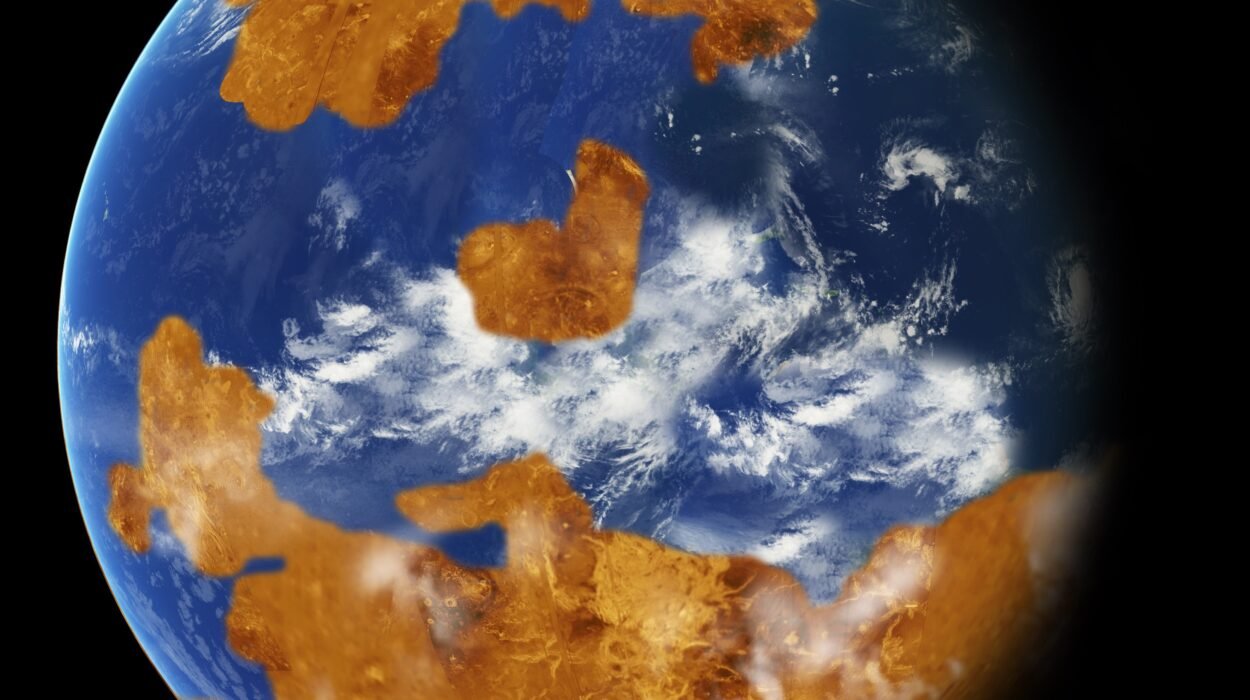
But as the black hole came closer, the ocean would not just rise—it would be pulled away. Water would be torn from Earth’s surface and flung into space, forming spiraling streams of vapor and ice around the black hole.
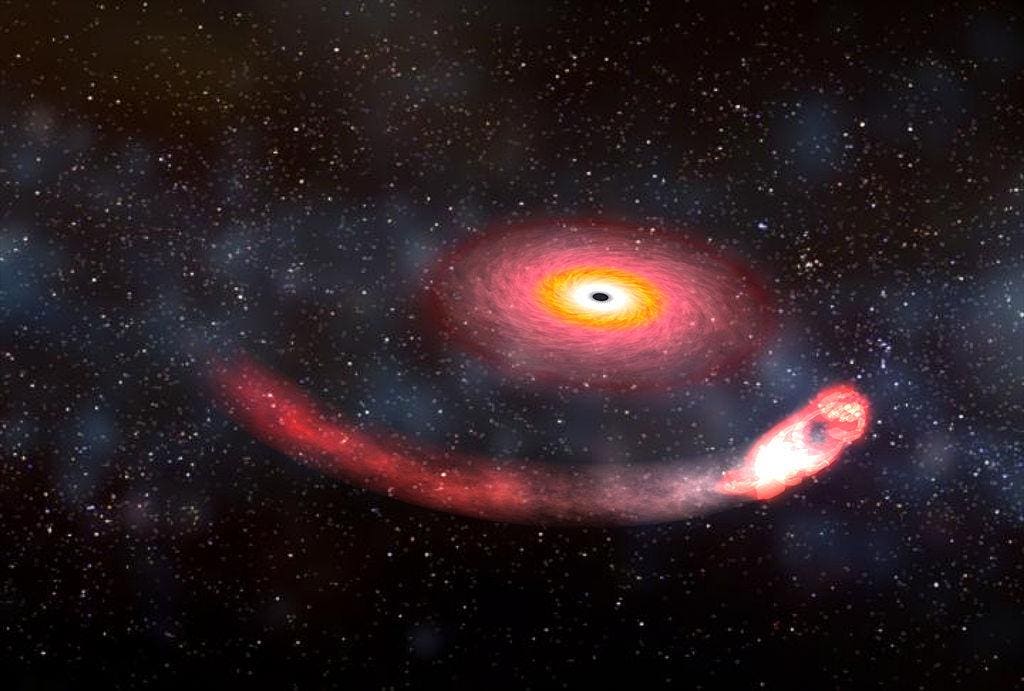
The oceans would become part of an accretion structure, the swirling disk of material that often forms around black holes. The very thing that makes Earth feel alive—its oceans—would be stripped away and turned into cosmic debris.
Earthquakes, Volcanoes, and the Shattering of the Crust
Even before Earth is torn apart, the planet’s interior would react violently. The stretching and squeezing caused by tidal forces would generate intense friction and heat inside Earth.
The crust would crack. Fault lines would rupture on a global scale. Earthquakes far stronger than anything in recorded history would shake the planet continuously.
Volcanic eruptions would likely become widespread. Magma chambers would destabilize. Entire regions could collapse. The surface of Earth could become a burning, fractured landscape, with lava pouring from countless openings.
In such a scenario, civilization would not collapse slowly. It would end almost immediately. No building could survive. No infrastructure could function. The planet itself would become unstable beneath every living thing.
Would We See the Black Hole in the Sky?
A black hole itself emits no light. If it were isolated in space, it would be essentially invisible. You would not see a dark sphere floating in the sky like a cosmic hole punched into reality.
However, a black hole passing through the solar system would likely interact with gas, dust, and debris. If it began pulling in matter, that matter would heat up as it fell toward the event horizon. Friction and compression in the accretion disk could generate intense radiation, including X-rays and gamma rays.
From Earth, the black hole could appear as a bright, violent source of energy rather than a dark object. It might glow like an artificial star, with jets of plasma shooting outward if the black hole formed strong magnetic fields.
In the night sky, it could look like a terrifying new beacon. The darkness would not be visual. It would be gravitational.
Radiation: The Accretion Disk’s Deadly Light
The most dangerous radiation near a black hole comes not from the black hole itself, but from the matter spiraling into it.
As material accelerates inward, it can reach enormous speeds. Collisions between particles heat the disk to millions of degrees. This produces X-rays and gamma rays strong enough to sterilize nearby planets.
If Earth approached a black hole surrounded by an active accretion disk, the radiation could become lethal long before tidal forces destroyed the planet. The atmosphere would absorb some of the energy, but high-energy radiation could ionize the upper atmosphere, strip away ozone, and trigger chemical reactions that make the surface increasingly hostile.
Life would face a double threat: gravitational destruction from tidal forces and biological destruction from radiation exposure.
In extreme cases, Earth could become uninhabitable even without being physically torn apart, simply because the radiation environment would be too intense for complex life to survive.
What Would Happen to the Sun?
If a black hole passed close to Earth, it would almost certainly pass close enough to influence the Sun as well. The Sun is the anchor of the solar system, and disturbing it would destabilize everything.
If the black hole were comparable in mass to the Sun and passed near it, the Sun could be pulled into a new orbit or even partially disrupted. In the most extreme scenario, the black hole could pass close enough to strip away solar material, feeding itself with hydrogen plasma.
If the black hole approached very closely, it could tear the Sun apart. The Sun’s gas would form a vast accretion disk, and the solar system would be flooded with radiation from this catastrophic feeding process.
The death of the Sun would mean instant doom for Earth regardless of tidal effects. The solar system would lose its central light source, and Earth would become a frozen wandering rock, assuming it survived gravitational disruption at all.
However, a direct Sun-destroying encounter would require a very close pass. More likely, the Sun would survive but the orbits of planets would be altered dramatically.
Could Earth Be Captured and Orbit the Black Hole?
In some scenarios, Earth might not be destroyed immediately. Instead, it could be gravitationally captured into orbit around the black hole.
At first glance, this sounds almost survivable. If Earth remained intact and maintained a stable orbit, perhaps life could continue.
But this hope collapses under physics.
A black hole does not provide warmth unless it has an accretion disk or is actively feeding. Without sunlight, Earth’s surface would freeze rapidly. Within days, average temperatures would plunge. Within months, oceans would begin freezing from the top down. Within a few years, much of the atmosphere could condense and fall as snow and ice.
If Earth were still geologically active, some life might survive near deep-sea hydrothermal vents, as certain organisms do today. But surface life would vanish.
And stable orbit is not guaranteed. The gravitational environment near a black hole could be chaotic, especially if other planets and the Sun were still involved.
So even if Earth were not torn apart, it could become a dark, frozen world wandering around a silent gravitational abyss.
Could a Small Black Hole Pass Through Earth?
This is where reality becomes truly strange. What if the black hole were not stellar-mass, but much smaller? Hypothetical “primordial” black holes could exist, formed in the early universe. Some could be as massive as a mountain but physically tiny—perhaps the size of an atom or smaller.
A black hole with the mass of a mountain would still have enormous gravity, but only at extremely close range. If such a black hole passed through the solar system, it might not disrupt planetary orbits much unless it came very near.
But if it passed through Earth itself, the result would be catastrophic in a different way.
It would punch through the planet like a gravitational bullet, passing through the crust and mantle, consuming a small amount of matter along its path. But the real damage would come from tidal forces and shockwaves. The black hole’s passage could generate earthquakes of unimaginable magnitude. It could leave behind a tunnel of molten rock, trigger volcanic eruptions, and potentially fracture the planet’s structure.
Would it swallow Earth? Probably not quickly. A small black hole would not instantly consume the entire planet like a vacuum. It would take enormous time to eat a planet-sized mass unless it remained trapped inside.
But even a brief pass-through could be enough to cause global devastation, wiping out civilization and triggering a mass extinction event.
The frightening truth is that Earth does not need to be “eaten” to be destroyed.
The Fate of Life: Could Anything Survive?
If a black hole came close enough to significantly affect Earth, surface life would almost certainly be doomed.
Humans depend on stable gravity, stable atmosphere, stable temperatures, and a stable biosphere. A black hole encounter would destroy all four.
Even if Earth remained physically intact but was thrown into deep space, humans would face immediate extinction without sunlight. Without agriculture, without heat, without functioning ecosystems, survival would depend on sealed underground habitats and advanced energy sources. That is not something current civilization could easily scale to billions of people.
However, microbial life could potentially survive in some scenarios. Deep underground bacteria might endure the chaos. If Earth froze after losing sunlight, microbial ecosystems could persist near geothermal heat sources. Life might not end completely, but complex life would.
Earth would become a ghost of its former self, a planet that once held oceans and forests, now reduced to a cold, battered remnant.
Would Earth “Go Dark” in the Literal Sense?
In one specific scenario, yes: Earth could go dark because the Sun could be lost.
If the black hole disrupted the Sun’s position or removed Earth from its orbit, Earth would lose its primary source of light and heat. The skies would become permanently black except for distant stars. The blue daylight would vanish. The warmth of morning would disappear forever.
The oceans would freeze. Weather would cease. Photosynthesis would end. Earth would become a frozen sphere drifting through space, illuminated only by starlight and occasional auroras.
That would be a true darkness—not because the black hole is dark, but because the Sun would no longer be part of Earth’s life.
But if the Sun remained in place and Earth stayed bound to it, Earth would not go dark. Instead, it would likely be torn apart, meaning there would be no Earth left to go dark at all.
How Likely Is This to Happen?
The good news is that the probability of a black hole coming dangerously close to Earth is extraordinarily low.
The nearest known black holes are many hundreds or thousands of light-years away. Space is vast, and objects do not wander randomly like ships in an ocean. The galaxy has structure, and stellar black holes are typically found in stable orbits around the Milky Way’s center.
For a black hole to enter our solar system, it would need to pass through an incredibly precise region of space at the same time Earth happens to be there. This is astronomically unlikely.
Even rogue black holes drifting through interstellar space are rare, and the chance of one passing close enough to cause major disruption is tiny. On human timescales, it is essentially not a practical worry.
The universe contains countless dangers, but most of them are separated from us by the greatest protective barrier of all: distance.
What Would Scientists Detect Before It Arrived?
If a black hole were approaching the solar system, we would not likely see it visually at first. But we could detect its gravitational effects.
Astronomers could notice unusual motion in distant stars as the black hole’s gravity bends their light, an effect called gravitational lensing. They might also detect disturbances in the orbits of comets and objects in the outer solar system.
If the black hole were interacting with gas, it could emit X-rays that space telescopes could detect. By the time it came close enough to pose danger, scientists would almost certainly know something massive was approaching.
We might have years of warning, depending on its speed and distance.
But warning does not guarantee survival. A black hole is not a storm you can hide from. It is gravity itself, arriving with no negotiation possible.
The Terrifying Beauty of the Physics
There is something deeply unsettling about black holes because they represent a limit. They are places where known physics bends toward failure. They force us to confront the boundaries of understanding.
A black hole near Earth would not be a dramatic monster with teeth. It would be silent. There would be no sound in space. No roaring. No explosions at first. Only a slow distortion of orbits, a creeping rise of tides, a tightening grip on the planet’s structure.
Then the violence would begin. Earth would crack. Oceans would rise and vanish. Mountains would collapse. The planet would stretch into a molten stream. The sky would glow with radiation as matter spiraled toward the event horizon.
And in the end, Earth would not fall in like a pebble into a lake. It would be dismantled, atom by atom, turned into a disk of fire and debris swirling around a darkness that does not shine.
The universe would not notice. The Milky Way would continue rotating. Stars would continue forming. Somewhere else, planets would continue orbiting in peace.
But for us, it would be the end of everything.
Final Answer: What Happens If a Black Hole Gets Too Close to Earth?
If a black hole came too close to Earth, the planet would face catastrophic consequences. Its orbit would be disrupted, potentially ejecting Earth into deep space or pulling it toward destruction. Tidal forces would stretch and fracture the planet, causing extreme earthquakes, volcanic eruptions, and massive tidal waves. If the black hole came close enough, Earth would be torn apart completely, becoming a stream of debris spiraling into an accretion disk.
If Earth somehow survived intact but lost the Sun’s warmth, it would freeze into a dark, dead world drifting through space. If the black hole was surrounded by hot infalling material, intense radiation could sterilize the planet even before gravitational forces destroyed it.
Earth could indeed “go dark,” not because a black hole blocks light, but because the delicate balance that allows sunlight, life, and stability would be shattered.
The reassuring truth is that such an event is extraordinarily unlikely. Black holes exist, but they are far away. The cosmos is full of dangers, yet it is also vast enough to keep most of them distant.
For now, Earth remains safe beneath its Sun, and black holes remain what they have always been: distant reminders that the universe is far stranger, and far more powerful, than the human imagination first assumes.