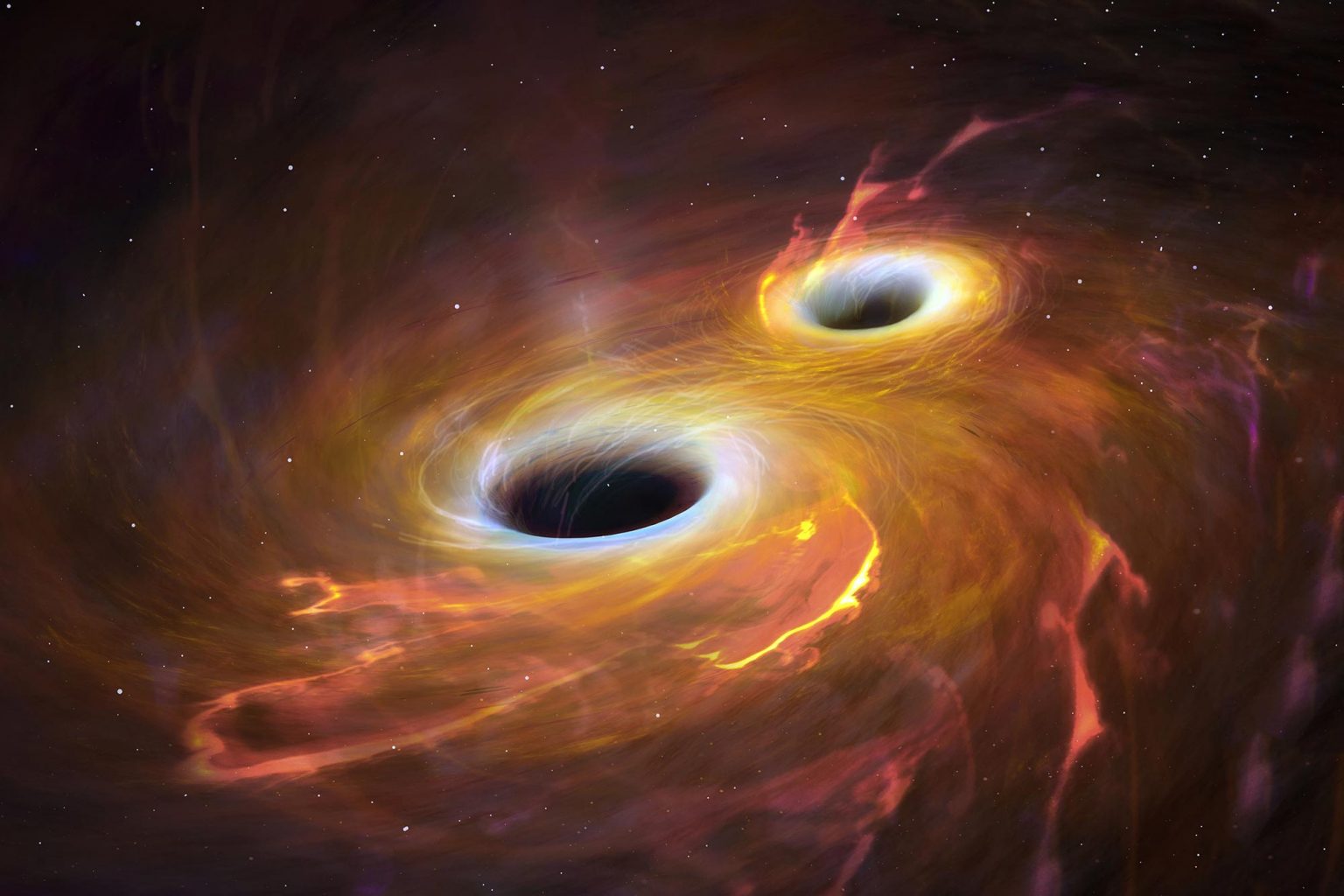
Somewhere in the deep darkness between galaxies, far beyond the reach of human eyes, the universe performs its most dramatic and violent dances. Two invisible monsters spiral around each other, locked in a gravitational embrace so intense that it warps the very fabric of space and time. They circle faster and faster, drawing closer, until the moment arrives when the universe itself seems to shudder.
Then they collide.
To imagine two black holes merging is to imagine gravity unleashed in its purest and most extreme form. There is no explosion of fire in the usual sense, no bright flash like a supernova. Instead, the collision is an event so powerful that it shakes spacetime like a drum. It sends ripples racing across the cosmos—ripples that can travel billions of light-years and still be detected on Earth.
Black hole collisions are among the most energetic events known in the universe, yet they occur in total darkness. They reveal a strange truth about nature: the greatest cosmic fireworks can happen without producing light at all.
So what really happens when two black holes collide? What does the collision look like? What happens to the matter, the energy, and the space around them? Could such a collision threaten Earth? And what do these events tell us about the universe itself?
The answers are some of the most breathtaking in modern physics.
Understanding Black Holes Before the Collision
A black hole is not a solid object, not a vacuum cleaner, and not a hole in the ordinary sense. It is a region of spacetime where gravity is so strong that nothing can escape once it crosses a boundary called the event horizon. Not light, not particles, not even information in any classical sense.
Black holes form when massive stars collapse under their own gravity, when dense stellar remnants merge, or when enormous clouds of matter collapse in the early universe. At the center of a black hole lies what general relativity predicts is a singularity: a point where density becomes infinite and the known laws of physics break down. Whether a true singularity exists or whether quantum physics changes the story is still unknown.
But from the outside, a black hole is defined by only a few measurable properties. It has mass, it may have spin, and it can have electric charge (though in most astrophysical settings, black holes are essentially neutral). This simplicity is part of what makes black holes so eerie. They can swallow entire stars, yet the only thing the universe sees afterward is their gravitational fingerprint.
When two black holes exist near each other, their gravitational fields interact in ways that create one of the most dramatic phenomena in the cosmos: a binary black hole system.
How Two Black Holes Find Each Other
Black holes do not usually wander alone. Many stars form in pairs or groups, and when both stars are massive enough, they can each end their lives as black holes. If the original stars were in a binary system, their black hole remnants may remain bound together, orbiting each other for millions or billions of years.
Black holes can also pair up through gravitational interactions in dense environments like globular clusters, where stars and stellar remnants are packed close together. In such crowded regions, black holes can capture each other through complex gravitational encounters.
Even supermassive black holes—those millions or billions of times more massive than the Sun—can merge. When galaxies collide, their central black holes sink toward the merged galaxy’s center through gravitational interactions with surrounding stars and gas, eventually forming a supermassive binary system.
Once two black holes become gravitationally bound, their fate is sealed. Their orbit will shrink, and sooner or later, they will collide.
But the mechanism that drives them together is not friction in the usual sense. It is something far more exotic: the emission of gravitational waves.
The Slow Spiral Toward Doom
When two massive objects orbit each other, they disturb spacetime. According to Einstein’s general relativity, accelerating masses create gravitational waves—ripples in spacetime that propagate outward at the speed of light.
For most ordinary systems, gravitational waves are unimaginably weak. The Earth orbits the Sun and emits gravitational waves, but the energy loss is so tiny that the orbit barely changes. The universe is filled with gravitational waves from countless motions, but we do not feel them because spacetime is incredibly stiff and resistant.
But black holes are different.
When two black holes orbit each other, the gravity involved is extreme. The waves they produce are strong enough to carry away significant energy. As energy is lost, the black holes move closer together. Their orbit shrinks. They begin to spiral inward.
At first, this inspiral can take billions of years. The black holes may be separated by millions of kilometers, circling each other at relatively moderate speeds. But as the orbit tightens, everything accelerates.
The closer they get, the faster they orbit, and the more gravitational wave energy they radiate. The waves grow stronger. The spiral quickens. The final moments become a runaway cascade, like a cosmic whirlpool pulling them into a single point of no return.
In the last seconds, the black holes can orbit each other dozens or even hundreds of times per second, moving at a significant fraction of the speed of light. Spacetime around them becomes violently distorted. Time itself behaves strangely. If you could watch from a safe distance, you would see the universe’s geometry twisting like fabric being wrung out.
Then comes the collision.
The Moment of Merger: No Fire, No Light, Just Spacetime Shockwaves
The merger of two black holes is not like two planets colliding or two stars crashing. There is no surface to smash, no rock to shatter, no flame to ignite. Black holes are defined by their event horizons, and when they approach each other, their horizons distort and stretch.
In the final moment, the event horizons touch and merge. Two separate regions of no escape become one. The black holes become a single, larger black hole.
But the newly formed black hole is not immediately calm. It is born in chaos. Its shape is distorted, its gravitational field is wildly uneven, and it vibrates as it settles into a stable form.
This “ringing” is not sound traveling through air. It is the black hole’s spacetime geometry oscillating, releasing energy in gravitational waves. Physicists call this the ringdown phase.
The ringdown is like striking a bell, except the bell is the fabric of the universe itself.
The gravitational waves released during merger are the true signature of the event. They radiate outward in all directions, stretching and compressing spacetime as they pass. If such a wave reaches Earth, it causes tiny distortions in distances—so small that they can only be measured by instruments of extraordinary precision.
Yet even though the physical effect is subtle by the time it reaches us, the energy released at the source is immense.
How Much Energy Is Released?
When two black holes merge, some of their combined mass is converted directly into gravitational wave energy, in accordance with Einstein’s famous equation:
E = mc²
This is not a metaphor. It is literal mass-energy conversion.
In the first gravitational wave detection in 2015, scientists observed the merger of two black holes about 1.3 billion light-years away. One black hole was about 36 times the mass of the Sun, the other about 29 times. The final black hole was about 62 solar masses.
That means about 3 solar masses were converted into pure energy and released as gravitational waves.
Three times the mass of the Sun turned into energy in a fraction of a second.
For a brief moment, the merger emitted more power than all the stars in the observable universe combined. And it did so without producing a visible flash.
This is one of the strangest truths in astrophysics: the most powerful energy release in the universe can happen in darkness.
What Happens to the Event Horizons?
To understand black hole mergers, it helps to imagine the event horizon not as a rigid boundary, but as a dynamic surface defined by the flow of spacetime.
As two black holes approach each other, their horizons stretch toward one another like two droplets of water about to merge. Just before collision, the geometry becomes extremely complex. The horizons may develop bulges and distortions, and the gravitational field between them becomes violently curved.
When they merge, the two horizons form a single, connected horizon. But this new horizon is not smooth at first. It may resemble a misshapen, vibrating surface that quickly relaxes into a stable shape.
The final black hole’s event horizon becomes a smooth sphere if the black hole has no spin. If it spins, the horizon becomes slightly flattened, like an oblate spheroid.
One of the most remarkable predictions of general relativity is that the total event horizon area increases during such mergers. This is known as Hawking’s area theorem, and it is closely related to the second law of thermodynamics. In fact, black holes have a kind of entropy proportional to the area of their event horizons.
So when black holes merge, the universe’s total black hole entropy increases. Even in this extreme collision, thermodynamics still rules.
What Happens to the Singularities?
In classical general relativity, each black hole contains a singularity at its center. When two black holes merge, their singularities are expected to merge as well, forming a new singularity inside the final black hole.
However, the singularity is hidden behind the event horizon, meaning it cannot be directly observed. The cosmic censorship hypothesis suggests that singularities should always remain hidden, preventing “naked singularities” that would expose physics-breaking regions to the universe.
Whether singularities truly exist or whether quantum gravity replaces them with something else remains unknown. But from the outside, we can describe the merger without needing to know exactly what happens at the singular core.
In a sense, black hole mergers remind us that physics can describe the universe’s behavior without fully understanding its deepest interior.
The Final Black Hole: A New Cosmic Object Is Born
After the merger, the final black hole has a mass roughly equal to the combined mass of the original two, minus the energy carried away by gravitational waves. It also has a spin determined by the orbital motion and spin of the original black holes.
Most merged black holes rotate rapidly. Their spin is not just a detail—it affects how the black hole interacts with surrounding space. A spinning black hole drags spacetime around with it in a phenomenon called frame dragging. This effect is extreme near the event horizon, where spacetime is forced into a kind of rotational flow.
If the black hole is surrounded by gas, its spin can influence the formation of accretion disks and jets. In some cases, spinning black holes can power relativistic jets—narrow beams of particles moving near the speed of light.
But in many black hole mergers detected so far, there is little or no surrounding matter, meaning the merger happens in darkness, producing almost no electromagnetic radiation.
The result is a silent birth: a new black hole, heavier and more powerful than either of its parents, now wandering the galaxy as an invisible gravitational presence.
Do Black Hole Collisions Create Explosions?
In popular culture, black hole collisions are portrayed as massive explosions that destroy everything nearby. The reality is both more subtle and more astonishing.
The collision does not produce an explosion of light like a supernova because black holes do not contain combustible material. There is no surface where energy can be released as heat and light. The energy release happens mostly through gravitational waves, which do not strongly interact with matter.
However, there are situations where black hole mergers could produce electromagnetic signals. If the black holes are surrounded by gas, dust, or an accretion disk, the gravitational disturbances during the merger could heat and shock this matter, causing bursts of radiation.
This is especially relevant for supermassive black hole mergers in galactic centers, where huge amounts of gas may be present. Such mergers could potentially create bright flares, jets, or changes in the surrounding disk.
But for stellar-mass black holes merging in empty space, the event is essentially invisible except through gravitational waves.
The collision is not a fiery blast. It is a cosmic tremor.
Gravitational Waves: The Universe’s Deepest Messenger
The most important outcome of a black hole merger is the emission of gravitational waves. These waves are not like sound waves or light waves. They are distortions in spacetime itself.
As a gravitational wave passes through a region of space, it stretches distances in one direction while compressing them in another, alternating in a rhythmic pattern. If a gravitational wave passes through Earth, it causes Earth itself to stretch and compress by an extremely tiny amount.
The first detection of gravitational waves was made by LIGO (Laser Interferometer Gravitational-Wave Observatory) in 2015. It confirmed a century-old prediction by Einstein and opened a new era of astronomy.
Before gravitational wave astronomy, humans could only observe the universe through electromagnetic radiation: visible light, radio waves, X-rays, and so on. But gravitational waves allow us to “hear” cosmic events that produce little or no light.
Black hole mergers are among the clearest gravitational wave sources because their signals are strong and clean. The wave pattern tells scientists the masses of the black holes, how fast they were orbiting, and how much energy was released.
It is a remarkable fact that by measuring a tiny vibration in spacetime on Earth, we can reconstruct the death dance of black holes billions of light-years away.
What Would It Look Like If You Were Nearby?
This is a dangerous question, because “nearby” is relative. If you were close enough to see two black holes merging, you would already be in an environment where survival is unlikely.
Black holes do not glow on their own, but they often have accretion disks of hot gas spiraling into them. If matter is present, the region around them could shine with intense X-rays and gamma rays. The gravity would distort light paths, bending the appearance of stars behind them into arcs and rings, a phenomenon known as gravitational lensing.
As the black holes spiral closer, the light from surrounding matter would flicker and brighten as tidal forces and relativistic effects intensify. Time dilation would become noticeable. If you tried to escape, you might find yourself trapped by the steep gravitational well.
In the final moments, the region would become a storm of distorted spacetime. If you were too close, tidal forces could stretch and compress you violently, potentially tearing you apart in a process sometimes called spaghettification.
But if you were at a safe distance, you might see very little. The merger itself would not produce a flash unless matter was present. You might only detect the event through the shaking of spacetime, which is not something human senses can directly perceive.
The collision would be like watching two invisible ghosts merge into one, while the universe trembles beneath your feet.
Can Two Black Holes Collide and Miss?
In the vastness of space, objects rarely collide directly. But black holes have an advantage: gravity.
If two black holes pass near each other, their immense gravitational attraction can cause them to lose energy through gravitational wave emission during the encounter. If enough energy is lost, they become bound into an orbit rather than flying apart. Over time, they spiral inward and merge.
However, if their encounter is too fast or too distant, they may simply slingshot past each other. In such cases, no merger occurs.
In dense star clusters, where many black holes may interact, these near-misses and captures can happen repeatedly. Some black holes may undergo multiple mergers, growing larger with each collision.
This is one possible way intermediate-mass black holes—those between stellar-mass and supermassive black holes—could form.
What Happens to Matter Around Them?
If there is gas, dust, or even stars nearby, a black hole merger can strongly disturb the environment.
The orbital motion of the black holes can stir up surrounding gas, heating it and generating radiation. If an accretion disk exists, the merger can create shockwaves and turbulence that may produce a sudden flare of light.
In supermassive black hole mergers, entire regions of a galaxy’s core may be disrupted. The surrounding gas may be compressed, potentially triggering bursts of star formation. Jets may change direction. The galaxy’s central gravitational structure can shift.
If stars are close enough, they may be ripped apart by tidal forces, producing dramatic events called tidal disruption events. The shredded star matter can glow brightly as it spirals into the black hole.
So while the black holes themselves remain dark, their influence on surrounding matter can light up the cosmos like a warning flare.
The Recoil Effect: When the New Black Hole Gets Kicked
One of the most fascinating consequences of black hole mergers is gravitational recoil.
Gravitational waves carry momentum as well as energy. If the merger is perfectly symmetrical—equal masses, aligned spins—the gravitational wave emission is balanced in all directions, and the final black hole remains relatively stationary.
But if the merger is asymmetrical, gravitational waves can be emitted more strongly in one direction. This creates a recoil force, like a rocket engine pushing the final black hole in the opposite direction.
The resulting “kick” can be enormous. In some cases, the recoil speed may reach thousands of kilometers per second. That is fast enough for the merged black hole to be ejected from its galaxy entirely, especially if the galaxy is small.
Imagine that: a black hole, millions of times the Sun’s mass, launched into intergalactic space by the momentum of spacetime ripples.
This is not speculation. It is a real prediction of general relativity supported by computer simulations, and astronomers have searched for observational evidence of displaced supermassive black holes.
A black hole collision does not always end in stillness. Sometimes it ends in exile.
Could Two Black Holes Colliding Destroy Earth?
It is natural to wonder whether a black hole merger could threaten our planet. The answer depends entirely on distance.
If two black holes merged far away—as all detected events so far have—the gravitational waves passing through Earth are harmless. They distort space by less than the width of a proton. You would not notice anything at all.
Even if a merger happened within our galaxy, it would still need to be extremely close to have any noticeable effect on Earth. Gravitational waves interact very weakly with matter, so they do not deliver energy in the destructive way that radiation or impacts do.
The real danger would come from associated electromagnetic radiation, such as gamma rays, if matter is present. If a merger occurred near Earth with a large accretion disk, the resulting radiation could be harmful. But such a scenario is extraordinarily unlikely.
Black holes are rare, and black hole mergers are rarer still. The odds of one occurring close enough to affect Earth are so small that it is not considered a practical existential risk.
In fact, if a black hole merger happened relatively nearby, it would likely be one of the greatest scientific opportunities in human history, not a catastrophe.
Supermassive Black Hole Collisions: Galaxy-Shaping Events
When two galaxies merge, their central supermassive black holes can eventually collide. These mergers are among the most powerful gravitational wave sources in the universe.
Unlike stellar black hole mergers, supermassive black hole mergers can take a long time. After the galaxies collide, the black holes sink toward the center through gravitational interactions with stars and gas. They form a binary system, but their orbit may stall at a separation of about a light-year, a challenge known as the final parsec problem.
Eventually, interactions with gas, stars, and gravitational wave emission bring them closer until they merge. When they do, the gravitational waves released are so strong that future detectors in space, such as the planned LISA mission, are expected to observe them from across the universe.
Supermassive black hole mergers may influence galaxy evolution. They can reshape the central star distribution, affect gas dynamics, and potentially regulate star formation by heating or expelling gas through jets and radiation.
In other words, black hole collisions are not just dramatic events. They may be architects of cosmic structure.
What Black Hole Mergers Teach Us About Physics
Black hole collisions are not merely astrophysical curiosities. They are laboratories for testing the deepest laws of nature.
They allow scientists to test general relativity in the strongest gravitational fields ever observed. They allow measurement of black hole properties and confirmation of theoretical predictions about horizon behavior and spacetime dynamics.
The ringdown phase, in particular, is extremely important. The frequency and decay rate of the ringdown gravitational waves depend on the mass and spin of the final black hole. If the observed ringdown does not match predictions, it could indicate new physics beyond general relativity.
Black hole mergers also provide clues about how black holes form and evolve. By measuring the masses and spins of merging black holes, scientists can infer whether they formed from binary stars, cluster interactions, or earlier mergers.
Each detected merger is like a fingerprint from a distant corner of the universe, telling us a story of cosmic history.
And perhaps most importantly, black hole collisions bring us closer to understanding the connection between gravity and quantum mechanics. Black holes sit at the intersection of these theories, and their behavior may eventually guide physicists toward a unified description of nature.
The Strange Beauty of a Collision in Darkness
It is difficult to fully appreciate how strange black hole mergers are without stepping back and reflecting on what they represent.
Two objects that cannot be seen. Two regions of spacetime where light cannot escape. Two gravitational abysses circling each other in perfect obedience to Einstein’s equations.
They do not collide with fire. They do not collide with sound. They collide by reshaping reality.
The universe does not need light to be violent. It does not need explosions for drama. Sometimes the greatest events happen in silence, expressed only through the trembling of spacetime itself.
And yet, those tremors reach us. They pass through Earth, through our bodies, through every atom, leaving behind a whisper of cosmic truth. For billions of years, black holes have been colliding unseen, sending ripples across the cosmos. Only recently has humanity become capable of detecting them.
In that sense, black hole collisions are not just astrophysical events. They are messages. They are the universe speaking in its deepest voice.
The Final Outcome: One Black Hole, One New Future
When two black holes collide, the end result is always a single black hole, larger and more powerful than either of its predecessors. Its mass is slightly less than the sum of the two originals, because some mass has been radiated away as gravitational wave energy. It is usually spinning rapidly. It may be kicked across space by recoil. It may be surrounded by disrupted gas that glows for years.
But the universe does not mourn. It moves forward.
The gravitational waves fade into the cosmic background. The surrounding matter settles. The new black hole becomes another silent inhabitant of the galaxy, shaping its environment through gravity.
And somewhere else, in another dark region of space, another pair of black holes begins its slow spiral toward collision.
The universe repeats its ancient dance, again and again, turning invisible monsters into cosmic instruments that play the music of spacetime.
Conclusion: A Collision That Shakes the Universe
If two black holes collide, they do not explode like stars. They do not create a flash that lights up the sky. Instead, they merge into one, releasing an enormous fraction of their mass-energy as gravitational waves—ripples in spacetime that travel across the universe at the speed of light.
The collision unfolds in three main phases: a slow inspiral, a violent merger, and a ringdown as the new black hole settles into stability. The energy released can rival the combined light output of all stars in the observable universe for a brief moment, yet the event may remain completely dark to telescopes.
These collisions are not just dramatic. They are essential to the universe’s evolution. They may build larger black holes, shape galaxies, and offer humanity one of the best opportunities to test the deepest laws of physics.
When two black holes collide, the universe does not simply change.
It trembles.
And in that trembling, we hear the sound of reality itself.