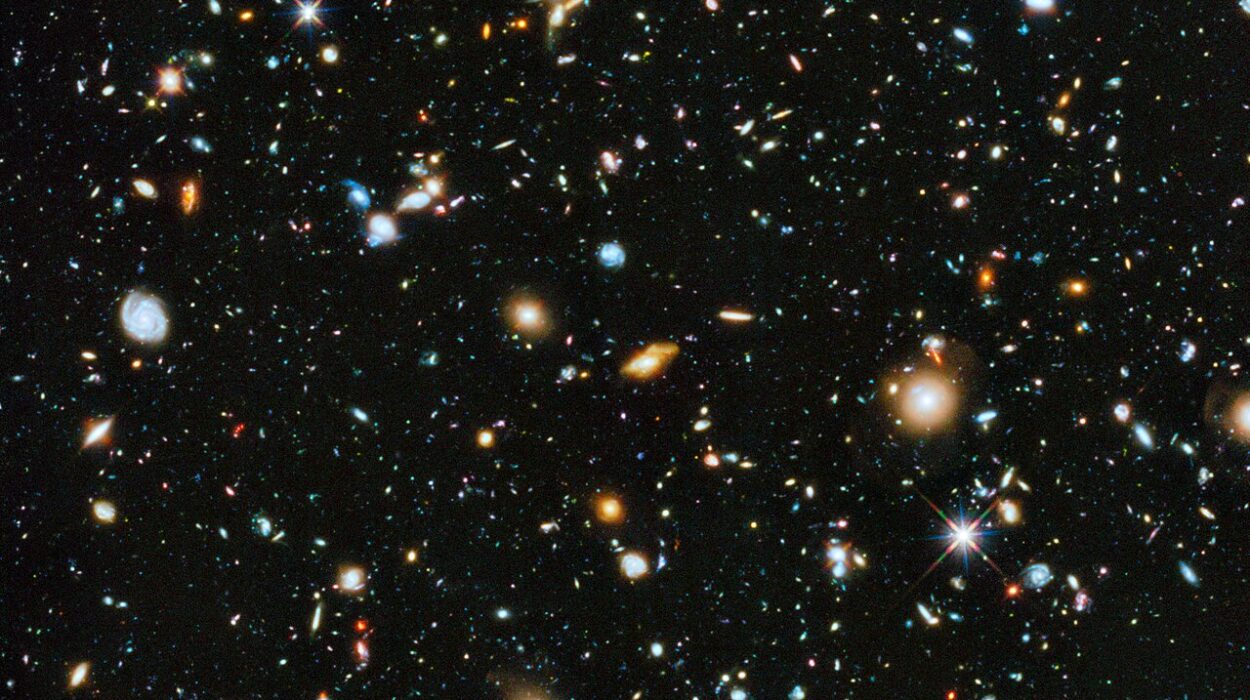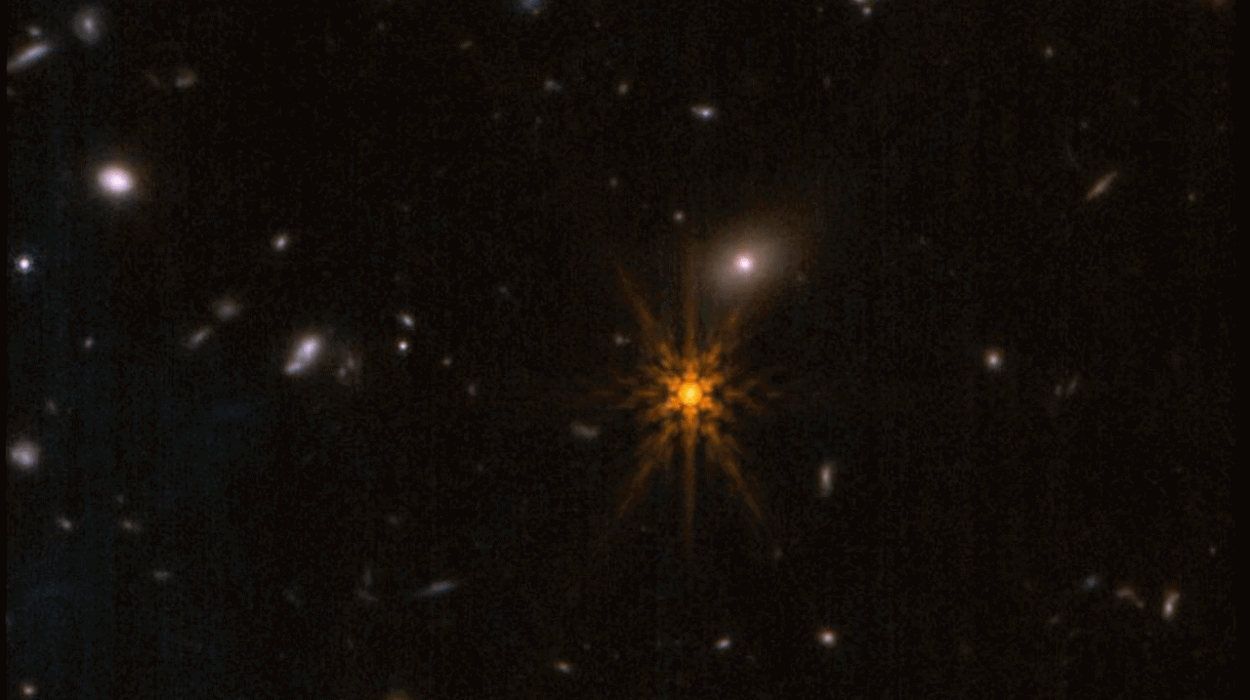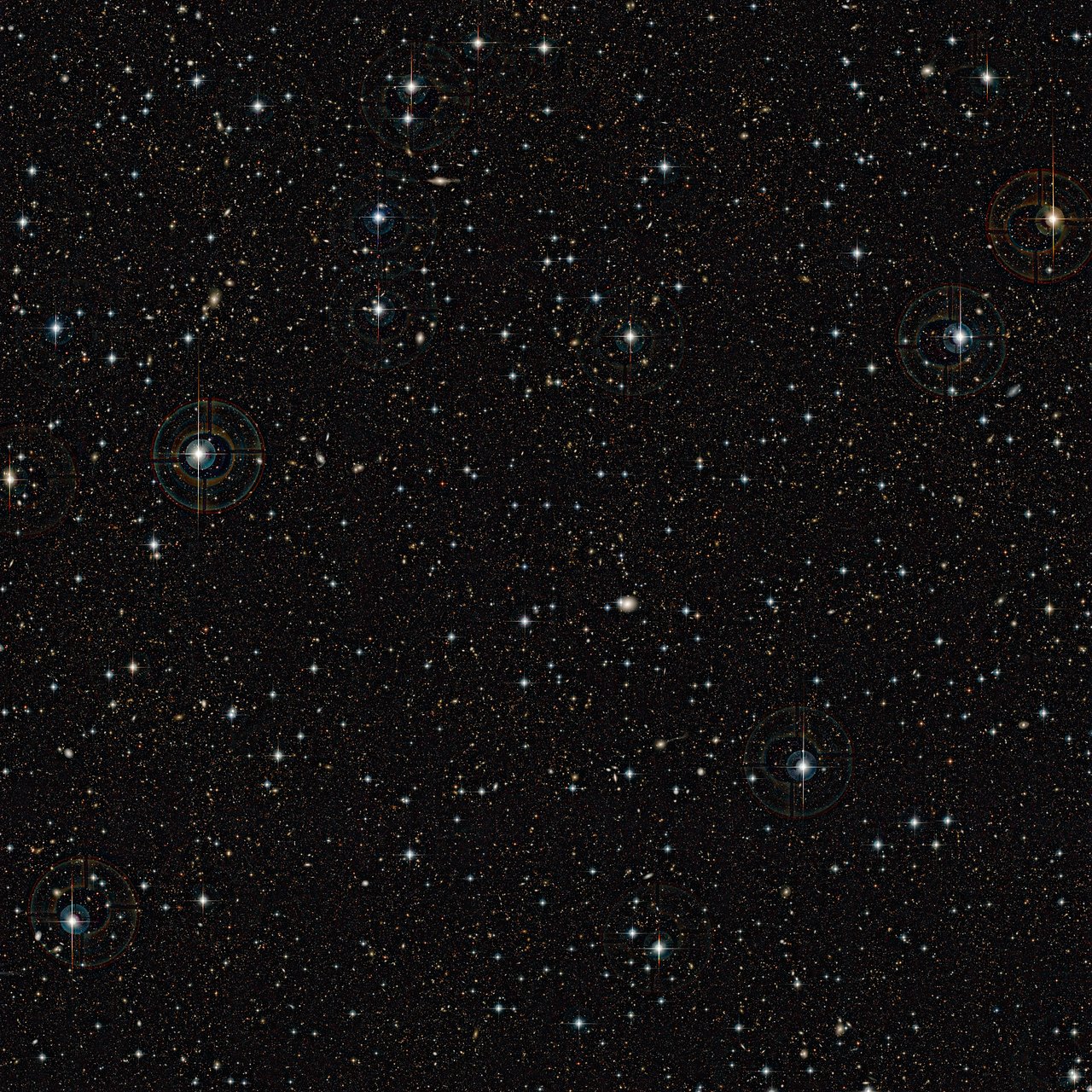
Look up at the night sky on a clear evening and it feels endless—an ocean of stars scattered across a black canvas, galaxies beyond galaxies, light traveling unimaginable distances just to reach your eyes. It’s easy to believe the universe is eternal, overflowing with brilliance, and that this cosmic glow will last forever.
But the truth is far stranger.
The universe is slowly getting darker.
Not because the stars are suddenly turning off, and not because some shadow is creeping across space like a curtain. The universe is fading for a deeper reason, a reason tied to time itself, to the physics of expansion, and to the slow exhaustion of cosmic fuel. It’s not dramatic in the way movies imagine. It’s quiet. It’s patient. It’s inevitable.
And it means that the universe we see today—bright with galaxies and star-forming nebulae—is living through a golden age that will not last.
What Does It Mean for the Universe to “Get Darker”?
When scientists say the universe is getting darker, they do not mean that space is literally filling with blackness like smoke. Space is already mostly dark. Darkness is the default condition of the cosmos.
What they mean is that the universe is producing less and less visible light over time. The total amount of starlight being generated is gradually decreasing. The galaxies are becoming less active. The cosmic fireworks that once lit up the universe are slowly fading.
In the early universe, stars were being born at an astonishing rate. Huge clouds of gas collapsed quickly, forming massive, hot stars that burned fiercely and died violently. Galaxies were chaotic, full of collisions and starburst regions. The universe was more luminous, more energetic, and more alive with creation.
Today, the universe is calmer. Star formation has slowed. Many galaxies have become quiet, dominated by old stars. And in the far future, the cosmos will become dominated by faint, cooling remnants—white dwarfs, neutron stars, and black holes drifting through expanding space.
The universe is not going dark suddenly. It is aging.
The Universe Once Had a Brighter Youth
To understand why the universe is dimming, it helps to picture cosmic history like the life of a living organism.
The universe was born about 13.8 billion years ago in the Big Bang. In its earliest moments, it was not filled with stars and galaxies. It was an extremely hot, dense soup of energy and particles. Light existed, but it could not travel freely because everything was packed tightly together. Photons were constantly scattered by charged particles, like light trapped inside fog.
Then, about 380,000 years after the Big Bang, the universe cooled enough for electrons and protons to combine into neutral atoms. This event is called recombination. Once atoms formed, photons could travel freely. Light was released into space, and the universe became transparent.
That ancient light still exists today. We detect it as the cosmic microwave background radiation, a faint glow that fills the entire universe. It is like the afterglow of creation itself, stretched and cooled by billions of years of expansion.
But that was only the beginning. The real brightness came later, when the first stars ignited.
Stars: The Universe’s Greatest Light Factories
A star is essentially a cosmic furnace powered by nuclear fusion. In its core, gravity squeezes hydrogen atoms together so intensely that they fuse into helium, releasing enormous amounts of energy. That energy escapes as heat and light, shining into space for millions or billions of years.
Stars are the primary reason the universe is bright at all. Without them, the universe would be a cold, dark expanse of gas and dust with no visible glow. Galaxies shine because they contain stars, and nebulae glow because starlight energizes surrounding gas.
But stars are not permanent. They are not infinite power sources. They burn fuel. They age. They die.
And the supply of star-making material is not endless either.
This is where the strange fading of the universe begins.
The Fuel for Light Is Running Out
The main fuel for star formation is hydrogen gas. Hydrogen is the simplest element and the most abundant substance in the universe. In the early cosmos, hydrogen gas filled space in vast clouds. Gravity pulled these clouds together, and new stars formed constantly.
But every time a star forms, it locks some of that hydrogen away.
Some of it becomes helium. Some of it becomes heavier elements. Some of it ends up trapped in stellar remnants like white dwarfs, neutron stars, and black holes. Some of it is blown into space by supernovae, but not always in a form that easily becomes new stars.
Over time, the universe gradually consumes its most useful fuel.
This is not a sudden shortage. It’s a slow cosmic drain, like a bank account being spent over billions of years. Star formation is still happening today, but the universe is not producing stars as efficiently as it once did.
Astronomers have observed that the star formation rate in the universe peaked around 10 billion years ago, when the cosmos was only a few billion years old. Since then, the rate has dropped dramatically.
In other words, the universe had its brightest era long ago. We live after the peak, in the long decline.
The Expansion of the Universe Is Stretching Light Itself
Even if stars kept forming forever, the universe would still grow darker because of expansion.
The universe is not static. Space itself is expanding. This means galaxies are, on average, moving away from one another. It is not like galaxies are flying through space like bullets. Rather, the space between them is stretching.
One consequence of this expansion is redshift.
When light travels through expanding space, its wavelength gets stretched along with the universe. Shorter wavelengths shift toward longer wavelengths. Visible light becomes infrared. Infrared becomes microwave. Microwave becomes radio.
The light does not disappear, but it becomes less energetic and harder to detect with ordinary eyes. It fades into longer and longer wavelengths.
So even the light that exists is being diluted and weakened over time. The universe is not just producing less starlight. The starlight it produces is being stretched into invisibility.
If you could fast-forward billions of years into the future, you would find that much of the light from galaxies has been redshifted far beyond the visible spectrum. Space would not glow with the familiar brilliance we see today. It would be filled with cold, faint radiation.
This is one of the strangest truths of modern cosmology: the universe is not only expanding outward, it is stretching the very meaning of light.
Dark Energy: The Accelerating Force Behind Cosmic Isolation
For much of the 20th century, scientists believed the universe’s expansion might be slowing down due to gravity. Galaxies pull on each other, after all, and gravity should act like a brake.
But in the late 1990s, astronomers made a shocking discovery. The universe’s expansion is not slowing. It is accelerating.
Something is pushing the universe apart faster and faster. Scientists call this mysterious driver dark energy.
We still do not fully understand what dark energy is. It could be a property of space itself, sometimes described as vacuum energy. It could be something more exotic, like a dynamic field that changes over time. But whatever it is, it dominates the cosmos.
And it has terrifying implications for the future brightness of the universe.
Acceleration means galaxies are not just drifting apart. They are being pulled away from each other faster and faster until, eventually, many galaxies will disappear from view entirely.
The Future Night Sky Will Lose Its Galaxies
Today, with a telescope, we can see billions of galaxies. The universe feels infinite and richly populated. But that is only because the light from those galaxies still has time to reach us.
In the far future, as expansion accelerates, distant galaxies will move away so quickly that their light will never reach Earth again. They will cross what is called the cosmic horizon, beyond which information cannot travel to us.
From the perspective of future astronomers, the universe will look much smaller.
The Milky Way and its neighboring galaxies will remain visible because they are gravitationally bound together. The Milky Way and Andromeda will eventually merge into a single galaxy. Nearby dwarf galaxies will orbit within this local group. But beyond that? The rest of the universe will slowly vanish from sight.
Not because it is gone, but because it becomes unreachable.
Imagine standing in a vast city at night, filled with lights stretching endlessly. Then imagine the city slowly drifting away, street by street, until only your neighborhood remains illuminated and everything else disappears beyond the horizon. The lights still exist, but you can no longer see them.
That is the fate of the universe under accelerating expansion.
The cosmos is not just getting darker. It is becoming lonelier.
Star Formation Is Slowing for Another Reason: Galaxies Are Calming Down
The early universe was chaotic. Galaxies collided often. These collisions compressed gas clouds, triggering bursts of star formation. Young galaxies were messy, turbulent, and full of fuel.
Over billions of years, galaxies matured. Many used up their gas. Others lost gas due to stellar winds and supernova explosions. Some galaxies became “quenched,” meaning they stopped forming new stars altogether.
Elliptical galaxies, for example, are often filled with old, reddish stars and little star-forming gas. They glow faintly compared to the bright blue star-forming galaxies that dominated the early universe.
The universe has shifted from a youthful era of creation into a quieter era of aging.
This is another reason cosmic brightness is declining: the engines of star birth are not firing as often.
The universe is not running out of matter, but it is running out of the conditions needed to transform that matter into new light.
Stars Themselves Are Becoming Dimmer on Average
Not all stars shine the same way. Massive stars burn hot and bright, but they live fast and die young. A star twenty times the Sun’s mass might live only a few million years. It shines like a beacon, flooding its surroundings with ultraviolet radiation.
Smaller stars, like red dwarfs, are dimmer but live far longer. Some red dwarfs can burn for trillions of years, far longer than the current age of the universe.
As time passes, the universe becomes dominated by these long-lived, low-mass stars. The brightest stars disappear first, leaving behind a quieter stellar population.
This changes the character of the universe’s light. The cosmos becomes redder and dimmer. Bright blue star clusters become rarer. Supernovae become less frequent. The spectacular light shows of the universe become less common.
The universe is not just dimming in quantity of light. It is changing in mood, like a fire that once roared now settling into glowing embers.
The Cosmic Microwave Background Is Also Fading Away
Even the oldest light in the universe is fading.
The cosmic microwave background, the leftover radiation from the Big Bang, is currently about 2.7 degrees above absolute zero. It is everywhere, filling space like a faint bath of warmth.
But as the universe expands, this radiation continues to stretch. Its wavelength becomes longer, its temperature drops, and its energy decreases. In the far future, it will become so cold and faint that it will be nearly undetectable.
This is deeply strange to think about. The afterglow of creation, the very signature of the Big Bang, is slowly being erased—not by destruction, but by stretching.
In a universe that expands forever, even the memory of the beginning becomes harder to find.
The Universe Is Getting Darker Because Entropy Is Increasing
Behind all of these processes lies a deeper physical principle: entropy.
Entropy is a measure of how energy spreads out and becomes less available to do useful work. The second law of thermodynamics states that in an isolated system, entropy tends to increase over time.
The universe is the ultimate isolated system.
In the early universe, energy was concentrated and hot. Over time, energy spreads out. It becomes more evenly distributed. It becomes harder to extract work from it. This is the long, unavoidable drift toward equilibrium.
Stars are like temporary islands of low entropy. They are places where energy is concentrated, where fusion can occur, where light can be generated. But stars do not last forever. Their fuel runs out, and their energy is released into space.
When a star shines, it is not merely producing light. It is increasing entropy by dispersing energy into the cold vacuum of space.
So the fading of the universe is not just a matter of running out of hydrogen. It is part of the universe’s overall thermodynamic evolution. The cosmos is moving toward a state where energy is spread so thinly that no new bright structures can form.
In that sense, darkness is not an accident. It is the direction of time.
The Long Future: When the Last Stars Burn Out
The far future of the universe is one of the most haunting topics in physics. If the universe continues expanding, and if dark energy remains dominant, then the cosmos will gradually approach what scientists sometimes call heat death.
This does not mean the universe becomes hot. It means it becomes cold, empty, and unable to produce new energy gradients.
In the next few billion years, galaxies will continue forming stars, but at a declining rate. Over tens of billions of years, star formation may nearly stop. The remaining gas will be used up or locked away.
Over trillions of years, the smallest red dwarf stars will still burn, glowing faintly. These stars may be the last true sources of starlight.
Eventually, even they will exhaust their fuel. The universe will become filled with stellar remnants: white dwarfs slowly cooling into black dwarfs, neutron stars drifting silently, and black holes swallowing matter when they can.
At that stage, the universe will be far darker than anything we can imagine. The night sky will contain almost no visible stars. There will be no bright galaxies beyond the local group. There may be no nebulae glowing in ultraviolet light. The cosmos will resemble an endless cold void, dotted with faint embers and invisible gravity wells.
Darkness will become the dominant condition of the universe, not as a dramatic event, but as a slow and steady fading.
Black Holes: The Final Guardians of Cosmic Energy
Even in a dark universe, black holes will remain.
Black holes do not emit light in the ordinary way. They swallow matter and energy, trapping it behind an event horizon. In the far future, black holes may become the most significant objects left, containing enormous fractions of the universe’s remaining organized mass-energy.
But even black holes are not eternal.
According to quantum physics, black holes can slowly lose mass through a process called Hawking radiation. This radiation is incredibly weak for large black holes, but over unimaginably long timescales, even supermassive black holes will evaporate.
For a black hole with the mass of the Sun, the evaporation time is around 10^67 years. For supermassive black holes, it can be around 10^100 years or more. These numbers are so large they dwarf human comprehension.
When black holes finally evaporate, they release their remaining energy into space as faint radiation. After that, the universe will be left with mostly low-energy photons and scattered particles.
At that point, the universe will not just be dark. It will be almost silent in every physical sense.
Is the Universe Actually Becoming “Darker,” or Just Different?
There is an important nuance here. Darkness is a human perception, and the universe does not care about human eyes. Even if visible light disappears, there will still be radiation in other wavelengths. There will still be particles, gravitational waves, and energy.
But for creatures like us—beings whose biology is tuned to visible starlight—the universe will indeed become darker. It will contain fewer sources of visible illumination, and the remaining light will be stretched beyond sight.
In the early universe, if you could somehow float through space, you might have seen galaxies blazing intensely, young stars glowing blue-white, and the sky filled with active star-forming regions. In the far future, the same journey might reveal almost nothing to the naked eye.
It is not that the universe becomes empty overnight. It becomes quiet in the way an aging forest becomes quiet when the great trees stop growing and only scattered shrubs remain.
The Strange Reason the Universe Is Getting Darker
So what is the strange reason?
The universe is getting darker because it is expanding and aging at the same time.
Expansion stretches light into weaker wavelengths and pushes galaxies beyond our horizon. Aging reduces the universe’s ability to form new stars by consuming and locking away the raw fuel needed for fusion. Entropy ensures that energy becomes more spread out and less capable of forming bright, ordered structures.
Dark energy accelerates this process by isolating galaxies and cutting off regions of the universe from one another. Star formation slows, bright stars die quickly, and the cosmos becomes dominated by faint, long-lived stars until even they burn out.
The universe is dimming not because something is stealing its light, but because the conditions that create light are temporary.
Light is not the default state of the cosmos. Light is an event.
Stars are rare moments of brilliance in an otherwise cold and dark universe. And like all moments, they pass.
Why This Cosmic Darkness Matters
The fading of the universe is not just an abstract scientific idea. It carries an emotional weight because it tells us something profound about our moment in cosmic history.
We live during a time when the universe is still filled with stars. Galaxies are still visible. The cosmic microwave background is still detectable. The night sky still carries messages from billions of years ago.
In the far future, intelligent beings—if any exist—may not even be able to discover the true size of the universe. They may see only their local galaxy cluster and conclude that the cosmos is small and static. They may never detect the cosmic microwave background, because it will have stretched beyond measurable wavelengths. They may not have evidence of the Big Bang at all.
In that sense, we are living in a privileged era of observation. The universe is still young enough to show its history.
The darkness of the future is not just physical. It is informational. The cosmos is slowly hiding its origins.
The Universe Is Not Dying, It Is Evolving
It is tempting to describe this fading as the “death” of the universe. But that is not entirely accurate. The universe is not a living organism that will collapse into nothingness. It is a physical system evolving according to its laws.
Even in a dark universe, physics continues. Particles still exist. Gravity still acts. Quantum fields still fluctuate. Space continues to expand. Time continues to flow.
The universe may become cold and dim, but it will still be a universe.
And in that distant future, even a single flicker of light—perhaps a rare collision of stellar remnants or a final burst of Hawking radiation—would be a spectacular event against the deep cosmic night.
The universe’s future is not a sudden blackout. It is a long twilight.
A Cosmic Twilight We Can Barely Imagine
If you could travel far enough forward in time, you would witness a universe transformed.
Galaxies would no longer crowd the sky. The Milky Way’s descendants might be the only visible structure. The background glow of the Big Bang would be nearly gone. The stars that remain would be faint red embers, burning slowly in isolation.
Eventually, even those embers would fade.
There would be no bright nebulae. No supernovae lighting up the darkness. No clusters of young stars. No blue giants. No dramatic cosmic birthplaces.
Just the slow drift of remnants in expanding space.
The strange reason the universe is getting darker is that the universe is moving forward in time, and time has consequences. Time consumes fuel. Time increases entropy. Time stretches space. Time pushes galaxies away. Time turns blazing stars into cold ashes.
The universe is not designed to remain bright forever.
It is designed—if that word even makes sense—to evolve.
The Final Truth: We Live in the Bright Era
There is a quiet wonder hidden in all of this.
The universe is not at its beginning, and it is not at its end. We exist somewhere in the middle, in an era when stars are still abundant and galaxies still shine. The cosmic story is still readable in the sky.
The fact that the universe is getting darker over time does not make today less meaningful. It makes today more rare.
We live under a sky filled with light not because that light is permanent, but because we exist during the universe’s luminous chapter. The darkness will come, but it has not arrived yet.
For now, the cosmos still glows.
For now, the stars still burn.
And every time you look up at the night sky, you are seeing the universe in one of its most beautiful phases—before the long fading, before the cosmic twilight deepens into a night that may last forever.