We like to believe that Earth is mapped, measured, and understood. Satellites circle overhead. Drones scan mountains. Deep-sea submersibles descend into ocean trenches. Laboratories analyze rocks down to atomic precision. And yet, even in this age of extraordinary technology, certain places on our planet remain stubbornly mysterious.
They are not myths. They are not exaggerations. They are real, measurable, physically present locations—yet their full explanations remain incomplete. Scientists have studied them, proposed theories, gathered data, and tested hypotheses. Still, pieces of the puzzle refuse to fall neatly into place.
These are not failures of science. They are frontiers.
Here are seven “impossible” places on Earth that continue to challenge what we think we know.
1. The Moving Stones of Racetrack Playa
In a remote basin inside Death Valley National Park lies Racetrack Playa, a dry lakebed so flat and barren that it feels almost extraterrestrial. Scattered across its cracked clay surface are rocks—some small enough to lift, others weighing hundreds of kilograms.
Behind many of these rocks stretch long, carved trails. The rocks have moved.
For decades, no one witnessed the motion. There were no footprints, no visible disturbances, no human interference. The stones simply appeared in new locations, leaving behind winding tracks that sometimes curved, intersected, or ran parallel to one another.
The mystery endured for nearly a century.
Early explanations suggested powerful desert winds. But winds in the valley, though fierce at times, seemed insufficient to push heavy rocks across dry ground. Some speculated about magnetic forces. Others proposed pranksters, though the remote location made that unlikely.
The breakthrough came in 2014 when researchers installed GPS trackers and time-lapse cameras. They discovered that under very specific conditions, the playa becomes temporarily flooded with shallow water. During cold winter nights, thin sheets of ice form across the surface. As the sun rises, the ice fractures into large floating panels. Light winds—far weaker than previously imagined necessary—push these ice sheets. The ice, in turn, gently nudges the rocks across the slick, wet clay.
The movement is slow and silent, sometimes just a few centimeters per second. But over hours, rocks can travel dozens of meters.
Yet even now, questions linger. Why do some rocks move while others remain still? Why do tracks sometimes curve sharply under seemingly uniform wind conditions? Why do certain stones travel farther than others?
We understand the basic mechanism, but not every detail of the dance.
In that quiet desert, nature reminds us that even the simplest phenomena can take decades to fully understand.
2. The Boiling River of the Amazon
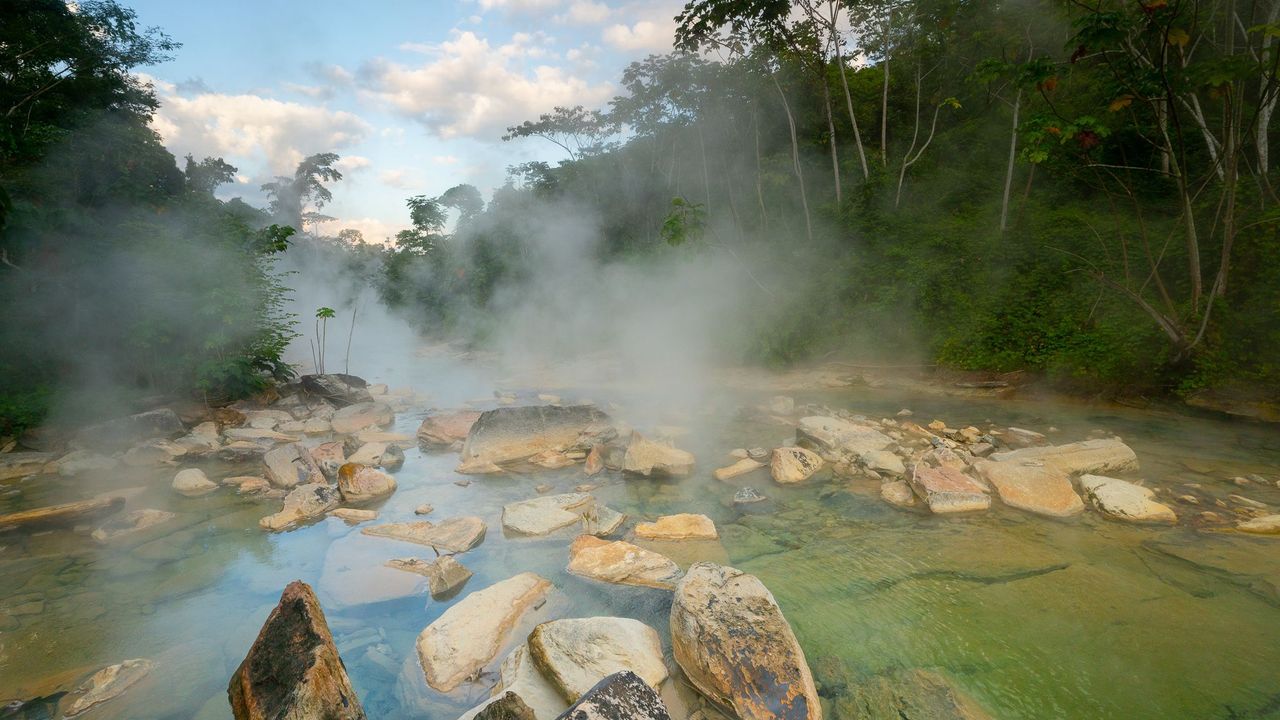
Deep in the Peruvian Amazon flows a river so hot that animals falling into it can be fatally scalded. Known locally as Shanay-Timpishka, or “boiled with the heat of the sun,” this river reaches temperatures near 90 degrees Celsius in certain sections.
At first glance, this seems geologically impossible.
Boiling rivers are typically associated with volcanic regions like Yellowstone National Park, where magma lies close to the surface. But the Boiling River lies hundreds of kilometers from the nearest active volcano. There is no obvious magmatic heat source.
For years, many scientists dismissed the reports as exaggerated folklore. But geoscientist Andrés Ruzo conducted detailed measurements and confirmed the temperatures. The river, in places, is indeed near boiling.
The prevailing explanation involves deep fault systems. Rainwater seeps into the Earth through fractures, travels downward to depths where geothermal heat warms it, and then resurfaces along fault lines. The Amazon Basin, though not volcanic, is geologically complex. The heat gradient below Earth’s surface increases with depth, and under the right conditions, groundwater can reach extreme temperatures.
Yet the scale remains puzzling. The river extends for kilometers, far longer than typical hot springs. Maintaining such temperatures over that distance requires sustained geothermal energy flow.
Exactly how water circulates, how deep it travels, and how stable the heat source remains over geological time are still subjects of investigation.
The Boiling River stands as a reminder that even in non-volcanic regions, Earth’s interior heat can manifest in astonishing ways.
3. The Door to Hell
In the Karakum Desert of Turkmenistan burns a crater that has been on fire for more than five decades. Officially known as the Darvaza gas crater, it is often called the “Door to Hell.”
The crater formed in 1971 when a Soviet drilling operation accidentally punctured a natural gas pocket. The ground collapsed, creating a large pit. To prevent the release of toxic methane gas, engineers ignited it, assuming the fire would burn out within days.
It did not.
Instead, the crater has burned continuously ever since.
Methane is a powerful greenhouse gas, and the crater’s persistence suggests a substantial underground supply. The geology of the region includes significant natural gas reserves, but the exact size and connectivity of the gas field feeding the crater remain uncertain.
Why has the fire endured so long? How extensive is the subterranean gas network? Could it eventually extinguish itself, or might it burn for centuries?
While the basic explanation is clear—combustion of methane—the full geological picture beneath the crater is not completely mapped.
The Darvaza crater is not supernatural. It is a human-ignited geological accident. But its longevity and scale continue to fascinate scientists and visitors alike.
4. The Blood Falls of Antarctica
On the icy continent of Antarctica, at the edge of the Taylor Glacier, a vivid red liquid seeps from the ice and stains the snow like blood.
Discovered in 1911, the phenomenon became known as Blood Falls. At first, scientists suspected red algae. Later, chemical analysis revealed something more surprising.
The red color comes from iron-rich brine. Beneath the glacier lies a subglacial lake sealed off from the surface for millions of years. This briny water is rich in dissolved iron. When it emerges from cracks in the glacier and contacts oxygen in the air, the iron oxidizes—essentially rusting—and turns red.
The chemistry is elegant. The mystery lies deeper.
How has liquid water remained unfrozen in such extreme cold? The answer involves salt content, pressure, and geothermal heat. The brine’s high salinity lowers its freezing point. Pressure from the overlying ice and heat from Earth’s interior help maintain liquidity.
Even more astonishing, microbial life has been found within this isolated ecosystem. These microbes survive without sunlight, metabolizing iron and sulfur compounds.
How did they evolve? How long have they existed in isolation? What does this tell us about the possibility of life beneath the icy surfaces of moons like Europa or Enceladus?
Blood Falls is not just a geological curiosity—it is a biological and astrobiological puzzle.
5. The Hessdalen Lights
In a remote valley in Norway known as Hessdalen, mysterious luminous phenomena appear in the night sky.
Since the early 20th century, observers have reported glowing orbs and floating lights that move erratically, hover, split, or accelerate suddenly. These lights have been photographed, recorded on radar, and studied by scientists.
The phenomenon, known as the Hessdalen Lights, has been the subject of long-term research. Some explanations suggest ionized gas created by geological processes. The valley contains deposits of zinc, iron, and other metals. Chemical reactions involving dust and atmospheric electricity might produce plasma-like glows.
Another hypothesis proposes that radon gas emissions ionize air particles, leading to light emissions under specific atmospheric conditions.
Yet no single explanation accounts for all observed characteristics. The lights vary in size, duration, color, and motion. Some persist for minutes. Others flicker briefly. Some appear stationary; others move at high speeds.
While there is no credible evidence linking the lights to extraterrestrial activity, their exact physical mechanism remains under investigation.
The Hessdalen Lights remind us that Earth’s atmosphere and geology can produce phenomena that still challenge complete understanding.
6. The Sailing Lakes of the Andes
High in the Andes Mountains of South America are lakes that seem to defy climatic logic. Some remain liquid despite temperatures that should freeze them solid. Others exhibit unusual seasonal behavior, filling and draining in patterns that do not align neatly with rainfall cycles.
In regions such as the Altiplano plateau, lakes like Lake Poopó have dramatically expanded and disappeared over decades. While climate variability, groundwater flow, and human water diversion explain much of the fluctuation, the precise interplay between tectonics, glacial melt, evaporation rates, and underground aquifers is complex.
High-altitude lakes are sensitive to small shifts in temperature and precipitation. Climate change adds another variable, accelerating glacial retreat and altering hydrological cycles.
Scientists continue to model these systems, but predicting their long-term behavior remains difficult. The Andes are tectonically active. Subsurface geology is fractured and uneven. Water may travel through hidden channels before resurfacing.
These lakes are not “impossible” in the supernatural sense—but their behavior underscores how incomplete our understanding of regional hydrology can be.
7. The Bermuda Triangle
Few places capture the public imagination like the Bermuda Triangle. Stretching roughly between Florida, Bermuda, and Puerto Rico, this region has long been associated with mysterious ship and aircraft disappearances.
Popular culture often portrays it as a zone of paranormal forces. However, scientific analysis reveals no evidence of supernatural activity. The number of disappearances is not statistically higher than in other heavily traveled ocean regions.
Yet certain natural factors make the area hazardous.
The region is subject to powerful storms and hurricanes. It contains complex ocean currents, including the Gulf Stream, which can rapidly disperse debris. Methane gas hydrates on the ocean floor have been proposed as a potential hazard; sudden methane releases could reduce water density, potentially affecting buoyancy. However, evidence for large-scale methane eruptions in the Bermuda Triangle specifically remains limited.
Navigation challenges, human error, unpredictable weather, and high traffic volume likely account for most incidents.
So why does it remain on this list?
Because it illustrates how myth can grow around incomplete understanding. While there is no scientific evidence of mysterious forces, not every disappearance has been conclusively explained in detail. In some cases, wreckage has never been found.
The Bermuda Triangle teaches a different kind of lesson: that human perception of mystery often exceeds the actual mystery itself. It reminds us to distinguish between unexplained and unexplainable.
Earth’s Remaining Frontiers
These seven places differ in scale, cause, and consequence. Some mysteries are nearly solved but not fully understood. Others remain active areas of research. None require abandoning scientific reasoning.
And that is precisely what makes them powerful.
They show that even on our own planet—mapped by satellites and probed by sensors—there are processes we do not completely grasp. Ice moves rocks. Rivers boil without volcanoes. Fire burns for decades in the desert. Iron-rich blood flows from Antarctic glaciers. Lights hover in Norwegian valleys. Lakes defy simple prediction. Legends grow around storms and currents.
Science does not shrink from these mysteries. It approaches them carefully, measuring, testing, revising.
The word “impossible” does not mean magic. It means “not yet fully understood.”
Earth is not a finished story. Beneath deserts, glaciers, forests, oceans, and skies, the planet continues to surprise us. And perhaps that is the most humbling truth of all.
We stand on a world that still holds secrets.
And that is not a failure of knowledge.
It is an invitation to keep exploring.