Few figures in ancient history have inspired as much fascination, debate, romance, and myth as Cleopatra. Her name echoes through centuries as a symbol of beauty, intelligence, political cunning, and tragic destiny. To some she was a seductive queen who captivated powerful Roman leaders. To others she was a brilliant strategist fighting desperately to preserve the independence of her kingdom. In truth, Cleopatra was far more complex than the legends that surround her.
She ruled during one of the most dramatic periods in Mediterranean history, when the ancient world was shifting and the Roman Republic was transforming into an empire. Her life intertwined with two of Rome’s most powerful men, shaping the fate of Egypt and influencing the course of Western civilization. Yet despite the fame that surrounds her, the real Cleopatra often hides behind centuries of exaggeration and propaganda.
Her story is not simply one of romance and tragedy. It is a story of political survival, cultural identity, intellectual brilliance, and a desperate struggle to maintain sovereignty in a world dominated by Rome. It is also a story that ends in one of history’s most famous and mysterious deaths.
Egypt in a Time of Decline
When Cleopatra VII Philopator was born in 69 BCE, Egypt was no longer the unstoppable empire it had once been. The era of pyramid-building pharaohs had passed more than two thousand years earlier. For centuries Egypt had been ruled by foreign dynasties.
Since the conquests of Alexander the Great in 332 BCE, Egypt had been governed by the Ptolemaic dynasty, a Greek royal family descended from one of Alexander’s generals, Ptolemy I Soter. These rulers adopted many Egyptian traditions and presented themselves as pharaohs, but culturally they remained largely Greek.
The capital of this Hellenistic kingdom was the dazzling city of Alexandria, one of the most magnificent cities in the ancient world. Founded by Alexander himself, Alexandria was famous for its enormous library, its bustling harbor, and the towering lighthouse known as the Pharos. Scholars, philosophers, scientists, and merchants from across the Mediterranean gathered there.
Yet despite its intellectual and economic strength, the Ptolemaic kingdom had grown politically unstable by the first century BCE. Internal family conflicts, corruption, and financial mismanagement weakened the state. Even more threatening was the rise of Rome, whose expanding power increasingly dominated the Mediterranean.
By Cleopatra’s birth, Egypt had become heavily dependent on Roman support. Roman generals frequently intervened in Egyptian politics, deciding which members of the royal family would rule. Egypt was rich in grain, and Rome depended heavily on Egyptian harvests to feed its population.
In this dangerous political environment, Cleopatra would eventually rise to power.
A Royal Childhood in Alexandria
Cleopatra was born into the Ptolemaic royal family, the daughter of Ptolemy XII Auletes. Her father’s reign was controversial and unstable. Known for his political maneuvering and dependence on Roman allies, he spent enormous sums bribing Roman leaders to maintain his position on the throne.
Unlike many rulers in her dynasty, Cleopatra appears to have received an exceptional education. Alexandria was one of the intellectual centers of the ancient world, home to scholars in mathematics, astronomy, philosophy, and medicine. Growing up in such an environment likely exposed her to a broad range of knowledge.
Ancient sources describe Cleopatra as highly intelligent and remarkably educated. She reportedly spoke several languages and, unlike many earlier Ptolemaic rulers, learned the Egyptian language itself. Previous members of her dynasty typically communicated through translators when addressing Egyptian subjects, but Cleopatra spoke directly to them.
Her education likely included philosophy, rhetoric, mathematics, astronomy, and political theory. These subjects were common for elite Greek education, but Cleopatra seems to have mastered them with unusual skill. Later writers emphasized that her greatest charm was not physical beauty alone but her voice, wit, and intellect.
As a young princess, Cleopatra would have grown up observing the fragile nature of royal power. Palace intrigue, shifting alliances, and Roman interference were constant features of Egyptian politics. These experiences shaped the political instincts that would later define her reign.
The Struggle for the Throne
When Ptolemy XII died in 51 BCE, Cleopatra was about eighteen years old. According to tradition within the Ptolemaic dynasty, she was meant to rule jointly with her younger brother, Ptolemy XIII, whom she was also expected to marry.
Sibling marriage was a long-standing tradition in the dynasty, intended to preserve royal bloodlines and maintain legitimacy in the eyes of Egyptian religious tradition. However, the arrangement did not produce harmony.
Cleopatra initially attempted to rule independently, placing her name alone on official documents and coins. This move angered powerful advisers who controlled the young Ptolemy XIII. Within a short time, Cleopatra was forced out of Alexandria and into exile.
She fled eastward, gathering supporters and attempting to build an army that could help her reclaim the throne. At this moment, events in Rome unexpectedly transformed her fate.
Julius Caesar Arrives in Egypt
In 48 BCE, the Roman Republic was engulfed in civil war between two powerful leaders: Julius Caesar and Pompey the Great. After suffering defeat in Greece, Pompey fled to Egypt seeking refuge.
The advisers of Ptolemy XIII believed that killing Pompey would please Caesar and strengthen their alliance with Rome. Pompey was murdered shortly after arriving in Egypt.
However, when Caesar arrived in Alexandria soon afterward, he was reportedly horrified by the assassination. Instead of rewarding Ptolemy XIII’s supporters, Caesar decided to intervene directly in the Egyptian royal dispute.
At this point Cleopatra saw her opportunity.
The Famous Meeting with Caesar
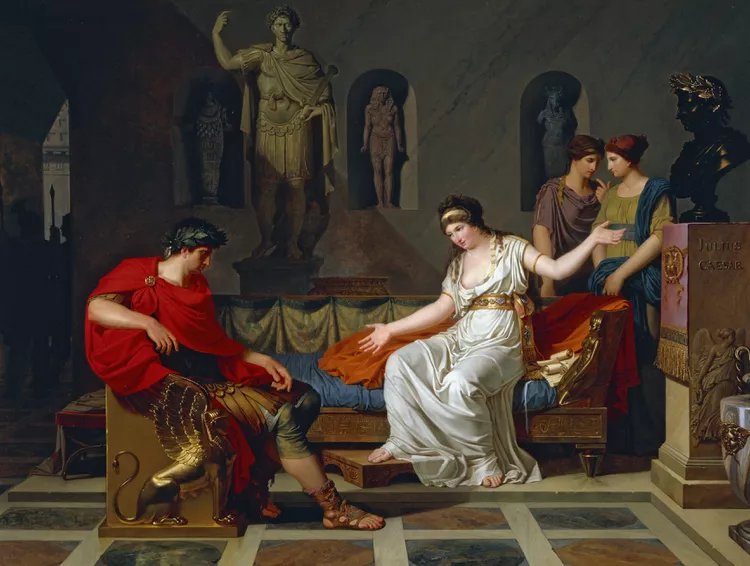
One of the most famous stories in ancient history describes Cleopatra secretly entering Caesar’s quarters wrapped inside a carpet or bedding sack carried by a servant. When the bundle was unrolled, the young queen emerged dramatically before the Roman general.
Though the precise details may have been embellished by later writers, the encounter clearly left a powerful impression. Cleopatra impressed Caesar with her intelligence, charm, and political insight.
Caesar decided to support her claim to the throne against her brother.
This decision triggered a violent conflict known as the Alexandrian War. Fighting broke out in the streets of Alexandria as Caesar’s forces battled those loyal to Ptolemy XIII. During the chaos, parts of the city were burned, and some ancient sources suggest that sections of the famous Library of Alexandria may have been damaged.
Eventually Caesar’s reinforcements arrived. Ptolemy XIII was defeated and reportedly drowned in the Nile while attempting to flee.
Cleopatra was restored to the throne, now ruling alongside another younger brother, Ptolemy XIV.
Cleopatra and Caesar
Cleopatra’s relationship with Julius Caesar soon deepened beyond politics. Ancient sources indicate that the two became lovers.
In 47 BCE Cleopatra gave birth to a son named Ptolemy XV Caesarion. Many believed Caesar to be the father, though Roman politics prevented official recognition.
For Cleopatra, the alliance with Caesar offered protection and legitimacy. For Caesar, Egypt’s wealth and strategic importance were valuable assets.
Cleopatra even traveled to Rome around 46 BCE, where she stayed in one of Caesar’s villas. Her presence in the city caused controversy among Roman elites, who already feared Caesar’s growing power.
The situation changed dramatically in 44 BCE when Julius Caesar was assassinated by Roman senators during the famous Assassination of Julius Caesar.
With her powerful ally gone, Cleopatra returned to Egypt. The future of Rome—and her own kingdom—became uncertain once again.
The Rise of Mark Antony
After Caesar’s death, Rome descended into another power struggle. Eventually authority was divided among three leaders known as the Second Triumvirate. One of them was Mark Antony.
Antony controlled the eastern provinces of the Roman world, which included regions neighboring Egypt. In 41 BCE he summoned Cleopatra to meet him in the city of Tarsus to explain her political loyalties.
Cleopatra understood the stakes. If she could win Antony’s support, Egypt might remain independent. If she failed, Rome could annex her kingdom.
According to ancient accounts, Cleopatra arrived in spectacular fashion. Her ship sailed up the river decorated with gold and purple sails, while music and perfume filled the air. She presented herself not merely as a queen but as the living embodiment of the goddess Isis.
Antony was captivated.
A Political and Romantic Alliance
Cleopatra and Mark Antony soon formed both a political alliance and a romantic partnership. Cleopatra returned with him to Alexandria, where they spent the winter together.
Their relationship would last more than a decade and produce three children.
For Cleopatra, Antony represented the best chance of preserving Egypt’s autonomy against Rome’s expanding power. Antony, in turn, relied heavily on Egypt’s wealth to finance his military campaigns.
Over time their alliance became deeply controversial in Rome. Antony’s political rival, Octavian, used propaganda to portray Antony as corrupted by an exotic eastern queen.
Roman writers later depicted Cleopatra as a manipulative seductress who controlled Antony through passion. However, modern historians often interpret their relationship as a strategic partnership between two powerful leaders facing immense political pressure.
The Donations of Alexandria
In 34 BCE Antony staged an elaborate ceremony in Alexandria known as the Donations of Alexandria. During this event he distributed territories among Cleopatra and their children, declaring them rulers of various eastern lands.
Cleopatra herself was proclaimed “Queen of Kings,” while her son Caesarion was named “King of Kings.”
These declarations outraged many Romans. To them it appeared that Antony was dividing Roman territories and placing them under the control of a foreign queen.
Octavian seized the opportunity to launch a political campaign against Antony, framing the conflict as a defense of Rome against eastern domination.
The Road to War
Tensions between Octavian and Antony escalated steadily. In 32 BCE the Roman Senate declared war—not on Antony directly, but on Cleopatra.
This framing allowed Octavian to portray the conflict as a struggle against a foreign enemy rather than another Roman civil war.
The decisive confrontation came in 31 BCE during the naval Battle of Actium off the western coast of Greece.
Antony and Cleopatra commanded a massive fleet, but Octavian’s forces, led by the skilled commander Marcus Agrippa, proved more effective.
During the battle Cleopatra’s ships withdrew from the fight, followed by Antony. Their fleet collapsed soon afterward.
The defeat marked the beginning of the end.
The Fall of Alexandria
After Actium, Antony and Cleopatra retreated to Egypt, hoping to regroup and defend Alexandria.
But Octavian advanced steadily toward them. By 30 BCE his forces had reached Egypt.
Facing inevitable defeat, Antony reportedly took his own life after receiving false news that Cleopatra had died. Mortally wounded, he was carried to Cleopatra’s mausoleum where he died in her arms.
With Antony gone and Roman troops entering the city, Cleopatra realized her fate was sealed.
The Mysterious Death of Cleopatra
On August 10 or 12, 30 BCE, Cleopatra herself died under mysterious circumstances.
Ancient writers reported that she committed suicide, traditionally said to have used the venom of an asp—a type of Egyptian cobra. The image of Cleopatra allowing a serpent to bite her became one of the most enduring legends in history.
However, historians continue to debate the exact method of her death. Some suggest poison hidden in a hairpin or ointment. Others question whether the snake story was symbolic or exaggerated.
What is clear is that Cleopatra chose death rather than being taken to Rome and displayed in Octavian’s triumphal parade.
She was only thirty-nine years old.
With her death, the Ptolemaic dynasty ended. Egypt soon became a Roman province, marking the conclusion of more than three thousand years of pharaonic rule.
Cleopatra’s Legacy
For centuries after her death, Cleopatra’s reputation was shaped largely by Roman writers who supported Octavian—now the emperor Augustus. Many portrayed her as dangerous, seductive, and manipulative.
Yet modern scholarship paints a more complex picture.
Cleopatra was a capable and multilingual ruler who governed a wealthy and sophisticated kingdom. She supported economic reforms, strengthened Egypt’s naval power, and maintained Alexandria’s role as a center of learning and culture.
She also skillfully navigated the brutal politics of the late Roman Republic for nearly two decades.
Her relationships with Caesar and Antony were not simply romantic entanglements but strategic alliances in a world dominated by Roman power.
Cleopatra remains one of the most recognizable figures in ancient history precisely because her story blends politics, intellect, passion, and tragedy. She lived at a moment when civilizations collided and empires were born.
Her life symbolizes the dramatic end of the ancient Egyptian world and the beginning of a new Roman age.
More than two thousand years later, Cleopatra continues to inspire historians, writers, filmmakers, and artists. Her story reminds us that history is shaped not only by armies and empires but by individuals whose intelligence, ambition, and courage leave a lasting mark on the world.