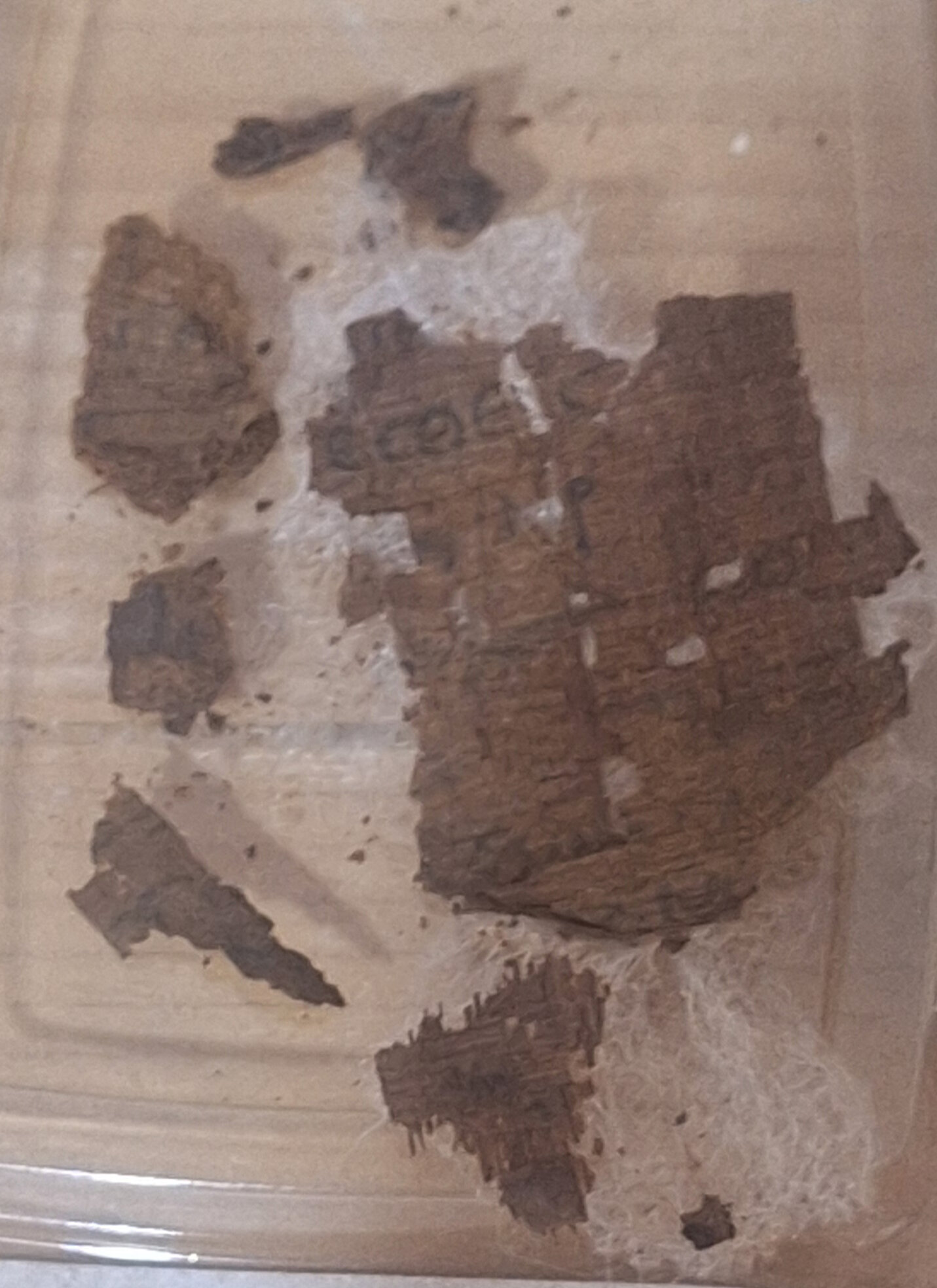
When archaeologists carefully uncovered a Roman-era mummy in the Egyptian town of Al Bahnasa late last year, they expected to find the usual remnants of ancient burial rites. Instead, they discovered a piece of world literature tucked away in the most intimate of places. Resting on the abdomen of the deceased was a weathered scroll of papyrus, deliberately incorporated into the mummification process. While the dry sands of Egypt have yielded many secrets over the centuries, this particular find has stunned researchers: it is the first time in archaeological history that a Greek literary masterpiece has been found physically integrated into the ritual embalming of a body.
The discovery occurred during a sprawling excavation campaign conducted between November 2025 and February 2026 by the Oxyrhynchus Archaeological Mission. Led by Maite Mascort and Esther Pons from the Institute of Ancient Near East Studies (IPOA) at the University of Barcelona, the team focused their efforts on Sector 22 of the ancient necropolis. Inside Tomb 65, a site dating back approximately 1,600 years, the team led by Núria Castellano realized they were looking at a funerary practice that defied established patterns.
A Literary Departure from Magical Tradition
For decades, the site of Oxyrhynchus—located roughly 190 kilometers south of Cairo—has been a goldmine for papyrologists. Since the late 19th century, the city has produced a staggering volume of ancient documents, ranging from mundane tax receipts to fragments of lost gospels. The University of Barcelona’s mission, which has been active at the site since 1992, had previously documented several Greek papyri bundled and sealed within mummification wraps. However, those previous finds followed a predictable script, almost always containing magical spells or ritualistic incantations designed to protect the soul in the afterlife.
The papyrus found in Tomb 65 broke that mold entirely. Rather than a series of charms or hexes, the text scrawled across the fibers was a fragment of the Iliad, the foundational epic of Western literature attributed to Homer. This shift from the supernatural to the literary suggests a deeply personal or symbolic connection between the deceased and the epic poem, marking a departure from the purely functional “magical” papyri found in neighboring burials.
Decoding the Catalog of Ships
Once the papyrus was safely recovered, it underwent rigorous analysis by a specialized team of experts. Conservator Margalida Munar worked alongside papyrologist Leah Mascia to stabilize and read the fragile script. Their findings were then reviewed by Ignasi-Xavier Adiego, a professor of classical philology and the director of the Oxyrhynchus project. The collaboration bore fruit when the team successfully identified the specific passage contained within the fragment.
The text originates from Book II of the Iliad, specifically the section known as the Catalog of Ships. This iconic passage serves as a grand, rhythmic roll call of the Greek forces, meticulously listing the contingents, leaders, and vessels that sailed across the Aegean to lay siege to Troy. As one of the most recognizable and historically significant sequences in the entire Homeric corpus, its presence inside a Roman-era tomb offers a rare glimpse into how classical education and high culture persisted in Egypt long after the height of the Hellenistic period.
Exploring the Funerary Complex of Al Bahnasa
The tomb itself is part of a larger, sophisticated funerary infrastructure. The excavation revealed a complex consisting of three limestone chambers designed to house the elite of ancient Oxyrhynchus. In addition to the mummies, the team found decorated wooden sarcophagi. Although many of these artifacts were in a state of disrepair—primarily due to the damage caused by historical looting—the presence of the Homeric papyrus remained undisturbed enough to provide clear evidence of its placement.
The location of the find is equally significant. Al Bahnasa sits adjacent to the Bahr Yussef, a prominent branch of the Nile. During the Greco-Roman period, this city was a thriving administrative and cultural hub. The fact that a resident of this city chose to be buried with a physical copy of the Iliad placed directly on their body speaks volumes about the enduring prestige of Greek literacy in the region during the fourth or fifth century AD.
The Novelty of the Funerary Context
While the Iliad is well-represented in the archaeological record, Professor Adiego emphasizes that the “real novelty” is the specific context of this find. While thousands of literary papyri have been pulled from ancient trash heaps and domestic ruins at Oxyrhynchus, they are rarely found as part of the formal funerary apparatus. Finding the Catalog of Ships bundled and sealed as part of the mummification ritual suggests that literature had moved beyond the library and into the realm of the sacred.
This discovery marks the conclusion of a highly successful campaign for the University of Barcelona, which remains one of the longest-running and most consistent Spanish archaeological missions in Egypt. The team’s ability to pinpoint the exact placement of the papyrus on the mummy’s abdomen provides a crucial data point for understanding the evolving relationship between Greek culture and Egyptian burial traditions during the Roman occupation.
Why This Matters
This discovery is more than just a rare book find; it reshapes our understanding of how the ancient world valued literature. By placing a fragment of the Iliad inside a mummy’s wraps, the survivors of the deceased transformed a work of poetry into a funerary object, potentially imbuing it with the same protective or status-driven power once reserved for magical scrolls.
It demonstrates that even 1,600 years ago, the works of Homer were so deeply woven into the fabric of daily life that they followed readers into the grave. This find bridges the gap between the intellectual world of the living and the ritual world of the dead, proving that for the citizens of ancient Oxyrhynchus, the great epics were not just stories to be read, but essential companions for the final journey.