In the vast, silent theater of the cosmos, galaxies are often thought of as self-contained cities of light, slowly spinning and giving birth to stars. However, deep within the heart of VV 340a, a spiral galaxy currently engaged in a slow-motion dance with a neighbor, something far more violent is unfolding. For years, astronomers have suspected that the supermassive black holes lurking at the centers of galaxies act as more than just gravitational anchors; they are the ultimate cosmic architects. Now, thanks to the keen eyes of the W. M. Keck Observatory on Maunakea, Hawaiʻi, we have a front-row seat to a spectacular display of power that is literally reshaping a galaxy from the inside out.
The Sleeping Giant Stirs and Spits Fire
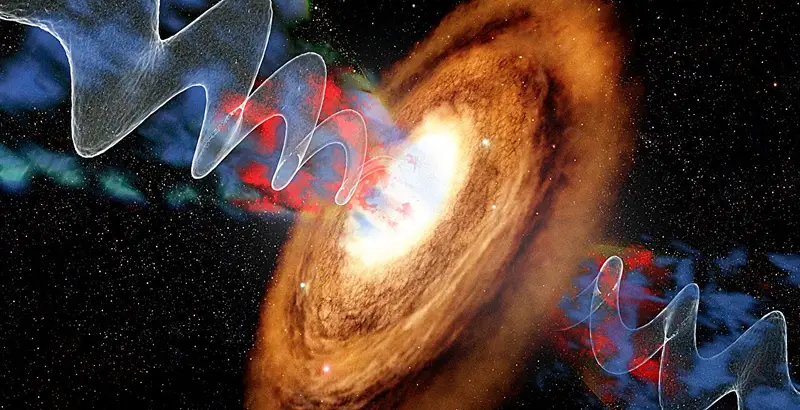
The story begins at the very core of VV 340a, where a monster is feeding. As matter falls toward the central supermassive black hole, not all of it is swallowed. Instead, through a complex interplay of physics, the black hole launches a pair of plasma jets into space. These are not mere flickers of light; they are torrents of energy that act like cosmic blowtorches. Using the James Webb Space Telescope, researchers peered through the dust of the galaxy to find coronal gas—plasma heated to such extreme temperatures that it glows with an intensity rarely seen.
Typically, this ultra-hot gas is a shy inhabitant, hugging the area immediately surrounding the black hole, spanning perhaps only a few hundred parsecs. But in VV 340a, the rules have been rewritten. This coronal gas has been observed stretching for several thousands of parsecs, marking it as the most extended structure of its kind ever recorded. It is a signature of immense power, a glowing testament to the black hole’s ability to influence its surroundings on a scale that defies previous expectations. This discovery provided the first clue that what was happening in this galaxy was not a routine celestial event, but a dramatic overhaul of its internal structure.
A Spear of Cold Light in the Dark
While the James Webb Space Telescope captured the searing heat of the core, it was the Keck Cosmic Web Imager (KCWI) on the Keck II telescope that revealed the true magnitude of the destruction. As the researchers looked further away from the bright center, they discovered a striking, spear-like structure of cooler, lower-energy gas. This gas isn’t just sitting there; it is being pushed. It forms a massive stream that extends a staggering 20,000 light-years away from the galaxy’s center, reaching far into the outskirts where the galaxy’s disk begins to fade into the void.
This distant gas serves as a fossil record of the black hole’s history. Because it takes time for material to travel such immense distances, the presence of this gas so far out proves that the black hole hasn’t just been active for a moment—it has been relentlessly pumping energy into the galaxy for a very long time. This extended stream of super-heated gas is the largest ever observed flowing from a nearby galaxy, and it acts as a bridge between the high-energy chaos of the core and the quiet reaches of the outer galaxy. Without the specialized sensors of the Keck Observatory, this ghostly trail would have remained invisible, leaving the true scale of the black hole’s influence a mystery.
The Wobble of a Cosmic Fire Hose
As if the sheer scale of the outflow wasn’t enough, the researchers discovered a strange twist in the story—literally. By incorporating radio data from the Karl G. Jansky Very Large Array (VLA), the team noticed that the plasma jets weren’t shooting out in straight lines. Instead, they were twisting into a complex, helical, S-shaped pattern. This is the signature of jet precession, a phenomenon where the axis of the jet wobbles over time, much like a spinning top that begins to lean and circle as it slows down.
Imagine holding a high-pressure fire hose that is slowly rotating in your hands; the water wouldn’t hit just one spot, but would spray in a wide, sweeping arc. This is exactly what is happening in VV 340a. This precessing, kiloparsec-scale radio jet is sweeping through the galaxy’s disk, ensuring that no corner is safe from its influence. It is the first time such a phenomenon has been seen driving such a massive outflow in a spiral galaxy. The wobble ensures that the energy from the black hole is distributed far and wide, maximizing its impact on the galaxy’s reservoir of gas.
A Galaxy Forced into Early Retirement
The most significant consequence of this cosmic spray is what it does to the galaxy’s future. Galaxies need gas to create stars; it is the “fuel” of the stellar engine. However, the data from KCWI shows that as the plasma jet plow through the galaxy, it drags cooler material along with it, effectively stripping the galaxy of its vital resources. The researchers calculated that the black hole is expelling material at a rate equivalent to losing nearly 20 suns every year.
This process is a death knell for star formation. By shoving the gas out into intergalactic space, the black hole is effectively “starving” the galaxy, preventing new stars from being born. This was perhaps the most shocking find of all because VV 340a is a young, star-forming spiral galaxy. Usually, these powerful, galaxy-altering jets are the hallmark of old, “dead” elliptical galaxies that finished their star-making days eons ago. Seeing this happen in a vibrant, merging spiral system like VV 340a suggests that galaxies might have their growth stunted much earlier in their lives than we once thought.
Why This Cosmic Upheaval Matters
The discovery at VV 340a is more than just a record-breaking observation; it is a fundamental shift in our understanding of galactic evolution. For a long time, the relationship between a supermassive black hole and its host galaxy was thought to be somewhat distant, with the black hole affecting only its immediate neighborhood. This research proves that a black hole can reach out across tens of thousands of light-years to dictate the fate of an entire galaxy. It shows that the “feedback” from a black hole—the way it returns energy to its environment—is a dominant force that can halt the growth of a galaxy in its tracks.
Furthermore, this discovery brings the mystery closer to home. While there is currently no fossil record of our own Milky Way undergoing such a violent episode, the fact that it is happening in a similar spiral galaxy like VV 340a means we can no longer rule it out. It forces us to look at our own galactic history with fresh eyes and wonder if our central black hole was once a “fire hose” that reshaped our cosmic neighborhood. By studying these distant outflows, we are learning the rules of the universe—rules that determine which galaxies will continue to shine with new stars and which will be silenced by the monsters at their hearts.
Study Details
Justin A. Kader et al, A precessing jet from an active galactic nucleus drives gas outflow from a disk galaxy, Science (2026). DOI: 10.1126/science.adp8989. www.science.org/doi/10.1126/science.adp8989